The phrase vishnu shastra hindi is usually searched by readers who want a Hindi text connected with Lord Vishnu. In most cases, the text they are looking for is the Vishnu Sahasranama, the hymn of one thousand names of Vishnu, which is available in Hindi with script, transliteration aids, and sometimes meanings. This article explains what that text is, where it appears in the Mahabharata, how its opening verses are structured, what devotees commonly believe about reciting it, and how to choose a reliable Hindi edition.
Quick answer: what “Vishnu Shastra Hindi” usually refers to

“Shastra” (शास्त्र) is a broad word meaning a scripture, treatise, or authoritative teaching, so the search phrase does not name one single canonical book. In Hindi devotional websites, however, the most common Vishnu-related text offered as a Hindi download or paath is the Vishnu Sahasranamam (विष्णु सहस्रनाम). Several Hindi sources describe it as a stotra of 1,000 divine names of Lord Vishnu, dedicated to Vishnu as the preserver of the universe.[1][2][4]
This is a reader-intent judgement based on how Hindi devotional sources present the material, not a search-volume finding. If you are looking for a different Vishnu-related work, such as a Purana or a regional-language text, the sections below on choosing an edition will help you check what you have found. Related HindusGod.com articles are listed later, with their current status noted.
What the Vishnu Sahasranama is
The Vishnu Sahasranama is a hymn that lists one thousand names of Vishnu, also called Hari, Narayana, or Keshava in different textual traditions. Source texts describe it as a sacred stotra, and it is widely recited across Hindu communities, especially in Vaishnava households.[1][2][4] The hymn is known in Sanskrit, and Hindi editions present the same Sanskrit verses in Devanagari, often with Hindi explanations added by editors or publishers.
It is important to separate the text from the devotional explanations that accompany it. The verses themselves are a scriptural hymn. Claims about peace, protection, or prosperity are devotional beliefs that many devotees hold, not measurable results that a text can guarantee. That distinction is developed further in the section on devotional belief below.
Where the hymn appears: the Mahabharata
Hindi sources for the Vishnu Sahasranama consistently place it in the Anushasana Parva of the Mahabharata.[2][4] In the narrative these sources describe, Bhishma, lying on the battlefield after the great war, instructs Yudhishthira on dharma and on the ways people may seek liberation. The hymn is presented as part of that teaching.[4]
This placement matters for readers who want to understand the text’s context. The Vishnu Sahasranama is not a separate scripture that stands apart from the epic; within the Mahabharata it is a teaching given inside a dialogue. A reader who wants to study the surrounding chapters should consult a full Mahabharata edition rather than relying only on a standalone Hindi booklet, which may omit the frame story.
Why the same hymn appears in more than one version
Hindi editions of the Vishnu Sahasranama do not always match exactly. The sources reviewed show spelling differences in the opening verse. One Hindi page gives the dhyana verse beginning शुक्लाम्बरधरं विष्णुं शशिवर्णं चतुर्भुजम्, while another Hindi edition gives the same verse with शुक्लांबरधरं.[1][6] Such differences are typical of hand-copied and printed texts, where anusvara, visarga, and sandhi may be written in different ways. Readers should expect minor variations and should not assume that one spelling is the only correct form.
The structure of the Hindi text
Many Hindi editions begin with a set of introductory verses before the list of names. The order and labels may differ between editions, but the following elements appear in the sources reviewed.
The dhyana verse
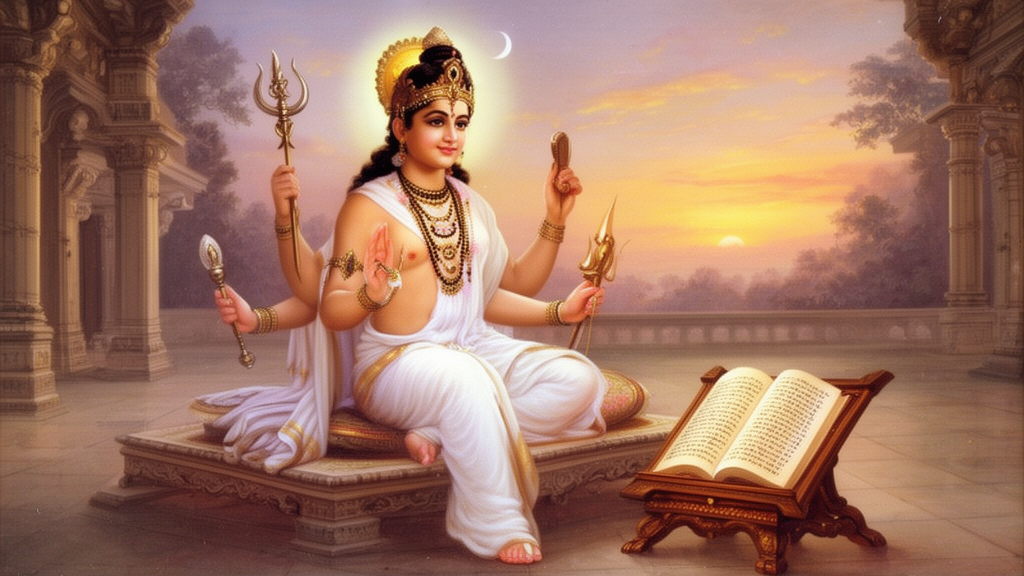
Many editions open with a meditation verse that describes Vishnu’s form. The verse is often recited before the thousand names, as a way of focusing the mind on the deity. The sources show the verse beginning with शुक्लाम्बरधरं विष्णुं शशिवर्णं चतुर्भुजम् and continuing with प्रसन्नवदनं ध्यायेत् सर्वविघ्नोपशान्तये.[1][4] Devotees commonly understand the verse as a meditation on Vishnu in white garments, moon-coloured radiance, and four arms. That reading is a traditional description of the verse, not a claim about how any person sees the deity.
The purva pithika (introductory section)
Several Hindi editions include an introductory section before the hymn itself. In one edition reviewed, this section includes verses that honour Vyasa, describe the teaching of Bhishma, and link the hymn to a line of sages.[4] The Hindi text presents these verses as traditional preface material. Scholars treat such prefatory passages as part of how the hymn was transmitted and presented, and editors may add or reorder them.
The viniyoga (procedural note)
Many editions include a viniyoga, a short statement that lists the hymn’s rishi (seer), chhanda (metre), devata (deity), and the purpose of recitation. One Hindi source gives the rishi as Vedavyasa and the metre as Anushtubh, and names Shri Mahavishnu Paramatma Shri Narayana as the deity.[1] These attributions are traditional. They describe how the hymn is presented in ritual recitation and are not historical proof of authorship.
Hindi editions, PDFs, and how to read them
Hindi PDFs and web pages make the Vishnu Sahasranama easy to access. Several sites reviewed offer Hindi lyrics, PDF downloads, or both.[1][2][4] Access is convenient, but a free file is not automatically an authoritative one. When comparing editions, look for the following:
- Script and language clarity: The Sanskrit verses should be in Devanagari, with Hindi explanations clearly separated from the verses.
- Source attribution: A good edition names the text it follows, such as the Mahabharata’s Anushasana Parva, or a named printed edition.
- Consistent numbering: Each name should be numbered in sequence, and the total should be 1,000 in editions that present the complete hymn.
- Transparent meanings: Hindi meanings are useful, but they are commentary or translation. A reader should be able to tell which words are the verses and which are the editor’s explanation.
- Acknowledged variants: Editions that note alternative readings are more useful for careful study than those that present one reading as final.
Two different Hindi pages in the sources reviewed show slightly different spellings and presentations of the same opening material.[1][6] This is a practical reason to compare more than one edition before memorising a text, especially if you plan to recite it in a community setting where others use a particular printed version.
What devotees believe about reciting the hymn
Devotional sources describe the Vishnu Sahasranama as a means of peace, protection, prosperity, and spiritual growth. One Hindi source states that regular chanting helps devotees find peace, prosperity, protection, and spiritual growth.[1] Another Hindi source describes the belief that recitation brings mental tranquility, protection, good fortune, and spiritual growth, and cultivates virtues such as faith, humility, and self-discipline.[4]
These statements describe what devotees believe or report. They are not measurable outcomes, and HindusGod.com does not present them as guaranteed results. Readers who recite the hymn for peace of mind, study, or devotion can understand these beliefs as part of a spiritual practice. Readers who face serious health, legal, financial, or safety problems should seek appropriate professional help alongside any devotional practice.
Text, tradition, belief, and scholarship: keeping them separate
Discussion of the Vishnu Sahasranama often mixes several kinds of statements. It helps to separate them:
- Scriptural text: The Sanskrit verses of the hymn and their placement in the Mahabharata.
- Traditional attribution: Claims that Vedavyasa is the rishi, or that Bhishma taught Yudhishthira. These are presented in the text and in devotional literature.
- Devotional belief: Claims that recitation brings peace, protection, or spiritual growth.
- Ritual practice: How and when people recite the hymn, which varies by household, region, and sampradaya.
- Scholarly analysis: Questions about the history of the text, its transmission, and its relationship to other Vishnu hymns. Those questions require academic sources and are not settled by devotional web pages.
When a web page makes a historical claim, such as a precise date for the hymn’s composition, readers should look for a scholarly edition or academic study. None of the sources reviewed for this article supplied a verified composition date, so this article does not give one.
Practical recitation: an order of steps
Practices vary widely. The steps below describe a common approach found in Hindi devotional sources. They are tradition-specific and optional, and families may follow different customs.
- Choose a text you trust. Use an edition that shows the Sanskrit clearly and names its source, then keep to the same edition for a while.
- Read the opening verses first. Many devotees begin with the dhyana verse, which focuses attention on Vishnu’s form.
- Recite at a steady pace. Clear pronunciation matters more than speed. Readers new to Sanskrit may use Hindi transliteration alongside the Devanagari text.
- Use the meanings for understanding, not as a substitute. Reading the Hindi explanation after recitation can help you connect with individual names.
- Close with a personal prayer or pause. Many devotees end with silent reflection or a short prayer in their own words.
Some households recite the full hymn daily, while others recite a portion, or recite on specific days. Choose a pattern that fits your time and your family’s practice. Do not treat any single pattern as the only correct method.
Regional and sampradaya differences
Vishnu worship is diverse. Vaishnava communities, including several sampradayas, have their own practices, devotional emphases, and preferred texts. A household that follows one sampradaya may use a different set of hymns or a different order of recitation from another. Regional languages also shape how the hymn is taught: Hindi editions are common in northern India, but readers in other regions may use Tamil, Telugu, Kannada, Malayalam, or Sanskrit editions for the same hymn.
If you are learning from a teacher, guru, or temple community, their tradition takes precedence for ritual details. This article describes what the sources reviewed say and does not claim to represent every Vaishnava lineage.
Related HindusGod.com articles
The following HindusGod.com links are WordPress drafts in the current site inventory. They may not be public yet, so each link should be checked before publication.
- For the broader Hindi usage of the term, see Hindi Shastra (URL status: draft, may not be public yet).
- For another Vishnu-related search term, see Vishnu Shastra Shastra (URL status: draft, may not be public yet).
- For the Vishnu Sahasranama as a specific subject, see Vishnu Sahasranama Shastra (URL status: draft, may not be public yet).
- For Vishnu-related Puranic material, see Vishnu Puran Shastra and Vishnu Purana in Hindi (URL status: drafts, may not be public yet).
- For a general article on Vishnu as a deity, see Bhagwan Vishnu Shastra (URL status: draft, may not be public yet).
- For a related Vishnu hymn tradition, see Maha Vishnu Shastra (URL status: draft, may not be public yet).
- For readers comparing regional-language editions, see Vishnu Shastra Gujarati, Vishnu Shastra in Telugu, Vishnu Shastra Kannada, and Vishnu Shastra Marathi (URL status: drafts, may not be public yet).
- For the general term of Hindu scripture in Hindi, see Hindu Shastra in Hindi (URL status: draft, may not be public yet).
Frequently asked questions
Is the Vishnu Sahasranama a separate book?
Hindi sources describe it as a hymn within the Mahabharata’s Anushasana Parva, presented as Bhishma’s teaching to Yudhishthira.[2][4] Many Hindi booklets print it separately for daily recitation, but that does not make it independent of the epic. Readers who want the full context should consult a Mahabharata edition.
Why do Hindi editions look slightly different?
Spelling of Sanskrit words, placement of anusvara, and the inclusion of introductory verses vary between printed and online editions.[1][6] Choose an edition that names its source and compare it with one more edition if you are learning the text carefully.
Do I need to recite the full hymn to benefit?
Devotional sources describe benefits such as peace and spiritual growth, but these are beliefs, not guaranteed results.[1][4] Practice patterns vary. Some devotees recite the full hymn daily, others recite part of it. Follow the guidance of your family or teacher on how much to recite.
Key takeaway
The search phrase vishnu shastra hindi most often leads to the Vishnu Sahasranama in Hindi, a hymn of one thousand names of Vishnu placed within the Mahabharata. Its value for many devotees lies in regular, attentive recitation and in understanding the meanings of the names. Before relying on a Hindi edition, check its source, its script, and whether it acknowledges variant readings. Keep the scriptural text, traditional attribution, devotional belief, and modern interpretation distinct, and treat claims of material results as beliefs rather than promises.
Sources and further reading
- Vishnu Sahasranamam Hindi Lyrics with PDF: Hindi lyrics, dhyana verse, viniyoga, and devotional description of the hymn (inspected; supports the dhyana verse text, viniyoga attributions, and devotional belief statements).
- श्री विष्णु सहस्रनाम स्तोत्रम पाठ, HinduNidhi: Hindi description of the hymn, its Mahabharata Anushasana Parva placement, and the opening verses (inspected; supports the Mahabharata placement and devotional description).
- Vishnu Sahasranam Stotra in Hindi, Bhaktinidhi: Hindi description of Bhishma’s teaching to Yudhishthira, the 1,000 names, the opening verse, and the dhyana verse (inspected; supports the narrative setting and devotional belief statements).
- Sree Vishnu Sahasra Nama Stotram – Hindi, Vaidika Vignanam (mobile): Hindi text showing alternative spelling of the dhyana verse (inspected; supports the variant-spelling observation only).