When readers search for vishnu shastra in telugu, they are most often looking for the Telugu text of the Vishnu Sahasranama, the hymn of one thousand names of Lord Vishnu. This article explains what that text is, where it comes from in the Mahabharata, how it is structured, why Telugu editions differ in layout and counting, and how devotees traditionally recite it. The word shastra is used loosely in online searches. In this guide it refers to the Telugu-script Vishnu Sahasranama and related Vishnu texts, not to a single officially named ‘Vishnu Shastra’ book.

Quick answer: what is the Telugu Vishnu Shastra?
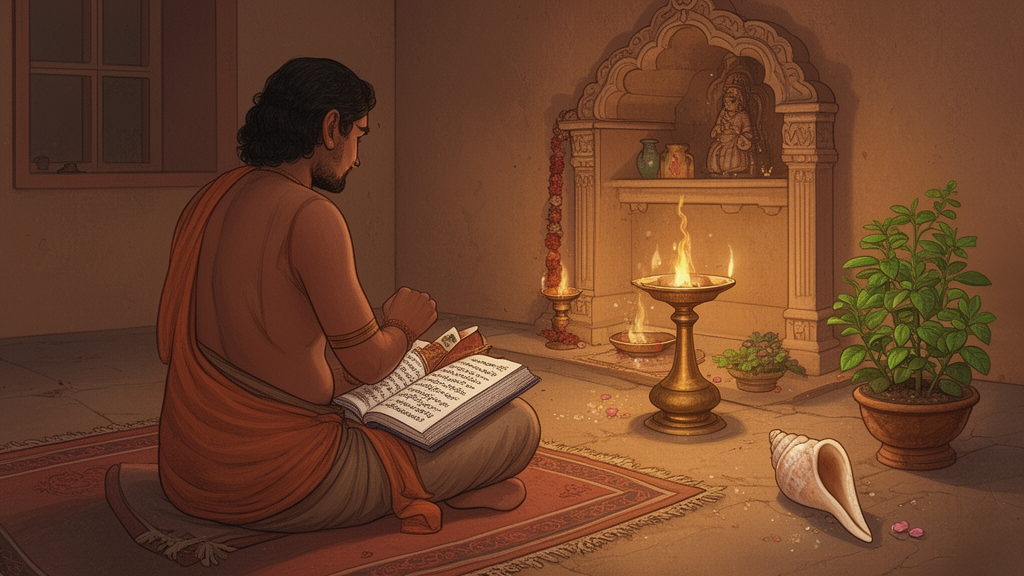
The text most commonly found under this search phrase is the Sri Vishnu Sahasranama Stotram in Telugu script. Online Telugu editions present it as a Sanskrit hymn written in Telugu letters, usually with the opening verses, a dhyanam (meditative verse), the thousand names, and a concluding section called the phalashruti, which describes the benefits devotees believe come from reciting it. Telugu-language sites describe it as part of the Mahabharata, specifically the Anushasana Parva, and attribute its teaching to Vyasa, with Bhishma speaking it to Yudhishthira.
Because the phrase is ambiguous, the safest approach is to identify the exact text you are reading. Check whether the page offers a stotram (continuous hymn), a namavali (names in a list), or a general Vishnu text such as a Purana. Those are different forms with different purposes.
Where the Vishnu Sahasranama comes from
According to the Stotrams website, the Vishnu Sahasranama is recorded in the Mahabharata’s Anushasana Parva, and the names were imparted by Bhishma Pitamaha to Yudhishthira while Bhishma lay on a bed of arrows. [5] The same source attributes the composition to Vyasa. [5] The Sahasranamam Telugu edition states that the text is taken from the Mahabharata, Anushasana Parva, chapter 149. [3]
These statements describe what the textual tradition and devotional websites report. They do not, by themselves, establish a historical date for the hymn. Scholars generally treat the Mahabharata as a long, layered text that grew over time, so the exact date and authorship of any individual section should be treated as an open academic question rather than settled fact.
Belief and text are different things
The Telugu editions and devotional pages often describe the hymn in strong devotional language. One page states that devotees recite it daily for peace of mind, mental clarity, and spiritual liberation, and that sincere chanting is believed to remove obstacles and purify the mind. [5] These are beliefs held within devotional practice. They are not measurable outcomes, and this guide does not present them as guaranteed results.
How the Telugu text is structured
Most Telugu editions follow a recognizable sequence. Reading the structure first helps you find your place in a long text and recognize when a page has omitted or added sections.
- Opening verses: A short introduction that includes the opening line Shuklambaradharam Vishnum, which describes Vishnu in white garments with a moon-like complexion and four arms. [2][3]
- Purva Pithika: Introductory verses that name Vyasa, Vasishtha, Shakti, and Parashara in the lineage of the text. [2][3]
- Dhyanam: A meditative section that visualizes Vishnu, including the verse that begins with the image of the reclining Lord on the ocean of milk. [3]
- The thousand names: The core list, presented in verses. Each verse contains several names. [1][2]
- Phalashruti: The concluding section describing the benefits traditionally associated with recitation. [1][5]
Within the names, several familiar forms appear together in a single verse. One Telugu edition lists, among others, Vishnu, Jishnu, Mahavishnu, Prabhavishnu, and Maheshwara in one verse. [2]
Counting the verses
Counts vary by source, which is a common issue with Sanskrit stotras. One Telugu edition describes the text as having all 108 shlokas of the thousand names. [3] A different edition page numbers the whole text across 215 verses, including sections before and after the core names. [5] These figures are not necessarily contradictory, because the sources count different parts of the text. Before comparing verse numbers across websites, confirm which parts each count includes.
Telugu script, transliteration, and spelling variants
Readers encounter several spellings for the same hymn. The most common forms include Vishnu Sahasranamam, Vishnu Sahasranama Stotram, Sri Vishnu Sahasranama Stotram, and Vishnu Sahasra Nama Stotram. [2][5] Telugu-language titles may use శ్రీ విష్ణు సహస్రనామ స్తోత్రం or శ్రీ విష్ణు సహస్రనామావళిః. [1][4]
The difference between a stotram and a namavali matters. A stotram is usually read as a continuous hymn with verse structure. A namavali is a list of names, often recited in a repeated format during worship. Stotranidhi publishes both a Vishnu Sahasranama Stotram page and a separate Vishnu Sahasranamavali page, which signals that the two forms are treated as distinct texts. [1][4]
Transliteration choices
Sanskrit words written in Telugu script are sometimes transliterated differently across sites. For example, one edition writes Vishnu with a standard Roman form, while another uses diacritics such as Viṣṇu. [3][5] Neither form changes the text, but consistency matters when you compare editions. If you are learning the pronunciation, choose one transliteration scheme and use it throughout your reading.
Choosing a reliable Telugu edition
Devotional websites vary in accuracy. Some pages provide full text with verse numbers and a meaning section, while others provide only lyrics. A careful reader can check these points before relying on an edition:
- Source attribution: Does the page identify the Mahabharata context, or only give a devotional title?
- Verse numbering: Are the verses numbered in a consistent way that you can compare with another edition?
- Meaning and translation: Is the translation labeled, and does the site say that translations may contain inaccuracies? One widely read English-meaning page states that its translations may contain occasional inaccuracies. [5]
- Alternate concluding verses: Some editions include alternate concluding shlokas. The Stotrams page lists such sections separately in its table of contents. [5]
- Text consistency: Do the first verses match across at least two independent editions?
For study, compare at least two editions. For daily recitation, many families use the edition that their local temple, teacher, or household has followed for generations. That local continuity is a valid tradition, but it is not the same as a single universal text.
How devotees traditionally recite it
Recitation practices differ by family, region, sampradaya, and teacher. The points below describe commonly reported practices, not a single required method.
Common practices
- Reciting the opening verses and dhyanam before the names as a preparatory step. [2][3]
- Reading slowly with attention to pronunciation, since the verses are in Sanskrit even when printed in Telugu script.
- Using a printed or downloaded edition for daily reading, as several devotional sites offer Telugu PDFs for offline use. [2]
- Reciting in a group or at a temple in some communities, and privately at home in others.
Points to confirm with a teacher
Pronunciation, the number of times to recite, and whether to recite the full hymn or only parts are matters of tradition. A teacher in your own lineage is the best guide for these details. Avoid treating one website’s instructions as the only correct way.
Phalashruti: reading the benefits section carefully
The phalashruti section describes outcomes associated with reciting the hymn. Devotional websites often summarize these as peace, protection, removal of obstacles, and spiritual progress. [1][5] In the study of Hindu texts, phalashruti is generally read as a devotional statement within the text’s own framework. It expresses what the tradition hopes or believes recitation will achieve.
This guide does not claim that reciting the Vishnu Sahasranama produces material success, health outcomes, or protection from specific events. Readers should understand the phalashruti as a statement of devotional belief and approach it with the same respect given to other devotional texts.
Related Vishnu texts on HindusGod.com
Readers searching for this topic often also look for other Vishnu-related Telugu texts. The following HindusGod.com pages are relevant. Several are currently WordPress drafts, so they may not be publicly visible until the owner publishes them.
- Vishnu Shastra Shastra for a broader overview of Vishnu-related shastra searches (target draft; may not be public yet).
- Vishnu Sahasranama Shastra for a closely related sahasranama overview (target draft; may not be public yet).
- Vishnu Names in Telugu for readers focused on the names of Vishnu (target draft; may not be public yet).
- Vishnu Puranam in Telugu for the Purana tradition, which is a different text from the Vishnu Sahasranama (target draft; may not be public yet).
- Vishnu Puran Shastra for a general Vishnu Purana overview (target draft; may not be public yet).
- Maha Vishnu Shastra for readers searching for Maha Vishnu texts (target draft; may not be public yet).
- Bhagwan Vishnu Shastra for another Vishnu-focused search variant (target draft; may not be public yet).
- Dharma Shastra in Telugu for readers interested in the broader meaning of dharma texts (target draft; may not be public yet).
- Manu Shastra in Telugu for a separate Dharma-literature topic (target draft; may not be public yet).
- Vishnu Shastra Hindi for readers who prefer a Hindi-language resource (target draft; may not be public yet).
Each of these pages serves a distinct reader need, so readers should choose the one that matches their question rather than reading them as duplicates.
Text, tradition, and scholarship: keeping them separate
Discussion of the Vishnu Sahasranama often mixes four different kinds of statements. Keeping them apart improves accuracy:
- Textual content: The verses and names as printed in editions of the hymn.
- Tradition: Claims such as the attribution to Vyasa and Bhishma, and the custom of daily recitation. [5]
- Devotional belief: Statements that recitation removes obstacles or grants liberation. [5]
- Scholarly interpretation: Analysis of the Mahabharata’s composition history, the relationship of the hymn to the wider epic, and the meaning of individual names.
The scholarly category needs particular care. This article does not provide a verified date for the hymn’s composition, because the sources reviewed for this draft do not establish one. Readers who want a historical account should consult academic editions and scholarship on the Mahabharata’s Anushasana Parva.
A practical way to begin reading
If you are new to the text, a steady approach works better than attempting the whole hymn at once.
- Choose one Telugu edition and one meaning source, and note the source of each.
- Read the opening verses and dhyanam several times until the Sanskrit rhythm feels familiar.
- Read a small set of names each day, using the meaning source to check the sense of each name.
- Compare your edition with a second edition at the verses you read to notice differences in spelling or numbering.
- Ask a teacher from your tradition about pronunciation and any recitation customs in your family or community.
Frequently asked questions
Is the Vishnu Sahasranama the same as a Vishnu Shastra?
Not exactly. The search phrase ‘Vishnu Shastra’ is used informally. The most commonly found Telugu text under this phrase is the Vishnu Sahasranama stotram, but other Vishnu texts, including Puranas and namavalis, are different works.
Where does the Vishnu Sahasranama appear in the Mahabharata?
Telugu devotional sources place it in the Anushasana Parva, and one edition cites chapter 149. [3][5] Check a critical edition of the Mahabharata for the exact location before citing a chapter number in academic work.
Why do Telugu editions show different verse counts?
Editions count verses differently. Some count only the core names, while others include the opening verses, dhyanam, and concluding sections. [3][5]
Does reciting the hymn guarantee a result?
No. The benefits described in the phalashruti are devotional beliefs within the tradition. This article does not present them as guaranteed outcomes.
Summary and next step
The phrase vishnu shastra in telugu most commonly points to the Telugu-script Vishnu Sahasranama, a hymn of one thousand names of Vishnu traditionally linked to the Mahabharata’s Anushasana Parva. To read it well, identify the edition, note the difference between a stotram and a namavali, compare verse numbering across sources, and separate textual content from tradition, devotional belief, and scholarly interpretation. For practice, consult a teacher from your own lineage, and use a reliable Telugu edition alongside a labeled meaning source.
Sources and further reading
- Stotra Nidhi, Sri Vishnu Sahasranama Stotram (Telugu and multi-script page): https://stotranidhi.com/sri-vishnu-sahasranama-stotram/. Supports the Telugu title, the opening verses, and the structure of the Telugu edition.
- Stotra Nidhi, Sri Vishnu Sahasranamavali: https://stotranidhi.com/sri-vishnu-sahasra-namavali-in-telugu/. Supports the distinction between the stotram and the namavali forms.
- Vishnu Sahasranamam Telugu Lyrics and PDF: https://vishnusahasranama.co.in/vishnu-sahasranamam-telugu/. Supports spelling variants, the opening verses, and the name-list verse cited above.
- Sahasranama.in, Vishnu Sahasranamam in Telugu: https://sahasranama.in/sahasranamam/telugu. Supports the Mahabharata Anushasana Parva 149 attribution, the dhyanam, and the 108-shloka description.
- Stotrams.com, Vishnu Sahasranama Stotram in Telugu with meaning: https://stotrams.com/stotra/vishnu-vishnusahasranama/telugu. Supports the Bhishma-Yudhishthira setting, the attribution to Vyasa, the verse-count table, the alternate concluding shlokas, and the devotional-belief statements.