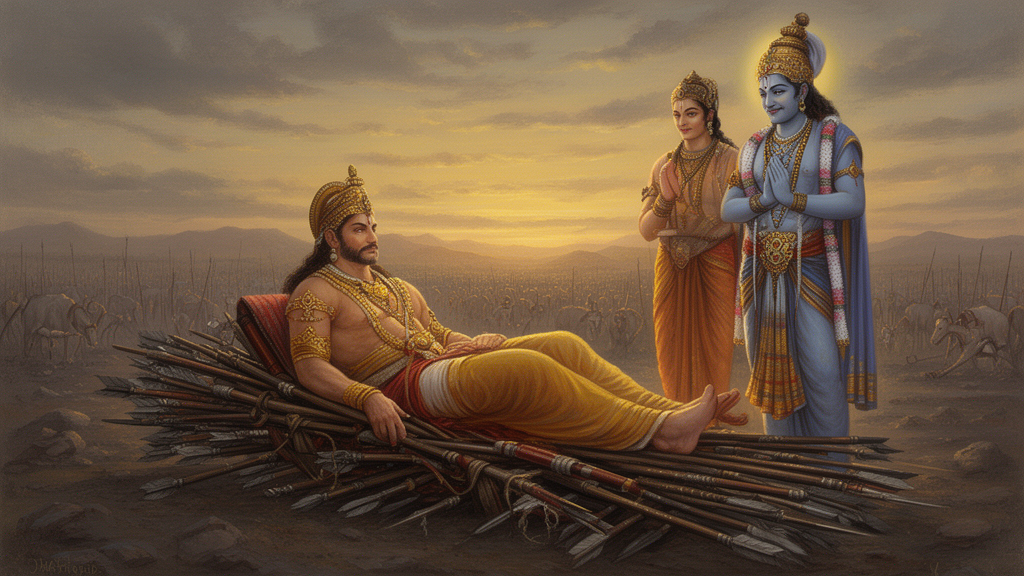
The Vishnu Sahasranama is a hymn of one thousand names of Lord Vishnu. Readers often search for it as the “Vishnu Sahasranama Shastra,” but the text is usually called a stotra (hymn) or stotram, and it is also written as Vishnu Sahasranamam or Vishnu Sahasra Nama Stotram. In the commonly cited account, it is part of the Mahabharata, and the tradition attributes its compilation to the sage Veda Vyasa. The hymn is presented as Bhishma’s answer, given from his bed of arrows, to a set of questions from Yudhishthira about the highest deity and the path to liberation.
This article explains what the hymn is, where it appears, how its opening section is structured, how its teaching is framed, and where recitation practices and textual versions differ. It separates three things that are often mixed together: what the text itself says, what traditions believe about it, and what scholars can and cannot establish from the sources consulted here.
A direct answer: what the Vishnu Sahasranama is

The Vishnu Sahasranama is a Sanskrit hymn that lists a thousand names of Vishnu, with an introduction and a closing portion. Its central teaching, as presented in the text, is that Vishnu is the one supreme deity and the highest refuge. The introduction to the hymn on Shlokam, a Sanskrit devotional resource, describes it as a compilation of a thousand names of Lord Vishnu composed by Sri Veda Vyasa and occurring within the Mahabharata.[1]
For most readers, the hymn is best understood as three layers working together:
- The narrative frame: Bhishma, dying on the battlefield of Kurukshetra, instructs Yudhishthira.
- The introductory section: Yudhishthira’s questions and Bhishma’s answers, which explain why Vishnu is worshipped and how remembrance of him is said to help a person.
- The name-list itself: the thousand names, recited as a devotional practice.
Because the hymn is both a story and a prayer, it is read differently in different settings. A scholar may ask about its textual history, while a devotee may recite it as daily worship. Both approaches can be respectful, but they answer different questions.
Naming and spelling: why “shastra” is a search variant
Transliterated Sanskrit names are not spelled consistently across books, websites, and recordings. The same hymn may appear as Vishnu Sahasranamam, Vishnu Sahasranama, Vishnu Sahasra Nama Stotram, or Shri Vishnu Sahasranamam. Devotional sites use these forms interchangeably. The Sanskrit title on one devotional page is श्री विष्णु सहस्र नाम स्तोत्रम्, which means the hymn is formally identified as a stotra of the thousand names of Vishnu.[4]
The word sahasra means thousand, and nama means name. The word shastra, in the sense of a treatise or authoritative manual, is not the term most often used for this hymn in the sources reviewed here. Readers who search with the word “shastra” are usually looking for the same text. This article uses the spelling Vishnu Sahasranama and explains the variants so readers can match them to the editions they use.
Where the hymn appears: the Mahabharata and Bhishma’s teaching
According to Shlokam, the hymn occurs within the body of the Mahabharata and was first revealed by Bhishma to Yudhishthira, the eldest of the five Pandava brothers. The setting is Kurukshetra after the battle. Bhishma is lying mortally wounded, but he waits for a more auspicious time, Uttarayana, before leaving his body. The source explains that he had received a boon from his father, King Shantanu, that allowed him to choose the moment of his death.[1]
The same source says Krishna recognized that Bhishma’s long life of righteousness and devotion would be lost to the world if he died without teaching. Krishna therefore encouraged Yudhishthira to seek Bhishma’s guidance on governance and dharma. Yudhishthira listened to a great deal of instruction, but still felt that he had not received a clear answer about the path to liberation, or moksha.[1]
The tradition, as presented on Shlokam, links the revelation to Bhishma Ekadasi. Readers should treat this as a traditional date association rather than a fixed historical date. The sources reviewed do not establish a calendar date for the events of the Mahabharata, and this article does not offer one.
The six questions that begin the teaching
The introductory part of the hymn, sometimes called the Poorvapeetika, is built around six questions. Shlokam lists them as they appear in the text’s introductory verses, which begin with the phrase kim ekam daivatam loke.[1] The questions are:
- Who is the one supreme deity in the world?
- What is the highest goal of life?
- By praising whom do human beings attain welfare?
- By worshipping which deity do people attain prosperity in this world and bliss in the next?
- Which code of conduct, or dharma, is the highest of all?
- By repeating which mantra or japa is a living being freed from the bondage of birth, life, and death?
These questions give the hymn its structure. Each question is answered in turn, and the answers form the spiritual argument of the introduction. For readers new to the text, this is a useful place to begin, because the hymn is not simply a list of names. It is an answer to a set of questions about the highest good.
Bhishma’s answer: Vishnu as the one supreme
Bhishma’s first answer, as quoted on Shlokam, identifies Vishnu as the one god who is the sanctity of all sacred things, the most auspicious of the auspicious, the god of gods, and the eternal father of all beings. The source gives the Sanskrit line beginning pavitraanaam pavitram yo, and the English meaning it offers is a paraphrase of that teaching.[1]
The second answer is expressed through a series of descriptions. Vishnu is described as the great radiance, the great austerity, the supreme truth that pervades all things, and the highest goal of attainment. The Sanskrit wording uses the phrase paramam yo repeatedly, a structure that emphasizes Vishnu as the “highest” in several senses.[1]
These statements are scripture within the frame of the hymn. They are not historical claims about Vishnu’s nature that can be tested by evidence. A reader who wants to understand the teaching should read the text’s own words first, then consider how theologians and traditions have interpreted them.
How the hymn is structured
Devotional editions of the Vishnu Sahasranama usually include several parts before the thousand names. A Sanskrit devotional page presents the complete hymn with these sections:
- Dhyanam (meditation verses): A verse describing Vishnu in white garments, with a moon-like complexion and four arms, recited to calm obstacles. The page translates the purpose of the verse as calming all obstacles.[4]
- Introductory verses: Verses that introduce the sage and the setting before Yudhishthira’s questions.[4]
- Poorvapeetika: The introduction to the hymn, including the questions and Bhishma’s replies.[1][4]
- Nyasa and viniyoga (ritual formulas): Short formulas that name the sage, the meter, the deity, and the purpose of recitation.[4]
- The thousand names: The main body of the hymn.
The viniyoga section on one devotional page identifies the sage as Sri Veda Vyasa, the meter as Anushtubh, and the deity as Sri Mahavishnu, the supreme self, with Srimannarayana as the presiding form.[4] These labels are part of the traditional recitation framework. Readers should note that they belong to a devotional and liturgical presentation. They are not the same as a scholarly edition’s critical notes.
A verse often cited for its promise
Several devotional editions include a verse that says a person is freed from the bondage of birth and rebirth by remembering Vishnu. A Sanskrit devotional page gives the line yasya smaranamaatrena janmasamsaara bandhanaat, followed by a salutation to Vishnu.[4][6]
This is a traditional teaching about remembrance and devotion. It describes the hope of liberation in the religious worldview of the text. It is not a guarantee of a specific material result, and it should not be read as a promise that reciting the hymn will bring health, wealth, or other outcomes. Hindu traditions differ in how they understand liberation, grace, effort, and ritual, so readers should treat this verse as one teaching among many rather than a universal formula.
Devotional belief, text, tradition, and scholarship
Discussions of the Vishnu Sahasranama often mix four different kinds of statement. It helps to separate them.
- Textual statements: What the hymn says, such as Bhishma’s answers and the list of names. These can be cited from a specific edition.
- Traditional attributions: Claims such as the attribution of the hymn to Veda Vyasa or the connection to Bhishma Ekadasi. These are central to the tradition, but they are not the same as independent historical proof.
- Devotional belief: Claims that regular chanting brings peace or spiritual protection. A devotional website describes regular chanting as bringing peace and keeping the reader connected with divine energy.[4] This is a belief stated by a devotional source, not a result that can be verified.
- Scholarly questions: Questions about the composition history, manuscript variants, and the relationship of this hymn to the wider Mahabharata. The sources consulted for this article do not provide a scholarly dating or a critical-edition analysis, so this article does not make claims in that area.
Readers who want historical or textual analysis should consult academic editions of the Mahabharata and critical studies of the Vishnu Sahasranama. Those sources are not included in the verified list for this post and should be added only after they are checked.
Textual variants and why editions differ
Different editions of the Vishnu Sahasranama may show small differences in spelling, word division, accent marks, and the arrangement of introductory verses. The sources reviewed for this post illustrate this point. In one Sanskrit devotional page, the verse with the phrase sadaika rupa rupaaya is written with spacing that separates the words differently from the version on another devotional page, which runs the words together in Devanagari.[4][6] The Sanskrit text and meaning remain the same in these examples, but a reader comparing two pages may notice differences.
Differences in the order of introductory verses also appear. One devotional page includes a Sanskrit line in the dhyanam that differs in wording from another version.[4][6] For this reason, readers should choose one edition for study or recitation and be aware that other editions may print the text differently. If a family, temple, or teacher uses a specific edition, that edition should guide practice.
How people recite the hymn
Recitation practices vary widely. Some people chant the full hymn every day, some chant it on Ekadashi or other occasions, and some use only the introduction or a selection of names. The tradition does not require one universal schedule. A household, temple, or lineage may have its own customs for pronunciation, sequence, and whether the hymn is recited with a teacher.
Many readers begin with a practical routine:
- Choose a reliable Devanagari edition and, if needed, a transliteration that you can read accurately.
- Read the English meaning for the introduction so you understand the questions and answers before reciting.
- Recite slowly and clearly, with attention to the sounds of each name.
- Keep a steady rhythm rather than rushing to finish the full list.
- If you are learning pronunciation, ask a qualified teacher from your own tradition for guidance.
These steps describe a common practice for learning and reciting, not a required ritual. The sequence and method may differ by family and community. Where a practice is specific to a particular tradition, that tradition should be named when it is described.
Why the names matter in devotion
The thousand names are a way of describing Vishnu from many angles. Each name points to a quality, action, or relationship associated with the deity. In devotional practice, the repetition of names is a way of keeping the mind focused on the deity and on the teaching of the hymn. Traditional commentators have explained individual names in different ways, and readers may encounter several meanings for the same name.
For this reason, readers who want the meaning of specific names should use a commentary or translation from a named tradition, and should attribute the explanation to that source. This article does not list individual name meanings because the sources consulted here do not provide a verified name-by-name translation.
Reading the hymn alongside other Vishnu texts
The Vishnu Sahasranama is one of many texts and practices connected with Vishnu. Readers searching for related material may also be interested in works that treat Vishnu in other forms, languages, or devotional settings. HindusGod.com has several related pages, including a general page on Vishnu, the deity of this hymn, and a page on Bhagwan Vishnu Shastra for readers exploring related material. Pages that focus on the Vishnu Puran or other Vishnu-centered works, such as Vishnu Puran Shastra, may help readers compare devotional and narrative literature.
Readers who prefer Indian languages for study may also consult language-specific pages on the site. These are currently listed as target drafts, so their availability should be checked before following them. Examples include the Hindi-language page on Vishnu Shastra Hindi, the Tamil-language page on Vishnu Shastra Tamil, and the Telugu page on Vishnu Shastra in Telugu. Others include Vishnu Shastra Gujarati, Vishnu Shastra Kannada, and Vishnu Shastra Marathi.
For readers interested in the wider category of Hindu scriptural and devotional texts, the page on Bhagwat Shastra may provide additional context. These links are offered for further exploration, not as a substitute for a reliable edition of the hymn.
Common questions about the Vishnu Sahasranama
Is the Vishnu Sahasranama part of the Mahabharata?
The Shlokam introduction states that the hymn occurs within the body of the Mahabharata and is revealed by Bhishma to Yudhishthira.[1] Readers who want the exact location within the epic should consult a critical or academic edition, because this article does not verify chapter-level placement from the sources reviewed.
Who composed the hymn?
The devotional sources reviewed attribute the compilation to Sri Veda Vyasa.[1][4] This is a traditional attribution. Scholars may discuss the composition history of the text differently, and this article does not provide a historical conclusion on authorship.
Do I need to know Sanskrit to recite it?
Many people recite the hymn with transliteration or with guidance from a teacher, and devotional sites offer lyrics in several scripts. Readers who are learning should begin with a clear edition and read the meaning of the introduction. Pronunciation guidance is best sought from a teacher within the reader’s own tradition.
Does reciting the hymn guarantee a result?
No. The text and devotional sources speak of peace, remembrance, devotion, and liberation as religious aims and beliefs. They do not offer a guaranteed material outcome, and this article does not make such a promise. Readers should approach the hymn according to their own faith, family practice, and guidance from their tradition.
Summary and next step
The Vishnu Sahasranama is a hymn of a thousand names of Vishnu, traditionally attributed to Veda Vyasa and placed within the Mahabharata. Its introduction presents Bhishma’s answers to Yudhishthira’s six questions, and its teaching centers on Vishnu as the one supreme deity and the highest refuge. Its devotional use is widespread, but practices of recitation, edition choice, and interpretation differ across families, regions, and traditions.
A practical next step is to choose one reliable Devanagari edition, read the introduction and its meaning, and then compare the text with an academic or traditional commentary. Readers who want to explore related Vishnu material can use the HindusGod.com links above once those pages are confirmed live.
Sources and further reading
- Vishnu Sahasranamam, Sanskrit lyrics with English meaning, Shlokam: used for the introduction, the six questions, Bhishma’s answers, and the Bhishma Ekadasi association. This is a devotional resource, so its English meaning should be checked against an academic or traditional translation before quotation.
- Vishnu Sahasranamam Sanskrit Lyrics and PDF: used for the Sanskrit text, dhyanam, viniyoga, and the attribution to Veda Vyasa. This is a devotional page and is not a critical edition.
- Vishnu Sahasranamam Lyrics and PDF, multilingual index: used for comparison of variant spellings and a Sanskrit dhyanam verse. This is also a devotional resource.