The Vedas are the oldest scriptures associated with Hinduism, a body of texts made up of four main collections: the Rigveda, Samaveda, Yajurveda, and Atharvaveda. In Hindu tradition they are treated as the foundation of religious knowledge, and the term Vedic texts usually refers to these collections along with the layers of commentary, ritual instruction, and philosophy that developed around them. This guide explains what the Vedas contain, how they are classified, how old they are according to scholarly sources, and why different Hindu communities relate to them in different ways.
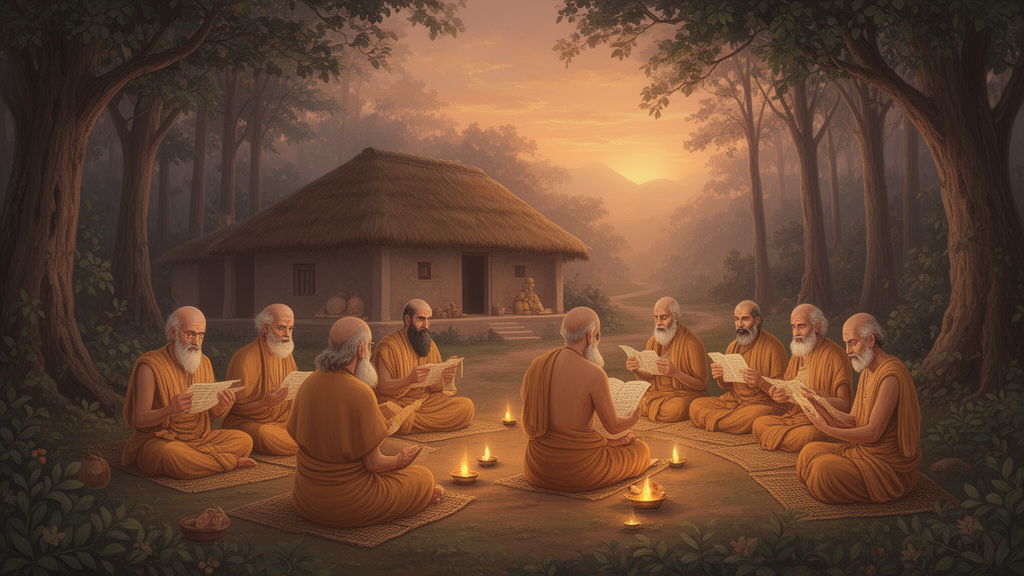
The short answer is this: the Vedas are a group of ancient Sanskrit collections of hymns, sacrificial formulas, chants, and philosophical dialogues. Hindu tradition regards them as shruti, meaning what is heard, and as a source of authority for the wider Hindu tradition. Historians and Indologists generally date the earliest parts to roughly 1500 to 1200 BCE, while noting that the exact dates are debated and that the texts were preserved orally for a long time before being written down.
What the Vedas Are

The Vedas are often described as the religious texts that inform Hinduism. Hinduism is also known in older usage as Sanatan Dharma, a phrase often rendered as Eternal Order or Eternal Path. The Vedas are commonly called scripture, but they do not work like a single book with one author and one narrative. The Vedic corpus is better understood as a set of distinct collections, each with its own purpose and style.
World History Encyclopedia explains that Hindus regard the Vedas as containing fundamental knowledge about the underlying cause of existence, its function, and the personal response that a person should make to it. The same source notes that, unlike scriptures in some other religions, the Vedas are not thought to have been revealed to a particular person at a specific historical moment. This is a devotional belief held within the tradition. Scholars studying the texts approach them as ancient compositions whose authors and settings can be investigated through language, internal evidence, and comparison with other sources.
That distinction matters. When you read about the Vedas, you will encounter three kinds of statements: what the texts say, what Hindu traditions believe about them, and what historians and philologists can reasonably reconstruct. This article keeps those categories separate wherever the sources allow.
Etymology: What the Word Veda Means
The word veda (Sanskrit: वेद) is generally connected to the Sanskrit root vid, meaning to know. Rigveda.live, a Vedic guide, explains that the word means a body of knowledge and links it to related words in other languages, including English wit and Greek oida. The literal meaning, then, is closer to knowledge or sacred learning than to a book in the modern sense.
The name also helps explain why the Vedas were treated as a learning tradition as much as a text. Learning the Vedas meant memorizing them, reciting them correctly, and understanding how they were used in ritual. Chapter-like divisions, recitation methods, and specialist roles all grew out of that practice.
Two related terms often appear in Vedic studies. Vedic refers to the period, language, and culture associated with the Vedas. Vedanta, a later term, refers to the philosophical tradition connected with the Upanishads, which appear at the end of Vedic literature. The Vedic Sanskrit language used in the earliest texts is different in some respects from classical Sanskrit, which is one reason scholars can use linguistic evidence to help date the material.
Shruti and Smriti: How Hindu Tradition Classifies Scripture
Hindu tradition often divides its sacred literature into two broad categories. Shruti means what is heard, and the Vedas are regarded as shruti. Smriti means what is remembered, a category that includes works such as the Mahabharata, the Ramayana, and the Bhagavad Gita, which are accounts of heroes, teachings, and social or moral guidance.
World History Encyclopedia summarizes this distinction clearly. It notes that the Vedas were preserved orally, with students memorizing them forwards and backwards and with close attention to exact pronunciation, so that what was originally heard remained intact. The same source also notes that some sects of Hinduism regard the Bhagavad Gita as shruti. This is an example of why the categories are not identical across traditions. The shruti and smriti classification is an important part of Hindu self-understanding, but its application to particular texts can vary.
For readers, the practical point is simple. When a Hindu teacher says the Vedas are shruti, they are making a statement about authority and origin within a religious framework. That statement is not the same as a historian’s claim about when a hymn was composed or who first recited it. Both can be true at the same time, but they answer different questions.
The Four Vedas
The four Vedas are traditionally listed as the Rigveda, Samaveda, Yajurveda, and Atharvaveda. Each one serves a different function, and each is best read as its own literary and ritual document rather than as four editions of the same material. Rigveda.live makes this point strongly: the four Vedas were compiled at different times, for different ritual specialists, and preserve different kinds of material.
Rigveda: Hymns of Praise
The Rigveda is the oldest of the four and is often treated as the foundation for the others. According to rigveda.live, it contains 1,028 hymns, called suktas, made up of 10,552 verses, organized into ten books called mandalas. Wikipedia gives a date range of approximately c. 1500 to 1200 BCE for the Rigveda within the Vedic period. The hymns are addressed to deities such as Indra, Agni, and Soma, and rigveda.live reports that Indra receives roughly 250 hymns, Agni about 200, and Soma the entire ninth mandala with 114 hymns.
Rigveda.live describes mandalas 2 through 7 as the so-called family books and dates mandalas 1, 8, 9, and 10 as later additions, with mandala 10 probably completed by around 1000 BCE. This internal layering is a scholarly observation about the text, not a devotional claim, and it illustrates how the Rigveda can be studied as a composite work.
Samaveda: The Veda of Melody
The Samaveda is closely related to the Rigveda. Rigveda.live describes it as the same poetry set to melody. For readers, this is one of the easiest ways to understand the difference between the collections: a Rigvedic verse may appear as a hymn in one place and as a chant in another. Wikipedia lists the Samaveda among the Vedas dated roughly c. 1200 to 900 BCE, alongside the Yajurveda and Atharvaveda, which places it later than the earliest Rigvedic hymns according to that source’s chronology.
Yajurveda: Formulas for Sacrifice
The Yajurveda is associated with prose formulas used by priests during the physical acts of sacrifice. Rigveda.live describes it as the Veda that supplied the sacrificial formulas for the priest who performed the ritual actions. Its textual history includes different recensions, which is one reason translations and editions can differ. Hinduwebsite.com, a Hindu sacred texts site, lists English translations of the Yajurveda, including a version identified as the Veda of the Black Yajus school, which shows that the collection has more than one recension.
Atharvaveda: Charms, Healing, and Spells
The Atharvaveda contains spells, charms, and healing incantations, according to rigveda.live. The same source notes that for centuries it was not considered a Veda at all. This is a historical and reception point, not a judgment about its present status. Modern Hindu traditions generally count it among the four Vedas, but readers should understand that its acceptance has a complicated history and that its contents include material very different from the praise hymns of the Rigveda.
When you read the Atharvaveda, it helps to identify whether a passage is being discussed as a sacred text, a ritual formula, or a historical witness to early popular practices. Each approach requires different evidence.
The Four Layers Inside the Vedas
Many Vedic collections are organized in layers. World History Encyclopedia lists four types of text found within the Vedas. The table below summarizes these categories as described in that source.
| Layer | Typical content, as described by World History Encyclopedia |
|---|---|
| Samhitas | Benedictions, prayers, and mantras |
| Brahmanas | Commentaries on rituals |
| Aranyakas | Rituals and observances, often associated with forest-based study |
| Upanishads | Philosophical narratives and dialogues |
The Samhita is the core collection of hymns or mantras and is the part most people mean when they speak of a particular Veda. The Brahmana layer explains how and why rituals are performed. The Aranyaka layer, sometimes described as forest texts, deals with rituals and observances in a more reflective register. The Upanishads, which come at the end of Vedic literature, contain the philosophical dialogues that later became the foundation for Vedanta.
These categories are useful but not perfectly rigid. Some Upanishads are attached to particular Vedic schools, and the boundaries between Brahmana and Aranyaka material can be debated by specialists. Treat the table as a practical map rather than a final classification.
Why the Upanishads Matter to Many Readers
Many readers first encounter the Vedas through the Upanishads because they are more accessible in philosophical content. Hinduwebsite.com lists free English translations of thirteen major Upanishads, including the Brihadaranyaka, Chandogya, and Katha Upanishads, alongside translations of the four Vedas. The page presents these works as foundational for study of Hindu metaphysics and spiritual thought. Because the Upanishads are philosophical dialogues, they show how Vedic material developed into later debates about the self, the ultimate reality, and liberation.
The Upanishads are part of the Vedic corpus in the layered sense described above, but they should not be read as identical in style or purpose to the Rigveda hymns. Hymns, ritual manuals, and philosophical dialogues ask different things of the reader.
Dating the Vedas: What Scholars Can and Cannot Say
The dating of the Vedas is one of the most common points of confusion. Wikipedia gives approximate ranges: c. 1500 to 1200 BCE for the Rigveda and c. 1200 to 900 BCE for the Yajurveda, Samaveda, and Atharvaveda. These ranges reflect a scholarly reconstruction, not a date written in the texts themselves.
World History Encyclopedia gives a different framing. It says the Vedas existed in oral form for generations before being committed to writing between about c. 1500 and c. 500 BCE, which it describes as the so-called Vedic Period. This wider range reflects the difference between when the material was composed, when it was memorized and recited, and when it was written down. The dates also depend on the method used, whether linguistic, archaeological, astronomical, or textual.
There is no single agreed date for the composition of every Vedic hymn. Scholars disagree about the details, and some Hindu traditions hold that the Vedas are not human compositions at all. Those are different kinds of claims. A responsible reader should note the disagreement rather than choose one date as if it were proven.
Oral Transmission
The oral transmission of the Vedas is one of the most distinctive features of their history. World History Encyclopedia explains that students memorized the texts with emphasis on exact pronunciation. This method was not merely a matter of memory. It was a way of preserving sound, rhythm, and recitation, which were considered essential to the ritual and spiritual function of the texts.
Oral transmission also helps explain why different recensions and schools developed. Rigveda.live notes that the sakha, or school, tradition is important in Vedic study. The same source says that about thirteen Vedic sakhas survive, out of more than 1,100 once claimed. Because this figure appears on a single blog page, readers should treat it as a claim to verify in specialist sources rather than as a settled statistic.
How Vedic Texts Are Studied and Translated Today
Most readers today use translations. Translation choices matter because Vedic Sanskrit is ancient, its vocabulary has layered meanings, and some words carry ritual or philosophical associations that a single English word may not capture. A translation is an interpretation, and it should be read with its translator and date in mind.
Hinduwebsite.com lists translations associated with Ralph T.H. Griffith for several Vedic collections, including the Rigveda and Samaveda. Griffith’s translations are historically important and widely available, but they reflect the scholarship and language of their time. Readers who want to compare translations should look at more than one edition and should check whether a translation is a direct rendering or a loose paraphrase.
Good study habits include reading the Sanskrit transliteration beside the translation when available, comparing two or three translations for difficult verses, and identifying whether a passage is hymn, ritual formula, commentary, or philosophical dialogue. This approach helps distinguish what a text says from what later commentators or modern interpreters have said about it.
Choosing a Reliable Edition
- Check the translator, publication date, and whether the translation covers the full collection or selected portions.
- Look for transliteration and notes if you want to see how Sanskrit terms were rendered.
- Use university presses, established scholarly editions, or recognized cultural institutions when possible.
- Be cautious with any source that presents a single translation as the only correct reading.
Different Traditions and Practices
The Vedas are central to many Hindu traditions, but they are not used in the same way by every community. Some traditions emphasize Vedic ritual, while others focus more on devotional worship of deities such as Vishnu, Shiva, or the Goddess. Philosophical schools draw on the Upanishads in different ways. Family, regional, and sampradaya traditions may also have their own patterns of recitation, study, and devotional practice.
It is therefore inaccurate to say that every Hindu reads the Vedas daily, memorizes them, or follows one interpretation of them. The more accurate statement is that the Vedas are an authoritative reference point within many Hindu traditions, and that the ways they are studied, recited, and applied vary widely.
Devotional Belief and Academic Interpretation
A devotional view may describe the Vedas as eternal knowledge heard by sages in meditation. Hinduwebsite.com describes the Vedas as eternal revelatory texts, not composed by any human author, but heard by ancient sages in deep meditation. Scholarly studies usually focus on composition, language, ritual context, and transmission. Both perspectives can coexist, but they should not be merged into one claim. A historian can describe how the Rigveda was composed and transmitted without denying that a tradition regards it as shruti.
For a deeper introduction to Vedic themes, you may find it useful to read Vedic Texts and Ancient Vedic Texts once they are published, since these pages address related questions on the same topic. Their current URL status is listed in the notes below.
Common Misunderstandings
The Vedas Are Not One Book
The most common misunderstanding is that the Vedas are a single book comparable to the Bible or the Quran. Rigveda.live makes this comparison directly, noting that Hinduism has four Vedas and that each does something different. Reading the four collections as one volume can hide their differences in purpose, language, and ritual function.
The Vedas Are Not Only Philosophy
Because the Upanishads are widely read, some readers assume the whole Vedic corpus is philosophical. In fact, the Samhitas are hymns and mantras, the Brahmanas are ritual commentaries, and the Atharvaveda includes charms and healing formulas. The philosophical dialogues are one important part of the corpus, not the whole of it.
The Vedas Are Not Always Read the Same Way
Hindu traditions differ on how to understand ritual, devotion, and the relationship between Vedic and later texts. Some communities emphasize the Vedas as the highest scriptural authority. Others place greater weight on devotional texts or philosophical commentaries. Acknowledging these differences is part of accurate writing on the subject.
Practical Steps for Starting Your Study
- Begin with a short overview of the four Vedas so you understand the difference between hymns, chants, ritual formulas, and spells.
- Read one Samhita passage, such as a Rigvedic hymn, and note the deity, the purpose, and the tone of the verses.
- Compare the passage in two translations to see how interpretation changes the wording.
- Read a section of an Upanishad to see how Vedic material developed into philosophical discussion.
- Consult scholarly introductions or university resources before drawing historical conclusions.
This approach keeps devotional reading, textual analysis, and historical study separate, while still allowing each to inform the others.
Frequently Asked Questions
Are the Vedas the same as Hinduism?
No. The Vedas are among the most important sacred texts associated with Hinduism, but Hinduism includes many other scriptures, deities, practices, and communities. The Vedas are one foundation within a diverse tradition.
Which Veda is the oldest?
The Rigveda is generally regarded as the oldest of the four Vedas. Wikipedia gives an approximate date range of c. 1500 to 1200 BCE for the Rigveda, while noting that the dating of the Vedic corpus is approximate.
Why are the Vedas called shruti?
Shruti means what is heard. Hindu tradition uses the term to describe the Vedas because they are regarded as received knowledge rather than human invention. World History Encyclopedia explains this classification and contrasts it with smriti, or what is remembered.
Do I need to read Sanskrit to understand the Vedas?
Reading the original Sanskrit is valuable for specialists, but many readers use reliable translations. Compare translations, check the translator, and consult notes or scholarly introductions when a passage is difficult.
Summary and Next Step
The Vedas are a collection of ancient Sanskrit texts that form a central part of Hindu scripture. The four Vedas, the Rigveda, Samaveda, Yajurveda, and Atharvaveda, differ in purpose and content, and each contains layers such as hymns, ritual commentaries, forest texts, and philosophical dialogues. Hindu tradition regards them as shruti, while scholars study their language, composition, transmission, and dating through textual and historical evidence.
For a respectful and accurate introduction, start with the structure of the Vedas, then move to specific texts and translations. Keep belief, tradition, and scholarship distinct, and check claims against reliable editions.
Sources and Further Reading
- Vedas, Wikipedia: used for the approximate Vedic period dates, the verse count of 20,379 mantras, and the overview of the Vedic corpus. Treat as a general reference and check its cited scholarly sources.
- The Vedas, World History Encyclopedia: used for the meaning of veda, the shruti and smriti classification, the four layers of Vedic texts, and the description of oral transmission and writing dates.
- What Are the Four Vedas? Guide to Hindu Sacred Texts, Rigveda.live: used for the structure of the Rigveda, its hymn and verse counts, mandala layering, and the description of each Veda’s ritual function. This is a blog-style guide, so specific scholarly claims should be checked against academic sources.
- Free Vedas and Upanishads Translations, Hinduwebsite.com: used to identify available English translations of the four Vedas and Upanishads and the Griffith translation attribution. Check each translation’s edition details before citing it.
- The Vedas, Translations, Philosophy and Vedic Tradition, Hinduwebsite.com: used for the description of the Vedas as eternal revelatory texts in a devotional framework and for its listing of Vedic translation sections.