Searches for vishnu shastra marathi usually mean one thing: a Marathi text of Lord Vishnu’s sacred names, most often the Vishnu Sahasranama. In the sources reviewed for this article, that text is described as a stotra of 1,000 names of Lord Vishnu, found in the Anushasana Parva of the Mahabharata. Technically, it is a hymn (stotra) rather than a shastra in the sense of a treatise, so this guide uses the term loosely and explains the distinction below.
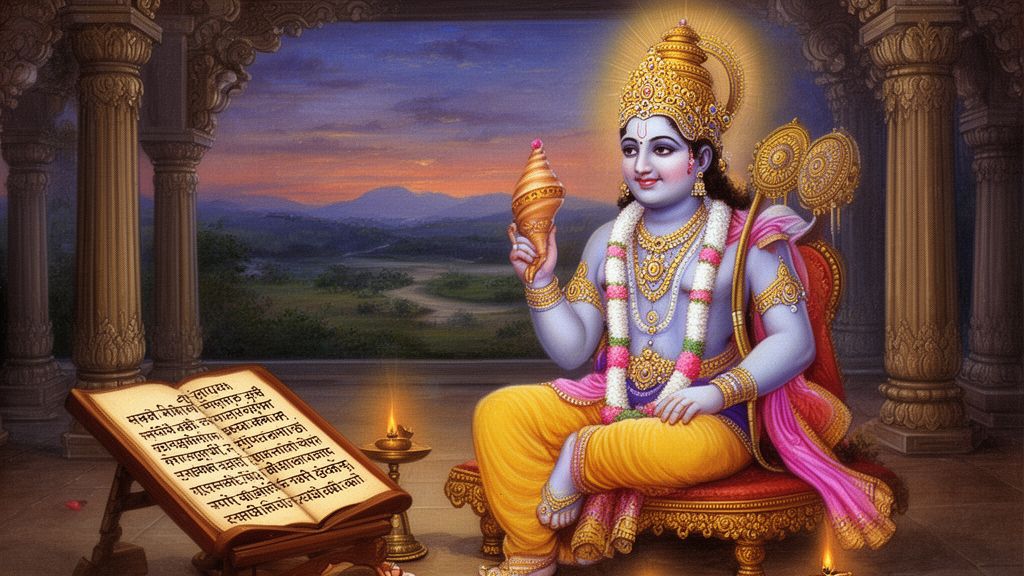
This post covers what the Vishnu Sahasranama is, how Marathi editions present it, what the sources say about its origin and benefits, how readers commonly recite it, and which related Vishnu texts on HindusGod.com may help you explore further. Religious claims are separated into the text itself, traditional belief, and scholarly or editorial context.
Quick answer: what people mean by Vishnu Shastra in Marathi

When Marathi readers search this phrase, they are most often looking for the Marathi-script lyrics, transliteration, meaning, or PDF of the Vishnu Sahasranama. The Marathi pages reviewed present the stotra in Devanagari, describe it as a hymn of 1,000 names, and attribute its setting to the Mahabharata’s Anushasana Parva, where Bhishma teaches Yudhishthira.
Three points help readers avoid confusion:
- The text: The Vishnu Sahasranama is a stotra of Vishnu’s names, opening with a verse beginning “विश्वं विष्णुर्वषट्कारो” (Viśvaṃ Viṣṇur Vaṣaṭkāro), which appears in the Marathi editions reviewed.
- The term “shastra”: Many websites use “shastra” loosely for sacred texts. For this hymn, “stotra” or “sahasranama” is the more precise term.
- The Marathi edition: Marathi readers should compare editions, because spelling, verse numbering, and transliteration vary between websites.
What the Vishnu Sahasranama is
The Vishnu Sahasranama is presented across the reviewed sources as a sacred hymn that lists 1,000 names of Lord Vishnu, the preserver in the Hindu tradition. Vaishnava devotion treats it as one of its most important stotras. One Marathi source describes it as a principal stotra of the Vaishnava path and states that the names are arranged in verses, with the text commonly described as containing 107 shlokas.
The verse count should be read with care. The Dharmsutra Marathi page gives 107 shlokas, while other pages divide the text into numbered verses that can differ by edition. Readers who need a fixed verse count for study or citation should compare a critical or scholarly edition, not only devotional websites.
Its setting in the Mahabharata
Multiple sources connect the hymn to the Mahabharata’s Anushasana Parva. In the framework described, Bhishma, lying on the battlefield after the great war, teaches Yudhishthira about dharma and the highest forms of worship. The Bhaktinidhi Marathi page states that Bhishma explains chanting these names as one of the highest forms of worship. The Dharmsutra page gives a specific location, Anushasana Parva 135.124, for a claim that regular recitation brings the three goals of dharma, artha, and kama. That citation should be checked against a scholarly Mahabharata edition before publication, because this article has not independently verified the verse location.
Why the Mahabharata setting matters
Knowing the Mahabharata setting helps readers understand the hymn as part of a larger teaching narrative. The question-and-answer form in the opening verses presents Yudhishthira asking which single deity, which single refuge, and which practice a person should follow. The answer leads to the thousand names. Readers who want the narrative context may find the related HindusGod.com post on Vishnu Sahasranama Shastra useful as a companion page (URL to confirm before publication, as it is currently a draft).
Opening verses readers often see in Marathi editions
Marathi editions often begin with a short prefatory verse before the main text. Several pages reviewed include this verse, which begins “शुक्लांबरधरं विष्णुं शशिवर्णं चतुर्भुजम्” and describes Vishnu in meditative form. Its purpose is usually described as a meditation before recitation, and some editions attach it as a preface rather than as part of the 1,000-name structure.
The main hymn then opens with the verse beginning “विश्वं विष्णुर्वषट्कारो भूतभव्यभवत्प्रभुः”, which is the verse most people recognize as the start of the 1,000 names. In the Marathi pages reviewed, the first verse lists names such as Vishvam, Vishnu, Vashatkara, and Bhutabhavya-bhavat-prabhu. A reader can use an edition that prints the Devanagari with a meaning gloss to understand these terms more clearly.
Readers should compare the opening verse across two or three Marathi editions before reciting, because small differences in spelling, anusvara, and sandhi appear between websites.
Spelling and transliteration differences in Marathi editions
The Marathi editions reviewed show real variation in spelling. For example, one page prints सहिष्नुर् in verse 16, while another prints सहिष्णुर् in the same place. Similar differences appear in the spelling of names such as अतींद्र and अतीन्द्र, and in the use of the avagraha sign (ऽ). These differences are normal in printed and online editions, but they matter for accurate recitation and for quoting the text.
For that reason, this article does not present one spelling as the only correct form. When quoting or teaching, choose one edition, keep its spelling consistent, and state the source. This is the same approach used in serious editorial work on scripture.
Common transliteration variations
- Vishnu / Vishnu: Some sites write the name with a long vowel or with the Marathi spelling विष्णू, while others use विष्णु.
- Sahasranama / Sahasranam / Sahasranamam: The word is spelled several ways in English. Each form refers to the same thousand-name hymn.
- Stotra / Stotram: Both forms are common and refer to the same type of devotional hymn.
How the 1,000 names are organized
The names are arranged in verses, and each verse usually contains several names. The sources reviewed show that many names describe Vishnu’s cosmic role, such as creator, sustainer, protector, and lord of the worlds. Other names describe qualities like truth, compassion, power, and purity. Some names are linked to stories or traditions associated with particular forms of Vishnu.
A practical way to study the list is to group names by theme rather than trying to memorize all 1,000 at once. Readers can start with the first few verses, where the opening names describe Vishnu as the all-pervading lord and the source of all beings. The sources reviewed describe the hymn’s emphasis on creation, preservation, and the wider cosmos, but the exact meaning of individual names depends on commentary, and commentators differ.
Using commentary responsibly
Commentaries on the Vishnu Sahasranama, including traditional Vaishnava commentaries, interpret the names in different ways. A name may be explained as a description of Vishnu’s nature, a reference to a particular form, or a philosophical concept. A devotional website may give a short meaning for each name, but readers should treat those glosses as one interpretation, not as the only possible meaning.
Who recites the Vishnu Sahasranama
The hymn is especially associated with Vaishnava devotion, but the sources reviewed also describe it as widely revered among Hindus more broadly. This is a useful example of how a text can be important in one tradition and still known across many communities. Some families recite it daily, some recite it on Ekadashi or other special days, and some use it during festivals or prayer gatherings. These practices vary, and no single schedule is universal.
The Bhaktinidhi Marathi page presents recitation as a form of prayer, meditation, and devotion. It also says devotees believe that recitation brings mental tranquility, protection, good fortune, and spiritual growth. These are beliefs described by the source and by devotees, not guaranteed outcomes that can be verified by study of the text. A responsible article should say that clearly, and readers should not treat recitation as a substitute for medical, legal, or financial advice.
Belief, text, tradition, and scholarship
Several kinds of statements appear around the Vishnu Sahasranama, and they should not be mixed together:
- What the text contains: The names, verse structure, and opening verses are features of the hymn itself, as shown in the Marathi editions reviewed.
- What the tradition teaches: Statements such as recitation being the highest form of worship, or leading to liberation, are teachings found in devotional and Vaishnava traditions and in the narrative framing of the Mahabharata passage.
- What devotees believe: Claims about peace, protection, prosperity, or good fortune are beliefs. They are not measurable outcomes.
- What scholarship says: Questions such as the hymn’s date of composition, its textual history, and how its names developed are areas for academic study. The sources reviewed do not provide enough evidence to settle these questions, so this article does not state a date.
Readers who want to explore these questions further should consult critical editions of the Mahabharata, academic studies of Vishnu devotion, and commentaries from recognized Vaishnava traditions.
A practical reading guide for Marathi readers
The following steps describe one common approach. They are tradition-specific and optional. Some families and sampradayas follow different procedures, and some readers simply read the text for study.
- Choose a trusted edition. Pick a Marathi edition that prints the Devanagari text clearly and identify its source. Compare it with one other edition if possible.
- Read the opening verses first. Understand the short introduction, the question from Yudhishthira, and the purpose of the hymn before attempting the full recitation.
- Learn the pronunciation slowly. Practice a few verses at a time. Many readers use an audio recording of a qualified reciter to check pronunciation, but the recording should be from a source you trust.
- Use the meaning as a study aid. A Marathi or English gloss can help you understand names without replacing the Sanskrit or Marathi text.
- Keep a steady routine. Many devotees choose a regular time, such as morning prayer, and they recite as much as they can with attention rather than rushing through the text.
Common mistakes to avoid
- Assuming every website has the same verse numbering or spelling.
- Treating a short meaning gloss as the only possible interpretation of a name.
- Expecting a specific material result from recitation. The sources describe belief and tradition, not measurable guarantees.
- Mixing the prefatory meditation verse with the main 1,000-name structure without noting the difference.
Related Vishnu texts and HindusGod.com pages
Readers searching for Vishnu texts in Marathi may also want to explore related topics. The pages below are current WordPress drafts in the content plan. They should be treated as future destinations until the owner confirms they are published, and their live status should be checked before publication.
- Vishnu Names in Marathi (URL to confirm before publication) can help readers compare names of Vishnu across Marathi sources.
- Vishnu Puran Marathi (URL to confirm before publication) covers a related Vishnu scripture in Marathi, where readers can see how a Purana differs from a stotra.
- Vishnu Puran Shastra (URL to confirm before publication) offers a companion discussion of Puranic texts.
- Vishnu (URL to confirm before publication) is the broader deity overview page for readers new to Lord Vishnu.
- Bhagwan Vishnu Shastra (URL to confirm before publication) and Maha Vishnu Shastra (URL to confirm before publication) may help readers compare related devotional texts that use the word shastra in different ways.
- Vishnu Shastra Shastra (URL to confirm before publication) is a related Vishnu shastra topic that may overlap with this search intent and should be reviewed for cannibalization before publication.
- Vishnu Shastra Gujarati, Vishnu Shastra Hindi, Vishnu Shastra in Telugu, Vishnu Shastra Kannada, and Vishnu Shastra Tamil (all URLs to confirm before publication) are language-specific pages that readers may use for comparison.
- Shiv Swarodaya Shastra in Marathi (URL to confirm before publication) may interest readers exploring other Marathi-language devotional texts.
Internal links to these drafts should be rechecked after the owner publishes or confirms each target. Links to unpublished drafts should not be treated as live links.
Frequently asked questions
Is Vishnu Shastra in Marathi the same as Vishnu Sahasranama?
Most Marathi pages using this phrase are describing the Vishnu Sahasranama, the hymn of 1,000 names of Lord Vishnu. Some websites use the word shastra loosely. Check the title and first verse of any edition before assuming it is the same text.
Where does the Vishnu Sahasranama appear?
The reviewed sources place it in the Anushasana Parva of the Mahabharata, where Bhishma explains it to Yudhishthira. Readers who need a precise citation should check a scholarly Mahabharata edition.
Why do Marathi editions differ?
Editions can differ in spelling, anusvara, sandhi, verse numbering, and whether a prefatory meditation verse is included. Compare two editions and state the one you use.
Does reciting the stotra guarantee a particular result?
No. The sources describe benefits as beliefs held by devotees. Recitation is a devotional and spiritual practice, not a guarantee of material, medical, or financial outcomes.
Sources and further reading
- Vishnu Sahasranama Stotra Marathi page: used to support the description of the Marathi text, the Mahabharata Anushasana Parva setting, and the opening verses shown in that edition.
- Vishnu Sahasranamam Marathi Lyrics and PDF: used to support the description of the stotra as a hymn of Vishnu’s names and the presence of the prefatory meditation verse in Marathi editions.
- Vishnu Sahasranam in Marathi: used to support the description of the Bhishma and Yudhishthira setting, the 1,000 names, and the devotional beliefs about recitation, which are presented here as beliefs.
- Sree Vishnu Sahasra Nama Stotram Marathi Lyrics: used to support the presence of the opening verses and the Marathi edition structure.
- Vishnu Sahasranamam in Marathi, Dharmsutra: used to support the description of the hymn as a Vaishnava stotra, the 107-shloka count stated by that page, and the Anushasana Parva 135.124 reference, which still requires verification against a scholarly edition.
Further reading should include a critical edition of the Mahabharata and academic work on Vishnu devotion. These were not verified in the research available for this draft, so they are not cited here.
Summary
The phrase vishnu shastra marathi most often refers to the Marathi text of the Vishnu Sahasranama, a stotra of 1,000 names of Lord Vishnu set within the Mahabharata’s Anushasana Parva. To use it well, compare Marathi editions, distinguish the hymn’s text from devotional belief, and treat recitation as a tradition-specific practice rather than a guaranteed result. Readers who want more background can start with the Vishnu deity overview and the related Vishnu texts linked above once those pages are confirmed as live.