The Vedas and the Upanishads are central texts of Hindu scripture, but they are different kinds of literature. The Vedas are the older collections, and the Upanishads are the concluding portions attached to them. Readers looking for the Vedas and Upanishads in Telugu can find Telugu-script texts and Telugu-language reading material for many Upanishads, though the available editions, translations and commentaries differ from site to site. This guide explains the structure of the Vedas, the place of the Upanishads within that structure, why the number of Upanishads varies by source, and how to read Telugu editions with care.
Short answer: how the Vedas and Upanishads are related

The Vedas are traditionally divided into four collections: Rig Veda, Yajur Veda, Sama Veda and Atharva Veda. According to the Telugu-language HinduTone article on the Vedas and Upanishads, these four are the most authoritative texts of Sanatana Dharma and deal with spirituality, dharma, sacrifice and prayer (HinduTone, Telugu). The Upanishads are described in the same source as the final parts of the Vedas, focused on philosophical and metaphysical teaching.
The Telugu Wikipedia entry on the Upanishads makes the same basic point: the Upanishads are the last portion of the Vedas, and each Veda has several parts, including the Brahmanas, which explain mantras and ritual procedure, and the Aranyakas, which explain the inner meaning of rites (Telugu Wikipedia: Upanishad). Note that this Wikipedia page was not fetched in full during preparation of this draft, so its claims are treated here as a secondary summary to be checked against the page itself.
In short, the Vedas are the foundational collections of hymns and ritual material, and the Upanishads are the texts that tradition calls the Vedanta, or the end of the Vedas. Many scholars and practitioners also use the word Vedanta more broadly for the philosophical schools that developed from the Upanishads, so the term can mean either the Upanishads themselves or later systems of interpretation.
What the Vedas are
The four Vedic collections
In the traditional listing used by the HinduTone article, the four Vedas are the Rig Veda, Yajur Veda, Sama Veda and Atharva Veda. The Telugu HinduTone page presents these as the basis of Hindu tradition, and states that Vedic texts discuss spirituality, dharma, yajnas (sacrificial rites) and prayer. These descriptions are useful as an overview, but they are a devotional-educational summary rather than a critical edition or academic study.
Why the Vedas are called shruti
In much of the Hindu tradition, the Vedas are regarded as shruti, a term usually understood as "that which is heard" and taken to refer to revealed scripture. This is a belief held within the tradition. The sources reviewed here do not establish how the texts were composed or transmitted in historical terms, and this article does not treat the tradition’s view as a historical finding.
The parts of each Veda
Telugu Wikipedia describes the internal structure of each Veda as having several parts. Two of these are the Brahmanas and Aranyakas. The Brahmanas are described as prose texts that explain mantras from the Samhita (the metrical hymn collection) and the rules for their use in ritual. The Aranyakas are described as texts explaining the inner meanings of various rites (Telugu Wikipedia: Upanishad). This structure helps explain why Upanishads are placed near the end of each Veda’s body of texts.
What the Upanishads are
The meaning of the word
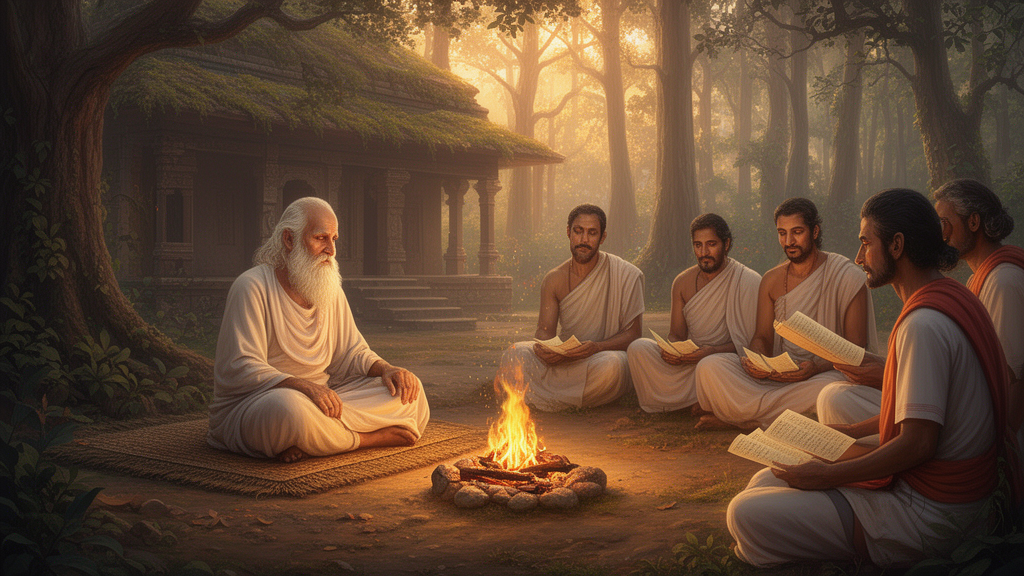
The Vedapath Telugu page on the Upanishads states that the word Upanishad is commonly explained as "sitting near", referring to students sitting close to a teacher to receive instruction (Vedapath: Upanishads in Telugu). This is a traditional explanation of the word’s sense. Scholars may discuss other derivations, but for a reader the core idea is straightforward: the Upanishads present teaching in the form of dialogues and instruction.
Main themes
According to the same Vedapath page, the Upanishads explore the nature of the self (Atman), ultimate reality (Brahman), the relationship between the individual and the cosmos, and the path to liberation (moksha). The page describes them as the philosophical culmination of Vedic thought. These themes are a useful orientation, but readers should note that each Upanishad develops them differently, and some texts emphasize yoga, devotion or ritual symbolism more than others.
Why the Upanishads are called Vedanta
The Vedapath page explains the term Vedanta as "the end of the Vedas", and the HinduTone article notes that Upanishads are called Vedanta because they teach the purport of the Vedas. Both sources present this as a traditional self-understanding. Later schools of Vedanta, which developed their own philosophical systems over time, are a separate topic and should not be confused with the Upanishadic texts themselves.
How the Upanishads connect to the Vedas
Upanishads attached to particular Vedas
Many Upanishads are linked to a specific Veda or to a Shakha (recension or school). The Vedapath page lists several examples. Aitareya Upanishad is described as connected with the Rig Veda and as contained within the Aitareya Aranyaka. Adhyatma Upanishad is listed under the Yajur Veda. Adhwayataraka Upanishad is listed under the Atharva Veda. These attributions come from the Vedapath catalogue and should be checked against a critical edition if you need precise Vedic school details.
Principal and sectarian Upanishads
The Vedapath page groups Upanishads into categories. Mukhya, or principal, Upanishads are described as those recognized by Adi Shankaracharya. Other categories include Yoga, Shaiva, Sannyasa, Shakta and Vaishnava Upanishads. The page describes these as sectarian or thematic groupings. This matters because a reader who expects every Upanishad to teach Advaita Vedanta in the same way will find variety instead. The texts reflect different doctrinal and devotional communities.
A simple reading order
- Begin with the Vedic background in The Vedas (WordPress draft, may not be public yet).
- Read an overview of the Upanishads in Upanishads (WordPress draft, may not be public yet).
- Compare the broader relationship in The Vedas and the Upanishads (WordPress draft, may not be public yet).
Why the number of Upanishads varies
The 108 list
The Sanskrit Documents Telugu-script index includes a list headed as the 108 Upanishads, identified as the Muktika Upanishad list (Sanskrit Documents in Telugu Script). This is a traditional enumeration that appears in many Upanishad collections and in devotional and educational resources.
The 60 texts on one platform
The Vedapath Telugu page says it offers 60 Upanishads for reading, listening and questions, with Sanskrit, transliteration, translations and enrichment in 31 languages. This number refers to the texts that platform has chosen to present. It is not a universal count of all Upanishads, and the platform’s categories should be read as its own organization.
What this means for readers
When an article, website or book says "108 Upanishads", "10 principal Upanishads" or "60 Upanishads", it is usually giving a count based on a particular list, tradition or purpose. Readers should check which list is being used. Some common examples on HindusGod.com are covered in 108 Upanishads in Telugu and 10 Upanishads in Telugu (both WordPress drafts, may not be public yet), while Ten Upanishads of Four Vedas (WordPress draft, may not be public yet) frames the subject around a different selection.
Telugu editions and where to read them
Telugu-script texts
Sanskrit Documents hosts a Telugu-script index of Sanskrit texts. Its index includes Upanishad titles such as Isha, Aitareya, Kaivalya, Kena and Katha, with notes indicating some texts have one or more translations. The index also lists Isha Upanishad with commentaries by Shankaracharya and Raghavendraswami. The page is a catalogue of files, so readers should open the individual files to confirm the edition, transliteration, script and translation before relying on them.
Telugu reading pages
Stotra Nidhi provides a Telugu-language Upanishads section with titles in Telugu script, including Isha, Aitareya, Katha, Kumara, Kena, Kaivalya, Ganapatyatharvashirsha, Ganeshatapini, Jabala, Chakshusha, Narayana, Panchabrahma, Bala and Bilva, among others. Its menu allows reading in several languages, including Telugu, Kannada, Tamil, Devanagari, English and IAST. The page is useful for finding Telugu titles, but the text is presented as a devotional reading resource, and the source for each text should be checked.
Multilingual study platforms
Vedapath presents Upanishads with Sanskrit, transliteration and translation, and it offers a Telugu interface and Telugu headings. Its descriptions of each text, such as the summaries of Adhwayataraka and Adhyatma Upanishads, are written in Telugu. For study, compare the translation with the Sanskrit and with a named commentary whenever possible.
How to judge an edition
- Identify the translator or editor. If the edition does not name them, treat the text as unverified for scholarly use.
- Check the Sanskrit text and transliteration. Telugu script can present Sanskrit words in different spellings, so keep the transliteration consistent when you compare sources.
- Separate commentary from scripture. A commentary by Shankaracharya or Raghavendraswami is an interpretation by a named author, not the bare text.
- Note the purpose. A devotional reading edition, a study guide and a critical edition serve different needs.
Example texts and what the sources say
Aitareya Upanishad
The Vedapath page links Aitareya Upanishad to the Rig Veda and to the Aitareya Aranyaka. It describes a teaching sequence in which the Self is first, followed by worlds and protective powers, and then consciousness enters the human body. The page also says the Upanishad distinguishes the senses, prana, mind and prajna (conscious intellect), and it cites the mahavakya "prajnanam brahma", which the Telugu text renders as a statement that Brahman is consciousness that illumines experience. In the Telugu wording on the Vedapath page, this is presented as the Upanishad’s teaching. Readers should check the Sanskrit and a named translation before quoting the phrase directly.
Adhyatma Upanishad
The Vedapath page describes Adhyatma Upanishad as a short Vedantic text linked to the Yajur Veda. It emphasizes inward self-knowledge over external ritual. The summary mentions the teaching of neti neti ("not this, not this"), the analysis of five sheaths (pancha kosha), and the analysis of waking, dream and deep-sleep states to reveal the witnessing consciousness. The same summary describes the reinterpretation of external sacrifice as an inner offering of ego, desire and the sense of agency. These are interpretive summaries from the source and should be presented as such, not as a verbatim translation.
Adhwayataraka Upanishad
The Vedapath page lists Adhwayataraka Upanishad under the Atharva Veda. It describes a short yoga text in which yoga includes body and mind practices but is oriented toward tarakam, a liberating knowledge. The summary states that breath-mind connection, control of the senses, meditation and absorption are helpful aids, while the highest goal is realization of the Self. For a general reader, this shows that yoga-related Upanishads often frame practice as a means toward self-knowledge rather than as an end in itself.
Isha Upanishad
Isha Upanishad appears in the Telugu-script index of Sanskrit Documents with commentaries by Shankaracharya and Raghavendraswami, and in the Telugu reading list at Stotra Nidhi. This makes it a practical starting point for comparing commentaries, but the sources reviewed here do not provide a verified summary of its verses. Use a named critical or annotated edition before making claims about specific verses.
Other titles in the Telugu index
Sanskrit Documents also lists Kena, Katha and Kaivalya Upanishads among the Telugu-script titles, with note of translations for some. Stotra Nidhi includes these titles as well. For these texts, the sources reviewed here establish availability but do not provide verified summaries, so this article does not describe their contents in detail. Readers can explore them through the linked editions and through HindusGod.com content such as Telugu Upanishads (WordPress draft, may not be public yet).
Telugu literature and the transmission of Vedantic ideas
The claim made by the HinduTone article
The HinduTone article states that Telugu literature developed under the influence of the Vedas and Upanishads, and it names poets Pothana, Tallapaka Annamayya, Bhadrachala Ramadasu and Tikkana as conveying the essence of these texts in Telugu. It says Pothana rendered the Srimad Bhagavatam into Telugu, Annamayya composed devotional kirtanas consistent with Vedic devotional literature, and Tikkana’s Mahabharata translation conveyed Vedantic ideas. This is a devotional-educational article, so these are its own characterizations. Readers should consult literary histories and critical editions of the poets for detailed scholarship.
Distinguishing literature from scripture
A Telugu devotional poem, a bhakti song and a translation of an Upanishad are different kinds of text. Even when a poet draws on Vedantic ideas, the poem is an author’s work in its own right. Keeping this distinction clear helps readers avoid treating a later literary work as a direct report of Upanishadic teaching.
Belief, tradition and scholarship
The Vedas and Upanishads are approached in several ways, and each approach answers different questions. Devotional belief treats them as sacred revelation. Tradition describes how texts are recited, taught and interpreted within communities and schools. Historical study asks when texts were composed, how they were transmitted and how they relate to other materials. Academic interpretation compares manuscripts, languages and doctrines.
The sources used for this draft are mostly educational, devotional or catalogue pages. They are useful for finding editions and for summarizing traditional presentations, but they do not establish dates of composition, manuscript histories or scholarly consensus on contested questions. For those topics, readers should consult academic editions and reputable reference works before drawing conclusions. This article therefore avoids dates and historical claims that the reviewed sources do not support.
How to study the Vedas and Upanishads in Telugu
- Start with orientation. Read a short overview of the four Vedas and the meaning of Upanishad, then move to individual texts.
- Choose one Upanishad at a time. Begin with a text that has a clear Telugu edition, such as Aitareya or Isha, and note the Veda or school it belongs to.
- Read the Sanskrit alongside the Telugu. Use transliteration to check terms such as Atman, Brahman and moksha, and keep a glossary of how each translator renders them.
- Compare at least two editions. If translations disagree, record the difference rather than choosing the most convenient version.
- Read commentary separately. Mark where a commentator, such as Shankaracharya, offers an interpretation.
- Keep devotional and scholarly questions apart. Ask whether a claim is from the text, from a tradition, from a modern teacher or from academic research.
Suggested reading path on HindusGod.com
For readers who want to move from general orientation to specific texts, the following WordPress drafts may become useful links once the owner publishes them. Their current status is recorded in the evidence notes.
- Upanishads in Telugu with Meaning (WordPress draft, may not be public yet) for a meaning-focused introduction.
- Vedas and Upanishads in English (WordPress draft, may not be public yet) for an English companion to this Telugu topic.
- Vedas Brahmanas and Upanishads (WordPress draft, may not be public yet) for the structure of Vedic literature.
- Hinduism Vedas and Upanishads (WordPress draft, may not be public yet) for broader context on Hindu scripture.
- Origin of Vedas and Upanishads (WordPress draft, may not be public yet) for questions of origin, which should be read with the caution noted above.
- Different Vedas and Upanishads (WordPress draft, may not be public yet) for variation across traditions.
- Hindu Vedas and Upanishads (WordPress draft, may not be public yet) for a general Hindu scripture overview.
- Puranas Vedas and Upanishads (WordPress draft, may not be public yet) for comparison with Puranic literature.
- Roopa Pai Vedas and Upanishads (WordPress draft, may not be public yet) for a related editorial angle.
- Vedas Upanishads Bhagavad Gita (WordPress draft, may not be public yet) for how Upanishadic ideas connect to the Gita.
- 112 Upanishads is not used here; use 112 Upanishads (WordPress draft, may not be public yet) only for readers comparing enumerations.
- 12 Upanishads (WordPress draft, may not be public yet) for another numbered selection.
- Telugu Upanishads (WordPress draft, may not be public yet) for Telugu-language study.
- Upanishads Y Vedas (WordPress draft, may not be public yet) for Spanish-language searchers, if the owner keeps that angle.
Frequently asked questions
Are the Upanishads part of the Vedas?
Yes, in the traditional sense. Telugu Wikipedia and the Vedapath page both describe the Upanishads as the concluding portions of the Vedas, known as Vedanta. Historians may discuss how these texts were composed and grouped, but the traditional position is that they belong to the Vedic corpus.
How many Upanishads are there?
The answer depends on the list. Sanskrit Documents includes a 108-Upanishad list identified as the Muktika list, while Vedapath presents 60 texts on its platform. Readers should check whether a count refers to a traditional list, a principal set or a particular website’s collection.
Which Upanishad should a beginner read first?
There is no single answer. A reader may begin with a short text that has a clear Telugu edition and a named translator, such as the Isha Upanishad, which is listed with commentaries in Telugu-script resources. Whichever text you choose, compare more than one edition and note which parts are translation and which are commentary.
Summary
The Vedas are the four traditional collections of Hindu scripture, and the Upanishads are the philosophical texts placed at the end of the Vedic corpus. Their Telugu editions and reading resources are widely available, but counts, groupings and translations vary. For a reliable study, identify the Veda or school of each text, separate scripture from commentary and literature, and verify editions before quoting them. Start with a short text, compare translations, and keep devotional belief, traditional teaching and scholarly research distinct.
Sources and Further Reading
- Upanishad, Telugu Wikipedia: used for the description of Upanishads as the final part of the Vedas and of the Brahmana and Aranyaka structure. Not fully fetched during preparation.
- Upanishads in Telugu, Vedapath: used for the meaning of Upanishad, main themes, categories, Veda attributions and descriptions of Aitareya, Adhyatma and Adhwayataraka Upanishads.
- Sanskrit Documents in Telugu Script: used for the Telugu-script catalogue, the 108 Upanishad list and commentary notes for Isha Upanishad.
- Upanishads in Telugu, Stotra Nidhi: used for the Telugu-language list of Upanishad titles.
- Vedas, Upanishads and Telugu Literature, HinduTone: used for the four Vedas, the general description of Upanishads as Vedanta, and the account of Telugu poets. This is a devotional-educational source and its claims about literature should be checked against scholarly work.