The Vedas and the Upanishads are the foundational scriptures of Hinduism, but they are not the same kind of text, and English readers often meet them in very different forms. In short, the Vedas are the oldest collections of hymns, chants, and ritual formulas, while the Upanishads are philosophical texts that appear at the end of the Vedic literature and discuss the self (Atman), ultimate reality (Brahman), and liberation. Many English editions present both together, and the most useful starting point is to read them as related but distinct layers of one tradition.
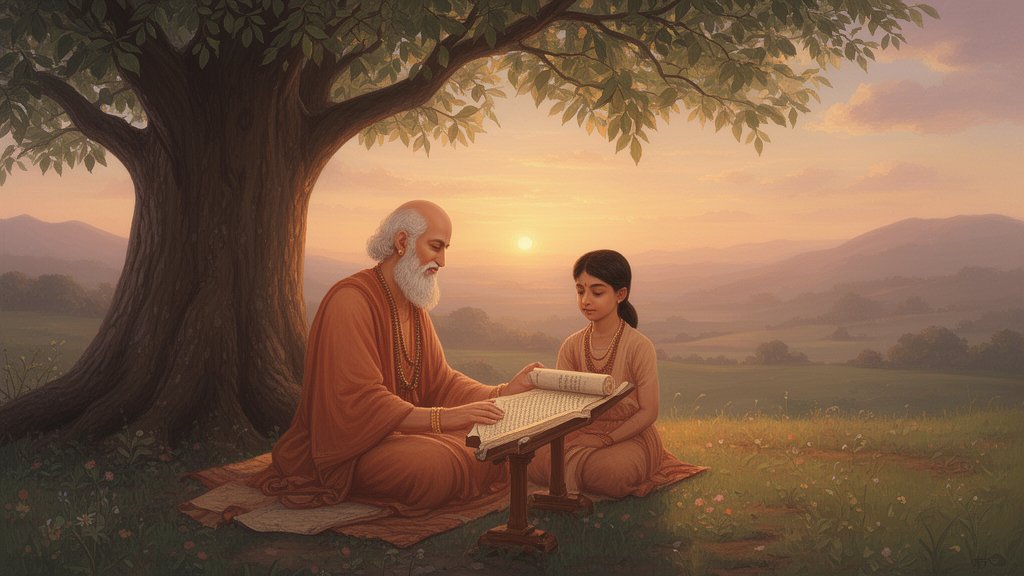
This guide explains what each collection contains, how the Upanishads are linked to the Vedas, how to judge English translations, and which editions are freely available. It separates what the texts say from later commentary, devotional interpretation, and modern scholarship, since readers encounter these categories blended together online.
What the Vedas are

The Vedas are traditionally regarded as shruti, a term usually translated as “that which is heard,” meaning revealed or authoritative texts within Hindu tradition. Wikipedia’s entry on the Vedas describes them as among the oldest scriptures of Hinduism, composed in Vedic Sanskrit, and notes a commonly cited chronology of roughly c. 1500–1200 BCE for the Rigveda and c. 1200–900 BCE for the Yajurveda, Samaveda, and Atharvaveda. These are scholarly estimates, not fixed dates, and scholars continue to debate them.[1]
There are four principal Vedas:
- Rigveda, a collection of hymns addressed to deities such as Agni, Indra, and Varuna.
- Samaveda, a collection arranged largely for melodic chanting.
- Yajurveda, a body of formulas used in sacrificial ritual, existing in several recensions.
- Atharvaveda, a collection that includes charms, healing and domestic formulas, and philosophical hymns.
Each Veda is organized into a samhita, or hymn and mantra collection. Around these samhitas developed Brahmanas, which explain ritual, and Aranyakas, texts often associated with forest contemplation. The Upanishads are generally placed at the end of this layered structure. The Wikipedia Vedas article lists the Brahmanas and the Aranyakas and Upanishads as embedded Vedic texts within the Vedic corpus.[2]
Why the Vedas are often called the “oldest” scriptures
The Vedas are called the oldest scriptures because the Rigvedic hymns are among the earliest surviving texts in the Indo-Aryan branch of Indo-European languages. Readers should note that this is a claim about linguistic and textual antiquity supported by scholarship, not a statement about divine origin. Traditional belief holds that the Vedas are eternal and unauthored, while historians and philologists discuss their composition, transmission, and authorship in human terms.[2]
What the Upanishads are
The word Upanishad is commonly explained as “sitting near,” referring to a student sitting close to a teacher to receive instruction. Vedapath, an online English reading platform, describes the Upanishads as the concluding portions of the Vedas, known as Vedanta, meaning “the end of the Vedas” or the culmination of Vedic thought.[4] Wikipedia’s Upanishads article similarly describes them as ancient Sanskrit religious and philosophical texts within Hinduism.[1]
Upanishads are typically written as dialogues or teaching narratives. In many of them, a teacher answers a student’s question about what the world is made of, what the self is, or how death and rebirth should be understood. The Katha Upanishad, for example, is known for a dialogue between the young Nachiketa and Yama, the god of death, a scene Wikipedia’s Upanishads article uses in its own illustration of the text.[1]
Principal and later Upanishads
The Upanishads are not a single closed book. The number depends on how the collection is defined. Vedapath presents 60 Upanishads with Sanskrit, transliteration, and translations; VedaSeek describes a collection of 108-plus texts and references the canonical Muktika list; and the Internet Archive lists a 112 Upanishads volume set with Sanskrit text and English translation.[4][5][6] These differences reflect how editors define the category, not a disagreement about one fixed number.
Wikipedia’s article classifies the Upanishads in several ways, including by the Vedic branch with which they are associated and by traditional lists such as the major and minor Upanishads. Its classification sections include Rig vedic, Sama vedic, and Yajur vedic groupings, with examples such as the Aitareya and Kaushitaki (Rig), the Chandogya and Kena (Sama), and the Brihadaranyaka, Isha, Taittiriya, Katha, Shvetashvatara, and Maitri (Yajur).[1]
Vedapath also distinguishes between the Mukhya (principal) Upanishads, which it says were recognized by Adi Shankaracharya, and later sectarian or specialized texts associated with yoga, Shaiva, Vaishnava, and Shakta traditions.[4] This is an important point for readers: the category “Upanishad” includes texts that differ in age, theme, and sectarian orientation.
How the Vedas and Upanishads relate
The simplest way to understand the relationship is that the Vedas contain several layers, and the Upanishads belong to the final layer. Earlier parts of the Vedic corpus focus heavily on hymns and ritual procedure. The Upanishads shift the emphasis toward inquiry: what remains constant beneath changing experience, and what is the relationship between the individual self and the ultimate reality.
This does not mean the Upanishads replaced the Vedas in practice. Many Hindu communities continue to recite Vedic hymns in ritual contexts, and many traditions treat the Upanishads as authoritative for philosophical understanding. The relationship is best described as continuity with development, not simple succession.
The Vedanta connection
The term Vedanta is used in several senses. In its earliest meaning, it refers to the Upanishads as the “end” of the Vedas. Later, Vedanta also names philosophical schools that interpret the Upanishads, the Brahma Sutra, and the Bhagavad Gita. Wikipedia’s Upanishads article covers several schools of Vedanta, including Advaita, Bhedabheda, Vishishtadvaita, and Dvaita, which read the Upanishadic teachings in different ways.[1] Readers should therefore treat school-based readings as interpretations, not as the plain meaning of the texts.
Core ideas readers meet in the Upanishads
Several themes recur across many Upanishads, though not every text emphasizes them equally.
Atman and Brahman
Atman is usually translated as “self,” and Brahman as ultimate reality. A central idea in many Upanishads is that these two are, at a deep level, not separate. Vedapath’s description of the Adhyatma Upanishad, a text it links to the Yajurveda, states that its central claim is the non-difference of Atman and Brahman.[4] That is how one Upanishad is summarized on one platform. Other schools, including dualist Vedanta, read the relationship differently.
Maya and the limits of perception
Wikipedia’s Upanishads article includes sections on reality and maya, a concept that is interpreted differently across traditions.[1] In popular usage, maya is sometimes reduced to “illusion.” In philosophical contexts, its meaning is debated, and careful readers should consult a specialist translation or commentary before drawing firm conclusions.
Knowledge, discipline, and liberation
Many Upanishads present knowledge as the path to liberation (moksha), with meditation, self-restraint, and teacher-student instruction as supports. Vedapath’s description of the Adhwayataraka Upanishad, for instance, frames yogic practice as supporting a higher discernment rather than being an end in itself.[4] This emphasis explains why the Upanishads are read as philosophy as well as scripture.
English translations: what to check before you read
Most English readers rely on translations, and translations differ in age, method, and purpose. A nineteenth-century verse translation, a modern academic edition, and a devotional or interpretive version can all present the same Sanskrit very differently. Before choosing an edition, check the following:
- Translator and date. Older translations may use dated vocabulary or assumptions.
- Scope. Some editions translate a single Upanishad; others collect many. Hinduwebsite.com, for example, presents free English translations of the Four Vedas and a set of major Upanishads, including Griffith translations of several Vedic texts.[3]
- Sanskrit and transliteration. Editions that include the Sanskrit text and transliteration allow you to check technical terms.
- Commentary. Some editions include a translator’s notes or a commentary tradition. Keep these separate from the translated text when you cite it.
- Verse or chapter numbering. Numbering can differ between editions, so compare a passage against more than one source if you plan to cite it.
Free and accessible English resources
Several free or low-cost resources are useful, each with a different purpose:
- Hinduwebsite.com’s Vedas and Upanishads page offers free English translations and links to Griffith’s Vedic translations.[3]
- Vedapath presents Upanishads in English with Sanskrit, transliteration, and audio-style recitation features, and describes its collection as covering 60 texts.[4]
- VedaSeek offers chapter-by-chapter online reading with Sanskrit and English and a directory of the Muktika list.[5]
- The Internet Archive hosts a two-volume set titled 112 Upanishads with Sanskrit text, English translation, and an index of verses, which readers can download or browse.[6]
Because these platforms use different editions and counts, it is wise to note which edition you are reading. For academic work, use a scholarly translation with a stated source text and publication information.
Three ways to begin reading
Readers often ask where to start. The answer depends on purpose, and the following approach is one practical option rather than the only correct path.
If you want an overview
- Read a short introduction to the Vedic corpus, such as the Wikipedia articles cited here, to understand the layers from Samhita to Upanishad.
- Read one short Upanishad in a clear English translation, such as the Isha or Mandukya.
- Compare the same passage in two translations to see how interpretation shapes wording.
If you want philosophical depth
- Begin with a major Upanishad associated with discussion of Atman and Brahman, such as the Brihadaranyaka or Chandogya.
- Keep a notebook of recurring terms: Atman, Brahman, maya, moksha, and jnana.
- Read a school-based commentary only after you have formed your own understanding from the primary text.
If you want Vedic hymns
- Start with a Rigveda translation to see the hymn style, deity addresses, and ritual context.
- Compare the Samaveda and Yajurveda to understand how the same ritual world is expressed in chant and formula.
- Read the Atharvaveda last, since its contents are more varied and include practical and domestic material.
Belief, text, tradition, and scholarship
Readers benefit from separating four kinds of statements that appear in discussions of the Vedas and Upanishads:
- What a text says. A translated passage can be cited directly, with its text and translation identified.
- Traditional belief. Many Hindus regard the Vedas as eternal and revealed. This is a matter of faith and tradition.
- Community practice. Recitation, initiation, and study practices vary by region, school, and family. Vedic recitation traditions, for example, include distinct recensions and chanting styles.
- Historical and scholarly interpretation. Dates, authorship, transmission, and the meaning of terms are discussed by historians, philologists, and philosophers, who sometimes disagree.
When a source says the Upanishads teach a particular doctrine, ask whether it refers to the Upanishad itself, a later school, or a modern author’s reading. Good editions make this distinction clear.
Common questions about Vedas and Upanishads in English
Are the Upanishads part of the Vedas?
Yes, in the traditional sense. Vedapath describes the Upanishads as the concluding portions of the Vedas, known as Vedanta.[4] Wikipedia also places the Upanishads among the texts embedded within the Vedic corpus.[2] Scholars sometimes discuss them as a distinct genre because they differ sharply in style and purpose from hymns and ritual manuals.
Which Upanishads are most often read first?
There is no single agreed order, but several major Upanishads are commonly introduced early in study. Wikipedia’s classification lists the Brihadaranyaka, Chandogya, Isha, Katha, and Taittiriya among its examples of Upanishads grouped under the Vedic branches.[1] Choose according to your interest, and use a translation with clear notes.
Why do different websites give different Upanishad counts?
The count depends on which texts are included. Traditional lists such as the Muktika canon contain 108 Upanishads, while other editions include later or regional texts. Vedapath shows 60 texts, VedaSeek references 108-plus, and the Internet Archive lists 112 in a published set.[4][5][6]
Summary and next step
The Vedas are the oldest scriptural collections of Hinduism, made up of hymns, ritual formulas, and related commentary-like layers. The Upanishads are philosophical texts at the end of the Vedic corpus, exploring the self, ultimate reality, and liberation. English readers can study both through free and scholarly translations, but should check translator, edition, source text, and whether a claim comes from the text itself or from later interpretation.
A useful next step is to choose one Vedic hymn collection and one major Upanishad, read them in the same translation series if possible, and note where the texts describe ritual and where they describe inquiry. For a broader overview of individual pages on this site, see the related articles below.
Related HindusGod.com reading
The following HindusGod.com articles address related questions. They are currently WordPress drafts, so the links may not be public until those posts are published:
- About Upanishads in English covers introductory questions about the Upanishads and their English study.
- The Vedas and the Upanishads offers a broader comparison of the two collections.
- 108 Upanishads in English addresses the traditional Upanishad count and its variations.
- Different Vedas and Upanishads explores differences among Vedic and Upanishadic texts.
- Hindu Vedas and Upanishads provides a general introduction to these scriptures.
- Hindu Vedas in English discusses English-language Vedic study.
- Hinduism Vedas and Upanishads places these texts within Hindu belief and practice.
- Origin of Vedas and Upanishads addresses questions of origin, tradition, and scholarship.
- Puranas Vedas and Upanishads explains how the Puranas relate to the Vedic corpus.
- The Holy Vedas in English covers English editions of the Vedas.
- Vedas Brahmanas and Upanishads explains the ritual commentary layer between the samhitas and the Upanishads.
- The Vedas offers a deeper overview of the four Vedas.
- Upanishads provides further background on the Upanishadic literature.
Sources and further reading
- Upanishads, Wikipedia: overview of the Upanishads, classification, and Vedanta schools. Supports general descriptions and classification examples.
- Vedas, Wikipedia: overview of the four Vedas, dating estimates, and structure. Supports chronology and layered organization, with dates as scholarly estimates.
- Free Vedas and Upanishads Translations, Hinduwebsite.com: listing of free English translations. Supports availability of translations, not the accuracy of each rendering.
- Upanishads in English, Vedapath: platform description of the Upanishads and Mukhya classification. Supports the Vedanta description and listed counts.
- The 108 Upanishads, VedaSeek: online reading platform and Muktika list. Supports the count of listed texts on that platform.
- 112 Upanishads, Internet Archive: digitized two-volume set with Sanskrit and English. Supports the existence of this edition.
Note for editors: the Wikipedia pages were reviewed through their table of contents and opening sections in the research record; check the full articles and cited scholarly sources before publication. Vedapath, VedaSeek, and Internet Archive are reader platforms and should be checked against the specific edition before quoting.