The Telugu Upanishads are Telugu-language editions and translations of the Upanishads, the philosophical texts that conclude the Vedas. This guide explains what the Upanishads are, why different sources give different counts, which texts are considered principal, and how Telugu readers can choose a reliable edition. It also shows how to read the texts with care, separating what the scripture says from later commentary and devotional interpretation.
Quick answer: what are the Telugu Upanishads?

The phrase usually refers to Upanishads that are available in Telugu script, either as original Sanskrit texts with Telugu transliteration and meaning, or as Telugu translations and commentaries. Telugu online libraries and Telugu-language book sites list Upanishads in Telugu, and some present them alongside Sanskrit, transliteration, and translations in other languages. The Upanishads themselves are in Sanskrit. Telugu editions are therefore translations or presentations of the same textual tradition, and their quality depends on the translator, the Sanskrit text used, and whether a commentary is included.
The number of Upanishads depends on the list being used. One Telugu list on Stotra Nidhi presents a set of Upanishads in several languages, while a Telugu general-information site lists 108 Upanishads. A Telugu library platform describes a collection of 60 Upanishads with Sanskrit, transliteration, and translations. These counts are not contradictory in every respect; they reflect different collections, categories, and purposes.
What the Upanishads are
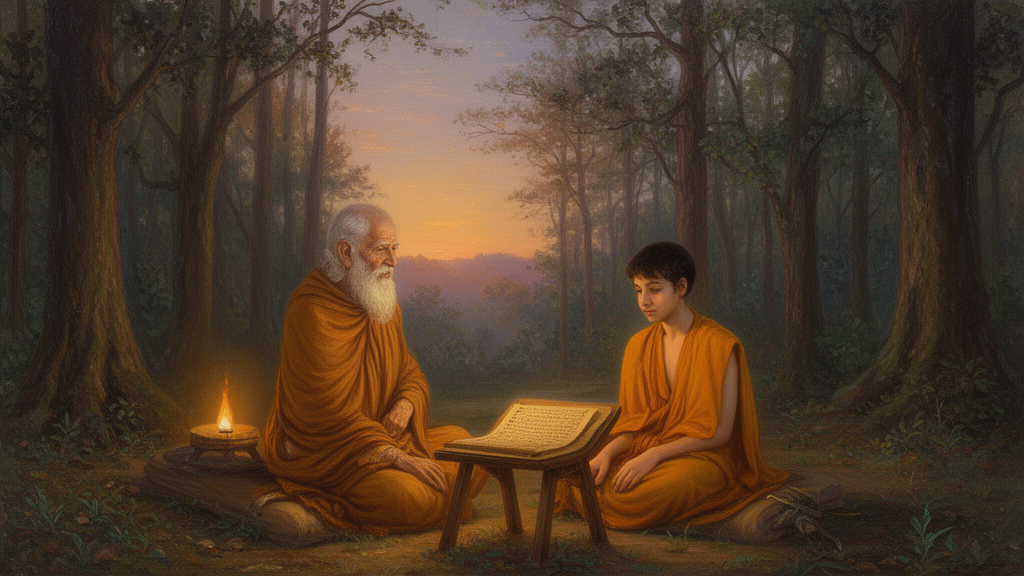
The Upanishads are generally described as the concluding portions of the Vedas, known as Vedanta, meaning the end of the Vedas. One Telugu platform explains the word Upanishad as literally meaning “sitting near” a teacher, and describes the texts as dialogues between teachers and seekers about the nature of the self, ultimate reality, the relation between the individual and the cosmos, and liberation. These themes are the core of the Upanishadic literature in most traditional presentations.
It helps to separate three layers. First, the scripture itself is the Sanskrit text, which is attached to particular Vedic branches (shakhas) and often introduced through dialogue, narrative, or teaching. Second, translations and editions in Telugu present the text for readers who may not know Sanskrit. Third, commentaries, including the work associated with Adi Shankaracharya and later Vedanta writers, offer interpretations that many traditions use to read the texts. A Telugu reader should know which of these layers a given book or website provides.
How many Upanishads are there?
The answer depends on the category being counted. Traditional Telugu listings often mention 108 Upanishads. One Telugu list presents a numbered set of 108 titles beginning with Isha, Kena, Katha, Prashna, Mundaka, Mandukya, Taittiriya, Aitareya, Chandogya, and Brihadaranyaka, and continuing through texts in several groups, including Yoga, Shaiva, Vaishnava, and Shakta-related works. This is a useful reading list, but it is a list of traditionally recognized titles, not a single historical canon agreed on by all scholars.
A different platform organizes 60 Upanishads into categories such as Mukhya (principal), Yoga, Vedic (general), Shaiva, Sannyasa, and Shakta and Vaishnava. Its description says that the Mukhya Upanishads are those recognized by Adi Shankaracharya, while the later sectarian groups include Yoga, Shaiva, Vaishnava, and Shakta texts. This distinction matters. When a reader sees “108 Upanishads,” the list may include later, sectarian, or minor texts that differ in age, language, and doctrinal emphasis from the older principal Upanishads.
The principal Upanishads
The principal Upanishads are the core texts most often studied in Vedanta. In the Telugu list on Andhra Bulletin, the first ten numbered titles are Isha, Kena, Katha, Prashna, Mundaka, Mandukya, Taittiriya, Aitareya, Chandogya, and Brihadaranyaka. Telugu readers often begin with these because they are widely studied and frequently translated.
- Isha (Ishavasya): A short Upanishad that is frequently read for its teaching on living in the world with detachment and awareness of the Self.
- Kena: Organized around questions about what empowers perception, speech, and mind.
- Katha: Known for a dialogue between Nachiketa and Yama about death and the Self.
- Prashna: Presented as a set of questions put to a teacher.
- Mundaka: Often read for its distinction between higher and lower knowledge.
- Mandukya: A very brief text with a well-known analysis of the syllable Om and the states of consciousness.
- Taittiriya: Includes teachings on the layers of the self and on ethical conduct as part of learning.
- Aitareya: Contains a cosmological sequence and a well-known teaching on consciousness.
- Chandogya: A long Upanishad containing many teaching narratives.
- Brihadaranyaka: A large text with dialogues on the Self and on the nature of Brahman.
These summaries are general orientation only. For study, use a full translation that identifies the Sanskrit edition, the translator, and the commentary tradition, if any.
A close look at two Telugu-accessible texts
Aitareya: creation as a sequence of teaching
The Aitareya Upanishad is one of the principal texts. One Telugu platform describes it as associated with the Rig Veda and as preserved within the Aitareya Aranyaka. It presents creation as a teaching sequence: the Self comes first, then worlds and protective powers, and finally consciousness enters the human body. The same description explains that the Upanishad distinguishes the senses, prana, mind, and prajna, or conscious intelligence, and treats the senses as powers that operate within the body while the witnessing consciousness illuminates them.
The Telugu summary also cites the phrase prajnanam brahma, meaning consciousness is Brahman, as a central teaching. This is a scriptural statement that Vedanta commentators read as an identification of Brahman with consciousness, not with a physical object. A reader should note that the platform presents this as its reading of the text, and that other translators may render the same statement with different wording.
Adhyatma: inward sacrifice and self-knowledge
The Adhyatma Upanishad is described on the same Telugu platform as associated with the Yajur Veda and as a short Vedanta treatise. Its central teaching is that the Self is Brahman, and that bondage comes from identifying the Self with the body, senses, and mind. The description mentions the method of neti neti, meaning not this, not this, in which the seeker negates identifications with the body and mind, along with the analysis of the five sheaths and the states of waking, dream, and deep sleep.
The same description says that the Upanishad reinterprets external sacrifice as an inward sacrifice, offering pride, desires, and the sense of agency into the fire of knowledge. It also lists disciplines such as calm, restraint, hearing, reflection, and contemplation as supporting steps toward liberation while living. This is an example of an Upanishad presenting ritual language in an inward way. It should not be read as a manual for external worship.
Telugu editions and where to find them
Several Telugu-language sources appear in the available research, and each serves a different need.
- Stotra Nidhi presents an Upanishad section with links to individual texts and a language selector covering Telugu, Kannada, Devanagari, English IAST, and Tamil. This is useful for readers comparing scripts or moving between languages.
- Vedapath presents Upanishads in Telugu with categories, Sanskrit text, transliteration, translations, and listed verse counts for some texts. Its listing structure makes it useful for checking which category a text belongs to.
- Andhra Bulletin provides a numbered Telugu list of 108 Upanishads. It is useful as a title index, but the research available for this article did not verify the full translation quality of its entries.
- Sri Sukabrahma Ashram lists Telugu Upanishad books as free PDF downloads and says it has 56 such books. The page is dated July 11, 2026, and its content and availability should be checked directly before readers rely on it.
When choosing among these sources, check the following details:
- Which Sanskrit text the translation follows, and whether it notes variant readings.
- Whether the translator is identified, and whether a commentary is included.
- Whether verse or section numbering matches a standard edition that a reader can compare with another translation.
- Whether the page is a scripture text, a commentary, or a devotional summary.
- Whether the download is legally offered by the publisher or host, and whether it is current.
Scripture, commentary, belief, and scholarship
Telugu readers often encounter Upanishads in devotional, educational, and academic settings at the same time. These are not interchangeable. A scripture passage says what the text states in its own context. A commentary explains how a tradition reads that passage. A devotional summary may connect the teaching to prayer or practice. A scholarly study may ask when a text was composed, how manuscripts differ, or how a teaching developed across time.
The available Telugu descriptions combine these elements in different ways. Some present the Upanishads as the highest philosophical teachings of ancient India. Others describe them as part of Vedic literature and as a basis for Vedanta. These are valid ways to describe the texts, but they are not the same claims as an independent historical dating of each Upanishad. Historical dating, manuscript history, and textual relationships should be checked in academic sources, not only in devotional or summary websites.
Traditions also differ in how they use the Upanishads. Advaita readings often emphasize the identity of Atman and Brahman. Other Vedantic schools interpret the same texts differently. Yoga, Shaiva, Vaishnava, and Shakta Upanishads belong to later or sectarian groupings, and some readers use them in devotional or sectarian contexts. A reader should avoid assuming that all Hindus study or interpret the Upanishads in one way.
How to read an Upanishad in Telugu
A practical approach is to read in layers. Start with a short text, such as Mandukya, Isha, or Kena, and read a full translation without stopping at every difficult term. Then read a second translation or a commentary. Where the translations differ, note the difference rather than deciding too quickly which one is correct.
Many Upanishads use dialogue, repetition, and examples. The Katha Upanishad, for example, is structured as a conversation between Nachiketa and Yama, and the dialogue form is part of the teaching. A reader who looks only for a single doctrinal sentence may miss how the argument develops. Keep a notebook of recurring words such as atman, brahman, prajna, and moksha, and note how each translator renders them.
Telugu readers can also compare terminology with Sanskrit. Sanskrit terms such as atman, brahman, moksha, and sakshi may be translated differently across editions. For example, a translation may use a Telugu word for the Self, consciousness, or inner witness. If the translation gives only one word, check the note or commentary to see the range of meaning.
A simple reading routine
- Read one short section aloud, if that helps focus.
- Write one sentence stating what the passage says in plain language.
- Check the Sanskrit term and how two translations render it.
- Note whether the passage is teaching, dialogue, narrative, or ritual language.
- Read a commentary separately and label it as commentary in your notes.
Common reading mistakes
The first mistake is treating a list title as proof of a text’s authority. A title in a list shows that a source includes it. It does not show that the text has the same status as the principal Upanishads.
The second mistake is reading one translation as the only meaning. Translation involves choices, and Telugu editions may reflect the translator’s school of thought. A useful study compares more than one.
The third mistake is treating ritual language as ritual instruction. Some Upanishadic passages use the vocabulary of sacrifice to describe inner knowledge, as the Adhyatma summary above illustrates. Readers who want to know how to perform worship should consult a tradition-specific puja guide or teacher.
Where to continue reading on HindusGod.com
For readers who want a broader overview, the HindusGod.com article Upanishads in Telugu with Meaning is a relevant companion topic. Readers who are specifically comparing the common numbering of Upanishad lists may also find 10 Upanishads in Telugu and 108 Upanishads in Telugu useful. For the principal set, see Upanishads. These destinations are currently WordPress drafts, so they may not be public when this article is published.
Readers interested in the Vedic background may also consult Vedas and Upanishads in Telugu. Readers looking for a list of Upanishads by number can use 112 Upanishads, 12 Upanishads, 13 Upanishads, and 14 Upanishads, though these pages are better understood as numbering or list topics rather than as separate editions of the texts.
Some numbered pages, such as 18 Upanishads, 3 Upanishads, 4 Upanishads, 5 Upanishads, 6 Upanishads, 8 Upanishads, and 9 Upanishads, may be useful only for readers comparing specific list groupings. Readers should not assume that every numbered topic describes a separate authoritative set.
For English-language orientation, the article About Upanishads in English and the topic Eight Upanishads may help readers compare terminology. The page Aurobindo Upanishads is relevant for readers interested in Sri Aurobindo’s translation and commentary, while Celextel Upanishads should be checked for its specific edition before a reader relies on it.
Frequently asked questions
Are the Telugu Upanishads the same as the Sanskrit Upanishads?
The Telugu editions present the same textual tradition, but they are not the Sanskrit text itself unless the page includes the Sanskrit. A Telugu translation is an interpretation shaped by the translator’s choices. Compare with a Sanskrit text or a second translation when precision matters.
Which Telugu Upanishad should a beginner read first?
Many beginners start with short principal texts such as Isha, Kena, or Mandukya, because they are compact and widely studied. A full translation with notes is more useful than a summary alone.
Why do some lists say 108 Upanishads while others say 60?
The lists count different collections. The 108 count is a traditional list that includes many later and sectarian texts, while a 60-text collection on one Telugu platform uses a more limited set and categorizes texts into principal, Vedic, Yoga, Shaiva, Sannyasa, and Shakta or Vaishnava groups. The difference should be explained rather than treated as a single correct number.
Summary
The Telugu Upanishads are Telugu-language presentations of the Upanishads, the concluding texts of the Vedas and a central source for Vedanta. Their number depends on the list, and their principal texts are generally distinguished from later sectarian works. A reader should choose an edition that identifies its Sanskrit source, translator, and commentary, and should keep scripture, tradition, devotional interpretation, and scholarly history separate.
A good next step is to read one principal Upanishad in full, compare two Telugu translations, and write down where the translations differ. This method keeps the text central and helps readers understand why traditions interpret it in different ways.
Sources and further reading
- Upanishads – ఉపనిషదః, Stotra Nidhi: Used for the presence of an Upanishad section with Telugu and other-language options and a listed set of Upanishad titles.
- Upanishads in Telugu, Vedapath: Used for the description of the Upanishads, the 60-text category structure, the Mukhya classification, and the summaries of Aitareya, Adhyatma, and Adhwayataraka.
- Upanishattulu list, Andhra Bulletin: Used for the numbered Telugu list of 108 Upanishad titles and the first ten listed principal titles.
- Upanishat – Free Telugu Books, Sri Sukabrahma Ashram: Used for the availability of Telugu Upanishad PDF books as stated on the page, which should be checked directly before use.
- Hindunet.org: Listed in the research source text for translations of principal Upanishads; not inspected for this draft and cited here only as a directory reference.
- Sankaracharya.org: Listed in the research source text for English translations and commentary; not inspected for this draft.
- Sri Aurobindo, The Upanishads, Sri Aurobindo Ashram, Pondicherry, 1972: Listed in the research source text as a translation and commentary reference; the full text was not inspected for this draft.