The Svetasvatara Upanishad, written in Tamil as சுவேதாசுவதர உபநிடதம் or ஸ்வேதாஶ்வதர உபநிஷத், is a Sanskrit Upanishad that tamil readers can study through Tamil translations, commentary and audio talks. It is associated with the Krishna Yajurveda and is divided into six chapters, called adhyayas. Its central concern is the question of ultimate cause: what is the source of the world and of the bondage of living beings, and how is liberation reached? Its answer centres on one supreme reality, which the text presents through the figure of Rudra-Shiva and through practices of meditation, discipline and devotion.
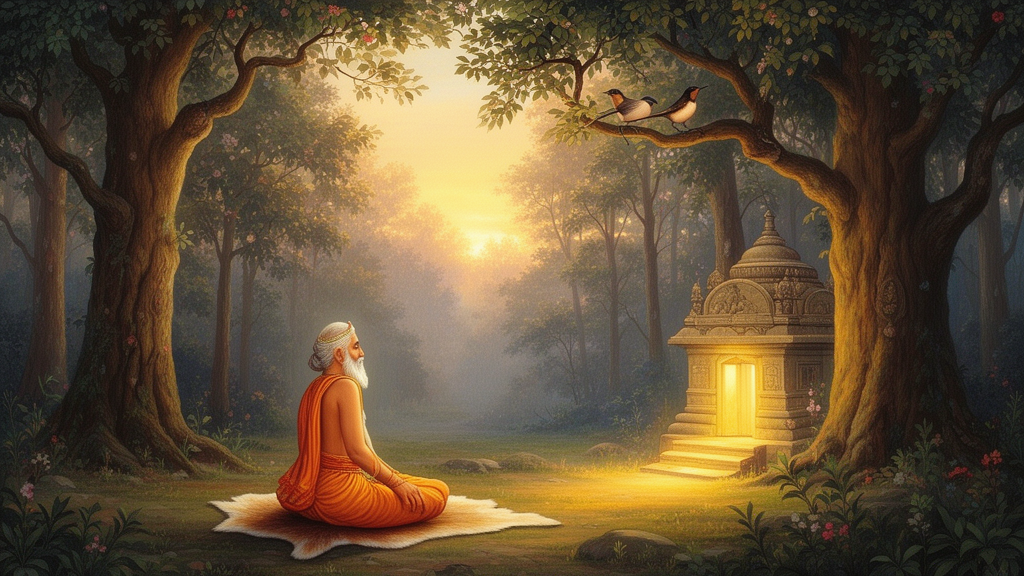
Quick answer: what the Svetasvatara Upanishad teaches
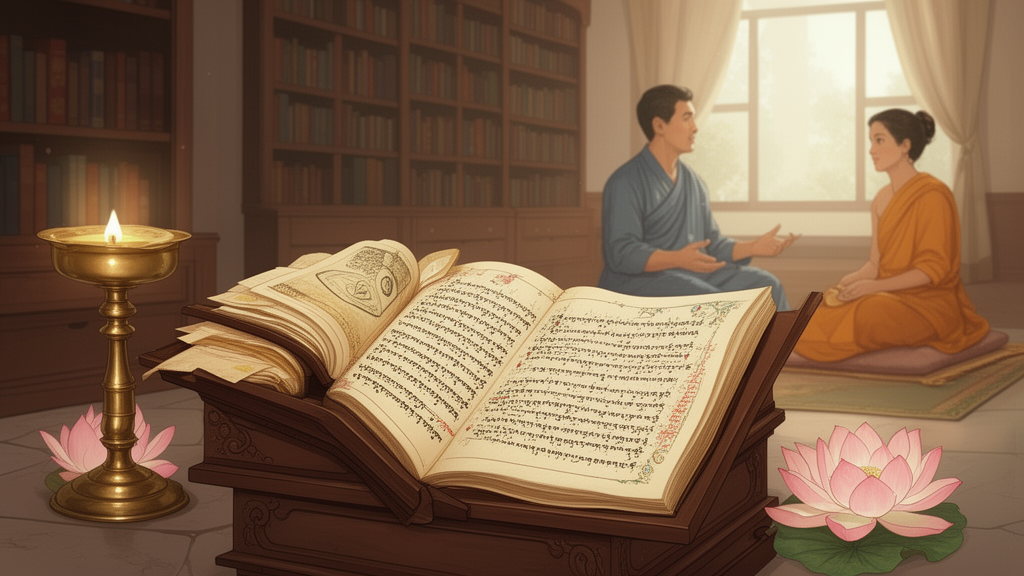
The Svetasvatara Upanishad asks what the ultimate cause of the universe is and rejects explanations that rely on a single factor alone. It then affirms a supreme principle, Brahman, which is also the inner Self, and it describes the Lord as the one who wields māyā. Rudra is praised as the supreme Lord, while the text also holds that the highest truth lies beyond limiting attributes. The Upanishad combines Vedanta philosophy with yoga and with devotion to Īśvara, and it stresses that a teacher-disciple lineage, faith and devotion are important on the path to liberation.
In short, the text is philosophical and meditative rather than a collection of stories. Readers who want its teaching in Tamil should compare more than one translation, because Tamil renderings and commentaries differ in wording and emphasis.
Where the Svetasvatara Upanishad fits
The Upanishads are generally described as the concluding portions of the Vedas, known as Vedanta, meaning the “end of the Vedas.” A Tamil study site describes them as dealing with the nature of the Self, ultimate reality, the relationship between the individual and the cosmos, and the path to liberation (moksha). That same site groups the Upanishads by Veda and by category, and it places the Svetasvatara Upanishad under the Krishna Yajur Veda and in its “Vedic (General)” grouping. [5]
A Tamil Wikipedia article identifies the Svetasvatara Upanishad as belonging to the Krishna Yajurveda. [1] This is a basic classification found in reference material. Scholars and traditions may describe the Upanishad’s placement in more detail, so readers who need precise textual history should consult a scholarly introduction rather than relying on a single summary.
Names and spellings readers may encounter
The same Upanishad appears under several spellings. In Tamil, you may see சுவேதாசுவதர உபநிடதம் and ஸ்வேதாஶ்வதர உபநிஷத். In English, common forms include Svetasvatara, Shvetashvatara and Śvetāśvatara. These spellings refer to the same text. This article uses “Svetasvatara Upanishad” for consistency, with Tamil forms shown where they help you search or study.
The six adhyayas
The text is organised into six chapters, or adhyayas. One Tamil reading platform lists the Upanishad as having 113 verses in total, across its six chapters. [3] Verse counts can differ between editions and numbering systems, so treat that figure as the count given by that platform rather than a universal number.
Why readers study it in Tamil
Tamil readers have several entry points. A Tamil reading platform presents the Upanishad with Tamil explanations, a chapter-by-chapter outline and a note that the text connects Vedanta, yoga and devotion to Īśvara. [3] A Tamil lecture series on the Vedavaani website records talks on the Svetasvatara Upanishad that go through individual chapters and sets of mantras, which is useful for listeners who prefer guided study. [4]
Tamil translations and talks are valuable, but they are interpretations as well as translations. A teacher’s commentary may explain a passage in terms of a particular school of Vedanta, a devotional tradition or a yoga-oriented reading. When you read a Tamil edition, check whether the translator is giving a word-for-word rendering, a free paraphrase or a commentary.
The six chapters at a glance
The following outline draws on Tamil summaries of the first two chapters and on a general summary of the whole text. Details for the later chapters should be checked against a full edition before you rely on them.
Chapter 1: the question of cause
The first chapter opens with questions about the ultimate source of Brahman, the origin of human life and what sustains it. According to a Tamil summary, the chapter examines six causal theories: time (kāla), inherent nature (svabhāva), fixed order (niyati), chance (yadṛcchā), origin or source (yoni), and the cosmic person (puruṣa). The chapter concludes that none of these alone is sufficient. [3]
The same summary says that the seers, through meditation, came to perceive a divine power of the Self, and that saṃsāra is described as a wheel of Brahman. [3] These images are central to how the Upanishad presents the problem of bondage: the cycle of birth and death is not explained by a single mechanical cause, and it must be understood in relation to the Self and the supreme principle.
Chapter 2: meditation and the indwelling Lord
According to a Tamil summary, the second chapter instructs the seeker to direct mind and intellect towards the supreme reality in meditation. It invokes the deity Savitṛ to begin spiritual awakening, and it presents Rudra-Brahman as dwelling in the hearts of all beings and pervading everything. [3] Through yogic practice, the seeker can see the supreme Self that dwells in the lotus of the heart and be freed from the cycle of birth and death. [3]
Chapters 3 to 6: what to check in a full text
The Tamil reading platform gives an outline for each chapter, but the summary available for this article is incomplete for chapters 3 to 6. [3] Talk titles on the Vedavaani website show that the later chapters are taught in sets of mantras, including sections on chapters 3, 4, 5 and 6. [4] To describe the content of these chapters accurately, compare an edition with a verse-by-verse translation and check each claim against the Tamil or Sanskrit text. This article does not describe those chapters in detail, to avoid unsupported summaries.
Key teachings of the Upanishad
The Tamil overview lists several themes that run through the whole text. These themes are useful for understanding the Upanishad, but each should be read in its own context. [3]
Ultimate causality and the supreme principle
The Upanishad begins by rejecting explanations that depend on one factor only. Instead, it points to a supreme principle as the ground of all things. In the Tamil summary, this principle is described as beyond limiting description, present everywhere, and ultimately the true reality. [3] Readers should note that this is a teaching of the text. Its interpretation has been developed in different ways within Vedanta and other traditions.
The two birds: experiencer and witness
The Svetasvatara Upanishad uses the image of two birds on the same tree. A Tamil summary explains this as the distinction between the living being (jīva), who experiences the fruits of action, and the witnessing Self (ātman), who is aware without being bound by experience. [3] The Upanishad teaches that liberation comes from turning attention to the witness. This is one of the text’s most widely discussed images, and it appears in Tamil summaries as a key part of its teaching on bondage and freedom.
Īśvara, māyā and Rudra-Shiva
The Upanishad presents the Lord as the one who wields māyā, and it praises Rudra-Shiva as the supreme Lord, the creator, ruler and refuge. A Tamil summary also states that Rudra is described beyond limiting attributes, and that the highest truth remains the all-pervading Brahman. [3]
This combination is important. The text honours Rudra-Shiva with great devotion, but its philosophical position does not reduce ultimate reality to a single personal form. Readers who follow Śaiva devotion, Vedantic non-dual interpretation or a more general Hindu approach may read these verses differently. The Tamil overview itself notes that the Īśvara teaching and the Brahman teaching are held together. [3]
Guṇas, bondage and knowledge
The Upanishad speaks of the guṇas and of prakṛti as the field of experience. Bondage arises through identification with that field, and freedom arises through knowledge and detachment. [3] This is a philosophical teaching. It describes the mind’s habit of identifying with the body, the senses and the results of action, and it proposes knowledge of the Self as the remedy.
Yoga, meditation and breath control
Yoga is presented as a disciplined inner practice. The Tamil summary lists meditation, control of breath (prāṇāyāma) and restraint of the mind (manonigraha) as means of directing the mind towards realisation. [3] These practices are not presented as ends in themselves. They are meant to support knowledge of the Self.
Grace, devotion and the teacher
The Upanishad joins devotion with knowledge. A Tamil summary says that bhakti and surrender are compatible with jñāna, and that the guru–śiṣya lineage, shraddhā (faith) and devotion are necessary on the path to liberation. [3] The text does not present knowledge and devotion as rival routes. It treats them as parts of one path, although different communities give different weight to each.
Liberation, immortality and peace
The Upanishad speaks of cutting the knot of the heart, overcoming fear and sorrow, and attaining peace and immortality (amṛtatva). [3] The term amṛtatva is a traditional word for immortality, and Upanishadic texts use it in a philosophical sense that is not identical with ordinary survival after death. Readers should be careful not to read it as a simple promise of a particular outcome.
Text, tradition, belief and scholarship
A responsible study of the Svetasvatara Upanishad separates several kinds of claim. The text itself makes philosophical and devotional statements, such as the supremacy of the Lord or the importance of meditation. Those are claims within a tradition. A Tamil talk or commentary explains those statements in a particular way. Scholars may compare manuscripts, describe historical development and place the text in a broader context of Vedic and Upanishadic literature.
For example, the statement that Rudra-Shiva is supreme in this Upanishad is a statement about what the text says and how a tradition reads it. A historian might ask when a particular version was composed or how it relates to other texts, and that is a different question. The Tamil sources used here do not provide detailed historical dating, so this article does not offer a date.
Regional and sectarian readings
Hindu communities do not all read this Upanishad in the same way. Some Vedanta teachers emphasise the non-dual Brahman, some devotional traditions emphasise Rudra-Shiva or Īśvara, and some yoga-oriented readers focus on meditation practices. A Tamil reader may encounter a commentary from one lineage and a different translation from another. Neither is a universal interpretation. It is useful to name the teacher or edition you are reading and to note the tradition it represents.
A practical method for studying the Tamil text
Readers who want to study the Svetasvatara Upanishad in Tamil can follow a simple sequence. This approach is a study method, not a religious requirement.
- Choose a Tamil edition with a clear translator or commentator. Note whether it gives the Sanskrit text, a transliteration, a translation and an explanation.
- Read the first chapter slowly. Focus on the six causal theories and the conclusion that no single factor is sufficient.
- Compare your reading with a second source. Use a different Tamil translation or a talk from a teacher who uses another interpretation.
- Mark the key images. Note the two birds, the wheel of saṃsāra and the lotus of the heart, and see how each is explained.
- Connect the teaching to practice. If you practise meditation, use the text as a source of reflection and be clear about which parts are teaching and which are your own practice.
- Keep a record of questions. Write down terms you do not understand, such as guṇa, prakṛti or īśvara, and look them up in a glossary or commentary.
Tamil study resources
Several Tamil resources can help you explore the text. The reading platform at vedapath.app presents the Svetasvatara Upanishad with a Tamil overview, chapter summaries and key teachings. [3] The Vedavaani website hosts a Tamil talk series in which the Svetasvatara Upanishad is taught chapter by chapter, with dated recordings. [4] A Tamil digital library, Sanatan Library, offers a downloadable Tamil book of the Upanishads by Swami Guruparananda. [6] Before downloading any file, check the site’s terms and the book’s copyright status, and confirm that the file is what you expect.
For readers who want the Sanskrit text, look for a Sanskrit edition with a clear citation, and compare it with a Tamil translation. This helps you see where a translator has interpreted a term.
Explore related HindusGod.com content on the Upanishads, including the Svetasvatara Upanishad in Hindi, the Svetasvatara Upanishad in Sanskrit and the general Svetasvatara page, once those pages are published. These links are currently draft destinations and may not yet be public.
Related Upanishads on HindusGod.com
Readers interested in the Upanishads more widely may find these related HindusGod.com pages useful. Each link points to a page that is currently a WordPress draft, so the owner should confirm that the page is published before this article goes live: Upanishad in Tamil, Brihadaranyaka Upanishad in Tamil, Isha Upanishad in Tamil, Katha Upanishad in Tamil, Kena Upanishad in Tamil, Mandukya Upanishad in Tamil, Mundaka Upanishad in Tamil, Taittiriya Upanishad in Tamil and meaning of Upanishad.
For the Svetasvatara Upanishad in other languages and formats, see Svetasvatara Upanishad in Hindi, Svetasvatara Upanishad online, Svetasvatara Upanishad in Sanskrit and Svetasvatara Upanishad 4 19. For the general topic, see Svetasvatara. If you are interested in numbered lists of the Upanishads, see 10 Upanishad, 108 Upanishad and 11 Upanishad.
Frequently asked questions
Is the Svetasvatara Upanishad written in Tamil?
No. The Upanishad is a Sanskrit text. Tamil versions, summaries and talks explain it for Tamil readers. When you see a Tamil title, it usually refers to a Tamil translation or introduction. [1][3]
Which Veda does the Svetasvatara Upanishad belong to?
It is associated with the Krishna Yajurveda. [1][3][5] Readers who need detailed textual history should consult a scholarly introduction.
Does the Upanishad teach only one form of God?
The text praises Rudra-Shiva as supreme Lord and also teaches that the highest reality is beyond limiting attributes. [3] Different traditions emphasise these ideas in different ways, so it is best to read the text with a commentary that names its tradition.
Summary and next step
The Svetasvatara Upanishad is a philosophical and meditative text from the Krishna Yajurveda. It examines the ultimate cause of the world, presents the two birds as an image of experience and witness, praises Rudra-Shiva as supreme Lord within a non-dual framework, and joins yoga, knowledge, faith and devotion. [1][3] To study it in Tamil, compare more than one edition, note the tradition behind each commentary and keep the text distinct from later interpretation.
Your next step is to choose one Tamil translation or talk series, read the first chapter alongside the outline above, and then check each point against the text itself.
Sources and further reading
- சுவேதாசுவதர உபநிடதம் – Tamil Wikipedia: used for the basic classification of the text as belonging to the Krishna Yajurveda. The page text was available only as a search snippet in this draft, not as a fully inspected page.
- Shvetashvatara Upanishad in Tamil, vedapath: used for the chapter outline, key teachings, the two birds allegory, Rudra-Shiva, yoga, guru-disciple lineage and the verse count shown on the page.
- Upanishads in Tamil, vedapath: used for the general description of the Upanishads and the Krishna Yajur Veda grouping.
- Svetasvatara Upanishad, Vedavaani: used to describe a Tamil chapter-by-chapter talk series. The series is a commentary, not a translation.
- உபநிஷத்துக்கள் – Upanishads Full Book in Tamil, Sanatan Library: cited only as a Tamil book listing by Swami Guruparananda. Check copyright and file terms before use.