An Upanishad is one of the philosophical texts that form the concluding portion of the Vedas, and Tamil readers can study them through Tamil translations, transliterations and commentaries. This guide explains what the Upanishads are, why the Tamil spellings vary, which texts are most often read in Tamil, and how to separate what a scripture says from later commentary and devotional interpretation.
Quick answer: what “Upanishad in Tamil” means
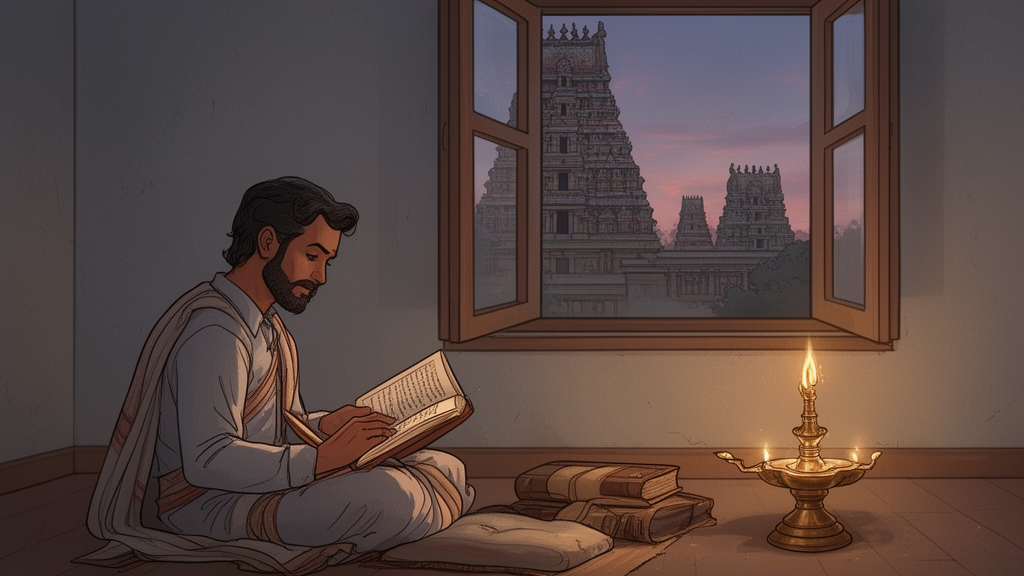
The phrase usually refers to a Tamil edition, translation, transliteration or commentary of one or more Upanishads. The Sanskrit originals are the reference texts, and Tamil editions help readers who want to study the ideas in their own language. Readers should check which Sanskrit text, translation and commentary a Tamil edition follows, because the same passage can be rendered in different ways.
In short, an Upanishad is a teaching text that centres on the nature of the self (atman), ultimate reality (brahman) and liberation (moksha). Tamil versions make these ideas accessible, but they should be read alongside a reliable source and, where possible, a scholarly or traditional commentary.
What an Upanishad is
The word and its place in the Vedas
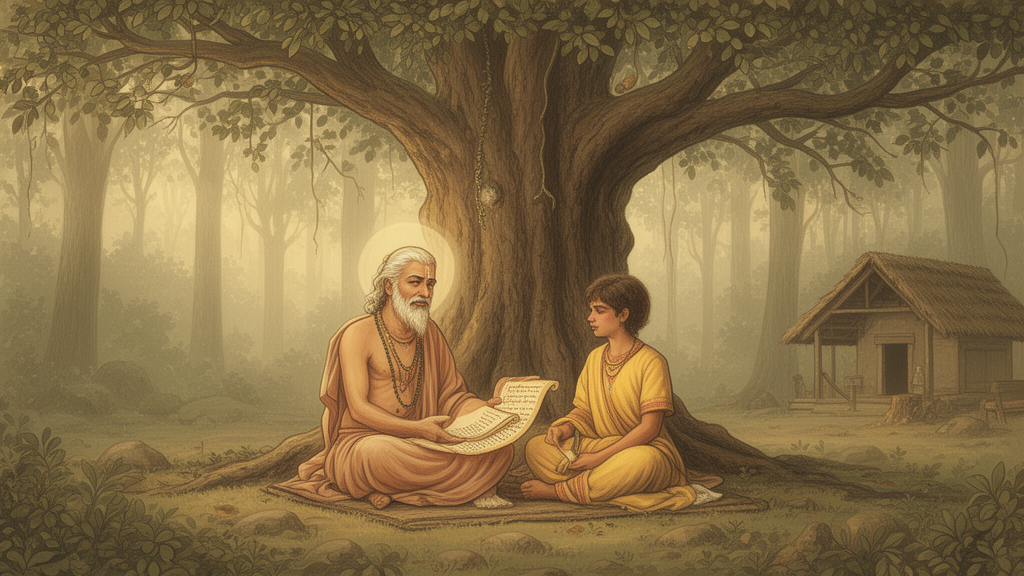
The Tamil Wikipedia article on the Upanishads uses the spelling உபநிடதம் and explains the term within the Hindu tradition of sacred texts (Tamil Wikipedia: உபநிடதம்). The English word is usually explained as “sitting near”, a reference to students sitting near a teacher to receive instruction. The Vedapath Tamil page also describes the Upanishads as the concluding portions of the Vedas, known as Vedanta, meaning the “end of the Vedas” (Vedapath: Upanishads in Tamil).
This placement matters. Many Upanishads are attached to particular Vedic branches, called shakhas, and the Vedas are usually divided into the Samhita, Brahmana and Aranyaka portions, with the Upanishads often coming at the end of the Brahmana or Aranyaka material. Not every text titled an Upanishad belongs to the same period or Veda, and some later texts were composed in the same format but have a different role.
Why the Upanishads are usually read as philosophy
The Upanishads are often read as dialogues between teachers and students, or as instructions on meditation and self-knowledge. The Vedapath description summarises them as profound dialogues on the nature of Brahman, Atman, consciousness and liberation (Vedapath). The Internet Encyclopedia of Philosophy also has an article on the Upanishads that discusses their philosophical themes and history (Internet Encyclopedia of Philosophy: Upanishads). That article is a useful secondary guide for readers who want an academic overview.
For a beginner, the most helpful habit is to ask two questions of each passage. First, what does the text itself say? Second, how has a commentator or tradition understood it? These are different questions, and the answers may differ.
Tamil spellings and variant forms
Tamil readers may see more than one spelling of the same word. Tamil Wikipedia uses உபநிடதம் (upanidatam), while other Tamil devotional and educational sites use உபநிஷத் (upanishad), which follows the Sanskrit pronunciation more closely. The Stotra Nidhi Tamil page uses உபநிஷத: in its heading and lists individual texts with Sanskrit-based names such as ஈஶாவாஸ்யோபநிஷத் (Isha Upanishad) and கேநோபநிஷத் (Kena Upanishad) (Stotra Nidhi: Upanishads in Tamil).
These variations do not change the meaning of the texts, but they can affect search and reading. When comparing editions, check the title, the Sanskrit name of the text, the transliteration scheme and whether the page is a translation, a transliteration or a commentary. Consistent spelling helps readers find the same text across different websites.
Principal and minor Upanishads: how traditions count them
One of the most common questions is how many Upanishads there are. The honest answer depends on the tradition and the list being used. The Vedapath page says the principal, or mukhya, Upanishads are those recognised by Adi Shankaracharya, and that the wider collection includes Yoga, Shaiva, Vaishnava, Shakta, Sannyasa and other sectarian texts (Vedapath). Its Tamil catalogue lists 60 texts, grouped by category and Veda.
Other traditions and publishers use larger numbers. A translation of a complete set of 108 Upanishads by Swami Paramananda is listed in the Tamil Wikipedia reference section, which points to a tradition of counting 108 texts (Tamil Wikipedia: உபநிடதம்). A safe way to present this is:
- Principal Upanishads: a smaller group, commonly associated with early commentarial tradition and especially with Adi Shankaracharya’s commentaries.
- Wider collections: larger lists that include later, sectarian and yoga-oriented texts.
- The 108 count: a traditional or editorial collection that readers will encounter in some translations, not a single fixed academic list.
Readers should therefore avoid claiming that there is one official number of Upanishads. When a post or edition says “108 Upanishads”, it is describing a particular collection.
Major themes in Tamil Upanishad teaching
Atman and Brahman
Two ideas recur across many Upanishads: atman, the self or inner principle, and brahman, ultimate reality. The Vedapath description names both as central concerns, and its entry for the Adhyatma Upanishad, which it associates with the Yajur Veda, summarises a teaching that the self is Brahman and that false identification with body, senses and mind is a source of bondage (Vedapath). That is one way the text is presented in a Tamil summary. Readers who want the exact wording should consult the Sanskrit text and a translation attributed to a named translator.
The relationship between atman and brahman is interpreted differently across schools of Vedanta. Advaita, the non-dual interpretation associated with Adi Shankaracharya, reads many Upanishadic passages as teaching the identity of atman and brahman. Other Vedanta schools interpret the same passages differently. A post should describe this as an interpretive tradition, not as the only meaning of the texts.
Knowledge and liberation
Many Upanishads present knowledge as the means to liberation. The Tamil introduction on the Vedaspark site says that, in the Vedic age, “knowledge” in India was understood primarily as spiritual knowledge, and that knowing the origin of the universe was called gnanam (Vedaspark: Upanishad Tamil). The same introduction describes the Upanishadic search as inward rather than outward, while acknowledging that other kinds of knowledge were treated as ordinary knowledge. This is the framing of a Tamil devotional and educational site, so it should be read as an interpretation of the tradition rather than a neutral historical claim.
The Vedaspark page also states that the word ananda in these texts should not be understood simply as ordinary happiness, because happiness and sorrow are paired experiences and the Upanishadic idea of bliss refers to a state beyond both (Vedaspark). This is a useful clarification for readers who might otherwise translate ananda too casually.
A phrase often quoted in Tamil introductions
The same Vedaspark introduction quotes the Sanskrit phrase shrunvantu vishva, amritasya putrah, rendered in the page’s Tamil text as an address to the children of immortal bliss. This phrase is widely associated with the Shvetashvatara Upanishad. Readers who want to cite it should verify the chapter and verse in a scripture edition, because a Tamil introduction may quote it without giving a reference.
Examples: some Upanishads commonly read in Tamil
HindusGod.com has several Tamil draft posts for individual Upanishads. These drafts may not be public yet, so the links below should be read as targets for future or current content rather than assurances that the pages are live. The summaries below are general background; check the full text and a reliable translation before quoting.
Isha Upanishad
The Isha Upanishad is one of the shorter texts and is often read as a teaching on living in the world with awareness of the divine presence. The Stotra Nidhi list gives it in Tamil as ஈஶாவாஸ்யோபநிஷத் (Stotra Nidhi). For a dedicated Tamil treatment, see the Isha Upanishad in Tamil page.
Kena Upanishad
The Kena Upanishad opens with a question about what directs the mind and the senses, and it moves toward a teaching about the power behind them. It appears in the Stotra Nidhi list as கேநோபநிஷத் (Stotra Nidhi). Readers can compare the Tamil overview at Kena Upanishad in Tamil.
Katha Upanishad
The Katha Upanishad is known for the dialogue between the young seeker Nachiketa and Yama, the lord of death. It is listed in Tamil as கடோ²பநிஷத் on the Stotra Nidhi page (Stotra Nidhi). See Katha Upanishad in Tamil for a related draft.
Mandukya and Mundaka Upanishads
The Mandukya Upanishad is a short text often associated with the syllable Om and with the four states of consciousness: waking, dream, deep sleep and a fourth state described as the witnessing ground. The Mundaka Upanishad is often read for its distinction between lower and higher knowledge. Tamil drafts are available at Mandukya Upanishad in Tamil and Mundaka Upanishad in Tamil.
Taittiriya and Brihadaranyaka Upanishads
The Taittiriya Upanishad is associated with the Taittiriya school of the Yajur Veda and includes teaching on the layers of the self. The Brihadaranyaka Upanishad is a longer prose text and is often associated with the teachings of Yajnavalkya. Readers can compare Tamil drafts at Taittiriya Upanishad in Tamil and Brihadaranyaka Upanishad in Tamil.
Aitareya Upanishad
Vedapath describes the Aitareya Upanishad as associated with the Rig Veda and as part of the Aitareya Aranyaka. Its teaching is presented as a philosophical sequence on creation and the entry of consciousness into the human body, rather than as a simple mythological narrative (Vedapath). The Tamil listing is also given by Stotra Nidhi as ஐதரேயோபநிஷத் (Stotra Nidhi). A related draft is Aitareya Upanishad.
Narayana and Svetasvatara Upanishads
The Narayana Upanishad appears in the Tamil list on Stotra Nidhi as நாராயணோபனிஷத், and the Svetasvatara Upanishad is a text often read for its theistic language. Because these texts are often connected to specific devotional traditions, readers should note the tradition they are reading. See Narayana Upanishad in Tamil and Svetasvatara Upanishad in Tamil.
Adhyatma and Advaita Upanishads
Vedapath describes the Adhyatma Upanishad as a short Vedanta text that emphasises inner knowledge of the self over outward ritual action, and it lists the text with 70 verses (Vedapath). It also describes the Adhwayataraka Upanishad, a Yoga text, as having 19 verses. These verse counts are from one Tamil catalogue and should be checked against a scripture edition before being repeated as fixed facts. Related HindusGod.com drafts are Adhyatma Upanishad and Advaita Upanishad.
Belief, tradition and scholarship: how to read responsibly
Readers often approach the Upanishads from different starting points. Some read them as sacred revelation, some as part of a living Vedanta or Yoga practice, some as philosophy, and some as historical documents. These approaches can coexist, but a responsible article should not treat them as interchangeable.
- Scripture: what the text says in Sanskrit and in a specific translation.
- Commentary: an interpretation by a named teacher or school, such as a Shankara or Madhva commentary.
- Tradition: how a community or lineage practises and understands the texts.
- Scholarship: historical, linguistic and philosophical study of dates, manuscripts and composition.
Dating is a good example. Scholars generally agree that the Upanishads were composed over a long period and that the earliest prose Upanishads are older than many later texts, but exact dates are debated and should not be presented as settled fact. Avoid precise dates unless a named academic source supports them.
How to choose a Tamil edition
Tamil editions vary a great deal. Some are word-for-word transliterations, some are paraphrases, some include the Sanskrit and some include a commentary. For a first reading, a Tamil translation with clear notes can help. For study, compare the Sanskrit transliteration, the Tamil rendering and an English or academic translation.
- Identify the Sanskrit title and the Veda or category the text belongs to.
- Check whether the Tamil page gives translation, transliteration or commentary.
- Look for the translator, commentator or publisher.
- Compare key terms such as atman, brahman, ananda and moksha across at least two sources.
- Use a scripture edition or scholarly resource when you need a chapter, verse or quotation.
Reading resources in Tamil and beyond
Several sources can help readers begin:
- Vedapath’s Tamil Upanishad catalogue lists 60 texts, grouped by category and Veda, with brief descriptions and reading options.
- Stotra Nidhi’s Tamil Upanishad page gives Tamil-script titles for many texts and links to a devotional reading collection.
- Vedaspark’s Tamil Upanishad introduction provides an interpretive introduction in Tamil.
- Internet Archive: Upanishads by Swami Guruparananda is an archive item titled Upanishads in Tamil. Its usability and licence should be checked on the item page before reuse.
- Internet Encyclopedia of Philosophy: Upanishads gives an academic overview of the philosophical texts.
Common questions about Upanishads in Tamil
Is there one official Tamil Upanishad?
No single official Tamil version is universal. Tamil readers may use translations, transliterations or commentaries from different publishers and traditions. The best choice depends on whether the reader wants a devotional reading, a philosophical introduction or a study text.
Which Upanishad should a beginner read first?
Beginners often start with shorter texts or with a guided introduction, such as the Isha or Mandukya Upanishad, because they are concise. A short introduction to the principal Upanishads can help readers see how the texts relate to one another. The choice is a matter of reader preference, not a fixed ranking.
Do Upanishads provide practical instructions?
Many Upanishads discuss meditation, self-inquiry and the discipline of the senses, but they are not manuals with guaranteed results. Practices described in them are best understood within their textual context and tradition, and any guidance should come from a qualified teacher or community rather than an online summary alone.
Closing takeaway
Upanishad in Tamil is best understood as a way into a large body of Sanskrit philosophical literature. Tamil editions make the texts accessible, but readers should check the Sanskrit title, the translator, the commentary tradition and the source of each claim. The most useful approach combines the text itself, a trusted translation and an honest awareness of how different traditions and scholars interpret it.
Sources and Further Reading
- Tamil Wikipedia: உபநிடதம் for the Tamil spelling, general description and a reference to a 108-text English translation.
- Tamil Wikipedia: மகா உபநிடதம் for a note that Maha Upanishad is a minor Sanskrit Upanishad (content not fully inspected in this draft).
- Vedapath: Upanishads in Tamil for category, Veda association, principal-text description and verse counts given in its catalogue.
- Stotra Nidhi: Upanishads in Tamil for Tamil-script titles of several texts.
- Vedaspark: Upanishad Tamil for a Tamil interpretive introduction, including the explanation of ananda.
- Internet Archive: Upanishads by Swami Guruparananda as an archived Tamil Upanishad item.
- Internet Encyclopedia of Philosophy: Upanishads for an academic overview.