The ten principal Upanishads are the ten Upanishads most often treated as the core of the Upanishadic corpus: Isha, Kena, Katha, Prashna, Mundaka, Mandukya, Taittiriya, Aitareya, Chandogya, and Brihadaranyaka. Traditionally they are called the Mukhya (principal) Upanishads, and they form the foundation of the Vedanta, or “end of the Veda,” tradition. This guide lists each text with its Veda affiliation, explains the four Mahavakyas (great sayings) often drawn from them, and shows why different lists say ten, thirteen, or 108.
The short answer for readers: the ten principal Upanishads are a traditionally recognized group, not a single book. Each one is a separate text attached to a particular Veda, and the group is valued as the most influential and widely studied Upanishads. Scholarly dating of the texts is uncertain, and different Hindu traditions read them in different ways.
What “Principal Upanishads” means
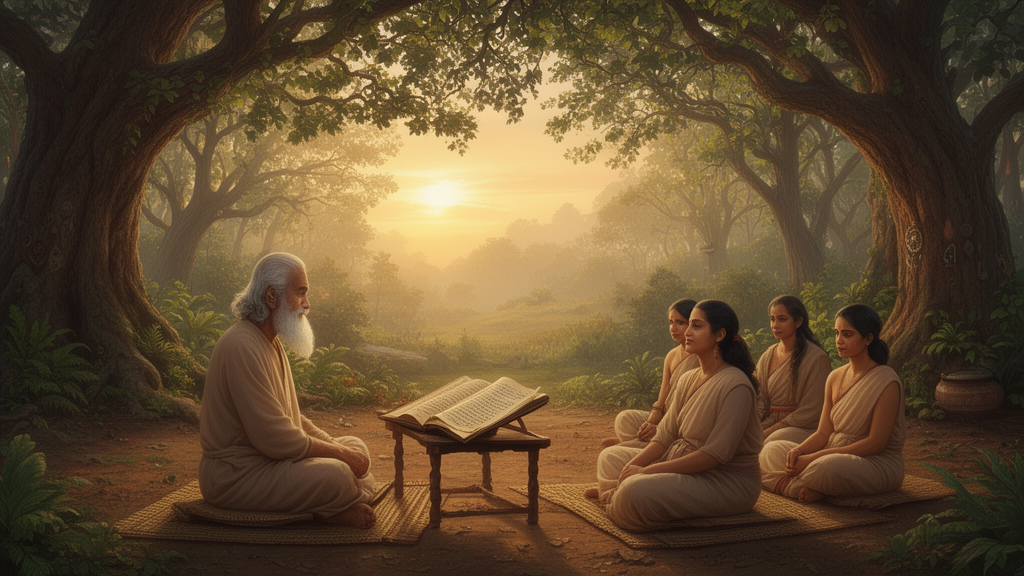
The word Upanishad is commonly analysed as upa (near), ni (down), and shad (to sit), suggesting a student sitting close to a teacher to receive teaching not given in public. Shankara, the commentator discussed below, also connected the word with a root meaning to loosen or destroy, understood as destroying ignorance. These are traditional explanations rather than a settled etymology, and readers will meet both.
The Upanishads are regarded as shruti, or revealed texts, within Hindu tradition. The Wikipedia article on the Principal Upanishads describes them as the most ancient and widely studied Upanishads of Hinduism, and as among the oldest and philosophically most influential texts of the wider Upanishadic corpus. In the tradition, the Upanishads are read as the concluding part of the Veda, which is why they are called Vedanta.
The Vedic structure helps explain where the Upanishads sit. Each Veda has layers: the Samhita (mantra collections), the Brahmana (ritual explanation), the Aranyaka (forest texts read symbolically), and finally the Upanishad, which presents philosophical conclusions. The earlier layers focus heavily on ritual: what to offer, when, and with which mantra. Several Upanishads question ritual as an end in itself. The Mundaka Upanishad, for example, describes the sacrificial rites as frail boats, a metaphor widely discussed in commentary literature.
The ten texts at a glance
The list below follows the traditional memory verse and the Veda affiliations given in the Grokipedia summary and the Divine Aarti guide. Affiliations can vary by source, so confirm them in the edition you use.
- Isha (Shukla Yajurveda): a very short text, often the first read by beginners, which speaks of the Self pervading all things.
- Kena (Samaveda): a text built around a question about what moves the mind and senses, and a teaching on Brahman that cannot be grasped by ordinary means.
- Katha (Krishna Yajurveda): a dialogue in which the boy Nachiketa asks Yama, the lord of death, about what happens after death. It is one of the best-known Upanishadic stories.
- Prashna (Atharvaveda): structured as six questions put to a teacher by students, covering topics such as the origin of beings and the nature of the life-breath.
- Mundaka (Atharvaveda): known for its discussion of higher and lower knowledge and its image of two birds on a tree.
- Mandukya (Atharvaveda): the shortest of the principal Upanishads, according to the Divine Aarti guide, with about twelve mantras. It is widely studied for its analysis of the syllable Om and four states of consciousness.
- Taittiriya (Krishna Yajurveda): includes an ethical instruction section and a teaching on the layers of the self.
- Aitareya (Rigveda): associated with the Rigveda and known for its account of creation and its role as a source of one of the Mahavakyas.
- Chandogya (Samaveda): a long prose text with many teaching dialogues, including the well-known instruction tat tvam asi.
- Brihadaranyaka (Shukla Yajurveda): the longest of the principal Upanishads, with extensive dialogues on Brahman, the Self, and rebirth.
Readers will notice that the Veda affiliations do not match the order in which people often read the texts. The grouping is traditional and reflects the Vedic schools (shakhas) to which each text was attached. Historically, each Veda had several shakhas, and Upanishads were associated with specific ones. This is one reason the ten are often described as representing different Vedic lines of teaching.
The four Mahavakyas
The Mahavakyas, or “great sayings,” are four short statements that Vedanta treats as condensed expressions of Upanishadic teaching. The Divine Aarti guide lists one from each Veda. Its listing is a secondary summary, so it is worth checking each reference in a primary edition before quoting it in study or teaching.
- Prajnanam brahma (“Consciousness is Brahman”), associated with the Aitareya Upanishad (3.3) and the Rigveda.
- Aham brahmasmi (“I am Brahman”), associated with the Brihadaranyaka Upanishad (1.4.10) and the Shukla Yajurveda.
- Tat tvam asi (“That thou art”), associated with the Chandogya Upanishad (6.8.7) and the Samaveda.
- Ayam atma brahma (“This Self is Brahman”), associated with the Mandukya Upanishad (2) and the Atharvaveda.
These sayings are philosophical teachings, not formulas to be recited for a material result. In Advaita Vedanta, they are central to the teaching that the individual self (atman) and ultimate reality (Brahman) are not ultimately different. Other Vedanta schools interpret the relationship differently, and the Mahavakyas are discussed within those debates as well. For a reader, the most useful approach is to read each saying in its own Upanishad, with its surrounding dialogue, rather than in isolation.
Why the numbers differ: ten, thirteen, 108, and more
Readers often encounter different counts. The variation reflects different ways of grouping texts rather than a single error. Three common situations are worth knowing.
The ten principal Upanishads
The ten are the group most often treated as principal, and the one associated with the commentary work of Adi Shankara. The Wikipedia article on the Principal Upanishads and the Grokipedia summary both present them as a traditionally recognized core. Shankara’s commentaries, usually dated to around the eighth century CE in general reference works, helped establish these texts as an authoritative base for Vedanta. Dating of Shankara is itself debated among scholars, so exact dates should be treated as approximate.
The thirteen-text canon
Some lists add three more texts to make thirteen. The Wikipedia article on the Principal Upanishads describes a thirteen-text canon and notes that this is a different grouping from the ten. The additional texts are included in some commentarial and popular traditions. If you come across a HindusGod draft on the thirteen principal Upanishads, treat it as a separate scope, not a contradiction of the ten. Our related draft is 13 Principal Upanishads, and a separate draft on The Thirteen Principal Upanishads covers the same grouping from another angle. Both URLs are WordPress drafts and may not be public yet.
The 108 Upanishads
The Divine Aarti guide notes that the Muktika list gives a total of 108 Upanishads, and that in principle there was one per Vedic shakha. Other lists are longer or shorter. Among the wider corpus, the names of many Upanishads are known from manuscripts and lists, but not every text has the same age, language, or authority. A useful general overview of the broader corpus is available in our draft on Upanishads, and for the larger number, see 112 Upanishads. Both are target drafts and may not yet be public.
The practical lesson is simple: when someone says “the principal Upanishads,” ask which list they mean. A reference to the ten, thirteen, or 108 is a reference to a specific tradition of classification.
Dating and composition: where sources disagree
Dating the Upanishads is one of the most difficult questions in Indology, and the sources used for this post do not agree. The Grokipedia summary states that the Ten Principal Upanishads were composed orally in Sanskrit between approximately 700 BCE and 300 BCE. This is a general scholarly range offered in a secondary summary, and readers should confirm it against academic histories of Vedic literature.
A personal blog cited in the research notes gives a very different range, placing composition in the 4000–5000 BC period, with other claims going back much earlier. That view is a devotional or speculative claim rather than a conclusion supported by the historical evidence summarised in the academic and encyclopaedic sources reviewed here. This post does not adopt that dating. Where you encounter a precise date for any Upanishad, check whether it is a scholarly estimate, a tradition’s belief, or a statement of faith.
The texts themselves do not name a single author. The Upanishads are attributed to seers and sages, and many of the teachings are presented as dialogues between a teacher and student, or between rival thinkers. Tradition holds that they were transmitted orally before being written down, which is why they are called shruti. Scholars generally accept that the texts developed over a long period and were edited and transmitted in many recensions.
Philosophical themes that run through the ten
Although the ten texts differ in form and length, they share recurring concerns. Understanding these themes helps readers see the group as a set rather than ten unrelated pieces.
- Brahman: the ultimate reality, described in many ways as the ground of all existence.
- Atman: the Self, which the texts relate to Brahman in different ways.
- Samsara and karma: the cycle of rebirth and the law of cause and effect, which the texts discuss as conditions from which liberation is sought.
- Moksha: liberation from the cycle of rebirth, presented as the goal of spiritual knowledge.
- Meditation and inquiry: the texts describe knowledge gained through reflection, teaching, and direct realisation rather than ritual alone.
The Upanishads often teach through metaphor and dialogue. In the Katha Upanishad, Nachiketa’s question about what happens after death leads to a discussion of the Self and the difference between what is lasting and what is transient. In the Chandogya, a father teaches his son about the subtle essence of things through repeated instructions. These stories show how the texts teach, and they are more useful to study than abstract summaries alone.
Commentaries and the Vedanta tradition
The ten principal Upanishads gained much of their authority through commentary. Adi Shankara wrote commentaries on them, and these became central to Advaita Vedanta, which teaches non-dualism. Other Vedanta schools, including those associated with Ramanuja and Madhva, read the same texts and reached different conclusions about the relationship between the self and Brahman. Because commentary shapes how a passage is understood, readers should distinguish three things:
- The text itself, in its Sanskrit original or a faithful edition.
- The commentary tradition, which explains the text within a philosophical system.
- Modern translation and interpretation, which may follow either of these or present a new reading.
When a summary says that “the Upanishads teach” a particular doctrine, ask whether it is quoting the text, a commentary, or a modern author. Many popular statements about the Upanishads combine all three without marking the difference.
Two books with a similar title
Readers searching for “The Ten Principal Upanishads” may also encounter a 1938 English book with that title. The Wikipedia article on The Ten Principal Upanishads describes it as an English version translated by the Irish poet W. B. Yeats and the Indian-born teacher Shri Purohit Swami. The translation was produced across the 1930s, with much of the work done in Majorca, and it was published in 1938. The authors aimed to render the texts in plain English, which is a literary choice rather than a critical scholarly edition.
This book is a distinct work from the set of Upanishads it translates. A reader wanting a close academic translation should consult scholarly editions and translations, while a reader interested in a literary and poetic rendering may find the Yeats and Swami version valuable as a cultural artefact. Note that the copyright status and reuse terms of translations differ, so quotations should be brief and attributed.
Where to start reading the ten
There is no single traditional reading order. The following is a practical suggestion, not a religious requirement. Many students begin with a shorter text to learn the style, then move to longer dialogues.
- Isha: a short introduction to the idea of the Self present in all things.
- Mandukya: a compact text, often studied alongside its later commentary, that introduces the states of consciousness and the syllable Om.
- Katha: a narrative dialogue that helps readers see how the Upanishads treat death, knowledge, and the Self.
- Kena and Mundaka: short texts that develop questions about knowledge and the limits of ordinary perception.
- Chandogya and Brihadaranyaka: the longer prose texts, where the Mahavakyas and many teaching dialogues appear.
Those who prefer a guided overview may also consult our drafts on the Principal Upanishads and Ten Upanishads, which approach the subject from different search angles. Both are WordPress drafts and may not be public yet. For a version of the ten with Vedic grouping, see Ten Upanishads of Four Vedas, also a draft.
Translation and study notes
Upanishadic Sanskrit is compact and can be ambiguous. Words such as atman, brahman, and maya carry different meanings in different contexts. Translators make choices, and readers should compare more than one translation when a passage matters for study.
Two editorial cautions apply. First, avoid treating any single translation as the only meaning of a passage. Second, when you cite a Mahavakya or a verse, check the chapter, section, and mantra number in a reliable edition, since numbering varies between editions. The Mahavakya references in this post follow the Divine Aarti guide and should be confirmed before citation.
Several academic and cultural institutions publish Upanishad texts and translations that readers can consult. Students who want a scholarly orientation can begin with a general reference work and then move to editions that give the Sanskrit text, notes, and commentary. The sources listed at the end of this post are a starting point, not a complete bibliography.
Traditional and devotional perspectives
For many Hindus, the Upanishads are not only historical documents. They are scripture, studied in temples, monasteries, and households, and recited in various forms in different communities. Their authority is understood differently across traditions. Some Vedanta traditions treat them as the highest teaching; others place them alongside devotion to a personal deity, ritual practice, or ethical duty. Readers should not assume that one reading represents all Hindu communities.
Many devotional readers look to the Upanishads for clarity about the Self and liberation. That is a legitimate religious use of the texts. Study does not guarantee a particular spiritual result, and the texts themselves emphasise inquiry, discipline, and realisation rather than automatic rewards. Describing their teachings as a method of study or practice is more accurate than presenting them as a guarantee of any material outcome.
Frequently asked questions
Are the ten principal Upanishads the only important Upanishads?
No. The ten are the most widely studied and historically influential core group, but the broader Upanishadic corpus includes many more texts. Some traditions give different lists, and many later texts are read within specific communities.
Does each principal Upanishad belong to a single Veda?
Each is traditionally associated with one Veda and a particular school or shakha. Some sources group them differently, so check the Veda affiliation in the edition or commentary you are using.
Do I need to read Sanskrit to study them?
No, but Sanskrit terms are important. Good translations and glossaries help, and comparing two or three translations can show where the meaning is interpretive.
Sources and further reading
- Wikipedia, “The Ten Principal Upanishads”: describes the Yeats and Swami English translation published in 1938 and its background. https://en.wikipedia.org/wiki/The_Ten_Principal_Upanishads
- Wikipedia, “Principal Upanishads”: overview of the Mukhya Upanishads, their place in Hindu scripture, the thirteen-text canon, dating, and commentary. https://en.wikipedia.org/wiki/Principal_Upanishads
- Grokipedia, “The Ten Principal Upanishads”: a secondary summary of the list, Veda affiliations, and Shankara’s role. Treat as a secondary source to check against primary editions. https://grokipedia.com/page/The_Ten_Principal_Upanishads
- Divine Aarti, “The 10 Principal Upanishads: List, Vedas & the Four Mahavakyas”: a devotional guide that lists Veda affiliations, the Mahavakyas, and the Muktika count of 108. Verify its statements against primary editions. https://www.divineaarti.com/blog-principal-upanishads
- Arun Singha, “A Brief Note on Ten Principal Upanishads”: a devotional blog on the Prasthana Traya and the Upanishads. Its dating claims are not supported by the academic sources reviewed here and are not adopted in this post. https://arunsingha.in/2022/07/03/a-brief-note-on-ten-principal-upanishads/
For scholarly editions and translations, consult university presses, academic libraries, and recognised Indological series. Confirm edition details before citation.
Takeaway
The ten principal Upanishads are a traditional core of the Vedanta scriptures, each tied to a Veda and widely studied for its philosophy of Brahman, Atman, and liberation. Start with the list, check the Veda and the list used in your source, read the Mahavakyas within their own texts, and compare translations and commentaries. Understanding where a claim comes from, whether text, tradition, or scholarship, is the best way to read the Upanishads with accuracy and respect.