The phrase Ten Upanishads usually refers to a conventional group of ten principal Upanishads, the ancient Sanskrit philosophical texts that form part of the Vedic scriptural tradition. The most commonly listed ten are Isha, Kena, Katha, Prashna, Mundaka, Mandukya, Taittiriya, Aitareya, Chandogya and Brihadaranyaka. However, the list is a tradition-based selection rather than a single fixed canon, and other traditions and scholars present different groupings. This guide explains what the group usually includes, how these texts relate to the Vedas, their central teachings, and how readers should approach translations and commentaries.
What the phrase “Ten Upanishads” usually means
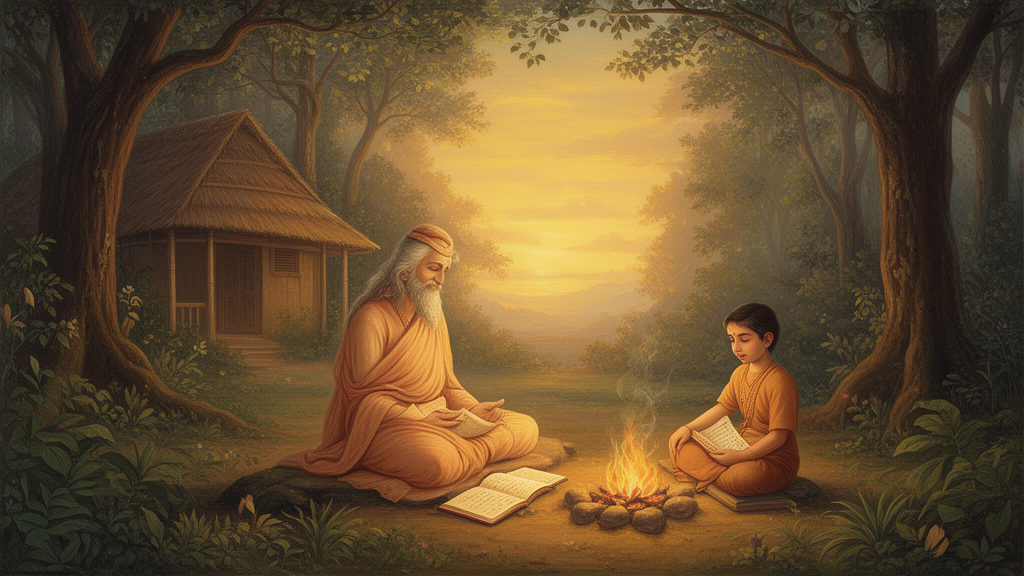
The word Upanishad is commonly explained as “sitting near” a teacher, a reference to students receiving teaching in close attention. Wikipedia’s article on the Upanishads notes this etymology as one of the topics it covers, alongside development, classification and philosophy.[1]
When readers search for “ten Upanishads,” they are usually looking for the principal group that is most often studied, quoted and commented on. That group is not the same as every Upanishad in existence. The Upanishads form a large body of literature, and Wikipedia’s classification section distinguishes the principal texts from a longer traditional list called the Muktika canon, which includes major and minor texts.[3]
The ten principal Upanishads
A widely used summary of the principal group lists the following texts, with their associated Vedic branches:[4]
- Isha (Shukla Yajurveda)
- Kena (Samaveda)
- Katha (Krishna Yajurveda)
- Prashna (Atharvaveda)
- Mundaka (Atharvaveda)
- Mandukya (Atharvaveda)
- Taittiriya (Krishna Yajurveda)
- Aitareya (Rigveda)
- Chandogya (Samaveda)
- Brihadaranyaka (Shukla Yajurveda)
The Wikipedia classification of the Upanishads by Veda also places many of these names under the same Vedic branches, including Aitareya under the Rig Vedic group, Kena and Chandogya under the Sama Vedic group, and Brihadaranyaka, Isha, Taittiriya and Katha under the Yajur Vedic group.[3] The source used for this guide does not show the full Atharva Vedic list, so the Atharvaveda attributions for Prashna, Mundaka and Mandukya should be checked against a fuller scholarly source before publication.
Why the list is not fixed
Different editions and traditions do not always agree on the same ten. A standard edition may include texts such as Shvetashvatara or Maitri in its wider Upanishadic listing, which are not part of every ten-text summary.[3][4] Readers should treat “the ten” as a widely taught core set, not as a universal verdict that excludes other Upanishads.
This flexibility is important for accuracy. Sampradayas, or teaching lineages, have often emphasized different texts, and modern anthologies also choose different selections for different readers.
How the Ten Upanishads relate to the Vedas
The Upanishads are traditionally counted among the shruti, the category of texts regarded as revealed or heard in Hindu tradition. Wikipedia’s scripture overview places the Upanishads within the Vedic literature, alongside the Samhitas, Brahmanas and Aranyakas.[1] These layers are often described in this general order, though the exact dates and relationships are debated by scholars.
Samhita, Brahmana, Aranyaka and Upanishad
In a simplified account, the Samhitas are collections of hymns, the Brahmanas explain ritual, and the Aranyakas are associated with forest-based reflection. The Upanishads developed as the later philosophical and meditative texts within the Vedic corpus. Grokipedia describes the Upanishads as the concluding part of the Vedas, often called the Jnana-Kanda or knowledge section, and says they shifted attention from ritual toward questions about reality and liberation.[4] Because Grokipedia is an AI-generated encyclopedia, this description should be checked against academic sources before it is repeated as settled history.
Why Vedic branches matter
Each Upanishad is linked to a Vedic school, called a shakha, and each school preserved its own tradition of recitation and texts. This is why an Upanishad may be described as Rig Vedic, Sama Vedic, Yajur Vedic or Atharva Vedic. The label does not mean that the text is only a ritual manual; many Upanishads are philosophical dialogues or meditative treatises.
Core teachings of the Ten Upanishads
The principal Upanishads are not a single creed. They contain dialogues, riddles, meditations and arguments, and different texts emphasize different ideas. Still, several themes recur often enough to help beginners orient themselves.
Atman and Brahman
The two most important concepts are Atman, usually translated as the individual self, and Brahman, the ultimate reality. Grokipedia summarizes a central theme of the principal Upanishads as the identity between the individual self and the universal essence.[4] Wikipedia’s Upanishads article also has dedicated sections on Atman and Brahman, and on reality and maya, showing that these are central to the wider philosophical discussion.[3]
The phrase Tat Tvam Asi, often translated as “You are That,” is one of the best-known expressions of this identity. Wikipedia’s image caption on the Upanishads page refers to this phrase, and Grokipedia describes it as a mahavakya or great saying.[1][4] Readers should note that the phrase is deeply interpreted in Vedanta commentaries, and its meaning is not limited to a single reading.
Karma, samsara and moksha
Many Upanishads discuss rebirth, action and liberation. Grokipedia states that the texts address the cycle of rebirth (samsara), the law of cause and effect (karma) and liberation (moksha).[4] In traditional understanding, moksha is freedom from the cycle of rebirth, but descriptions of it vary between schools. A reader should not assume that every Upanishad presents the same account of liberation.
Knowledge, meditation and ethical life
The Upanishads often present knowledge as more than information. Their teaching is commonly described as a path of inquiry, meditation and self-understanding. Grokipedia says these texts guide seekers toward ethical living and self-inquiry, although the source is a secondary summary and not a primary study.[4] A useful way to read them is to notice where the text presents an argument, where it presents a story, and where it presents an instruction for meditation.
A guide to the principal texts
The ten principal Upanishads are easier to approach when grouped by their form. The following overview is not a substitute for a full translation, but it can help new readers decide where to begin.
Prose Upanishads: Brihadaranyaka and Chandogya
The Brihadaranyaka and Chandogya are among the longest and most widely studied principal Upanishads. Their prose contains dialogues, cosmological speculation and teachings on the self. Grokipedia groups Brihadaranyaka, Chandogya, Taittiriya and Aitareya among the major prose Upanishads.[4] Because these texts are long, beginners often benefit from reading a modern translation with notes or a commentary that marks the sections clearly.
For example, the Chandogya is connected with the phrase Tat Tvam Asi, while the Brihadaranyaka is frequently studied for its dialogues on the self and its discussions of Brahman.[1][4] Readers can compare these two texts to see how a shared concept is explained through different stories and images.
Dialogue and story: Katha and Nachiketa
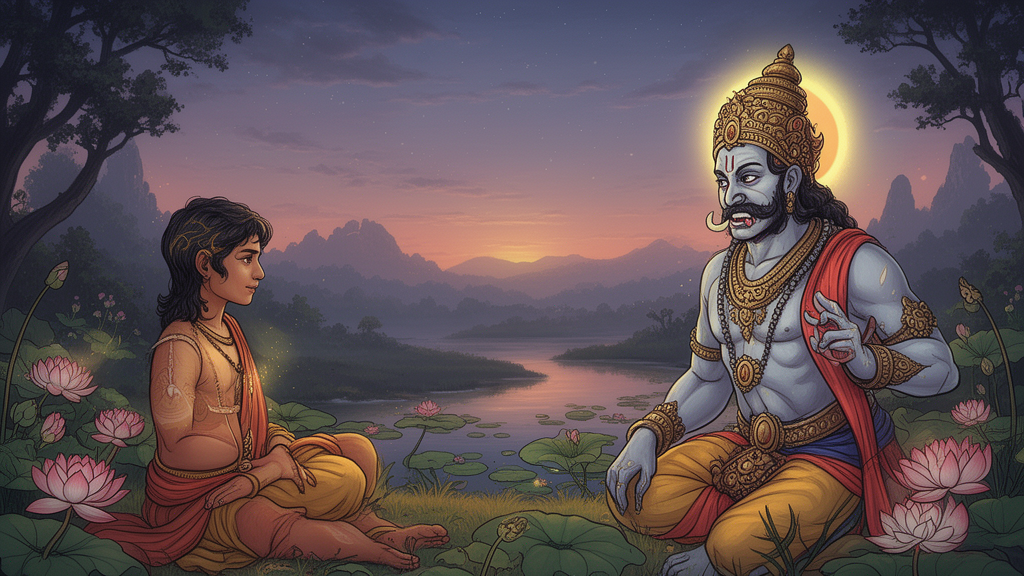
The Katha Upanishad is one of the best-known narrative Upanishads. Wikipedia’s image caption on the Upanishads page refers to Yama teaching Nachiketa in the Katha Upanishad, and this dialogue is one of the clearest entry points for many readers.[1] The story explores death, knowledge and the self through a conversation between a young seeker and the lord of death. Because it is narrative, it is often easier to read than abstract metaphysical passages, though its philosophical content is still demanding.
Shorter and verse-like texts
Several principal Upanishads are short and dense. Grokipedia groups Isha, Kena, Katha, Prashna, Mundaka and Mandukya among the verse and dialogic Upanishads.[4] Isha is commonly studied for its short verses on action, renunciation and the relationship between the self and the whole. Mandukya is often studied because of its concise analysis of the syllable Om and states of consciousness, though its treatment is often discussed together with the Mandukya Karika and Vedanta commentaries rather than alone.
When reading short texts, it is helpful to read slowly and compare several translations. A brief verse may carry more meaning than its length suggests, and traditional commentaries often provide the context that a short translation omits.
Approaching the texts in a practical order
- Start with a translation that includes a clear introduction and notes on terminology.
- Read one Upanishad at a time, noting the question or problem the text opens with.
- Look for recurring words such as Atman, Brahman, knowledge and liberation.
- Compare a traditional commentary, a modern academic study and a devotional reading where possible.
- Keep a note of which claims are from the text itself and which are from commentary or interpretation.
Commentaries and schools of interpretation
The meaning of the Upanishads has been shaped by centuries of commentary. Grokipedia attributes major commentaries on the ten to Adi Shankaracharya, who is commonly associated with non-dualistic Advaita Vedanta.[4] This attribution is widely discussed in academic and religious literature, but the source here is a secondary summary. Readers who want to verify the historical claim should consult a reliable academic history of Vedanta.
Wikipedia’s Upanishads article lists several Vedanta schools that interpret these texts in different ways: Advaita Vedanta, Bhedabheda, Vishishtadvaita and Dvaita.[3] These schools do not all understand Atman and Brahman in the same way. For example, Advaita is usually associated with non-dual identity, while Dvaita emphasizes a real distinction between the individual and the supreme. Explaining these differences helps avoid presenting one school’s view as the only reading of the Upanishads.
Scripture, commentary and modern interpretation
It is useful to separate three things when reading any Upanishad. First, the text itself is the scripture. Second, the commentary is a traditional explanation, often written by a teacher within a particular lineage. Third, a modern interpretation may come from a scholar, a translator, a teacher or a devotional writer who applies the text to present-day life. All three can be valuable, but they should not be treated as the same kind of evidence.
Translations and editions
Many readers first encounter the Upanishads through translations. A translation is an interpretation, and translators must choose English words for Sanskrit terms that may have several meanings. Words such as Atman and Brahman are often left untranslated for this reason.
Modern translation projects
The Wikipedia article on the Upanishads notes a section on translations and another on reception in the West, showing that translation has shaped how these texts are understood outside India.[3] A well-known example is the English version associated with W. B. Yeats and Shri Purohit Swami. Wikipedia describes this book, titled The Ten Principal Upanishads, as an English version translated by the Irish poet W. B. Yeats and the Indian-born teacher Shri Purohit Swami, published in 1938.[2]
According to the same source, Yeats and Swami worked on the translation through the 1930s, with much of the work done in Majorca between 1935 and 1936. Shri Purohit Swami knew Sanskrit, English, Hindi and Marathi, while Yeats knew English.[2] The Yeats-Swami book is therefore a literary and collaborative translation, and readers should check it alongside more literal translations.
Traditional and archive editions
The Internet Archive holds a digitized item titled Ten Upanishads by Swami Sivananda, listed in its Spirituality and Religion collection.[5] The catalog page was inspected for this guide, but its full text was not reviewed. Readers should therefore confirm the edition, translation and scope before relying on it for study or citation.
Checking a translation
- Check whether the translator states the source text and edition.
- Look for notes explaining key Sanskrit terms.
- Compare how several translations render a central word such as Atman or Brahman.
- Be cautious when a translation adds explanatory phrases that are not in the original.
Ten Principal Upanishads and The Ten Principal Upanishads: a common mix-up
Searchers often see the title The Ten Principal Upanishads and assume it is a separate Sanskrit text. This is a matter of terminology. The W. B. Yeats and Shri Purohit Swami book uses the phrase as its English title, while the traditional group of ten principal Upanishads refers to Sanskrit texts in the Vedic tradition.[2][4] Keeping these two meanings apart prevents confusion about authorship, date and religious status.
Religious and historical context
The Upanishads are scripture in Hindu tradition, but they are also historical texts with a complex composition history. Wikipedia’s article covers topics such as authorship, chronology and geography, reflecting the fact that scholars do not agree on a single history.[3] Grokipedia gives a date range of roughly 700 to 300 BCE for oral composition of the principal Upanishads.[4] Because scholars disagree and the sources here are limited, this guide does not treat that range as settled. Readers who need dates for research should consult academic histories of Vedic literature.
Religious meaning and historical dating should be kept separate. A devotee may read the Upanishads as revealed truth, while a historian may study the same texts as evolving literature in a particular social and intellectual setting. Both approaches can be respectful, but they answer different questions.
Practical examples for readers
Suppose a reader wants to understand the idea that the self is connected with ultimate reality. One useful method is to read a short passage from the Chandogya, then read the Katha dialogue on the self, and then compare a commentary on both. The reader can note the image or example used, the claim being made, and the way later schools explain it. This method keeps the text, the commentary and the interpretation distinct.
Another example is the Isha Upanishad, which is short enough to read in one sitting. A reader can list the main terms, mark which verses are about action and which are about knowledge, and then compare two translations. This exercise shows how translation choices change the feel of a verse.
Frequently asked questions
Are the Ten Upanishads the only Upanishads?
No. The ten principal Upanishads are a widely studied group, but the wider Upanishadic literature is much larger. Wikipedia’s classification section distinguishes principal texts from a longer traditional list known as the Muktika canon.[3]
Do all Hindus read the same ten Upanishads?
No single reading list applies to all Hindus. Different traditions, teachers and regions emphasize different texts and commentaries, so a reader should identify the lineage or tradition behind a particular study guide.
Where should a beginner start?
Many beginners start with a short Upanishad such as Isha or a narrative text such as Katha. A translation with an introduction and glossary is more helpful than a bare text.
Is Tat Tvam Asi the main message of the Upanishads?
It is one of the best-known phrases and is central to many Vedanta interpretations, but it is not the only teaching. The Upanishads also address karma, liberation, meditation and ethics.[1][4]
Closing takeaway
The Ten Upanishads are best understood as a study group of principal Sanskrit texts within the Vedic tradition. They explore Atman, Brahman, liberation and knowledge through dialogue, story and meditative reflection. Their meaning has been developed through many commentaries and translations, and a careful reader should distinguish the text, the tradition, the commentary and modern interpretation. A good next step is to choose one short Upanishad, read it in a translation with notes, and compare it with a traditional commentary.
Related HindusGod.com reading
Readers may also explore the following related draft pages, which may not be public yet. Links should be checked again before publication: Ten Principal Upanishads, Ten Upanishads of Four Vedas, Upanishads overview, About Upanishads in English, Essence of the Upanishads and Aurobindo Upanishads.
Sources and further reading
- Upanishads, Wikipedia: used for etymology, classification, Vedic branch listings, philosophical headings, Vedanta school headings and image-caption references.
- The Ten Principal Upanishads, Wikipedia: used for the description of the Yeats and Shri Purohit Swami English translation.
- The Ten Principal Upanishads, Grokipedia: used only as a secondary summary for the principal list, themes and dating range; it should be replaced with academic sources before publication.
- Ten Upanishads by Swami Sivananda, Internet Archive: used to identify a digitized edition in the catalog; its content was not reviewed.