The ten principal Upanishads are the traditional core of the Upanishadic literature, and each is associated with one of the four Vedas: the Rig, Sama, Yajur and Atharva. The usual list is Aitareya, Kena, Chandogya, Brihadaranyaka, Isha, Taittiriya, Katha, Mundaka, Mandukya and Prashna. Understanding which Veda each text belongs to, and how the tradition arranges them, makes the Upanishads much easier to navigate. This guide explains the list, the Veda connections, the four Mahavakyas (great sentences), why sources give different totals, and where historical evidence ends and devotional or Vedantic interpretation begins.
What the ten principal Upanishads are

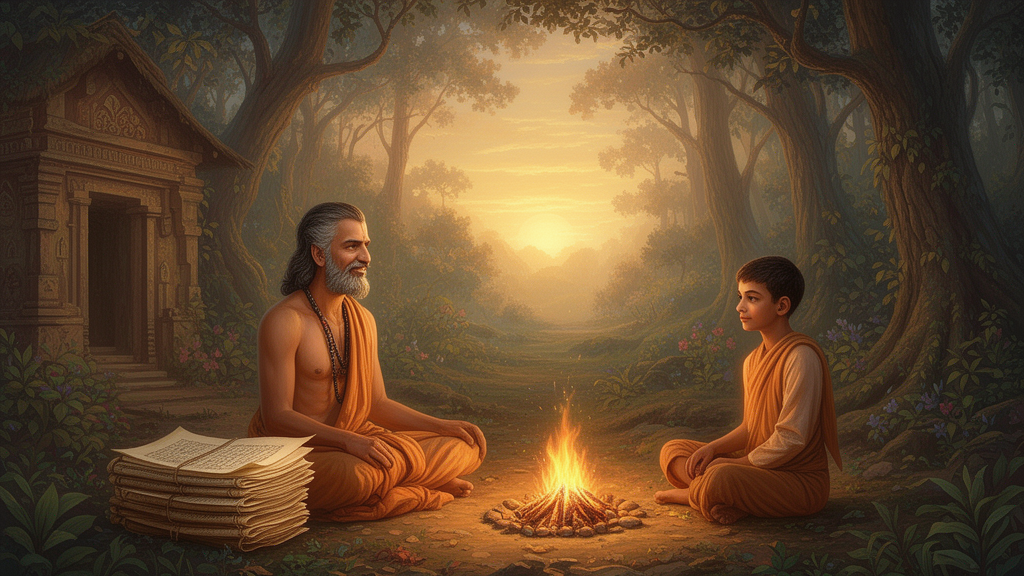
The Upanishads are the concluding portion of the Vedic corpus. A commonly cited explanation of the word is that it combines upa (near), ni (down) and shad (to sit), suggesting a student sitting close to a teacher to receive instruction that was not given publicly. The commentator Shankara also derives the word from a root meaning to loosen or destroy, reading it as that which destroys ignorance. Both explanations are traditional interpretations, and they are presented here as such.
Each Veda has four layers. The Samhita contains the mantras themselves. The Brahmana explains how the mantras are applied in ritual. The Aranyaka consists of “forest” texts that read ritual symbolically, and the Upanishad is the last layer, containing the philosophical conclusion associated with Vedanta, meaning the end of the Veda. This is why the Upanishads are sometimes described as the Vedanta.
The ten principal texts are sometimes called the mukhya (chief) Upanishads. The Wikipedia article on the Principal Upanishads describes them as the oldest and philosophically most influential texts among the Upanishads, and notes that the term refers to a canon of thirteen texts in some classifications. The ten-text list is therefore a traditional selection within a larger body of material, not the only possible boundary.
The ten Upanishads and their Vedas
The following grouping follows the Veda affiliations listed in the Wikipedia classification of Upanishads. Readers should treat the assignments as the traditional attribution rather than a claim about historical authorship, which scholars do not regard as settled.
Rig Veda: Aitareya Upanishad
The Aitareya Upanishad is the Upanishad traditionally linked to the Rig Veda. It is one of the ten principal texts and is the source of one of the four Mahavakyas, prajnanam brahma, which is commonly translated as “consciousness is Brahman.” For readers who want a Rig Veda entry point into the Upanishads, this is a natural first text to examine alongside a reliable translation.
Sama Veda: Chandogya and Kena Upanishads
The Sama Veda is connected in the tradition with two of the ten: the Chandogya and the Kena. The Chandogya is one of the longer principal Upanishads and contains the Mahavakya tat tvam asi, usually rendered as “that thou art,” cited in the source material at Chandogya 6.8.7. The Kena takes up questions about the power behind perception and speech. Both are often read as Sama Veda texts, but the specific verse citations should always be checked against the edition used.
Yajur Veda: Brihadaranyaka, Isha, Taittiriya and Katha Upanishads
Four of the ten are associated with the Yajur Veda. The Brihadaranyaka is the longest of the ten principal Upanishads, according to a widely used reference summary, and it contains the Mahavakya aham brahmasmi (“I am Brahman”) at Brihadaranyaka 1.4.10. The Isha is the shortest Yajur Veda text in this group and is often studied as a compact teaching on the relationship between the self and the whole. The Taittiriya and Katha Upanishads are also in this group. The Katha, which presents a dialogue between Yama and the young Nachiketa, is among the most widely read of the principal texts.
A note on terminology: Yajur Veda is commonly divided into Shukla (White) and Krishna (Black) branches. Brihadaranyaka is generally placed in the Shukla branch, while the classification of Isha, Taittiriya and Katha by branch should be checked against a specific scholarly edition before it is stated in print.
Atharva Veda: Mundaka, Mandukya and Prashna Upanishads
The Atharva Veda contributes three texts: the Mundaka, Mandukya and Prashna. The Mandukya is the shortest of the ten, with twelve mantras according to the summary cited here, and it contains the Mahavakya ayam atma brahma (“this Self is Brahman”). Its brevity makes it a frequent starting point for students, although its concise verses are often explained through long commentarial traditions. The Mundaka is known for a passage that describes ritual sacrifices as frail boats, a metaphor that illustrates the Upanishadic shift toward inner knowledge. The Prashna is organized as a set of questions put to a teacher.
The four Mahavakyas
The Mahavakyas are four short statements from the Upanishads that the Vedantic tradition treats as compressed expressions of the Upanishadic teaching. The tradition assigns one to each Veda. The source used for this article presents them as follows, and the citations below are those given in that source; each should be verified against a scripture edition before publication.
- Prajnanam brahma: consciousness is Brahman, from the Aitareya Upanishad 3.3, associated with the Rig Veda.
- Aham brahmasmi: I am Brahman, from the Brihadaranyaka Upanishad 1.4.10, associated with the Shukla Yajur Veda.
- Tat tvam asi: that thou art, from the Chandogya Upanishad 6.8.7, associated with the Sama Veda.
- Ayam atma brahma: this Self is Brahman, from the Mandukya Upanishad 2, associated with the Atharva Veda.
Vedanta teachers often read these four together as a sequence rather than four unrelated claims. The source article describes the arrangement as moving from awareness, to identity with Brahman, to the teaching that the individual self is not separate from it. This sequence is an interpretive reading within the Vedanta tradition and should be presented as such, not as a universal reading of the texts.
For readers, the practical value of the Mahavakyas is that they offer a short way into the larger philosophical discussions. They should not be treated as detachable slogans, since each one comes within a longer passage whose context shapes its meaning.
Why sources give different totals
Readers often encounter lists that say ten, eleven, thirteen or one hundred and eight Upanishads. These numbers are not contradictory; they describe different selections. The ten principal Upanishads follow a traditional memory verse that names the chief texts. The Wikipedia article on the Principal Upanishads describes a thirteen-text canon, which adds further texts such as the Kaushitaki, Shvetashvatara and Maitri. The source article referenced for this post reports a total of 108 in the Muktika list, a Telugu-linked tradition of 108 texts that assigns Upanishads to Vedic branches. It also notes that, in principle, there is one Upanishad for each Vedic shakha, or recension, although the surviving material does not map neatly onto that ideal.
The Vedic Heritage Portal of the Government of India makes a useful caution: in later times the Upanishads gained a more independent position, yet they still professed to belong more particularly to one or another of the four Vedas. It also states that it is difficult to ascertain the exact number that should be regarded as authentic Upanishads. Both points suggest that the number ten is best understood as a traditional and practical selection rather than a fixed historical census.
When you see a different count in another book or website, check which list the author is using. A reference to 108 Upanishads, for example, is not the same claim as a reference to the ten principal Upanishads, even though both appear in the same tradition.
Dating and authorship: where evidence is uncertain
Traditional Hinduism regards the Vedas, including the Upanishads, as shruti, meaning revealed or heard, rather than as the work of a human author. This is a devotional and scriptural claim. It is not a historical statement that scholars can verify, and it should be distinguished from academic discussion of composition.
Historians and philologists generally approach the Upanishads through language, internal references, manuscript evidence and comparison with other texts. The Wikipedia articles on the Upanishads discuss authorship, chronology and geography as separate topics, which reflects how much remains debated. Specific dates for individual texts vary widely among scholars and should be treated as approximations. This article does not assign precise dates to any of the ten texts, because the sources consulted for this post do not provide reliable grounds for doing so.
The usual approach for a responsible reader is to hold three layers apart. The first is what a named text says. The second is how a tradition, such as Advaita Vedanta, reads that text. The third is what modern scholarship says about the text’s language, origin and transmission. Each layer is legitimate, but they answer different questions.
Major philosophical themes
The ten principal Upanishads are most often studied for their discussions of Brahman, the ultimate reality, and Atman, the innermost self. The Wikipedia summary of the Principal Upanishads lists these alongside the Mahavakyas, and also covers karma, samsara (the cycle of rebirth) and moksha (liberation), as well as psychology, consciousness and proto-yogic practices. These topics appear across different texts rather than in a single doctrinal package.
Brahman and Atman
The relationship between Brahman and Atman is the central theme in many of the texts. In the Mahavakyas, the teaching is expressed in direct statements of identity. The Upanishads do not all express this relationship in the same terms, however. Some use dialogues between teacher and student, some use images such as the spokes of a wheel, and others use questions and answers. Readers who encounter only one passage may miss this variety.
Karma, samsara and moksha
The Upanishads are an important early source for ideas of karma, rebirth and liberation, which later became central to many Hindu traditions. Presenting these ideas as a single fixed doctrine would oversimplify the material. Scholars discuss how these concepts develop across texts, and different schools interpret them in different ways.
Ritual and inner knowledge
A recurring theme is the relationship between ritual and knowledge. The earlier Vedic layers focus heavily on ritual actions. The Upanishads often shift attention to the inner person who performs the ritual. The source article describes the Mundaka’s sacrifice-as-boat image and notes that the Chandogya and Brihadaranyaka show ritualists being out-argued in debate. This does not mean the Upanishads reject ritual altogether; scholars and practitioners continue to debate how these passages should be understood in relation to worship and daily observance.
Commentaries and the Vedanta schools
The ten principal Upanishads gained a central place in later philosophy largely through commentaries. The source article states that Adi Shankaracharya wrote commentaries on the ten principal Upanishads, and that the wider Vedanta tradition rests on them. Commentary is a separate category from scripture, and readers should note when a passage is being explained by a commentator rather than stated by the text.
Later Vedanta schools read the same texts in different ways. According to the Wikipedia article on Upanishads, the main schools discussed include Advaita Vedanta, Bhedabheda, Vishishtadvaita and Dvaita. Their interpretations of Brahman, the self and the world differ significantly. A student who studies one school’s reading should be aware that other schools may reach different conclusions from the same passages.
This diversity is central to understanding the Upanishads within Hinduism. The texts are not a single book with one agreed meaning. They are a body of material that has been interpreted across centuries by communities with different philosophical commitments.
How to begin reading the ten Upanishads
The source article referenced for this post promises a practical reading order, but the sources consulted here do not provide one in full, so the following is an editorial suggestion rather than a sourced prescription. A reader who is new to the material might start with a short text such as the Mandukya, whose twelve mantras make it manageable in one sitting. The Isha, which is also brief, offers a compact introduction to its themes. From there, a reader might move to the Katha for its narrative structure, then to the Chandogya or Brihadaranyaka, which are longer and more demanding.
Whatever order you choose, use a translation that identifies its sources and explains its choices. Compare at least two translations for difficult passages. Where a translation adds words that are not in the Sanskrit, a good edition will mark them. Note the difference between a verse, a commentary and a summary, and keep a record of the chapter and section numbers you cite.
Reading also benefits from a teacher or study group where the tradition is practised, but this is a matter of personal and community choice. Scholarly study and devotional study can both be valuable. They answer different questions and do not have to be mixed.
Traditions and communities differ
Hindu communities do not all approach the Upanishads in the same way. Some traditions emphasize Vedanta philosophy and its commentaries. Others focus on devotional worship of a personal deity, drawing on texts such as the Puranas and the Bhagavad Gita. Many people encounter the Upanishads through recitation, family teaching or temple culture rather than through formal study. Regional languages, local customs and the teachings of particular lineages all shape how these texts are used.
For this reason, avoid statements that all Hindus accept one interpretation of the Upanishads. A more accurate description is that the Upanishads are a foundational body of scripture within Hindu thought, read differently across traditions. A reader who wants to know what a specific community believes should ask that community directly or consult a source written from within that tradition.
Related HindusGod.com reading
Readers who want a broader overview may find these related guides useful. The Ten Upanishads guide covers the same core list in more depth. For a shorter introduction to the four-text grouping, see the four Upanishads article. The discussion of the Vedas and the Upanishads explains how the two relate in the Vedic corpus. Readers interested in how the Upanishads came to be associated with the Vedas can start with the article on the origin of the Vedas and Upanishads. For the four Vedas themselves, see the Four Vedas in Hinduism and the overview of the Vedas. Those who want a wider list of Upanishad titles can read the Upanishads overview and the article on the ten principal Upanishads. Readers who encounter the figure 112 will find context in the article on 112 Upanishads. Comparisons between Vedic branches are covered in the article on different Vedas and Upanishads, and the relationship between the Hindu Vedas and the Upanishads is discussed in this guide.
Frequently asked questions
Are the ten principal Upanishads the only authentic Upanishads?
No. The ten are a traditional and widely taught core. Other lists include more texts, and the Vedic Heritage Portal notes that it is difficult to determine exactly which texts should be regarded as authentic. The answer depends on which tradition or scholarly list is being followed.
Which Upanishad should a beginner read first?
There is no single required answer. Many readers begin with a short text such as the Mandukya or Isha, using a translation with clear notes. This is a practical suggestion rather than a traditional rule.
Do the Mahavakyas appear in the Upanishads themselves?
Yes, according to the source article used for this post, each of the four Mahavakyas is drawn from a specific Upanishad passage. Readers should check each citation in a reliable edition, because the wording and numbering can vary across editions.
Summary and next step
The ten principal Upanishads are the Aitareya, Kena, Chandogya, Brihadaranyaka, Isha, Taittiriya, Katha, Mundaka, Mandukya and Prashna. They are traditionally linked to the Rig, Sama, Yajur and Atharva Vedas, and they contain the four Mahavakyas that Vedanta teachers treat as summaries of the Upanishadic message. Counts such as eleven, thirteen or 108 refer to different lists, and dating and authorship remain matters for scholarly discussion. A careful reader keeps scripture, tradition, devotion and scholarship distinct, checks citations against trustworthy editions and remembers that Hindu communities read these texts in varied ways. The next step is to choose one short Upanishad, read it in a reliable translation alongside its commentary tradition, and compare how two Vedanta schools understand it.
Sources and further reading
- Upanishads, Wikipedia: general overview of the Upanishads, their Veda classification, Vedanta schools and translations.
- Principal Upanishads, Wikipedia: the principal texts, the thirteen-text canon, themes and commentarial tradition.
- The 10 Principal Upanishads: List, Vedas and the Four Mahavakyas, Divine Aarti: the ten-text list, Veda affiliations, Mahavakya citations and the Shankara commentary statement. This is a devotional website, so its claims should be checked against a scripture edition.
- Upanishads, Vedic Heritage Portal: government-hosted overview noting the four Vedas and the difficulty of fixing the authentic number of Upanishads. Full page content was not inspected for this draft, so confirm before publication.