In Sanskrit, sūtra (सूत्र) most commonly means a short aphorism, a concise rule or formula, or a text built from such aphorisms. Its literal sense is often given as “thread” or “string,” and the word’s core idea is compression: a few words hold a larger body of teaching that a teacher unpacks orally. Wikipedia describes the term as “formula” in its literal sense and as an aphorism or collection of aphorisms in Indian literary traditions.[1]
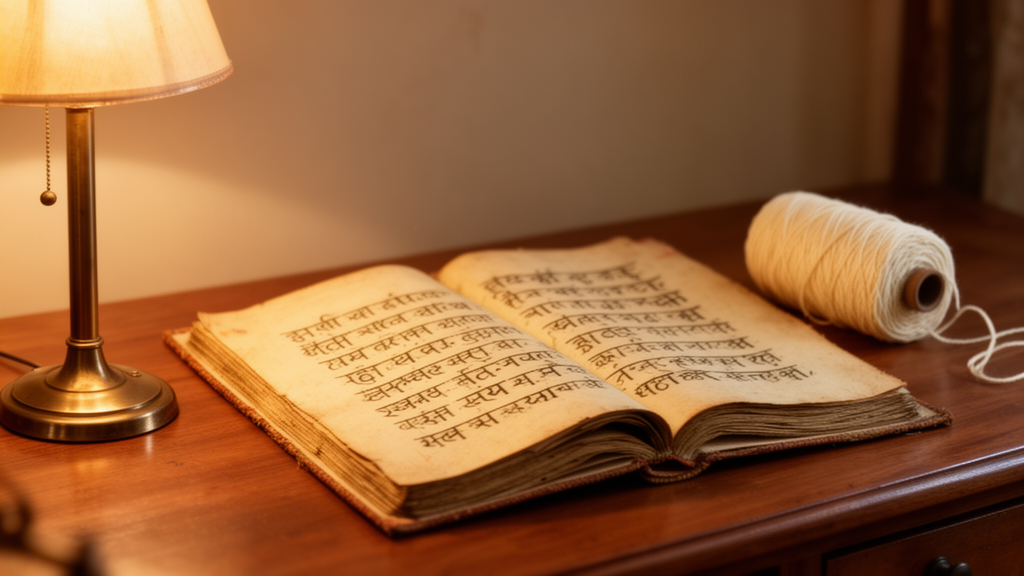
This article explains the basic meaning of sutra, how the form developed in Hindu literature, how it differs in Buddhism and Jainism, and why the word can carry different senses in different texts.
Quick answer: what sutra means in Sanskrit

The short answer is that a sutra is a condensed rule or aphorism. A dictionary entry for the Sanskrit word lists several primary meanings: thread or string, a concise aphoristic rule or formula, and a text composed of such aphorisms.[4] In a religious or philosophical setting, the word usually refers to the second or third sense.
When a reader sees “sutra” in a title such as Yoga Sutras or Brahma Sutras, the word signals a systematic text made of brief statements rather than a narrative, hymn, or long prose commentary.
Core meanings of sūtra
Thread or string
The most literal meaning is “thread.” Wisdom Library’s glossary records the word as a neuter noun and gives meanings that include a golden thread or neck-chain in a classical Indian dramaturgy treatise. In the Nāṭyaśāstra, a sūtra can refer to a type of ornament worn at the neck or waist, a usage described in the glossary’s reference to chapter 23.[2] This sense is physical and concrete, and it is separate from the textual meaning.
Formula or condensed rule
The textual sense developed from the idea of a thread that holds things together. A Puranic glossary entry in the same source gives a definition for sūtra as “few letters, free from doubt, terse, and universal.”[2] That short definition captures what makes the form distinctive: economy of words and broad applicability.
Aphorism or manual
Wikipedia describes a sutra as an aphorism or collection of aphorisms in the form of a manual, or more broadly a condensed manual or text.[1] Each sutra may be a short rule, “like a theorem distilled into few words or syllables,” around which teaching on ritual, philosophy, grammar, or another field can be built.[1]
Why the word means “thread”
The link between thread and text is a common explanation, and it is useful for understanding the form. Opensadhaka’s Sanskrit lexicon entry gives the root as sīv (सीव्), meaning to sew or stitch, and explains the sense of thread holding beads together in a necklace.[4] That page presents the etymology as an explanation of the word’s sense; readers who need a formal dictionary etymology should check a standard Sanskrit dictionary, because the derivation is discussed in more than one way in reference works.
The same entry links the form to memorization. Because teachings were transmitted orally, they had to be compressed enough to be memorized and then expanded by a teacher.[4] This is a plausible functional explanation rather than a settled historical fact, and it should be treated as an interpretation.
Sutra as a literary form
Wikipedia states that in Hinduism, sutras are a distinct type of literary composition, a compilation of short aphoristic statements.[1][3] The form was used across many fields. Every school of Hindu philosophy, Vedic guides for rites of passage, various arts, law, and social ethics developed their own sutras to help transmit ideas from one generation to the next.[3][6]
A sutra text typically depends on commentary. The Opensadhaka lexicon describes the Yoga Sutras as requiring a commentary, or bhāṣya, to unpack the terse statements.[4] Readers who approach a sutra without a commentary often find that the text is cryptic on its own. This is one reason sutra literature is closely linked to commentarial traditions and to teacher-student instruction.
Features of a sutra
- Brevity: statements are short, sometimes only a few words.
- Systematic scope: many sutras organize a whole field, such as yoga, grammar, or Vedanta.
- Dependence on interpretation: meaning is often expanded through commentary.
- Transmission: the form supports oral teaching and memorization.
Sutras in Hindu traditions
Sutra literature in Hinduism covers several different genres. It is useful to separate them, because a reader who looks for a single universal meaning may be confused by the variety.
Vedic and ritual sutras
Wikipedia notes that the oldest sutras of Hinduism are found in the Brahmana and Aranyaka layers of the Vedas.[1] Over time, ritual manuals, sometimes described as Vedic guides for rites of passage, took the sutra form.[3] Ritual sutras set out procedures, sequences, and obligations for specific rites. Their use is tied to particular Vedic schools and traditions, so specific practices should be understood as tradition-specific rather than universal.
Dharma and social-ethical sutras
Sutra literature also covered law and social ethics.[3] Dharma sutras are an example of this wider category. Their content reflects the norms of the communities and schools that produced them, and they should be read in historical and textual context rather than as direct guidance for all Hindus today.
Philosophical sutras
Several well-known Hindu texts are called sutras because they condense a philosophical system into aphorisms.
- Yoga Sutras of Patanjali: Opensadhaka’s summary states that the text contains 196 sutras arranged in four chapters, systematizing yoga.[4] The number of sutras is a count that should be checked against a specific critical edition, since numbering can vary between editions.
- Brahma Sutras (Vedanta Sutras): Opensadhaka describes them as 555 aphorisms systematizing the teachings of the Upanishads, forming one of the three pillars of Vedanta with the Upanishads and the Bhagavad Gita.[4] The count and the “three pillars” framing are standard descriptions in Vedanta study but are presented here as a traditional classification.
The Vedanta tradition itself is interpreted differently by different schools, so readers who study the Brahma Sutras should note that commentarial traditions give different readings of the same aphorisms.
Grammar and logic
Opensadhaka notes that Panini’s Ashtadhyayi is a grammar of Sanskrit written in sutra form, and that the format was also used in Nyaya (logic), Vaisheshika (atomism), and Mimamsa (ritual exegesis).[4] The grammatical sutras show that the form was not limited to religious teaching. It was a method for systematic knowledge across disciplines.
Sutras in Buddhism and Jainism
The word sutra also appears in Buddhist and Jain contexts, and the meaning shifts there. Wikipedia explains that in Buddhism, sutras (also called suttas) are canonical scriptures, many regarded as records of the oral teachings of Gautama Buddha. They are not aphoristic, but are quite detailed, sometimes with repetition.[1] In Jainism, sutras, also known as suyas, are canonical sermons of Mahavira contained in the Jain Agamas.[1]
Wikipedia also notes that the Buddhist usage may reflect a derivation from Vedic or Sanskrit sūkta (well spoken), rather than from sūtra (thread).[1] This is a point of scholarly discussion, and it is useful for readers who meet both terms. The Buddhist Lotus Sutra and Heart Sutra, for example, are long or medium-length texts, not aphorism collections in the Hindu sense.
Reading a sutra in context
Because sutras are compressed, the most reliable way to understand them is to read them with a commentary and to check the specific edition being used. Three habits help:
- Identify the tradition. A Yoga Sutra, a Brahma Sutra, and a Buddhist sutra belong to different literary and religious worlds.
- Read the surrounding chapter or section. Sutras often depend on the terms defined in earlier sutras.
- Compare commentaries. Schools may explain the same word differently.
Example: Yoga Sutra 1.2
Opensadhaka quotes Yoga Sutra 1.2 as yogaś citta-vṛtti-nirodhaḥ and gives the translation “Yoga is the cessation of the fluctuations of the mind.”[4] Readers should note that this is a translation given on that page. Different translators render the key terms differently, and commentators have debated the meaning of “nirodha” and the role of practice. The sentence is an example of the sutra form: a short statement whose full sense depends on commentary and practice.
Example: Brahma Sutra 1.1.1
Opensadhaka also gives Brahma Sutra 1.1.1 as athāto brahma-jijñāsā, rendered there as “Now, therefore, the inquiry into Brahman.”[4] The page explains that the opening word atha is often read as implying prior qualifications, and that atah gives the reason for the inquiry. This is one interpretation of the opening line, and Vedanta commentators read it in different ways.
Other senses of sutra in Sanskrit texts
Not every occurrence of sūtra refers to a philosophical text. Sanskrit dictionaries and glossaries record a range of usages.
- Ornament or thread: the Nāṭyaśāstra glossary describes sūtra as a neck-chain or waist ornament in dramaturgical and costume contexts.[2]
- Synopsis or codes: the Sanskrit Dictionary entry for sutra lists senses such as synopsis or notes, used in the Caitanya Vaishnava literature cited on that site.[3] In those contexts, sutra can mean a summary outline that a later text expands.
- Vedanta-sutra: the same dictionary lists Brahma-sutra and Vedanta-sutra as names for the Vedanta aphorisms.[3]
- Puranic usage: Wisdom Library’s glossary lists a Puranic entry describing sūtra as a heavenly ornament, in a passage about Shiva’s neck after he swallowed poison.[2] This is a narrative description, not a definition of the aphoristic sense.
These uses show why context is essential. A reader who sees “sutra” in a dictionary, a ritual manual, a grammar, and a Buddhist scripture may find four different senses in play.
Common confusions
Sutra, sutta, and sukta
Sutra, sutta, and sukta are related in some discussions but differ in meaning and usage. Wikipedia notes the Buddhist term sutta and the possible derivation of Buddhist usage from sūkta.[1] Readers should not assume that these words are interchangeable.
Sutra and mantra
A mantra is typically a sacred sound, phrase, or verse used in recitation or devotion, while a sutra is a text form defined by aphoristic compression. A verse can be a mantra in one context and part of a sutra in another, but the terms describe different categories. Mantra material should be checked against its own source and tradition.
Sutra and a religious promise
Studying a sutra is a form of scriptural and philosophical learning. The sources cited here describe the literary form, its uses, and its commentarial traditions. They do not establish that reading or reciting a sutra produces a specific material benefit. Claims about spiritual results belong to devotional belief and should be presented as such.
Practical examples for readers
If you are looking up a sutra for study, these questions can guide your reading:
- Is the text a ritual manual, philosophical system, grammar, or devotional scripture?
- Which school or tradition produced it?
- Does the edition include a commentary?
- Is the translation attributed to a named translator or edition?
For devotional use, many readers follow the teaching of their own lineage or teacher. Practices, recitation patterns, and interpretations vary across Hindu communities, regions, and sampradayas, so guidance should be sought from a tradition-appropriate teacher when needed.
Related HindusGod.com reading
The following HindusGod.com pages are WordPress drafts at the time of writing. They may not be public until the owner publishes them, so readers should treat these as future links to confirm.
- For a broader overview of the word in Sanskrit contexts, see Sanskrit Sutra (URL to confirm: draft, may not be public).
- For the meaning of the term in another context, see Meaning Sutra (URL to confirm: draft, may not be public).
- For a Buddhist sutra written in Sanskrit, see Heart Sutra Sanskrit (URL to confirm: draft, may not be public).
- For a Buddhist sutra with a longer narrative form, see Lotus Sutra Sanskrit (URL to confirm: draft, may not be public).
- For a Buddhist sutra on the perfection of wisdom, see Prajnaparamita Sutra Sanskrit (URL to confirm: draft, may not be public).
- For a Jain text in the sutra tradition, see Tattvartha Sutra Sanskrit (URL to confirm: draft, may not be public).
These links are included because they cover related terms and traditions. They are not presented as evidence for the claims above.
Frequently asked questions
Is sutra always a religious text?
No. Sutra literature includes grammar, logic, ritual manuals, law, and arts. Some sutras are religious or philosophical, but the form was used across disciplines.[1][3][4]
Does sutra mean thread?
The literal sense is commonly given as thread or string, and the textual sense developed from that idea of holding teachings together. Readers should note that the etymology is presented in different ways in reference works.[1][4]
Why are sutras hard to understand alone?
Sutras are designed to be terse. Their meaning is often expanded through commentary and teacher-student transmission, so a commentary is usually necessary for study.[4]
Summary
In Sanskrit, sutra most often means a concise aphorism, rule, or formula, and by extension a text composed of such aphorisms. Its literal sense of thread helps explain the form: many teachings are held together in a few words and expanded through commentary. The meaning changes with context, so a ritual manual, a Yoga Sutra, a grammar, a Buddhist sutta, and a Jain sermon should each be read on their own terms. For study, identify the tradition, consult a commentary, and check the edition and translation.
Sources and further reading
- Sutra, Wikipedia: general overview of the term across Hinduism, Buddhism, and Jainism, including etymology and the sutra form.
- Sutra, Sūtra: 47 definitions, Wisdom Library: glossary entries for the word in Puranic, dramaturgical, and other contexts.
- Sutra, Sanskrit Dictionary: dictionary entries showing usages of sutra in Caitanya Vaishnava and Vedanta-related texts.
- Sutra in Sanskrit, Opensadhaka Sanskrit Lexicon: summary of meanings, etymology, and examples from Yoga Sutras and Brahma Sutras; verify verse text and translations against a scripture edition and a standard academic translation.
Readers who want to verify the Sanskrit text of specific sutras should consult a critical or scholarly edition of the relevant work and a translation with a named translator.