Tantra shastra in Bengali refers to tantric texts, reference works and modern Bengali-language books that explain tantra. The phrase does not point to one single book or one single tradition. Some Bengali editions are translations or reprints of older texts, some are dictionaries or explanatory works, and some are modern compilations written for general readers. Reading them well means checking which kind of book you have in hand, who translated or compiled it, and which claims come from the text itself and which come from later commentary.
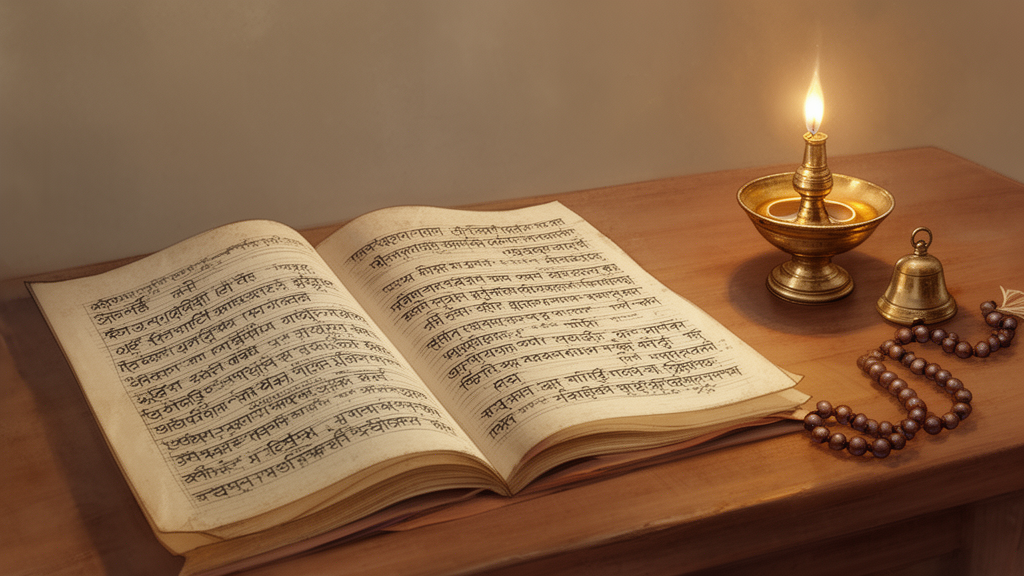
This guide explains the main categories, shows examples from Bengali-language books and archive records found during research, and offers a practical way to evaluate a Bengali tantra book before you rely on it. It is written for readers who are curious about Hinduism and Bengal’s religious culture, and for those who want to study tantra responsibly.
What “tantra shastra” means
The word tantra is commonly understood as a body of ritual, meditative and devotional teachings, often presented as a dialogue between a deity and a devotee or between a teacher and a disciple. Shastra means a treatise or authoritative teaching. Together, tantra shastra usually refers to texts or instructional traditions in this family, though the exact meaning depends on the author and period.
Tantra is not a single system. Scholars and practitioners commonly distinguish several broad strands, including Shaiva, Shakta (goddess-centred), Vaishnava and Buddhist tantra. In Bengal, goddess worship and tantric ideas have been especially visible, and the names of Kali, Tara and Kamakhya appear often in local literature. Because these strands differ in deities, ritual vocabulary and social settings, a statement about “tantra” in general should always be checked against the specific text or tradition it refers to.
It also helps to know that the word tantra appears in book titles in many ways. A modern book may use the word for marketing, for cultural interest, or for a folklore collection, even when its content is not a ritual manual. This is one reason the source of a Bengali tantra book matters as much as its title.
Examples of tantra-related books in Bengali
The following examples come from publisher pages and an archive catalogue record that were inspected during research. They show the range of material available, but they do not by themselves establish what each text teaches.
Kama Shastra or Mohini Tantra (Bengali edition)
A Bongo Hridoy product page lists Kama Shastra or Mohini Tantra (Bengali) as a book in the “Books & Magazines” category. The publisher describes it as compiled by Surendranath Bhattacharya and as an introduction to historical teachings, traditional beliefs and literary concepts associated with Kama Shastra and Mohini Tantra, written in simple Bengali. The same page describes it as suitable for students, researchers and general readers interested in Indian culture and tantra studies.
Two points deserve care. First, the description is the publisher’s own marketing text, so it tells you what the seller claims about the book rather than independently confirming its contents. Second, the title joins two subjects, Kama Shastra (a text on pleasure and worldly life) and Mohini Tantra. These are not the same genre, and a combined title does not mean the two traditions are identical. A reader should look at the table of contents or a sample before assuming how the book treats either subject.
Mahanirban Tantram (Bengali-script record)
An Internet Archive record titled Mahanirban Tantram lists Kaliprasanna Bidyaratna as translator and identifies the item as a Bengali-script digital copy. Mahanirvana Tantra is widely known in Bengal and beyond as a tantric text, but the archive page inspected during this research shows only the catalogue information and archive navigation. It does not, on its own, confirm the text’s contents, the translation’s accuracy or the edition’s date. Anyone using the digitised copy should compare the Bengali text with a printed edition or a scholarly study before quoting it.
Tantra Abhidhana (Bengali)
An Internet Archive record for Tantra Abhidhana (Bengali), edited by Panchanana Shastri and published by Nava Bharata Publications, Kolkata, is listed in the archive. The word abhidhana is generally understood as a lexicon or dictionary, so a title like this would usually be a reference work explaining technical terms. As with the other archive record, the inspected page did not provide the entries themselves, so the exact coverage should be checked in the scan or print copy.
Kamrup Kamakhya Tantra Shastra
A Bongo Hridoy page presents Kamrup Kamakhya Tantra Shastra as a Bengali book connected with tantra philosophy, mantra traditions and the Kamakhya region. The page links the Kamakhya tradition with Assam and with goddess worship. These are useful pointers, but the description is again a publisher summary. The Kamakhya temple and its traditions are important within Assamese and wider Shakta contexts, and readers who want to study them should look for scholarly studies or the primary text rather than relying on a sales description.
A user-uploaded Bengali tantra PDF
A Scribd page titled Bengali Tantra describes itself as a book of tantra in Bengali, uploaded by an individual user, with about 33 pages. The page’s extracted text is partly garbled, and the uploader’s description (“very much helpful for tantriks”) is an informal claim rather than evidence. Uploaded PDFs can be incomplete, mislabelled or copied without permission. If you use such a file, verify its origin and compare it with a reliable edition before relying on it.
Scripture, tradition and scholarship: keep them separate
When reading any tantra shastra in Bengali, it helps to ask which of four things a passage represents:
- Text: what the named work actually says, in the original or in a specified translation.
- Tradition: how a lineage, community or guru has understood and practised the teaching.
- Belief or devotion: what devotees hold to be true or meaningful, which may not be a claim that can be tested historically.
- Scholarship: what historians, philologists or religious studies scholars conclude from manuscripts, dates and comparative evidence.
These categories often overlap in a single book. A Bengali compilation may quote a text, add a commentary, and summarise a folk belief in the same chapter. Good editions mark these boundaries with translator notes, introductions or references. Where they do not, a reader should treat the book as one interpretation among several.
The same caution applies to dates and origins. Many tantric works are preserved in manuscripts and printed editions whose dating is debated. A specific year or century should be accepted only when a named scholarly source gives it. Likewise, claims that a text is “ancient” or “secret” are descriptions that need evidence, not facts to repeat.
How to evaluate a Bengali tantra book
Use the following checks before buying, borrowing or quoting a tantra book in Bengali:
- Identify the type of work. Is it a primary text, a translation, a dictionary, a commentary, a popular introduction or a folklore collection?
- Check the named editor, translator or compiler. Look for a credible name, a preface and an explanation of the method used.
- Look at the publisher and edition. Note the publisher, place, edition and whether the book cites its source manuscripts or printed editions.
- Read the contents list. A table of contents shows whether the book covers philosophy, history, mantra, ritual or literature, and whether it mixes them.
- Look for references. Notes, bibliographies and citations make it possible to check claims. Books without any sources should be treated as general introductions.
- Be cautious about instructions. Ritual or initiatory instructions in tantra are often tied to a lineage and to a qualified teacher. A book alone may not give the context needed to practise safely or correctly.
A useful habit is to compare one claim across two or three sources. If a Bengali book, an academic study and a primary edition agree on a point, the claim is stronger. If they disagree, the disagreement itself is worth describing.
Diversity within tantra and Bengal’s religious landscape
Tantra has been practised and written about across South Asia, including in Bengal, Assam, Tamil and Kannada-speaking regions, Nepal and Tibet. Bengali-language material therefore reflects a regional tradition within a much larger field. Goddess-centred traditions, particularly those honouring Kali, Tara and forms associated with Kamakhya, have a strong presence in Bengali and Assamese writing. Other tantric and yogic lines are shaped by Shaiva or Vaishnava theology.
This diversity matters for readers. A ritual in one lineage may be unfamiliar or even disapproved of in another. Some practices are performed only by initiates, while others are general devotional acts. Modern writing sometimes presents tantra as a single esoteric system, but the textual and social record is more varied than that. When a book speaks of “the tantric view” or “the tantric practice”, ask which tradition it means.
Readers who want to explore a specific deity or strand can use the related HindusGod.com drafts listed below. Those pages are being prepared as separate studies, so they are not yet confirmed as public links.
Common misunderstandings
Tantra is not the same as Kama Shastra
The Bengali title that pairs Kama Shastra with Mohini Tantra shows why this needs saying. Kama Shastra is generally associated with a classical treatise on desire and worldly life, while tantra refers to a different body of ritual and philosophical literature. A book may discuss both, but a reader should not assume that one is simply another name for the other.
Tantra does not mean only sensational practices
Popular media often focuses on the most unusual or controversial material associated with tantra. Scholarly and devotional literature gives a more varied picture, including meditation, mantra, temple worship, yogic disciplines and philosophical reflection. Presenting tantra only through its most sensational elements is misleading.
A book title does not prove a practice
A book about tantra can explain history, doctrine or literature without endorsing any practice. Equally, a devotee may find a book meaningful without treating every statement in it as historical fact. Keeping these levels apart is central to reading the material accurately.
Practice, caution and qualified guidance
Many tantric traditions place strong emphasis on initiation (diksha) from a qualified teacher, correct understanding of mantra and the context of ritual. Where this is the case, the tradition itself sets conditions for practice. A reader who wants to perform a practice should consult the tradition concerned and a qualified teacher rather than relying only on a printed book.
No book, mantra or ritual should be presented as guaranteeing health, wealth, protection, success or any other outcome. Such promises are not supported by the textual evidence reviewed for this article. Where a tradition speaks of spiritual benefit, it should be described as belief or teaching within that tradition, not as a verified result.
Suggested reading path
If you are new to the subject, a practical sequence is to begin with a general introduction, then move to a reference work for terms, and finally to a primary text or scholarly study on a specific goddess or lineage. In Bengali, that might mean starting with a dictionary-style work such as the archive record for Tantra Abhidhana, then reading a translated text such as the Mahanirban Tantram record once you can compare its edition with another source.
On HindusGod.com, the following drafts are related to this topic. They are listed here as target drafts and may not yet be public: Tantra Shastra as a broad overview, Tantra Shastra in English for readers comparing language editions, Tantra Shastra in Hindi for parallel reading across Indian languages, Tantra Shastra Kannada and Tantra Shastra Telugu for regional tantra literature. For deity-focused reading, see Kali Tantra Shastra, Shiv Tantra Shastra, Tara Tantra Shastra and Shabar Tantra Shastra. For a wider view of Bengali-language Hindu texts, see Hindu Shastra in Bengali, and for classical Bengali epics, see Bengali Puran. Related scripture overviews include Agama Shastra and Aghor Shastra, which readers may compare when studying tantric and Agamic categories.
Frequently asked questions
Is there one standard tantra shastra in Bengali?
No. The phrase covers several kinds of Bengali-language material, including translated or reprinted texts, reference dictionaries, modern compilations and general introductions. Each should be evaluated by its editor, publisher and content.
How can I tell whether a Bengali tantra book is reliable?
Check the translator or compiler, the edition details, whether the book cites its sources, and whether it separates the text from commentary. Comparing the claim with another edition or a scholarly study is the most reliable check.
Should a beginner perform tantric rituals from a book?
Many traditions require initiation and guidance from a qualified teacher. A book can help with understanding, but it may not provide the full context needed for safe or correct practice.
Key takeaway
Tantra shastra in Bengali is best approached as a field of texts and interpretations rather than a single doctrine. Start by identifying what kind of book you are reading, verify its editor and edition, and keep the scripture, the tradition, devotional belief and scholarly analysis distinct. That approach respects the diversity of Hindu and tantric traditions and makes the material easier to study accurately.
Sources and further reading
- Kama Shastra or Mohini Tantra (Bengali), Bongo Hridoy: publisher listing used to describe the Bengali edition’s stated compiler and scope. The description is the seller’s own text.
- Kamrup Kamakhya Tantra Shastra, Bongo Hridoy: publisher listing used for the book’s stated connection with tantra and the Kamakhya tradition.
- Kama Shastra or Mohini Tantra (Bengali), Exotic India: a second retailer listing for the same Bengali title, used to confirm that the title is marketed under this name.
- Mahanirban Tantram, Internet Archive: catalogue record listing a Bengali-script edition and translator Kaliprasanna Bidyaratna. The text itself was not reviewed in this research.
- Tantra Abhidhana (Bengali), Internet Archive: catalogue record for a Bengali tantra reference edited by Panchanana Shastri and published in Kolkata. Entries were not reviewed in this research.
- Bengali Tantra, Scribd: user-uploaded PDF listing. Provenance and completeness are unverified; use only with caution.
Reader note: publisher and uploader descriptions are used here only to identify the books and their stated scope. Readers should consult the editions themselves and, where possible, scholarly studies for historical and doctrinal claims.