Tantra shastra (तंत्र शास्त्र) refers to the body of texts, teachings and ritual systems that the Sanskrit word tantra describes. In Hindi discussions, the phrase often points to the Shaiva Agama, Yamala and other tantric literature, along with later commentaries and practice manuals. The word itself does not mean only black magic or secret rites, which is how it is often used in popular speech. This guide explains the meaning of the term, where it appears in Hindi sources, how the literature is grouped, and where the evidence is strong and where it is still debated.

What tantra shastra means in Hindi
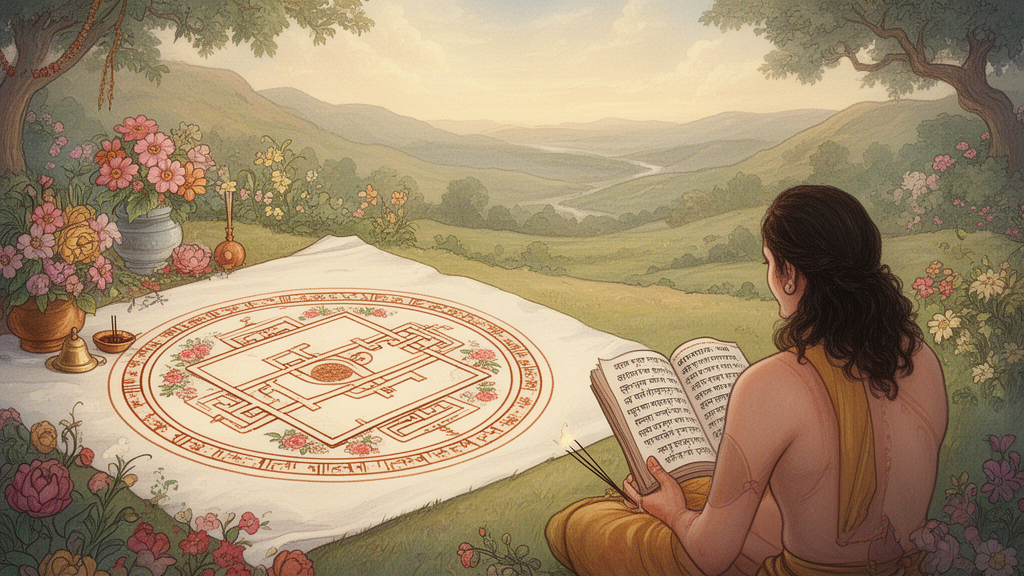
In Hindi, tantra (तन्त्र) is usually understood as a system, method or body of teaching. Shastra (शास्त्र) means a treatise or science. So tantra shastra literally means a systematic teaching or treatise on tantra. A Hindi encyclopedia entry on tantra explains the word through its Sanskrit roots and cites a passage from the Kamikagama, a Shaiva Agama text, which says that tantra extends knowledge of principles (tattva) and mantras across many subjects and protects life. That passage is a traditional definition, and it should be read as the way one tradition describes its own literature.
For most readers, the most useful starting point is this: tantra shastra is a family of texts, not one book. Different sects, regions and lineages preserved different scriptures, and the same word may be used for theology, ritual, yoga, mantra science or temple worship.
Sanskrit roots and the traditional definition
Hindi Wikipedia’s article on tantra (हिन्दी विकिपीडिया, तन्त्र) gives a common etymology. It says the root tan means to extend or spread, and the suffix tra is associated with protection. On this reading, tantra is knowledge that expands and protects human life. This etymology is presented as a traditional explanation, not as a settled philological conclusion. Scholars often treat folk and traditional etymologies with caution, so readers should treat this as an interpretation supported by traditional texts rather than a proven derivation.
The same article quotes the Kamikagama’s statement that tantra deals with an unlimited range of subjects, including tattva and mantra, and that its purpose is to protect life. The quotation is cited here as reported in that encyclopedia entry. The original Kamikagama text and a critical edition were not checked for this post, so the wording should not be treated as a verified translation.
Why the word has a broad meaning
A Hindi popular article on tantra (Webdunia Hindi) notes that the word tantra behaves like the word yoga in Indian philosophy. Just as a philosophical school may be described as a yoga, a system of thought may also be described as a tantra. The article gives the example of Sankhya being called Sankhya-tantra as well as Sankhya-yoga, and it suggests that tantra can be understood in the sense of a doctrine or principle. This is useful for understanding why the term covers more than rituals.
Main categories of tantra shastra
Hindi popular sources often divide tantra texts into several groups. The Webdunia article lists three broad categories: Agama tantra, Yamala tantra and Mukhya tantra. This classification is common in popular summaries, but it is not the only scholarly arrangement. Academic treatments usually discuss tantric traditions by sect, such as Shaiva, Shakta and Vaishnava, and by the type of literature involved, such as agamas, yamalas and mantra-focused manuals.
Agamas and Shaiva tantra
The Webdunia article connects tantra to the Shaiva Agamas. It presents this as the main textual association in popular accounts, while also noting that the origins of tantra are debated. Readers should treat the Shaiva connection as well-established in the sense that many tantra texts are Shaiva, but not as a complete description of every tantric tradition. Tantric literature also developed within Shakta, Vaishnava and other contexts.
Yamalas, mantra manuals and later texts
Yamala texts are often discussed as dialogue-style works that describe deities, mantras, worship and ritual procedure. The provided source list includes a Scribd listing of a Mahanirvana Tantra Sanskrit-Hindi translation and related Hindi editions of Yamala and mantra works. A user-uploaded Scribd page is not a scholarly edition, so it can only show that such Hindi translations circulate. It cannot establish the accuracy of any translation or the date of any text.
Hindi publishing also includes narrower works. An Internet Archive record lists a 1987 Hindi-language publication titled Sri Shodashi Tantra Shastra by Pandit Rajesh Dikshit, which focuses on the Shodashi tradition. This shows that Hindi printed editions of specific tantric works exist, but the archive page itself does not verify the text’s contents, date of composition or ritual details.
Tantra in Hindu, Buddhist and Jain contexts
The Webdunia article states that tantra is found in Hindu, Buddhist and Jain traditions. This is a useful reminder that tantric ideas and practices were not confined to one religion. Buddhist and Jain tantric literature has its own terminology, texts and history. A post on Hindu tantra shastra should therefore avoid implying that all tantra belongs to one community or one philosophy.
Belief, text, tradition and scholarship
When reading about tantra shastra, it helps to separate four kinds of statements. A scriptural statement says what a named text says, such as the Kamikagama’s definition quoted in Hindi encyclopedic sources. A traditional belief is a view held by a sect or community, such as the belief that tantra protects life or that a particular mantra is effective. A historical or scholarly claim concerns dates, origins and transmission, and needs evidence from manuscripts, inscriptions or critical studies. A modern interpretation explains tantra for today’s reader, often through the language of yoga, meditation or personal practice.
These categories often overlap in popular writing. For example, a claim that tantra has Vedic roots may be presented as history, while it is actually a traditional or interpretive claim. The Webdunia article mentions that tantra is linked to the Atharva Veda, but it also says the origin of tantra is debated. A fair summary is that the question of origins is disputed and needs careful sourcing.
Why scholarship matters
The Hindi scholarly book Bharatiya Tantra Shastra: Siddhanta aur Sadhana by Dr. Shyama Kanta Dvivedi, published in the Krishnadas Prachya Vidya series of the Chowkhamba Sanskrit Series Office, is one example of Hindi academic-style work on tantra. The Internet Archive record was inspected, and it confirms the title, author, series and publisher information. This post does not quote or summarize specific arguments from the book because the full text was not reviewed for this draft. Readers who want the scholarly side should consult the book directly and compare it with other academic studies.
Common misunderstandings
Tantra is often associated with secret rituals, supernatural power or sensational practices. The Webdunia article explicitly states that tantra is not related to meat, alcohol and sexual rites in the way popular stereotypes suggest, and it argues that people who engage in such acts do not become tantrikas in the true sense. This is one viewpoint from a popular Hindi publication and should be read as such.
The sources reviewed here are not enough to describe the full range of historical tantric ritual, including any left-handed or transgressive practices recorded in some texts and communities. A balanced post should acknowledge that some tantric traditions include ritual elements that outsiders have often misunderstood, while avoiding sensational claims that the sources do not support.
Avoid promises of supernatural results
Many advertisements and online articles promise that tantra mantras, yantras or sadhanas will bring wealth, success, protection or control over others. The sources used for this post do not support such guaranteed outcomes. Religious and devotional practices are meaningful within their traditions, but they should not be presented as reliable methods for material results.
How to approach tantra texts in Hindi
Readers interested in tantra shastra in Hindi should begin by identifying the specific text they want to study. The word tantra is broad, so a search may bring together Shaiva agamas, Shakta mantra manuals, popular astrology-linked material and modern yoga writing. Each may use similar vocabulary for different purposes.
- Identify the text, such as Mahanirvana Tantra, Shodashi Tantra or a Yamala text, and note its tradition.
- Check the edition, translator, publisher and year of publication.
- Separate the original Sanskrit verse from Hindi translation and from commentary.
- Compare at least one academic or critical source before accepting claims about origin or practice.
- Note whether a ritual instruction is tradition-specific, optional, or intended for initiated practitioners.
This approach keeps the study of tantra grounded. It also helps readers respect the living traditions that continue to use these texts.
Related tantra and shastra topics on HindusGod.com
HindusGod.com has several related topics that readers may find useful when exploring tantra shastra in Hindi. The links below point to WordPress draft posts from the verified target list. Because these are drafts, some links may not be public until the owner publishes them.
- For a broader overview of Hindi shastra terminology, see Hindi Shastra.
- For a related English-language version of this topic, see Tantra Shastra in English.
- For regional variants of the same search theme, see Tantra Shastra in Bengali, Tantra Shastra Kannada and Tantra Shastra Telugu.
- For a Shaiva focus, see Shiv Tantra Shastra.
- For a goddess-centred tantric topic, see Kali Tantra Shastra and Tara Tantra Shastra.
- For another category of ritual and mantra literature, see Shabar Tantra Shastra.
- For agama and scriptural comparisons, see Agama Shastra in Hindi.
- For the wider category of dharma literature, see Dharma Shastra in Hindi and Hindu Shastra in Hindi.
- For a Shakta goddess text topic, see Lalita Shastra in Hindi.
Readers interested in the Vedic and philosophical context may also consult Ved Shastra in Hindi and Vedanta Shastra in Hindi, which cover different textual foundations.
Regional and linguistic differences
Tantric literature circulates across many Indian languages. Hindi translations, Bengali traditions, Kannada and Telugu materials, and English scholarship each emphasize different texts, lineages and interpretations. A Hindi reader may find that a Hindi edition is a translation of a Sanskrit text, a modern summary, or an independent Hindi composition. Each category has different evidentiary value.
Regional practice also varies. Bengali Shakta traditions, South Indian temple and agamic practices, and northern Hindi devotional communities do not all use the same terminology or follow the same rituals. For that reason, a responsible post should describe tantra as a plural field rather than a single uniform system.
Frequently asked questions
Is tantra shastra the same as black magic?
No. In Sanskrit and Hindi sources, tantra refers to a body of texts and systems that cover philosophy, mantra, ritual and worship. Popular associations with black magic are not a complete description of the literature. Some sources also argue that such associations are a misunderstanding or a result of sensational portrayals.
Which tantra texts are available in Hindi?
Hindi editions and summaries exist for several tantric works, including Mahanirvana Tantra and Shodashi-related material. Readers should check the publisher, translator, year and whether the text is a critical edition, a translation or a popular adaptation. Online uploads and bookseller listings should be verified before use.
Can tantra be practised without initiation?
This depends on the tradition and text. Some tantric literature includes ritual instructions meant for initiated practitioners, while other material focuses on philosophy, worship or general devotion. The sources reviewed here do not establish a single rule for all traditions, so readers should consult qualified teachers within a specific lineage when considering practice.
Summary and next step
Tantra shastra in Hindi refers to the texts, teachings and practices associated with the word tantra. The term has Sanskrit roots, traditional etymologies, a broad meaning as a system or doctrine, and a rich literature across Hindu, Buddhist and Jain contexts. Popular stereotypes do not capture the full history. Readers should distinguish scripture from commentary, tradition from scholarship, and devotional claims from verified historical evidence. The next step is to choose a specific text or tradition, check its edition and translator, and read it alongside an academic or lineage-based source.
Sources and further reading
- Hindi Wikipedia, “तन्त्र” (etymology and Kamikagama citation): https://hi.wikipedia.org/wiki/तन्त्र. Used for the traditional etymology and the reported Kamikagama definition. Its wording was not checked against the original Kamikagama text.
- Webdunia Hindi, “तंत्र शास्त्र का ज्ञान क्या है”: https://hindi.webdunia.com/astrology-tantra-mantra-yantra/tantra-shastra-in-hindi-116090100058_1.html. Used for the popular explanation of tantra as a system, the Agama, Yamala and Mukhya classification, and the statement that origins are debated.
- Internet Archive, Dr. Shyama Kanta Dvivedi, Bharatiya Tantra Shastra Siddhanta Aur Sadhana (Hindi): https://archive.org/details/GSGg_bharatiya-tantra-shastra-siddhanta-aur-sadhana-hindi-by-dr.-shyama-kanta-dvivedi. Used only to identify the book and its publication series.
- Internet Archive, Sri Shodashi Tantra Shastra (1987, Pandit Rajesh Dikshit): https://archive.org/details/wg455. Used only to confirm a Hindi-language publication on the Shodashi tradition.