This article explains what Tantra Shastra means, how the term is used in English-language books and websites, and how to read about it without confusing scripture, tradition, and modern interpretation. The short answer is that Tantra Shastra refers to the body of teachings found in tantric texts, which are associated with esoteric traditions within Hinduism and Buddhism. Those texts cover ritual, mantra, yantra and mandala, meditation, initiation, and worship. Because the tradition is large and varied, no single English summary speaks for every lineage.
The guide below separates what sources say about the texts, what the traditions teach, and what scholars and modern writers have added. It also points to English-language resources you can check yourself.
Quick answer: what Tantra Shastra means
In everyday English usage, Tantra Shastra is a phrase combining two terms. Tantra refers to a family of esoteric traditions and texts. Shastra is commonly rendered as a treatise, teaching, or authoritative body of knowledge. Put together, the phrase is usually understood as the teaching literature of the tantric traditions. This is an editorial gloss on common usage; readers who need a precise Sanskrit definition should consult a dictionary or a specialist source.
The English Wikipedia article on Tantra describes tantra as esoteric traditions of Hinduism and Buddhism, and its contents list separate sections for Hindu tantra, Buddhist tantra, and Western scholarly research. Tantra – Wikipedia is a useful starting overview, though it is a secondary encyclopedia and should be checked against primary texts for detailed claims.
Tantra and Tantra Shastra are related but not identical
Readers often meet the word tantra in three different ways: as a general name for a tradition, as the name of particular texts, and as a popular word that has come to mean something quite different in modern speech. Tantra Shastra points mainly to the first two meanings, the traditions and their textual literature.
A blog article on the subject describes the tradition as arising primarily from the Agamas and Tantras, which it presents as scriptures transmitted through guru-disciple lineages. It also says these texts were composed between the early centuries CE and the medieval period, and that they cover Shaiva, Shakta, Vaishnava, and Buddhist streams. That source is a secondary commentary, so its dating and categories should be treated as one author’s summary rather than settled scholarship. Scholars generally emphasize that tantric literature is diverse and difficult to date precisely.
This is why a responsible discussion of Tantra Shastra names the specific text, tradition, or commentary being discussed. A statement about one Shaiva Tantra may not apply to a Vaishnava Samhita or a Buddhist tantra.
The main traditions
English overviews commonly divide tantric material into Hindu and Buddhist streams. Within Hinduism, the Wikipedia outline separates Shaiva and Shakta tantra from Vaishnava tantra. Buddhist tantra is treated as a separate tradition. These categories help readers, but they are not perfectly fixed. Texts, teachers, and communities have overlapped, and some later works are hard to assign to one stream only.
Shaiva and Shakta tantra
Shaiva and Shakta tantra are among the best-known strands in English-language discussions. The Wikipedia article groups them together under Hindu tantra. In general terms, Shaiva traditions center on Shiva, while Shakta traditions give central importance to the Goddess as Shakti, the dynamic power of the divine. Many readers encounter these traditions through goddess worship, mantras associated with deities such as Kali and Tara, and yantra-based worship.
Writers on the subject often connect Tantra Shastra with the Shakta and Shaiva worldview in which Shiva and Shakti are understood as inseparable principles. A blog overview states that the universe is understood to emerge from the interplay of Shakti and Shiva. That is a typical devotional and philosophical explanation within the tradition, not a single universal doctrine. Readers should identify which school or text the explanation comes from.
For example, a reader interested in goddess-centered tantric worship might begin with the Kali Tantra Shastra page, while a reader more interested in Shiva-centered material could compare the Shiv Tantra Shastra page. Both are drafts and may not yet be public.
Vaishnava tantra
The Wikipedia article includes a separate section on Vaishnava tantra, which signals that tantric literature is not limited to Shaiva and Shakta communities. Vaishnava texts and practices center on Vishnu and his forms, and many of them use mantra, initiation, and temple or home worship. Because the Vaishnava stream is less often discussed in popular English writing, readers should be careful when a source treats ‘tantra’ as only a goddess or Shiva tradition.
When reading about Vaishnava tantra, look for specific texts, editions, and scholarly studies rather than general claims that all tantra is one thing. Where a page does not name its source, treat its statements as unverified.
Buddhist tantra
Buddhist tantra is a distinct Buddhist literature and practice tradition. The English Wikipedia article treats it as its own section, separate from Hindu tantra. Readers who meet Vajrayogini or the Kalachakra mandala in tantric art are often seeing Buddhist material. The Wikipedia article’s image caption lists Sri Yantra, Kalachakra Mandala, a Shaiva Nath chakra, and Vajrayogini as examples of tantric art, which shows how the traditions overlap in visual culture while remaining distinct in doctrine and lineage.
Because Buddhist tantra has its own canon and interpretations, a page on Tantra Shastra should not present Hindu tantric teaching as if it were the Buddhist view, or the reverse.
Core themes and practices described in tantric sources
English sources describe several recurring themes. These themes appear differently across traditions, so they should be read as areas of practice rather than a checklist that every practitioner follows.
- Worship and ritual: The Wikipedia outline includes a section on worship and ritual within the tantric traditions.
- Mantra: Mantra recitation is a major part of tantric practice. A blog summary of tantric worship says deities are approached through specific mantras, sometimes with prescribed rhythms, and that worship may include visual symbols and offerings.
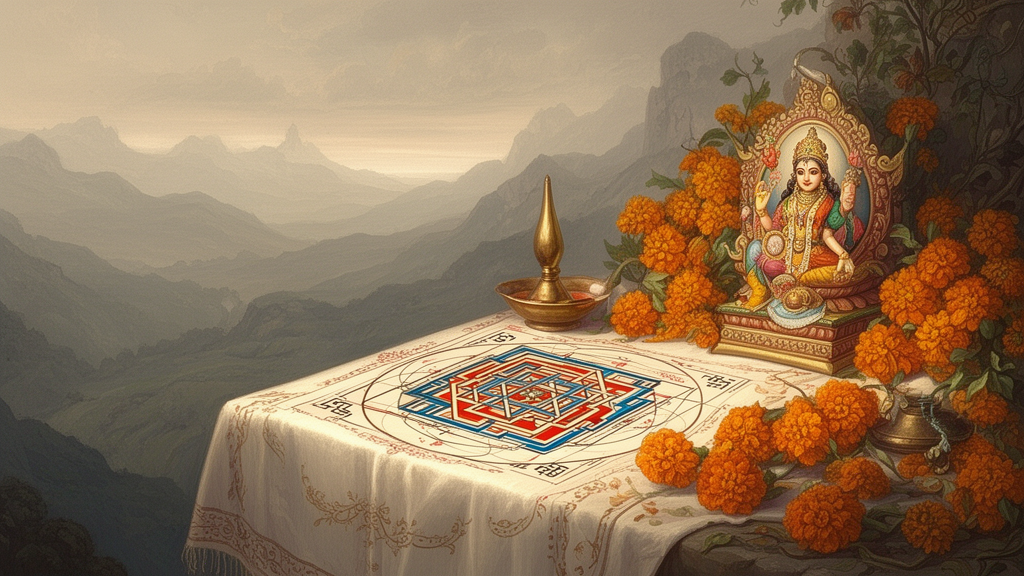
- Yantra and mandala: Diagrams used in worship and meditation are discussed in the Wikipedia outline as mandalas and yantras.
- Yoga and meditation: The Wikipedia outline lists yoga, mantra, and meditation as a related practice area.
- Sadhana: A blog overview describes sadhana as systematic practice, ranging from daily rites to fire rituals (homam), with time, altar, offerings, and mantra chosen according to lineage and purpose.
- Diksha: Initiation is treated in the Wikipedia outline as a separate practice section.
Why ‘prescribed’ does not mean ‘universal’
Many English discussions use the language of precise prescriptions, such as the right time of day, lunar phase, or arrangement of an altar. These details are real features of many ritual manuals, but they are tradition-specific. A family temple, a monastic lineage, and a household practitioner may follow different instructions, and some instructions are taught only after initiation. Readers should not treat a single blog’s ritual description as a general guide to performing worship.
A key English quotation on inclusivity
John Woodroffe’s English work Introduction to Tantra Shastra is one of the most cited introductions in English. An archived 1956 Ganesh and Co. edition is listed on the Internet Archive. A hosted copy of Woodroffe’s introduction also circulates as a PDF, quoting a Gautamiya-Tantra passage that reads in Sanskrit: Sarvavarṇādhikāraśca nāriṇām yogya eva ca, and in the source’s English rendering: ‘The Tantra is for all men, of whatever caste, and for all women.’
This passage is useful for showing that some tantric texts were presented as open to people of different social backgrounds. It is not a complete account of tantric history. Practice has also included lineage rules, initiation requirements, and social constraints, and scholars discuss how far inclusive claims were realized in different periods and communities. Readers should cite the text and translation directly and avoid saying that all tantric communities have always followed this principle.
English-language study: Woodroffe and later scholarship
The Wikipedia article identifies John Woodroffe as an important figure in Western scholarly research on tantra. His introduction helped make tantric texts and ideas known to English-speaking readers. Because his work was written in a particular historical and colonial-era setting, careful readers should compare it with later studies and with traditional commentaries.
When using an English introduction, note the following:
- Identify the author, edition, and date.
- Check whether the book quotes primary Sanskrit texts or summarizes them.
- Compare the translation with another edition or with a scholarly work when a claim matters.
- Separate the author’s interpretation from the text itself.
Common misunderstandings
Tantra is often misunderstood, especially in popular media. Some readers reduce the whole tradition to sexual symbolism or to ritual shortcuts. The Wikipedia outline does include a section on sex and eroticism, but it appears within a broader list of tantric topics. A respectful reading recognizes that tantric literature is large, that some practices are restricted to initiates, and that many traditions emphasize ethics, discipline, and guru guidance.
Another misunderstanding is that Tantra Shastra offers guaranteed results. Devotional and ritual language often promises spiritual progress, protection, or fulfillment. Those claims are part of religious belief and should be read as beliefs. This article does not present any tantric practice as producing a material, health, or supernatural result.
Tantra Shastra and other shastras
The word shastra is used for many categories of teaching, from Dharma Shastra to Agama Shastra. Tantra Shastra overlaps with Agama literature in some descriptions, although the relationship between Agama and Tantra categories depends on the tradition. Readers comparing these terms should check the scriptural category used in a specific source. The Dharma Shastra in English page and the Agama Shastra page cover different categories and may help readers compare them.
How to read Tantra Shastra in English
Readers who want to study the subject in English can use this approach:
- Start with a survey. An encyclopedia overview, such as the Wikipedia article, helps you learn the main traditions and terms.
- Move to a primary or near-primary edition. Where possible, read a scripture edition or a translation that names its source text.
- Read a scholarly introduction. Use academic and museum resources to understand context.
- Ask a teacher from a relevant lineage. Initiation and practice instructions are tradition-specific.
For regional-language study, the site has draft pages for Tantra Shastra in Bengali, Hindi, Kannada, and Telugu. Those pages may not yet be public, so check their status before sharing.
Other related topics
Readers interested in specific tantric deities or practices may also consult Tara Tantra Shastra and Shabar Tantra Shastra. These topics overlap with the general category but focus on particular deities or ritual systems, so they should be read as more specific material.
For broader scriptural context, the Bhagwat Shastra page and the Bhagwat in English page cover a different body of devotional literature and may help readers see how Hindu scripture categories differ.
Frequently asked questions
Is Tantra Shastra the same as Tantra Shastra in Hinduism only?
No. Tantra is discussed in both Hindu and Buddhist contexts, according to the Wikipedia overview. Hindu tantra includes Shaiva, Shakta, and Vaishnava streams. Buddhist tantra is a separate tradition with its own texts and lineages.
Do I need initiation to read tantric texts?
Reading an English introduction does not require initiation. Some ritual instructions, however, are taught within lineages, and many traditions treat certain practices as restricted. Check the tradition and text you are studying before attempting any ritual.
Which English source should I start with?
Start with a general overview to learn terms and traditions. Then compare it with an English introduction that names its sources, such as Woodroffe’s work, and consult a teacher or specialist resource for practice.
Summary
Tantra Shastra in English refers to the literature and teachings of the tantric traditions, which appear in Hindu and Buddhist forms. The most useful way to study it is to separate the texts, the traditions that use them, the practices described in them, and the modern commentary that explains them. Readers should note which school, text, translation, or lineage a claim comes from, and should treat ritual instructions as tradition-specific rather than universal.
Sources and further reading
- Tantra – Wikipedia: overview of tantra as esoteric Hindu and Buddhist traditions, with section headings on traditions, practices, and Western scholarship. Used for the general structure and the Woodroffe reference.
- Introduction To Tantra Sastra, 1956, Ganesh Co, Sir John Woodroffe – Internet Archive: catalogue page for an English edition by Sir John Woodroffe. Used to identify the author, title, and edition.
- Introduction of Tantra S’astra (PDF, Woodroffe): hosted copy of Woodroffe’s introduction, cited for the Gautamiya-Tantra quotation. Readers should compare it with an official or library edition before relying on it.
- Seven Subjects In Tantrashastra – Hindu Blog: secondary commentary on tantric subjects and textual background. Use with caution because it is not a primary source.
Editorial note: Prior to publication, verify each external link, check translation details against a standard edition, and confirm the status of the internal draft links.