Ved Shastra in Hindi refers to the body of knowledge found in the Vedas, the oldest scriptures that Hindu tradition regards as authoritative. In Hindi, वेद (Ved) usually means the four core collections of Vedic mantras, while शास्त्र (Shastra) is a broader word for a scripture, treatise, or authoritative discipline. This guide explains what the term means, names the four Vedas, outlines the wider Vedic literature, and separates what the texts say from later tradition and modern scholarship.
Quick answer: what is Ved Shastra?
When people search for ved shastra in hindi, they are usually looking for a Hindi explanation of the Vedas as Shastra. The Vedas are the foundational texts of Sanatan Dharma, and Hindi sources commonly describe them as the oldest scriptures of the tradition (Hindi Wikipedia: वेद). The four traditional collections are the Rig Veda, Yajur Veda, Sama Veda, and Atharva Veda. Around these Samhitas are Brahmanas, Aranyakas, and Upanishads, which together form what is called Vedic literature (Hindi Wikipedia: वैदिक साहित्य).
In short, Ved Shastra means the Vedic scriptural tradition in Hindi: the Vedic mantras, their ritual and philosophical commentaries, and the way Hindu communities have studied and preserved them over many centuries.
What the words Ved and Shastra mean
Ved: knowledge
Many Hindi sources connect the word veda with the Sanskrit root vid, meaning to know, and explain Ved as knowledge (4 Vedas in Hindi, Hindi Sahitya Darpan). This is a traditional etymology that many readers find helpful. It explains the meaning of the word as the tradition understands it; it is not a claim that every modern linguist accepts without discussion.
Shastra: authoritative teaching
शास्त्र is a general Sanskrit term for a teaching or treatise that carries authority within a field. In Hindu usage it can refer to scripture, law, grammar, music, medicine, or philosophy. This is why a phrase like Ved Shastra is best read as shorthand for Vedic scripture rather than a separate, single book. For related categories, see Hindu Shastra in Hindi and Hindi Shastra (both currently WordPress drafts; URL to confirm before publication if they are not yet live).
Why the Vedas are called Shruti
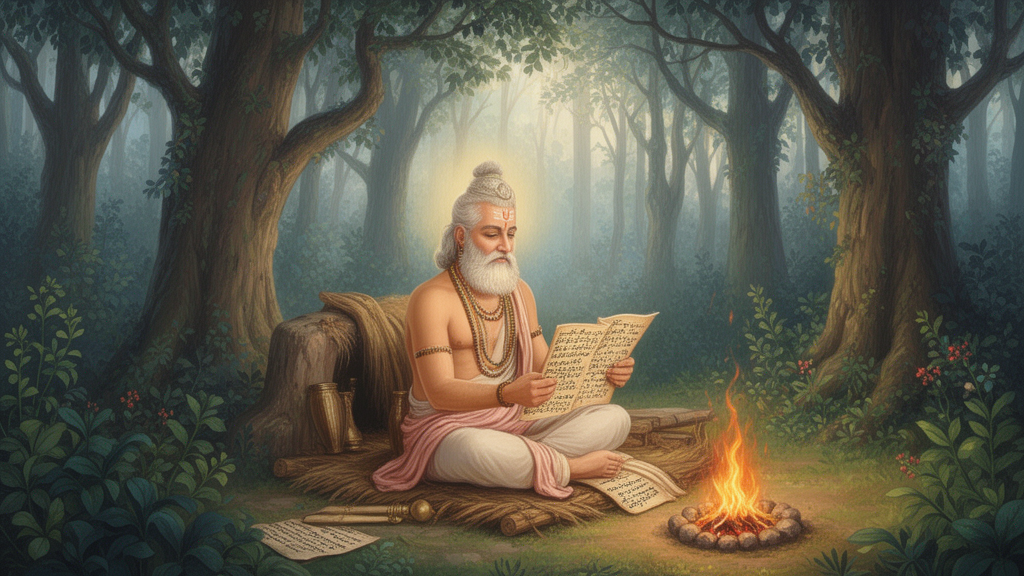
The Vedas are often called श्रुति (Shruti), meaning what is heard. Traditional accounts say the mantras were revealed to ancient seers rather than composed as ordinary human literature. One Hindi source states that the mantras were believed to have been heard by the rishis, which is why the Vedas are called Shruti (4 Vedas in Hindi, Hindi Sahitya Darpan). This is a devotional and traditional belief. Academic historians usually discuss the Vedas as composed, memorized, and transmitted over time by named and unnamed communities of poets and priests.
Both perspectives can be respected. A devotee may understand Shruti as revelation, while a historian may study the same texts as religious literature with a long oral history.
The four Vedas at a glance
The four Samhitas are commonly listed as Rig, Yajur, Sama, and Atharva. The table below gives a simple orientation. Descriptions vary among editions and teachers, so readers should check a specific translation for detailed content.
| Veda | General character | Commonly described content |
|---|---|---|
| Rig Veda | Verse hymns | Hymns praising deities such as Indra, Agni, Surya, and Varuna |
| Yajur Veda | Prose and sacrificial formulas | Mantras and instructions used in yajna rituals |
| Sama Veda | Melodic verses | Verses arranged for chanting and musical recitation |
| Atharva Veda | Varied hymns and practical formulas | Hymns for daily life, healing, and ritual concerns, as described in many introductions |
Rig Veda: the oldest collection
The Rig Veda is widely described as the first and oldest Veda. Hindi sources say it is written in verse and that many of its hymns are addressed to deities including Indra, Agni, Surya, Varuna, and Savita (Rig Veda in Hindi, Mahakavya). One Hindi reference notes that Indra is praised with many hymns in the Rig Veda, which is a textual observation a reader can check directly in a translation.
Counts of the Rig Veda vary by source. Mahakavya describes the collection as having 10 mandalas and 1028 suktas, but gives different totals for the number of mantras in different parts of its own discussion. This is a useful reminder that numbers should be checked against a specific critical or scholarly edition before quoting them. Readers can also consult 4 Ved 6 Shastra 18 Puran in Hindi for an overview of the wider classification, once that draft is confirmed as live.
Yajur Veda: formulas for ritual
The Yajur Veda is commonly described as having a prose character, unlike the verse-based Rig Veda (Mahakavya). Its material is closely associated with sacrificial action. Readers should understand that a yajna is a ritual performed according to specific procedures, and the Yajur Veda is especially connected with the priests who handled those procedures. Its textual traditions include several recensions, which is one reason translators and scholars distinguish between school-specific versions.
Sama Veda: the Veda of melody
The Sama Veda is described in Hindi sources as the melodic or song-based Veda (Mahakavya). Many of its verses are drawn from the Rig Veda and arranged for chanting. This is why it is often connected with musical recitation in Vedic tradition.
Atharva Veda: a varied collection
The Atharva Veda is often described as containing a wider range of hymns, including material concerned with everyday life, protection, healing, and ritual needs. Traditional sources connect it with the sage Atharvan or Angira in some accounts (Four Vedas in Hindi, Webdunia). The Atharva Veda is also a place where readers should be careful: some popular Hindi summaries present its formulas as direct solutions to personal problems. The text can be studied for its ritual and cultural content, but the post does not treat any formula as a guaranteed outcome.
The wider Vedic literature
Many readers searching for Ved Shastra are really asking about the entire Vedic corpus. Hindi reference material describes Vedic literature as including the Samhitas, Brahmana texts, Aranyakas, and Upanishads (Hindi Wikipedia: वैदिक साहित्य). Each category has a different role.
- Samhitas: the core collections of mantras, such as the four Vedas.
- Brahmanas: prose works that explain ritual procedures and their meanings.
- Aranyakas: texts traditionally associated with forest study and deeper reflection on ritual symbolism.
- Upanishads: philosophical texts that discuss Brahman, Atman, and the nature of reality. These are often called Vedanta.
For the Upanishads, a separate guide is useful. See Ved Upanishad in Hindi (WordPress draft; URL to confirm if not yet live) and Vedanta Shastra in Hindi (WordPress draft; URL to confirm if not yet live).
Why the distinction matters
If a reader quotes a line from an Upanishad as if it were a hymn from the Rig Veda, the historical and ritual context changes. The Samhitas are primarily mantra collections, the Brahmanas explain ritual, and the Upanishads discuss philosophy. Keeping these categories separate helps readers avoid mixing scripture, commentary, and modern interpretation.
Traditional origin stories and their status
Hindu tradition contains several accounts of how the Vedas came into existence. These accounts are important within devotional and scriptural life, but they should be presented as traditional beliefs rather than historical reports.
The Shatapatha Brahmana account
Hindi sources report that the Shatapatha Brahmana describes Agni, Vayu, Surya, and Angira or Aditya performing austerities and obtaining the four Vedas (4 Vedas in Hindi, Hindi Sahitya Darpan; Four Vedas in Hindi, Webdunia). Some summaries connect the first three Vedas with Agni, Vayu, and Surya, and the Atharva Veda with Angira. These associations are symbolic and traditional. They are not a scientific explanation of authorship.
The account of Brahma’s four faces
Another traditional account says the four Vedas emerged from the four mouths of Brahma (Webdunia). Readers encounter this account in devotional literature and popular teaching. It is best described as a mythic or devotional image of the Vedas’ origin.
The idea of a single original Veda
Some Hindi sources say that the Vedas were once a single collection and were later divided into four parts for study (Hindi Sahitya Darpan). This is presented in many traditional texts and summaries. Modern scholars generally discuss the four collections as distinct textual corpora with their own histories, so the single-origin idea should be described as tradition, not as a settled historical finding.
Historical and scholarly perspectives
When readers ask when the Vedas were written, the honest answer is that there is no single date accepted by all scholars and traditions. Hindi websites often give a date range for the Rig Veda around 1500 to 1000 BCE (Mahakavya). That is one published range, but it should be read with care. Historians and linguists debate dating because the Vedas were transmitted orally for long periods, and the manuscripts that survive are much later than the earliest layers of composition.
Scholars also study the Vedas for information about language, society, and religious practice. Hindi sources describe the Rig Veda as containing information about the social and political life of the early Aryan-speaking communities (Mahakavya). The term Aryan is contested in modern scholarship and can refer to a linguistic group rather than a single ethnic or racial category. This post uses it only as a source description, and readers should consult academic histories for a fuller discussion.
Belief, tradition, and scholarship
- Devotional belief: the Vedas are revealed knowledge and sacred sound, central to many Hindu rituals and worldviews.
- Textual evidence: the mantras, their structure, languages, and internal references can be studied in editions and translations.
- Oral tradition: many Vedic schools preserved recitation through memory, with specific pronunciation and chanting methods.
- Academic interpretation: historians and philologists propose dates, geographic contexts, and meanings, and they often disagree.
These categories do not compete with one another. A reader may hold devotional belief while also using scholarly editions for study. What matters is clear labeling.
How to read the Vedas in Hindi
Many readers begin with Hindi translations because the Sanskrit is unfamiliar. Hindi is helpful for access, but it is important to check the edition, translator, and whether the text includes the original Sanskrit. A good reading process includes these steps:
- Identify which Veda, Brahmana, Aranyaka, or Upanishad the passage belongs to.
- Check whether the book provides Sanskrit text, transliteration, and Hindi translation.
- Read the translator’s notes and any commentary, and mark which parts are commentary.
- Compare two translations for difficult passages, especially philosophical or ritual terms.
- Record whether a practice described in the text is ritual, philosophical, historical, or devotional.
Examples of useful reading questions
- Is this passage a prayer, a ritual instruction, or a philosophical discussion?
- Does the commentary belong to a particular school or sampradaya?
- Is the translation a literal rendering or an explanatory paraphrase?
For broader scripture reading, the post on Dharma Shastra in Hindi (WordPress draft; URL to confirm if not yet live) explains how dharma texts differ from Vedic mantra collections.
Regional, community, and sampradaya differences
Vedic study has been carried on by many families, schools, and regions. Traditions preserved different recensions and recitation styles, and Hindu communities differ in how they use the Vedas in daily and ritual life. Some households chant Vedic mantras as part of formal ceremonies; others primarily read the Vedas as literature or philosophy. Neither approach is universal, and readers should not assume that one local practice represents all Hindus.
Some readers also encounter Hindi terms such as वेद पुराण or वेद उपनिषद. These phrases group related texts together, but they do not mean the same category. The Puranas and Upanishads have different content, dates, and traditional uses from the Samhitas. For a comparison, see Ved Puran Shastra and Ved Puran Hindi (both WordPress drafts; URLs to confirm if not yet live).
Common mistakes to avoid
- Treating every Hindi summary as a primary source. Popular websites are useful for orientation but may simplify or repeat unverified claims.
- Quoting numbers without checking the edition. Mantra counts, sukta counts, and chapter divisions differ across editions.
- Assuming a formula guarantees a result. Vedic mantras and rituals are religious practices. Texts and traditions do not offer guaranteed material or health outcomes that can be presented as established fact.
- Mixing categories. Samhitas, Brahmanas, Aranyakas, Upanishads, Puranas, and later Shastras are not interchangeable.
Where to begin
A reader new to Ved Shastra can start with a short overview of the four Vedas, then move to one Samhita, and then to an Upanishad translated with notes. This sequence helps readers see the difference between hymn, ritual explanation, and philosophy. Use a translation that identifies its source text and translator. If possible, compare the Hindi translation with the Sanskrit transliteration or an academic commentary.
For readers interested in the broader Shastra tradition, Char Ved Shastra (WordPress draft; URL to confirm if not yet live) can serve as a related overview of the four Vedas. Readers interested in devotional and temple-linked texts can also explore Agama Shastra in Hindi (WordPress draft; URL to confirm if not yet live), though Agama texts belong to a different body of literature and should not be confused with the Vedas.
Frequently asked questions
Is Ved Shastra one book?
No. Ved Shastra is a general way of referring to the Vedic scriptural tradition. The core Vedas are four Samhitas, and Vedic literature also includes Brahmanas, Aranyakas, and Upanishads.
Which Veda is the oldest?
The Rig Veda is commonly described as the oldest and first Veda, according to Hindi reference sources and many introductions. Dating remains debated among scholars, so the claim should be presented as a traditional and commonly stated view unless supported by a specific academic source.
Can I read the Vedas in Hindi?
Yes, many Hindi translations and summaries exist. Check the translator, edition, and whether the Sanskrit text is included. For serious study, compare translations and read commentary notes.
Are the Vedas only for priests?
Historically, Vedic recitation and ritual were closely associated with trained specialists in many traditions. Modern Hindu practice varies widely, and many readers study the Vedas for philosophical, cultural, or devotional reasons. Access norms differ by family, community, and sampradaya.
Summary and next step
Ved Shastra in Hindi refers to the Vedic scriptures and the wider literature that grew around them. The four Vedas, the Samhitas, Brahmanas, Aranyakas, and Upanishads each have different purposes. Traditional accounts of their origin are important to devotees, while scholars study dates, language, and textual history. A careful reader keeps belief, text, tradition, and scholarship distinct, checks translations, and treats ritual or devotional claims as tradition-specific.
Sources and further reading
- Hindi Wikipedia: वेद. Used for the general description of the Vedas as the oldest scriptures of Sanatan Dharma and as foundational texts. Snippet-level review only; full page not inspected.
- Hindi Wikipedia: वैदिक साहित्य. Used for the categories of Vedic literature: Samhitas, Brahmanas, Aranyakas, and Upanishads. Snippet-level review only; full page not inspected.
- Rig Veda in Hindi, Mahakavya. Used for Rig Veda structure, the stated date range, deity references, and the description of the Yajur and Sama Vedas. Traditional or website claims; verify against an academic edition before quoting numbers.
- 4 Vedas in Hindi, Hindi Sahitya Darpan. Used for the etymology of Veda, the Shruti description, and the Shatapatha Brahmana origin account as reported in a devotional summary.
- Four Vedas in Hindi, Webdunia. Used for the Shatapatha Brahmana account and the Brahma account of the Vedas’ origin as traditional narratives.