Vedanta shastra refers to the body of texts and commentaries that explain the philosophical ‘end’ or conclusion of the Vedas, mainly the Upanishads, the Brahma Sutra and the Bhagavad Gita, along with later commentaries and summaries. In Hindi, readers usually meet the subject through translations and explanations of the Vedanta Sara of Sadananda, the Brahma Sutra in Hindi, and modern Hindi books on Vedanta darshan. This guide explains the term, the main texts, how Hindi readers can approach them, and where traditions and scholars disagree.

What the word Vedanta means
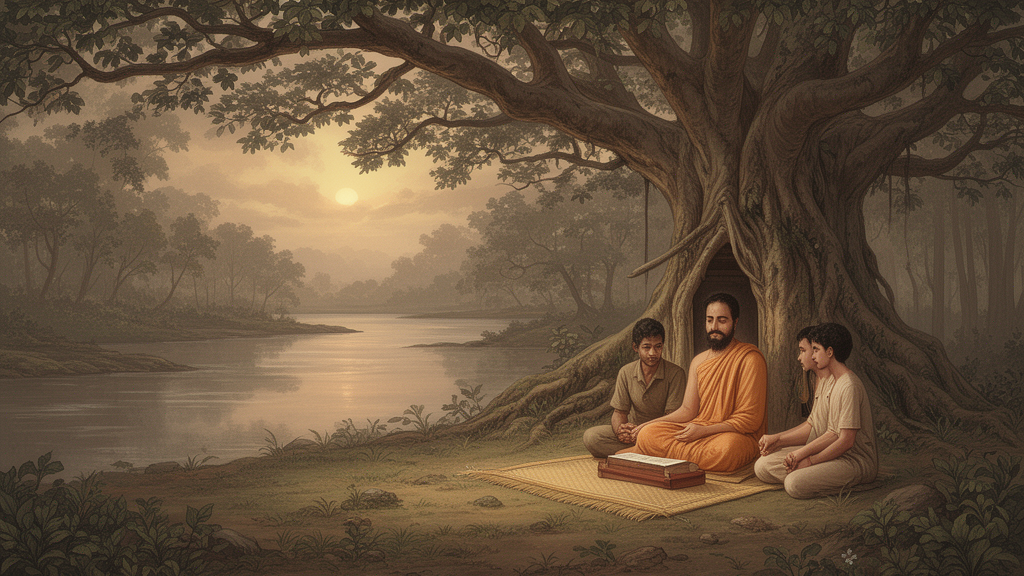
The Hindi Wikipedia article on Vedanta darshan states that the word ‘वेदान्त’ literally means ‘the end of the Vedas’ (वेदों का अन्त) [1]. The word therefore points to the Upanishads, which are generally placed at the end or final portion of Vedic literature, and to the philosophical reflection that grew from them.
The literal meaning is a useful starting point, but it does not fully describe the subject. Over time, ‘Vedanta’ came to mean a family of interpretations, each with its own answers to questions about Brahman, the individual self (ātman or jīva), the world, and liberation (mokṣa). Readers should treat the phrase as a name for a tradition of study rather than a single book.
What ‘Vedanta shastra’ covers
In Hindi, शास्त्र (shastra) means a treatise, a systematic text, or a body of teaching. A Vedanta shastra is therefore any authoritative or systematic work that explains Vedanta ideas. Note that this is a general description of usage. The exact list of texts that count as Vedanta varies by school and by teacher.
Commonly, Vedanta study is organised around three sources, often called the prasthanatrayi (the three starting points):
- Upanishads: The Vedic-era reflective texts that discuss Brahman, ātman and the nature of knowledge.
- Brahma Sutra: A short, aphoristic text, traditionally attributed to Badarayana, that systematises Upanishadic teaching. Hindi readers can find a Hindi edition titled Vedant Darshan (Brahm Sutra) that is attributed to Harikrishnadas Goyandka [4].
- Bhagavad Gita: The dialogue within the Mahabharata, read by many Vedanta teachers as a practical guide to the same core ideas.
Other works, such as Sadananda’s Vedanta Sara, are classed as manuals or summaries that help students learn the framework of the tradition. The three-source model is a common scholarly and traditional description, but it is not the only way to organise Vedanta literature, and the Gita’s place is interpreted differently across schools.
Key Vedanta texts available in Hindi
Several Vedanta works are available to Hindi readers in print, digital and archived forms. Their availability does not guarantee the quality of a translation, so it is worth comparing editions and checking the translator and commentary.
Vedanta Sara of Sadananda
The Vedanta Sara is one of the best-known introductory manuals in this field. The Internet Archive holds at least two Hindi-related records for it: one titled ‘Sadananda’s Vedanta Sara – Hindi’ [2], and another titled ‘Vedantasara of Sadananda’ with Dr. Rakesh Shastri listed as the presenter or editor [3]. A separate PDF record, edited by Krishna Kanta Tripathi, is also listed as a Hindi-language study edition [6]. These records show that the text has been made available in Hindi, but the cited pages were not all checked for their full contents, so readers should confirm the translation and commentary before relying on any single edition.
Because the Vedanta Sara is a manual, it is useful for learning terms such as adhyasa (superimposition), Brahman, ātman and mokṣa in a structured order. A beginner can read a chapter, then compare it with a modern explanation to see how the author’s language is interpreted.
Brahma Sutra in Hindi
The Brahma Sutra is a difficult text because its aphorisms are very short. A Hindi reader often relies on a commentary or an explanatory book. The ePustakalay listing for Vedant Darshan (Brahm Sutra) by Harikrishnadas Goyandka describes a Hindi work with a detailed contents list, including chapters and sections that discuss the states of the self in dreaming and deep sleep, and the relation between the self and the supreme being [4]. The text on that page includes machine-translated and partly garbled excerpts, so the listing is good for seeing the book’s structure but not for quoting its wording.
Vedanta Darshan by Swami Brahma Muni
A second ePustakalay listing titled Vedanta Darshan, attributed to Swami Brahma Muni, shows a Hindi book with a sutra index that begins with questions about the creation of the world and the role of prakriti (nature) [5]. The excerpt on that page is also machine-generated and contains errors. It can help a reader see how a Hindi edition organises the sutras, but readers should compare the printed text with other editions before drawing conclusions.
Major schools and why they read the texts differently
Vedanta is not a single doctrine. Scholars commonly describe several major schools, and their differences often come from how they read the relationship between Brahman, the individual self, and the world. The main schools usually named in introductory works are:
- Advaita (non-dualism): Associated with Shankara, this school teaches that Brahman alone is ultimately real, and that the individual self is not different from Brahman in its essence.
- Vishishtadvaita (qualified non-dualism): Associated with Ramanuja, this school holds that the self and world are real but depend on Brahman, which is understood as a personal and qualified reality.
- Dvaita (dualism): Associated with Madhva, this school distinguishes Brahman from the individual souls and the world in a more fundamental way.
These summaries are general descriptions from standard scholarly accounts. They are not yet tied to fetched sources in this draft, so each named teacher and school should be checked against a scholarly reference before publication. Readers should also note that devotional communities within these schools may place different emphasis on the same text.
Belief, text, tradition and scholarship
Vedanta can be discussed in four different ways, and it helps to keep them separate:
- Text: What a named work says, such as a particular sutra or a passage in the Vedanta Sara.
- Tradition: What a lineage or school teaches about that text, often passed through a guru-shishya relationship.
- Devotional belief: How a practitioner personally relates to Brahman, Ishvara, or a chosen deity.
- Scholarship: Historical and philosophical analysis of how the texts developed and how commentators read them.
Keeping these separate avoids common mistakes. For example, a statement that ‘Vedanta teaches that the world is illusory’ is a claim associated with particular readings, especially Advaita, and not a universal description of Vedanta. Similarly, a devotional statement about divine grace should be presented as belief within a tradition, not as a universal conclusion of the texts.
How to start reading Vedanta in Hindi
A practical approach for a new reader is to move in stages rather than starting with the hardest text.
- Begin with an overview. Read an introductory explanation of Vedanta, such as the Hindi Wikipedia article on Vedanta darshan [1], to learn the basic vocabulary and history.
- Read a manual. Use a Hindi edition of the Vedanta Sara, where the topics are arranged in a teaching sequence. Compare at least two editions if possible, because translators and commentators differ.
- Study the Upanishad passages in a translation with notes. Choose an edition that gives the Sanskrit text, a Hindi rendering, and an explanation of difficult terms.
- Read the Brahma Sutra with a commentary. The aphorisms are compressed, so an explanatory book helps. Check the school of the commentator.
- Keep a glossary. Record terms such as brahman, ātman, māyā, adhyāsa, and mokṣa, with the sense used in each book.
This method slows reading down, but it helps the reader see when a Hindi explanation is adding an interpretation and when it is reporting the text.
Checking translations and transliterations
Sanskrit terms appear in Hindi books in several spellings. For example, the same word may be written with or without a long vowel, or with different consonant marks. Readers should compare terms across editions and not assume a spelling variant is a different concept. When a translation uses a common Hindi word for a Sanskrit term, check whether that word carries the same sense in the source tradition.
Examples of how Vedanta ideas appear in Hindi study texts
To make the subject concrete, consider two kinds of passages that appear in Hindi Vedanta studies.
Example 1: The states of the self
Some Hindi editions of the Brahma Sutra discuss how the self behaves in dreaming and deep sleep. The ePustakalay contents list for the Goyandka edition includes sections on dream experience and deep sleep, and on the self’s relation to the supreme being [4]. A reader studying this topic should first identify what the sutra or commentary says, then identify the commentator’s interpretation, and only then consider how the topic is discussed in devotional or modern settings.
Example 2: Creation and nature
Another Hindi Vedanta index begins with discussions of the world’s origin and the role of prakriti (nature) in creation [5]. Readers should notice that the question of what causes the world is answered differently by different schools. Some understand prakriti as dependent on Brahman, while others stress other relationships. The Hindi text is therefore best read as one school’s answer, not as a settled account shared by every Vedanta tradition.
Where Vedanta fits among other shastras
Hindi readers often see the word shastra used in many contexts: Dharma Shastra, Ayurveda, music, and temple or ritual texts. Vedanta differs from many of these because it is primarily philosophical, although it is connected to ritual and devotional practice in many communities. For a broader view of shastra in Hindi, readers can explore the HindusGod.com overview of Hindi Shastra, which introduces the general meaning of the term (URL to confirm: target draft, may not yet be public).
The category of ‘shastra’ is also used for works on law, ritual, and technical knowledge. If you want to compare Vedanta with a legal or ritual tradition, see the discussion of Dharma Shastra in Hindi, which covers a different category of text (URL to confirm: target draft, may not yet be public). For a wider list of Hindu scriptural categories, the guide to 4 Ved 6 Shastra 18 Puran in Hindi gives a broad orientation (URL to confirm: target draft, may not yet be public).
For the Vedic base of Vedanta, the page on Ved Shastra in Hindi explains the Vedas as a group of texts that Vedanta later reflected upon (URL to confirm: target draft, may not yet be public). Readers who want the broader Hindu scriptural context can also consult Hindu Shastra in Hindi (URL to confirm: target draft, may not yet be public).
Vedanta and Tantra or Agama
Some readers meet Vedanta alongside Tantra and Agama literature, which have their own traditions, rituals and texts. The Tantra Shastra in Hindi overview and the Agama Shastra in Hindi overview describe those separate traditions (URLs to confirm: target drafts, may not yet be public). Keeping these categories distinct helps readers avoid assuming that all shastras share one philosophy or one ritual method.
Common misunderstandings
- Vedanta is one book. It is a family of texts and interpretations.
- All Vedanta teaches the same view of the world. The major schools differ, and their differences are central to the tradition.
- A Hindi translation is the original text. Translations are interpretations, and their quality varies.
- Philosophy and devotion are the same thing. Vedanta can support devotional practice, but a philosophical text is not automatically a devotional manual, and devotional belief is not the same as scholarly analysis.
Frequently asked questions
Is Vedanta a religion or a philosophy?
Vedanta is usually described as a philosophical tradition that is connected to Hindu religious life. Many practitioners see it as both philosophy and spiritual practice, while academic accounts often focus on its textual and conceptual history. The answer depends on the reader’s framework and the school being discussed.
Which Vedanta text should a beginner read first?
Many beginners start with an introductory manual such as the Vedanta Sara, then move to the Upanishads and the Brahma Sutra with a commentary. Choose a Hindi edition that clearly identifies its translator, commentary and school.
Do I need Sanskrit to study Vedanta in Hindi?
Sanskrit is not required to begin, but it helps when comparing translations. A bilingual edition or a glossary of key terms can make the Hindi text easier to check.
Summary and next step
Vedanta shastra in Hindi refers to the Hindi study of Vedanta texts, including the Upanishads, the Brahma Sutra, the Bhagavad Gita, and manuals such as the Vedanta Sara. The word Vedanta means ‘the end of the Vedas’, and the tradition includes several schools with different interpretations. Start with an introduction, choose an edition with clear notes, and keep the difference between text, tradition, belief and scholarship in view. The next useful step is to compare two Hindi editions of the Vedanta Sara or the Brahma Sutra and note how their explanations differ.
Sources and further reading
- वेदान्त दर्शन – Hindi Wikipedia (general overview; the meaning ‘end of the Vedas’ is taken from this source)
- Sadananda’s Vedanta Sara – Hindi, Internet Archive (catalogue record for a Hindi edition)
- Vedantasara of Sadananda, Dr. Rakesh Shastri, Internet Archive (catalogue record)
- Vedant Darshan (Brahm Sutra) by Harikrishnadas Goyandka, ePustakalay (contents listing; machine-translated excerpt)
- Vedanta Darshan by Swami Brahma Muni, ePustakalay (contents listing; machine-translated excerpt)
- Vedanta Sara, edited by Krishna Kanta Tripathi, PDF text on Internet Archive (not fully inspected)