The original Upanishads are the Sanskrit philosophical texts, composed in the late Vedic period, that form the foundation of later Vedanta and many strands of Hindu thought. When people search for the original Upanishads, they usually want to know three things: which texts are considered the earliest and most authoritative, what language and form they originally had, and how to tell the original teachings apart from translations, later compilations, and modern interpretations. This guide answers those questions in order and separates what the texts say from what traditions and scholars add to them.
What “original” means in this context
The English word original carries several meanings. Dictionary definitions describe it as relating to an origin or beginning, as existing since the beginning, or as the first form from which copies or translations are made. Merriam-Webster defines it as relating to or constituting an origin or beginning, Cambridge Dictionary describes the earliest form of something, and Dictionary.com gives the sense of the source from which a copy or translation is made. Applied to the Upanishads, the word has a specific meaning: the earliest Sanskrit texts, as opposed to English or other-language renderings and later works that bear the same name.
This distinction matters because the Upanishads are not a single book. The name refers to a large body of texts, composed over a long period and preserved in several recensions, or versions, in different Vedic schools. Readers who want the original teaching usually need to look at the Sanskrit texts themselves, or at translations that clearly identify the edition and the Sanskrit they follow.
The Upanishads and the Vedic background
The Upanishads are generally regarded as the final parts of the Vedic literature, which is why they are often called Vedanta, meaning the end or culmination of the Veda. Earlier Vedic texts are largely made up of hymns, ritual formulas, and instructions for sacrifice. The Upanishads turn toward questions about the nature of the self, the nature of ultimate reality, and the relationship between the two. Words such as atman (the self) and brahman (ultimate reality) become central in these texts.
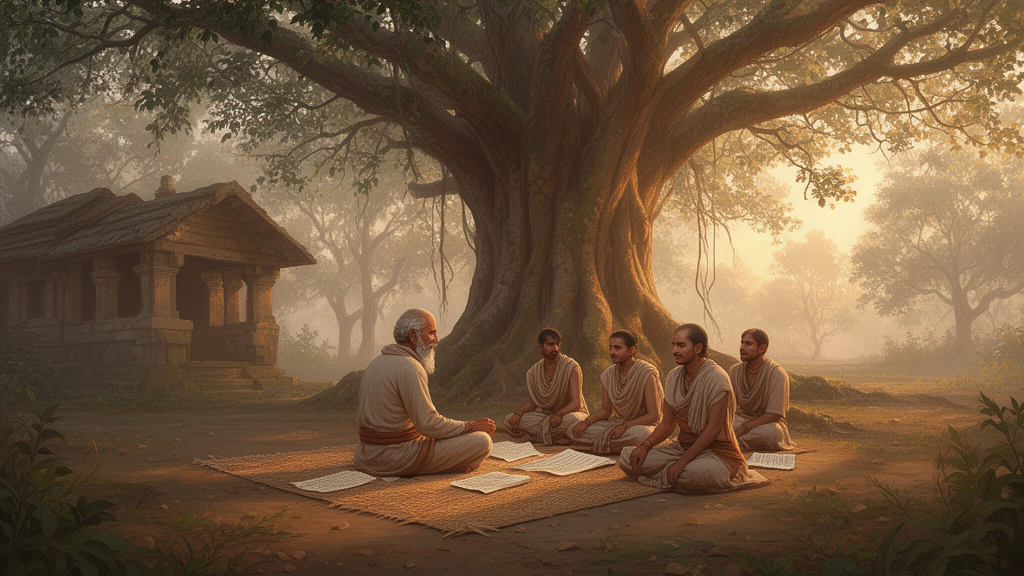
The tradition itself offers an explanation for the name. The word upanishad is often read as sitting down near, pointing to a student sitting close to a teacher to receive instruction. This is a traditional interpretation. Scholars also discuss the word’s possible etymologies, and the sense of secret or esoteric teaching found in some commentaries is one of several readings rather than a settled historical fact.
Dating the earliest texts
Dating ancient Indian texts is difficult, and precise dates should be treated with caution. Most scholars place the earliest prose Upanishads, including the Brihadaranyaka and the Chandogya, in roughly the seventh to sixth centuries BCE, while later texts were composed over subsequent centuries. Some dates in popular sources are presented with more certainty than the evidence allows. The safest statement is that the principal early Upanishads belong to the late Vedic period, and that their exact chronology remains a matter of scholarly discussion.
Which texts are considered original?
Many Upanishads are known today, but traditions differ about which texts count as the core. Among the most widely studied are the early prose Upanishads, often called the principal or older Upanishads:
- Brihadaranyaka
- Chandogya
- Taittiriya
- Aitareya
- Kena
- Katha
- Isha
- Prashna
- Mundaka
- Mandukya
Some lists also include Shvetashvatara and Kaushitaki among the principal texts. Commentators in the Advaita Vedanta tradition associated with Shankara, for example, wrote extensive commentaries on a set of principal Upanishads, and the exact selection can vary by source and school. Readers searching for the original Upanishads should therefore look for editions that state which group of texts they include.
Later Upanishads, numbering in the hundreds across various counts, were composed over a much longer period and are often grouped by theme, such as Samanya, Yoga, Sannyasa, Shakta, Vaishnava, and Shaiva. Traditional counts such as 108 and 112 appear in different collections and commentaries, and they describe textual lists that differ from one another. For background on these numbers, see the HindusGod.com guide on 112 Upanishads and the related overview of Upanishads.
The original language and why it matters
The original Upanishads were composed in Sanskrit, and much of their meaning depends on the grammar and vocabulary of that language. Words such as atman, brahman, maya, and moksha carry layered meanings that translators render in different ways. For example, atman may be translated as self, soul, or inner self, and each choice carries interpretive assumptions. Reading the Sanskrit, or at least a translation that explains its key terms, helps readers see where a rendering reflects a particular school of thought.
Readers interested in the language question can explore the HindusGod.com page on Upanishads original language, which is part of the site’s content planning for this topic.
Original text versus later interpretation
Three layers are useful to keep separate when reading the Upanishads:
- The Sanskrit text, as preserved in manuscripts and critical editions.
- Commentary, such as the commentaries of Shankara, Ramanuja, or Madhva, which interpret the text within a philosophical system.
- Modern interpretation, including translations, popular books, and modern spiritual writings that may reframe the texts for new audiences.
Each layer can be valuable, but they are not the same thing. A statement that appears in a modern summary may reflect a commentator’s reading rather than the literal wording of the Sanskrit.
Key teachings found in the early Upanishads
The early Upanishads contain many teachings, and the main themes are not the same for every text. The following points are common in the principal Upanishads, but each should be read in its own context.
The search for the self and ultimate reality
A central theme is the inquiry into the self, atman, and its relation to brahman. The Brihadaranyaka Upanishad (1.4.10) contains the famous declaration aham brahmasmi, usually translated as I am brahman. Readers should note that this is a single statement within a larger dialogue, and that Advaita Vedanta gives it a non-dual interpretation that other schools understand differently. Verify the chapter and verse against the edition you are reading before quoting it.
The identity statement in the Chandogya
The Chandogya Upanishad (6.8.7) includes the phrase tat tvam asi, often rendered as that you are. It appears in a teaching in which a father instructs his son through the example of salt dissolved in water. Its meaning is debated among traditions: Advaita Vedanta reads it as identity of atman and brahman, while Vishishtadvaita and Dvaita read the relationship differently. Presenting one reading as the only meaning would be inaccurate.
Knowledge and liberation
Many Upanishads link knowledge with liberation, or moksha, from the cycle of rebirth. This is one of the most influential ideas in later Indian philosophy, but the texts do not all describe liberation in the same way, and the precise nature of the goal is itself a point of dispute among commentators.
How to read the original Upanishads today
Readers who want to approach the original texts can follow a practical sequence. The steps below are suggestions rather than a required method.
- Choose a reputable edition or translation that states the Sanskrit source, the manuscript tradition, and the translator’s approach.
- Read a short introduction on the text’s date, school, and structure before reading the passages themselves.
- Start with a shorter text, such as the Isha or Mundaka, before attempting the long prose of the Brihadaranyaka.
- Note key Sanskrit terms and track how the translator renders them across passages.
- Compare at least one commentary to see how a tradition interprets the same verse.
- Separate the text from your own reflection, marking which ideas come from the Upanishad and which come from commentary or personal understanding.
Translation and tradition
English translations of the Upanishads have a long history. Max Müller’s work for the Sacred Books of the East series, published in the late nineteenth century, made several Upanishads widely available in English. Later translations, including Patrick Olivelle’s scholarly rendering published by Oxford University Press in the 1990s, reflect different scholarly and philosophical priorities. Translations also differ in how they handle the Sanskrit, the sequence of verses, and the division of chapters. Readers should check the translator and publication details rather than relying on a single rendering. For a short orientation to the topic in English, see the HindusGod.com article About Upanishads in English.
Modern readings and devotional use
Many people also encounter the Upanishads through modern interpreters, such as Sri Aurobindo, whose writings on the Upanishads reflect his own philosophy of integral yoga. Modern readings can be meaningful for contemporary readers, but they represent a particular interpreter’s view. Readers can explore one such interpretation through the HindusGod.com page on Aurobindo Upanishads, keeping in mind that it is not the same as the text itself.
Devotional and ritual practices connected with the Upanishads vary widely. Some communities recite selected passages, others study them in philosophical traditions, and others use them in personal reflection. These practices are shaped by sampradaya, region, and family custom. No single method is universal.
Common misunderstandings about the original Upanishads
One book with one message
The Upanishads are a literature rather than a single book. They contain different voices, styles, and philosophical positions, and some texts disagree with one another. Summaries that present them as one unified doctrine often flatten those differences.
Every Upanishad is equally old
The principal early Upanishads and the later minor Upanishads differ greatly in date and content. Treating all of them as equally early or equally authoritative is inaccurate.
Translations are the same as the original
A translation is an interpretation, however careful. Where a translator’s choice matters, a good edition will explain it. Readers who want to study the original closely should compare translations and, where possible, consult the Sanskrit.
Using related HindusGod.com guides
Readers who want to explore the subject further can compare several related pages. The general overview Upanishads gives broad context, while 12 Upanishads, 13 Upanishads, and 18 Upanishads address different ways of grouping the texts. Because these pages are currently WordPress drafts and may not be public yet, confirm their live status before linking to them from external sources.
For questions about selected groupings, the pages on Eight Upanishads, Five Upanishads, and 14 Upanishads may help readers compare numbering systems. Each of these pages should be checked for accuracy before publication, especially where a number refers to a specific list.
Frequently asked questions
Which Upanishad is the oldest?
The Brihadaranyaka and Chandogya are generally regarded among the oldest prose Upanishads, but the exact ordering and dating are debated. Scholars do not agree on a single chronology for all texts.
Do I need to read Sanskrit to understand the Upanishads?
No, but it helps. A good translation with an introduction and notes on key terms can make the texts accessible. Reading the Sanskrit gives a closer view of how the translation was formed.
Are the Upanishads the same as Vedanta?
Vedanta literally means the end of the Veda and is often used for the Upanishads. Later Vedanta schools, such as Advaita, Vishishtadvaita, and Dvaita, developed interpretations of these texts and other works. The Upanishads are the root texts, not the whole of Vedanta.
Summary and takeaway
The original Upanishads are the early Sanskrit texts that explore the self, ultimate reality, and liberation. They are best approached by distinguishing the Sanskrit text, the commentaries, and modern interpretations, and by recognizing that different traditions read the same passages differently. A careful reader will check editions, note translation choices, and treat traditional counts and interpretations as part of the story rather than as settled facts.
Sources and further reading
- Merriam-Webster, definition of original: used for the general meaning of the word original.
- Cambridge Dictionary, definition of original: used for the sense of existing since the beginning or being the earliest form.
- Dictionary.com, definition of original: used for the sense of being the source from which copies or translations are made.
- Wikipedia, Upanishad: general orientation only; check its cited academic sources before relying on specific dates or counts.