The Upanishads are written primarily in Sanskrit. Their original language is an early form of Sanskrit, and the oldest texts show features of Vedic Sanskrit, while later ones reflect the more systematic Classical Sanskrit. Readers who want to understand the Upanishads in their original form should know three things: the texts are in Sanskrit, they were preserved orally for a long time before being written down, and every English rendering is an interpretation of that Sanskrit. This guide explains what the original language is, why it matters, and how to approach the texts responsibly.
Direct answer: what language are the Upanishads written in?
The Upanishads are written in Sanskrit, an ancient Indo-Aryan language. The Wikipedia article on the Upanishads lists Sanskrit as the language of the texts, and the Teacher Finder article cited in this guide describes them as predominantly written in Sanskrit. Within that single language family, the earliest texts are generally described as showing Vedic Sanskrit features, and later texts show Classical Sanskrit features.
Two points keep this answer accurate. First, the Upanishads are a collection of many texts, not one book, so their language is not uniform. Second, the Sanskrit of the Upanishads reached readers through oral recitation and later manuscripts, so the surviving written form is the product of a long transmission history. For a beginner, the simplest accurate statement is: the Upanishads are Sanskrit texts from ancient India, and their original language is Sanskrit.
What is Sanskrit in the context of the Upanishads?
Sanskrit is an ancient Indo-Aryan language. The Teacher Finder article describes it as the foundation of several modern Indian languages and dialects, and as the primary liturgical language of Hinduism. In Hindu traditions, Sanskrit is used in ritual recitation, scriptural study, and philosophical debate. Many Indian scientific, philosophical, and religious works were also composed in Sanskrit, which is why the language is often discussed as a classical language of India.
When people search for “upanishads original language”, they usually want to know which form of Sanskrit appears in these texts and whether they can read them in that original. The answer depends on the particular Upanishad, its place in the Veda it belongs to, and the edition being used. The language is the same broad tradition, but the texts vary in style, age, and vocabulary.
Vedic Sanskrit and Classical Sanskrit
Scholars commonly distinguish between Vedic Sanskrit, the language of the Vedic hymns and related prose, and Classical Sanskrit, the more standardized form later associated with grammarians. The Teacher Finder article states that the earliest Upanishads bear the characteristics of Vedic Sanskrit, including grammatical, phonetic, and semantic features, and that later Upanishads show elements of Classical Sanskrit.
The article also attributes the formalization of Classical Sanskrit to the grammarian Panini, and dates him to around the 4th century BCE. Dates for Panini are discussed in scholarship with varying estimates, so treat that date as one source’s view rather than a settled fact. What is less debated is the general pattern: Upanishadic prose ranges from older Vedic-influenced forms to later forms that are closer to what readers expect from classical texts.
In practical terms, a reader working with the older Upanishads may notice archaic grammar, unusual word order, and technical vocabulary connected to ritual. Later Upanishads may read more smoothly to someone who has studied Classical Sanskrit. Neither form is “more sacred” than the other within the scholarly description; they simply reflect different periods of language use.
Which Upanishads are in the original language?
All the Upanishads are preserved in Sanskrit, but the number of Upanishads is not fixed. The Wikipedia article on the Upanishads organizes them into groups, including Rig vedic, Sama vedic, Yajur vedic, and Atharva vedic texts, and separately discusses later and minor collections. The Brihadaranyaka Upanishad is listed as a Yajur vedic text, and the Chandogya Upanishad as a Sama vedic text.
An Internet Archive record for an English edition titled “112 Upanishads (Sanskrit Text, English Translation, An Exhaustive Introduction, Index of Verses)” shows that editions may combine Sanskrit text with translation and indexing. That title is useful evidence that bilingual editions exist, but it does not establish a universal count of Upanishads. Collections differ, and scholars do not all use the same list.
For readers, a useful way to think about the corpus is:
- Principal or older Upanishads: The texts most often studied in academic and traditional contexts, such as the Brihadaranyaka, Chandogya, Taittiriya, Katha, and Isha Upanishads, which appear in the classification on Wikipedia.
- Later or minor Upanishads: Texts included in later collections, sometimes with different chronology, themes, and style.
- Named collections: Lists such as the 112 Upanishads edition mentioned above, which present a larger group under one title.
If you want to explore one text in depth, start with a single Upanishad and a single Sanskrit edition rather than trying to read the whole corpus at once.
Why the original Sanskrit matters
The Teacher Finder article argues that understanding the language of the Upanishads helps readers grasp their symbolism, nuance, and philosophical language. This is a reasonable claim for readers who want to study terms like brahman and atman, whose meanings shift between contexts. The Wikipedia article on the Upanishads presents Atman and Brahman as central concepts in the texts, and the Brihadaranyaka article lists Atman and Brahman as core topics.
Translation necessarily makes choices. A single Sanskrit word may be rendered as “self”, “soul”, “essence”, or “inner reality” depending on the translator and the context. Reading a translation without knowing the original term can hide these choices. Knowing the Sanskrit term helps you see where a translator has interpreted and where the translation is closer to a literal reading.
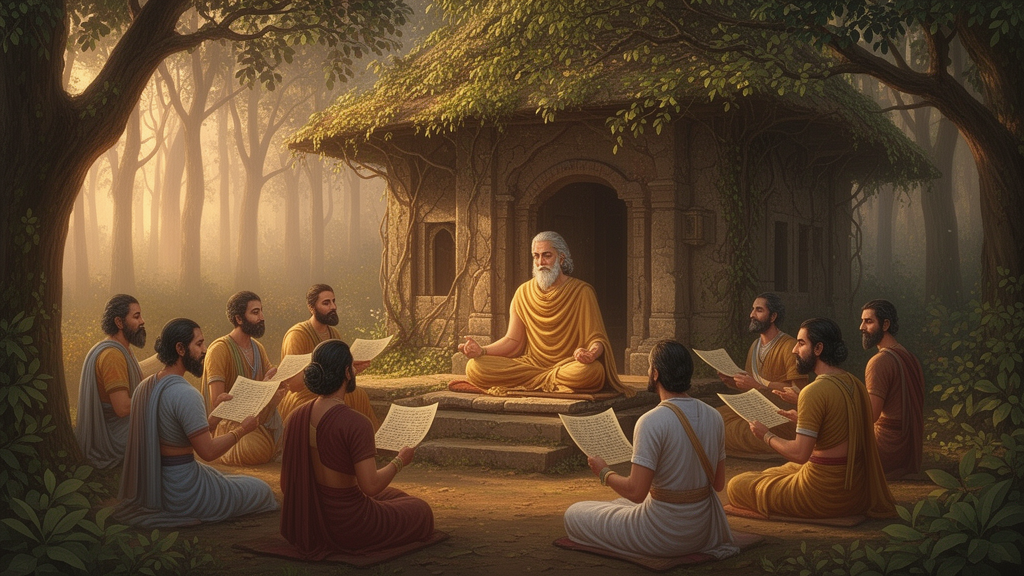
The original language also matters because of the tradition of recitation. In many Hindu contexts, sacred texts are studied and remembered through sound, pronunciation, and accent, not only through print. The Bhaktilipi article states that the Upanishads were preserved orally before being written in manuscripts, and that oral teaching came first in Indian sacred learning. Recitation practice is therefore part of the original-language experience, though specific recitation methods vary by school, region, and family.
A practical example: Aham Brahmasmi
The Brihadaranyaka Upanishad article identifies the phrase “Aham Brahmasmi” as one of its popular verses. In Sanskrit, the phrase is typically read as meaning “I am Brahman”. A reader who sees only the English phrase may not know how the words are built or how commentators have understood them. Studying the Sanskrit clause in its surrounding passage, and comparing several translations and commentaries, gives a more careful understanding than relying on a single slogan.
This example also shows why the original language should not be used as a shortcut to certainty. A phrase can be well known in popular culture while still being interpreted differently within Vedanta schools. The Brihadaranyaka article notes commentaries by Adi Shankara, Madhvacharya, and Ramanujacharya, who developed different philosophical readings of the Upanishadic texts.
Key terms to know before reading the Sanskrit
Several Sanskrit terms appear again and again in discussions of the Upanishads. Knowing them in their original form will help you read translations and editions more critically.
- Upanishad: The term is discussed in scholarship and the Sacred Books of the East material, which includes a section on the meaning of the word. The word is commonly associated with the idea of sitting near a teacher, though interpretations vary.
- Shruti: A category of Hindu scripture regarded as revealed or heard. Wikipedia’s navigation and the Bhaktilipi article both place the Upanishads within this tradition in Hindu understanding.
- Brahman: The ultimate reality in the philosophical texts.
- Atman: The inner self or essence of a living being, discussed in relation to Brahman.
- Veda: The larger body of Vedic literature to which the Upanishads belong as the concluding portions, often described as Vedanta.
Each of these terms has a long interpretive history. When you see them in a translation, check whether the translator has kept the Sanskrit term or replaced it with an English word, and whether a glossary or commentary explains the choice.
Scripts: Devanagari, IAST and transliteration
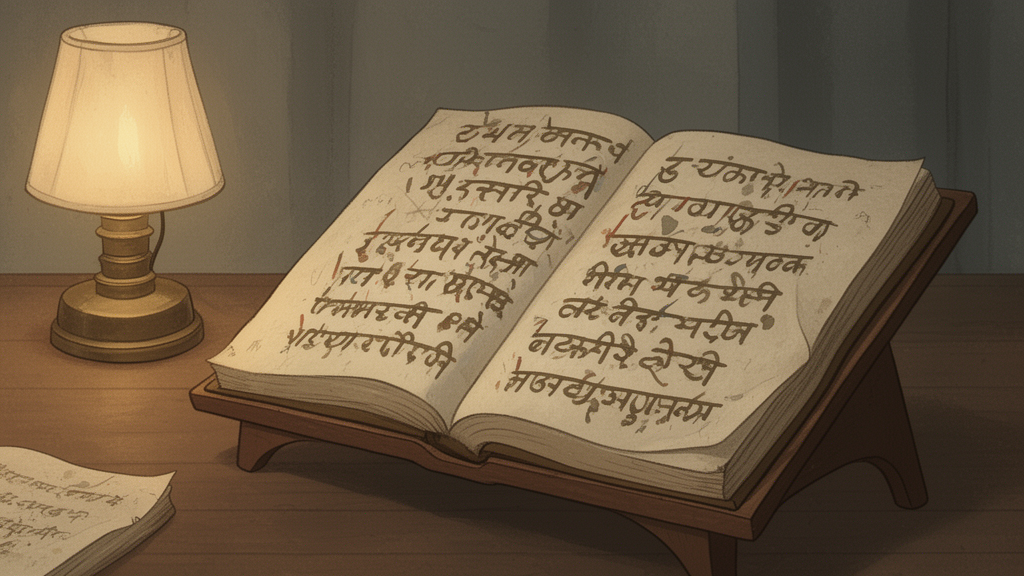
Sanskrit can be written in many scripts. The Wikipedia article on the Brihadaranyaka Upanishad displays verses in Devanagari and also gives the title in IAST (International Alphabet of Sanskrit Transliteration). Devanagari is the script most often used for Sanskrit and Hindi, and IAST is a Roman-letter system that uses diacritics to represent Sanskrit sounds.
Transliteration is important because English spelling does not map cleanly onto Sanskrit sounds. For example, the title is written as Bṛhadāraṇyaka in IAST and as बृहदारण्यक in Devanagari. Consistent transliteration matters when comparing editions. Different publishers and websites may spell the same name as “Brihadaranyaka”, “Brihadaranyaka”, or “Bṛhadāraṇyaka”, and this is normal variation rather than a different text.
If you are new to Sanskrit, learning to recognize Devanagari letters and IAST diacritics will help you check editions. The Wikipedia article also includes a warning that Indic text may not render correctly on some devices, so check your device’s font support before relying on a script display.
How translations were introduced to readers
The original Sanskrit has been translated into many languages. The Sacred Texts Archive page for “First Translation of the Upanishads”, part of the Sacred Books of the East volume 1, lists a section titled “First Translation of the Upanishads” and names Rammohun Roy in its table of contents. The same contents list includes sections on the position of the Upanishads in Vedic literature, the classes of Upanishads, critical treatment of the text, and the meaning of the word Upanishad. That structure shows how an early English edition framed the texts for readers.
The Sacred Texts page is a useful orientation resource, but the table of contents alone does not tell us the content of the translation. For claims about how Rammohun Roy translated particular passages, consult the full text of the edition itself. Academic and institutional editions usually provide more detailed notes on sources and variant readings.
How to compare translations
- Check the translator, the year, and the edition. Older translations may reflect the scholarship and assumptions of their time.
- Look for the Sanskrit text beside the translation, if available. Bilingual editions make it easier to see which words the translator has chosen to render.
- Compare key terms such as brahman, atman, and maya across at least two translations.
- Read introductions and notes. They often explain the textual basis, the commentary tradition, and the translator’s method.
- Keep a note of which claims come from the Sanskrit, which come from the translator, and which come from a later commentary.
Translations, commentaries and interpretations
A translation is not the same as the original text, and a commentary is not the same as the Upanishad. The Brihadaranyaka Upanishad article lists commentators including Adi Shankara, Madhvacharya, and Ramanujacharya. These commentators belong to different Vedanta traditions. The Wikipedia Upanishads article includes sections on Advaita Vedanta, Bhedabheda, Vishishtadvaita, and Dvaita, which show that the same Upanishadic passages have been read in different philosophical ways.
This matters for readers because a phrase may appear in a translation with a particular meaning shaped by one commentary tradition. When you read a claim such as “the Upanishads teach that the self is identical with Brahman”, ask whether the claim comes from the Sanskrit text, from a specific commentator, or from a modern summary. Non-dualist and qualified non-dualist readings may treat the relation between Atman and Brahman differently. The fair approach is to name the tradition whenever you describe an interpretation.
Traditional view and academic dating
Traditional Hindu understanding treats the Upanishads as sacred Shruti, meaning heard or revealed scripture. Academic study approaches the same texts through language, historical clues, manuscript evidence, and comparison with other Vedic literature. Both perspectives are valid for their own purposes, but they answer different questions. A devotional reader may ask about the spiritual authority of a text. A historian may ask when a passage was composed and how it changed over time.
The Brihadaranyaka Upanishad article gives a date range of the 7th to 6th century BCE, with references in the article to scholarly estimates. The Bhaktilipi article takes a more cautious approach: the earliest major Upanishads are generally placed in the later Vedic period, roughly in the first millennium BCE, but exact dates are debated. The Wikipedia Upanishads article presents the texts within a wider Vedic structure, but its chronology section is not reproduced in the material reviewed for this draft, so avoid treating a single date as settled for all Upanishads.
The careful statement is this: Sanskrit Upanishads developed over a long period, and different texts belong to different layers of that development. Specific dates should always be attributed to a named source and treated as estimates.
Oral transmission and manuscripts
The Bhaktilipi article distinguishes three things that are often confused: when teachings arose, when they were orally transmitted, and when manuscripts were written. In Indian sacred learning, oral teaching came first. A text might be memorized and recited for generations before it was copied into manuscripts. This means that the written Sanskrit we read today is the result of both recitation and later copying.
Manuscript copying also means that small differences can appear between versions. Editors compare manuscripts and choose readings, a process called critical editing. If you use a scholarly critical edition, its introduction and apparatus will explain which readings were preferred and why. Simpler editions may present a single reading without this detail.
Reading the original: a practical approach
Most readers do not need to master Sanskrit grammar before they can benefit from the Upanishads. A careful approach can still bring you closer to the original language.
- Choose one Upanishad. Start with a text that has a clear structure and a widely available edition. The Brihadaranyaka and Chandogya are common starting points in academic lists.
- Read the Sanskrit and translation side by side. Bilingual editions help you notice where a translator adds explanation.
- Learn the key terms. Keep a glossary of Sanskrit words such as brahman, atman, and karma, and note how each translation renders them.
- Read an introduction. Look for information about dating, manuscripts, the commentary tradition, and the translator’s method.
- Compare with a commentary. Read at least one traditional commentary, and note which school it represents.
- Check claims against the text. If a claim about the Upanishads appears online, check whether it is in the Sanskrit, in a translation, or in a later interpretation.
Where to find the Sanskrit texts
For readers who want to see the Sanskrit directly, the strongest starting point is a critical or scholarly edition from a university, library, or established publisher. The Internet Archive holds some bilingual editions, such as the record for the 112 Upanishads volume, but the usability and accuracy of each scanned edition should be checked against its publication details. Digital archives may include editions with outdated transliteration, incomplete sections, or uneven translation notes. Use them as starting points, then verify important passages against a reliable printed or institutional edition.
How HindusGod.com readers can use this guide
This guide focuses on language and textual context. It does not replace devotional practice or teacher-led study. Many Hindu communities learn the Upanishads through guru lineages, recitation groups, temple discourses, or family traditions. Those contexts can offer guidance on pronunciation, meaning, and practice that a written article cannot provide. If you are learning to recite a Sanskrit text, consider consulting a qualified teacher from your own tradition.
If you are exploring the broader Upanishads, the following HindusGod.com draft pages are relevant for further reading, although they are not yet confirmed as public: Upanishads Language covers the language question from another angle, and Upanishads in Sanskrit Language is the most closely related companion article. For a broader overview, see Upanishads, and for the count question, see 112 Upanishads. Readers interested in a particular number grouping can also consult 12 Upanishads and 13 Upanishads. For the original text specifically, see Original Upanishads. For reader questions about English-language presentations, see About Upanishads in English, and for the count of a commonly cited set, see Eight Upanishads. Note: these internal links point to WordPress draft targets; their public availability depends on the owner publishing those posts.
Common misunderstandings
- “The Upanishads are all the same language stage.” They are all Sanskrit, but earlier and later texts reflect different linguistic features.
- “A translation is the Upanishad.” A translation is an interpretation of the Sanskrit, shaped by choices about vocabulary and meaning.
- “There is one fixed number of Upanishads.” Collections differ, and editions may group texts differently.
- “Each Upanishad has one exact date.” Dating is debated, and many texts developed over time.
- “Commentary and scripture are the same.” Commentaries explain the text from particular philosophical or devotional viewpoints.
Frequently asked questions
Are all the Upanishads written in Sanskrit?
The reviewed sources describe the Upanishads as predominantly written in Sanskrit. Within the Sanskrit corpus, different texts show different linguistic stages, and any claim about a specific Upanishad should be checked against that text and a reliable edition.
Did the Upanishads start as written texts?
The Bhaktilipi article states that the Upanishads were preserved orally before being written down in manuscripts. Oral transmission and written copying both shaped how the texts reached modern readers.
Can I read the Upanishads without knowing Sanskrit?
Yes. Translations and introductions make the texts accessible. However, if you want to understand key terms and translation choices, learning basic Sanskrit vocabulary and using bilingual editions is very helpful.
What is the difference between Vedic and Classical Sanskrit?
Vedic Sanskrit is the older language of the Vedic texts, and Classical Sanskrit is the more standardized form later described by grammarians. The Teacher Finder article describes the earlier Upanishads as showing Vedic features and later texts as showing Classical features.
Which script should I use to read the original Sanskrit?
Devanagari is commonly used for Sanskrit text in print, and IAST is a common Roman transliteration. Choose an edition that clearly states its script and transliteration method, and use the same system consistently when comparing passages.
Summary and next step
The Upanishads are written in Sanskrit, and their original language is best understood as a family of Sanskrit styles rather than one uniform text. Earlier texts reflect Vedic Sanskrit features, later texts show Classical Sanskrit features, and the written forms we read today developed through oral recitation and manuscript copying. Translations are valuable, but they are interpretations. When you study a particular Upanishad, identify the Sanskrit term, the translator, the commentary tradition, and the source of any date or claim.
A good next step is to choose one Upanishad, find a bilingual or critical edition, and read its introduction before reading the main text. Keep your sources separate: text, translation, commentary, and modern interpretation are different layers, and clear notes will help you keep them distinct.
Sources and further reading
- Upanishads, Wikipedia: general overview, Sanskrit as the language of the texts, classification into Vedic branches, and Vedanta schools. Use as an orientation source, then consult primary and scholarly editions.
- Brihadaranyaka Upanishad, Wikipedia: Shukla Yajurveda affiliation, six chapters, Devanagari and IAST title display, date range given by the article, commentators, and the popular phrase “Aham Brahmasmi”.
- What language is the Upanishads written in?, Teacher Finder Blog: source for the general statement that the Upanishads are predominantly in Sanskrit and for the Vedic and Classical Sanskrit distinction. This is a secondary blog source; its dating of Panini should be checked against scholarly sources before reuse.
- First Translation of the Upanishads, Sacred Texts Archive: table of contents for the Sacred Books of the East volume, including the section on the first translation, the meaning of the word Upanishad, and the classes of Upanishads. Full sections were not reviewed for this draft.
- 112 Upanishads (Sanskrit Text, English Translation, An Exhaustive Introduction, Index of Verses), Internet Archive: record for a two-volume bilingual edition; supports the existence of a Sanskrit-and-English edition with that title only.
- When Were the Upanishads Written? Origin and Timeline, Bhaktilipi: source for the distinction between composition, oral transmission, and manuscript writing, and for the cautious statement that exact dates are debated.