The Upanishads and the Vedas are closely connected, but they are not the same kind of text. The Vedas are the older collection of hymns, ritual formulas, and sacrificial instructions that form the core of Vedic literature. The Upanishads are philosophical and meditative texts that developed within that tradition and are usually understood as its concluding part. In short, the Upanishads are part of the Vedic corpus, yet they shifted the focus from ritual action toward knowledge of the self and ultimate reality.
This guide explains how the two bodies of literature fit together, what each contains, where they differ, and why Hindu traditions read them in different ways. It also notes where sources agree and where scholars or traditions disagree. For a broader overview of the Vedic literature, see The Vedas and Upanishads.
What the Vedas Are
The word Veda comes from a Sanskrit root meaning knowledge. In Hindu tradition, the Vedas are the foundational scriptures, composed in Vedic Sanskrit, and they are counted among the oldest religious texts in the world. The standard list has four collections: the Rigveda, Samaveda, Yajurveda, and Atharvaveda. A general introduction to the Vedas from GeeksforGeeks describes them as collections of hymns, rituals, and chants used in Vedic religion, though this is a secondary educational summary rather than a scholarly edition.
Traditionally, the Vedas are regarded as shruti, meaning what is heard or revealed. The Vajiram explainer describes them as considered timeless and believed to have been discovered by ancient sages rather than authored by a named individual. That belief is a devotional and traditional position. It is not a claim that modern historians can test directly.
The Vedas were first transmitted orally. Students memorized and recited them under teachers, and the same secondary sources note that written documentation came later. This oral method is one reason the texts are often described as carefully preserved. Scholars discuss the history of the written transmission separately from the traditional account.
What the Upanishads Are
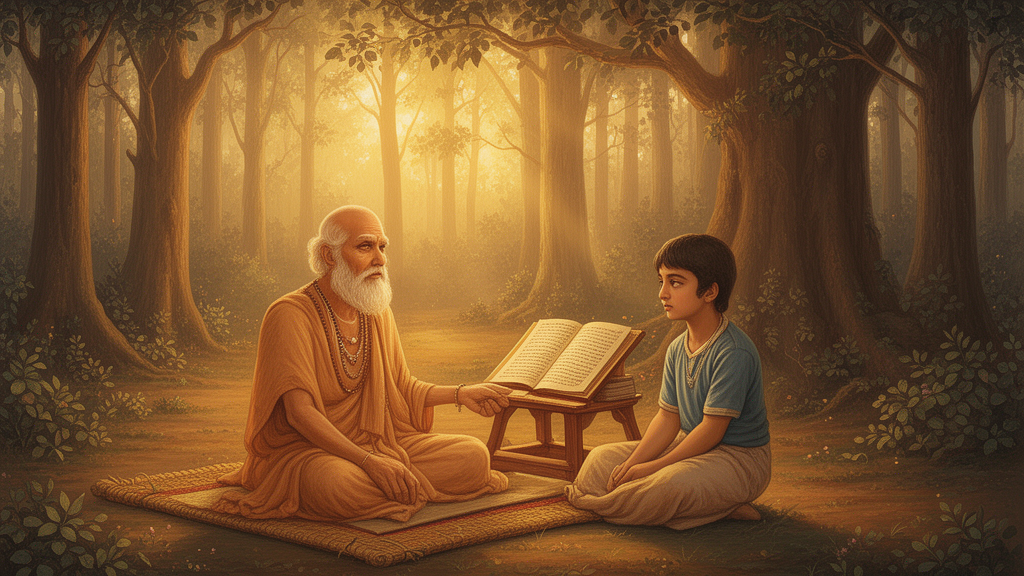
The Upanishads are prose and verse texts in which teachers and students, sages and seekers, discuss questions about existence, the self, and the ultimate reality. Wikipedia’s article on the Upanishads describes them as ancient Sanskrit religious and philosophical texts of Hinduism, and its classification section shows that they are traditionally linked to particular Vedic branches.
Many Upanishads are structured as dialogues or instructive stories. Rather than listing rituals, they often ask what remains constant beneath changing experience, what the individual self is, and how liberation is understood. Their language and method differ from the hymns and ritual manuals of the earlier Vedic collections, which is why many readers notice a shift in tone the moment they move from one to the other.
Here the terminology matters. The Upanishads are commonly called Vedanta, a word often explained as meaning the end or culmination of the Vedas. The VedaSeek guide uses this explanation, and it is widely repeated in Hindu educational material. Vedanta later also became the name of philosophical schools that interpret the Upanishads in different ways, which is discussed below.
The Name Upanishad
The word Upanishad is usually discussed in relation to a sense of sitting near a teacher. Britannica’s section on the Upanishads notes this traditional meaning and adds that the word was originally understood in other ways, including connection or equivalence. This is a useful example of how a term can carry more than one interpretation. The traditional meaning of teacher-centered study fits the dialogue format of many texts, while the older sense of connection points toward the Upanishadic idea that the individual and the ultimate are related.
Note that Britannica’s page was not fetched in full for this draft. The etymology is taken from the search-result text, so readers who need a scholarly account should consult the full article and the works of Sanskrit specialists.
How the Upanishads Fit Inside the Vedas
The most useful way to understand the relationship is to see the Vedas as a layered literature. Several secondary sources describe each Veda as having four parts. The table below follows the layering described in the VedaSeek guide and the Vajiram explainer, both of which present the Upanishads as the final layer of each Veda.
- Samhitas: collections of mantras, hymns, and prayers, often addressed to deities such as Agni, Indra, and Varuna.
- Brahmanas: prose texts that explain how sacrifices (yajnas) are performed and what the rites mean.
- Aranyakas: texts often described as forest treatises, which discuss the symbolic and meditative meaning of ritual.
- Upanishads: dialogues and discourses on ultimate reality, the individual self, and liberation.
Each Veda has its own set of Upanishads. The Rigveda is associated with the Aitareya Upanishad, the Samaveda with the Chandogya and Kena, the Yajurveda with several texts including the Brihadaranyaka, Isha, Katha, and Taittiriya, and the Atharvaveda with the Mundaka and Mandukya, according to the Vajiram table. Wikipedia’s classification lists a similar grouping under the headings Rig vedic, Sama vedic, and Yajur vedic, and it also covers the Muktika canon, which groups Upanishads into major and minor lists. Because lists vary by source and tradition, a reader should not assume one fixed number or one fixed list.
Some texts are not neatly placed. Secondary charts show that certain layers are missing or absorbed in some Vedic branches, and the Atharvaveda’s Brahmana is described as absorbed or lost in one table. Such details show that the Vedic literature developed through schools and recensions rather than a single uniform arrangement.
For readers who want a further overview of how the Upanishads appear in the wider tradition, Hindu Vedas and Upanishads and Hinduism Vedas and Upanishads offer related context on HindusGod.com, though those drafts may not yet be public.
From Ritual to Knowledge
The clearest difference between the two literatures is emphasis. The Vedic hymns and Brahmanas center on ritual, sacrifice, cosmic order, and the deities who receive offerings. The Upanishads place greater weight on knowledge, inquiry, and self-understanding. Britannica’s summary puts it this way: in the Upanishads, Vedic ritualism and the teaching of interconnected phenomena give way to a new emphasis on knowledge alone. Britannica’s wording is presented here as a summary of the scholarly view, and the full article should be checked for its qualifications.
Secondary guides often summarize this contrast in a table. The GeeksforGeeks comparison lists the Vedas as ritualistic and ceremonial and the Upanishads as philosophical, mystical, and focused on self-realization. Those labels are useful for a first reading, but they simplify the material. Many Upanishadic passages still refer to sacrifice, and later Hindu practice often combined ritual, devotion, and philosophy.
A good way to read the shift is to ask what a text is trying to achieve. A Vedic hymn often supports an offering or invokes a deity for a specific ceremony. An Upanishad often asks the reader to reflect on what the ritual symbolizes, or to ask whether the self that performs the ritual can be understood in its own right. The Upanishads do not always reject ritual, but they make knowledge central in a way that changes how later thinkers read the older texts.
Key Concepts in the Upanishads
Several concepts recur across the Upanishads, although their interpretation varies. Wikipedia’s overview organizes its philosophy section around the development of thought, the relationship between atman and Brahman, and the concept of reality and maya. Each of these ideas needs careful handling.
Brahman
Brahman is commonly described as the ultimate reality underlying all things. The Upanishads discuss it through many images and arguments, and the texts do not always describe it in the same way. Some passages describe it through negation, saying what it is not, while others use analogies or poetic description. Readers should be cautious about reducing Brahman to a single doctrine, since different Upanishadic passages and later schools emphasize different aspects.
Atman
Atman is usually translated as self or soul, though the translation is debated. In the Upanishads, atman refers to the innermost self. Several texts connect this self with Brahman, which is the basis of the well-known Upanishadic teaching that the innermost self and ultimate reality are related. The precise nature of that relationship is one of the main points of disagreement among later schools.
Moksha
Moksha means liberation from the cycle of birth and death, a theme that becomes central in later Hindu philosophy. The VedaSeek guide describes the Upanishads as exploring the path to liberation, and this is a common summary. Liberation is understood differently across traditions. Some connect it with realization of unity with Brahman, some with devotion to a personal deity, and others with a relationship that remains distinct.
Examples from the Texts
Concrete examples help show how the Upanishads work as literature and teaching.
The Katha Upanishad and Nachiketa
The Katha Upanishad is one of the best-known Upanishads and is associated with the Yajurveda in the groupings above. Wikipedia’s image caption for the article describes the scene of Yama teaching Nachiketa. In brief, the young Nachiketa asks Yama about what happens after death, and the dialogue turns into an inquiry into the self and liberation. The story illustrates the Upanishadic method: a question about life is answered through a conversation that moves from ritual and worldly reward to deeper knowledge. Readers who want the full text should use a reliable translation and check how each translator renders key terms.
Tat Tvam Asi
The phrase Tat tvam asi, often translated as that thou art, is one of the most quoted Upanishadic formulas. Wikipedia’s article includes an image caption describing it as an Upanishadic phrase, and it is widely displayed in Hindu contexts, including at the Sabarimala temple in Kerala. The phrase is commonly traced to the Chandogya Upanishad, but readers should verify the exact passage in a primary edition before quoting it. Its meaning is also interpreted differently. Advaita Vedanta reads it as identity between atman and Brahman, while other Vedanta schools understand the relationship in different terms.
Reading a Passage Step by Step
A simple reading method helps beginners. First, identify the speaker and listener, because many Upanishads are dialogues. Second, note the question being asked, since the answer often responds to a specific problem. Third, check the translation for technical terms such as atman, Brahman, and moksha. Fourth, compare the passage with a commentary from a tradition that you want to understand. This approach keeps the text separate from later interpretation, which is an important distinction in Hindu scholarship.
Dates and Scholarly Views
Many introductory sources give approximate dates for the Vedas and the Upanishads. The GeeksforGeeks article gives a range of about 1200 to 400 BCE for the Vedas and about 700 to 400 BCE for the Upanishads. These ranges are useful as rough orientation, but they should not be treated as precise historical facts. Dating early Indian texts is difficult because most were transmitted orally for long periods, and scholars rely on linguistic, internal, and archaeological evidence that can be debated.
The more important historical point is that the Upanishads are later than the earliest Vedic hymns and emerge within a long tradition. They reflect changing philosophical concerns over time, rather than a sudden break. Scholars often describe a development from hymn and ritual toward reflection and speculation, but they also recognize that the boundaries between genres were not always rigid.
The distinction between belief and history matters here. The idea that the Vedas were revealed and not authored belongs to a traditional and devotional account. Historical dating and scholarly reconstruction belong to a different category of evidence. A good post or study keeps these categories separate, and this guide follows that practice.
Traditions, Schools, and Regional Differences
Hindu traditions do not all read the Upanishads in the same way. The Vedanta schools are the clearest example. Wikipedia’s article lists Advaita Vedanta, Bhedabheda, Vishishtadvaita, and Dvaita as major interpretive schools. Advaita Vedanta is commonly associated with non-dual identity between atman and Brahman. Vishishtadvaita understands Brahman as qualified by a differentiated world and selves. Dvaita emphasizes a real distinction between the individual and the supreme being. Bhedabheda, as its name suggests, combines difference and non-difference in its account. These are interpretive positions, not simple facts that every reader must accept.
Devotional traditions add another layer. Many Hindus who revere a personal deity read Upanishadic teachings through that devotion, while others focus on ritual observance, temple worship, or scriptural study. The Vedas and Upanishads remain authoritative in many Hindu contexts, but the practices that people actually follow vary by region, family, community, and sampradaya.
Language and textual transmission also vary. The Vedas and Upanishads have been preserved within different Vedic branches, and regional traditions have produced their own recitation styles and commentaries. Translations into modern languages also differ in choice of terms. A reader who compares two English translations of the same passage may see different vocabulary for the same Sanskrit word, which is a reason to note the translator and edition in any serious study.
Reading the Texts Today
For most readers, the first encounter with these texts comes through translation. Translations are valuable, but they involve interpretation. The Sanskrit term atman, for example, may appear as self, soul, or spirit, and each choice carries assumptions. When quoting or studying a passage, check the translator, the edition, and whether the translation is based on a commentary.
The Vedic language is also different from later Classical Sanskrit. The GeeksforGeeks comparison notes that the Vedas are composed in Vedic Sanskrit and the Upanishads are generally described as late Vedic Sanskrit texts or as written in Classical Sanskrit in some tables. Sources disagree in how they label the language of the Upanishads, so a careful reader should check a specialist reference before making a firm claim.
The classification of the Upanishads is another point to handle carefully. Some educational charts label the Upanishads as smriti, which usually refers to remembered texts, while the traditional view places them within shruti. The Wikipedia article’s series navigation groups the Upanishads with the Vedic divisions under shruti, and the classification dispute is a good example of why readers should distinguish traditional categories from modern summaries.
Further Study on HindusGod.com
Readers who want to compare the Vedas and Upanishads more closely can explore related pages on HindusGod.com. Different Vedas and Upanishads covers distinctions between the texts, while Origin of Vedas and Upanishads looks at how these works are traditionally introduced. Those pages are currently drafts and may not be public yet, so the owner should confirm their status before relying on the links in published material.
For the place of the Upanishads in a wider body of Hindu scripture, Puranas Vedas and Upanishads compares the Vedic corpus with later literature. Readers interested in the relation between scriptures and devotional texts may also find Vedas Upanishads Bhagavad Gita helpful, since it connects the Upanishadic tradition with a text widely read in devotional contexts.
A number of pages focus on particular lists or groupings. Ten Upanishads of Four Vedas discusses a commonly cited selection, while 112 Upanishads addresses the larger collections that appear in some lists. Because the number and selection of Upanishads differs across sources, readers should treat any single list as one tradition’s selection rather than a universal canon. For readers who want a language-focused resource, Vedas and Upanishads in English is a useful starting point, and Vedas Brahmanas and Upanishads explains how the Brahmana layer connects with the Upanishads.
Frequently Asked Questions
Are the Upanishads part of the Vedas?
Yes, in the traditional and most common educational account. The Upanishads are usually described as the concluding layer of each Veda and are often called Vedanta. Some sources also treat them as a separate literary genre with their own philosophical emphasis, so it is accurate to say they are both part of the Vedic corpus and distinct in focus.
Which Vedas are the Upanishads associated with?
Each Veda has its own associated Upanishads. The Rigveda is linked with the Aitareya Upanishad, the Samaveda with the Chandogya and Kena, the Yajurveda with several texts such as the Brihadaranyaka and Katha, and the Atharvaveda with the Mundaka and Mandukya, according to the Vajiram table. Other lists exist, so check the textual tradition you are studying.
Should beginners read the Vedas or the Upanishads first?
There is no single required order. Many beginners start with the Upanishads because their philosophical questions are easier to approach in translation. Readers who want to understand the origin of the ideas may read introductions to the Vedas first. A teacher or community study group can help, especially for texts that are read as part of a specific lineage.
Summary
The Upanishads and Vedas belong to the same broad tradition, but they differ in purpose and emphasis. The Vedas contain hymns, chants, ritual formulas, and sacrificial instructions, and they are traditionally regarded as revealed. The Upanishads are the concluding layer of the Vedic literature and focus on knowledge of the self, ultimate reality, and liberation. Their interpretation varies across Vedanta schools and devotional traditions, and their dates and classification are discussed differently by scholars and educational sources.
A useful next step is to choose one Upanishad, read a reliable translation with notes, and compare it with the Vedic ritual background described in a basic introduction. That approach keeps the scripture, the translation, and the later interpretation clearly distinct.
Sources and Further Reading
- Upanishads, Wikipedia: used for the description of the Upanishads, their classification, the Vedanta schools, and the Katha Upanishad and Tat tvam asi image captions. Treat as a general reference that should be checked against primary editions and scholarly works.
- Hinduism: The Upanishads, Britannica: used for the traditional meaning of the word Upanishad and the summary of the shift from ritual to knowledge. The full page was not fetched for this draft.
- Difference between Vedas and Upanishads, GeeksforGeeks: used for approximate date ranges and comparison labels. This is a secondary educational source and its labels should be checked.
- Difference Between Vedas and Upanishads, Vajiram and Ravi: used for the four-part structure of each Veda, the Veda-to-Upanishad table, and the description of oral transmission. This is a secondary educational source.
- Upanishads vs Vedas: Key Differences Explained, VedaSeek: used for the description of the Upanishads as Vedanta and the layered structure of the Vedas. This is a secondary commentary-style source.