The Vairocana Sutra is the common English name for the Vairocanābhisaṃbodhi Sūtra, an important Vajrayana Buddhist text. It is also known as the Mahāvairocana Tantra, and in Japan as the Mahāvairocana Sūtra. Its central figure is the Buddha Vairocana, whose name is often translated as “the Sun” or “Shining.” This article explains what the text is, how it is named and dated, what it covers, and how different Buddhist traditions read it. Where sources disagree or only partly support a claim, the article says so.
Quick answer: what the Vairocana Sutra is
The Vairocana Sutra is a Buddhist scripture that teaches esoteric (tantric) philosophy and ritual practice centred on the cosmic Buddha Vairocana. According to the Wikipedia overview, it was composed before 674 CE and is one of the earliest comprehensive manuals of tantric Buddhism. Its practical sections, as summarised by the Berkeley Buddhist Research Institute edition description, cover the construction of a maṇḍala, initiation rites, mantra recitation, ritual hand gestures called mudrās, and visualisation techniques.
For most readers, the key points are these:
- Name: The text appears under several names in different languages, and the same work is often discussed as a “sūtra” in Japanese and Chinese contexts and as a “tantra” in later Indian and Tibetan classifications.
- Subject: The Buddha Vairocana, presented as a universal, luminous source of awakening.
- Content: Doctrine together with ritual, including maṇḍala construction, initiation, mantra, mudrā, and visualisation.
- Tradition: It is central to the Shingon school in Japan and is also part of the Tendai tradition, while Tibetan Buddhism classifies it within the carya category.
This is a Buddhist text. Hindus searching for the phrase may encounter it while exploring Indian Buddhist history, Vajrayana practice, or East Asian religion. It is not a Hindu scripture, and its devotional and ritual claims belong to Buddhist traditions.
Names and spellings readers may encounter
The text has several names, and readers will see different forms depending on the language and school.
Sanskrit and English titles
The Sanskrit title is Vairocanābhisaṃbodhi Sūtra, which is commonly rendered as “Vairocana’s Awakening Sūtra.” The Wikipedia article on the text also gives the Sanskrit title Mahāvairocana Tantra. Both names point to the same core text, though scholars and translators may choose different titles depending on whether they emphasise its scriptural form or its ritual content.
The spelling “Vairocana Sutra” without diacritics is a common search form. In formal writing, it is better to keep the diacritics (Vairocanābhisaṃbodhi Sūtra) and explain the shorter form when first used.
Chinese and Japanese titles
In Chinese, the text is known as 大毘盧遮那成佛神變加持經, with the short title 大日經 (Da Ri Jing). In Japan, it is called Daibirushana jōbutsu jinpen kajikyō and is known as the Mahāvairocana Sūtra. These titles reflect the way Chinese and Japanese Buddhists received and organised the text.
Composition and date: what scholars say
The date and place of composition are not settled in a single, uncontested form, so it is important to separate the claims clearly.
- Earliest date claim: The Wikipedia article states that the text was composed before 674 CE. This is a limit, not an exact date.
- Likely period and place: Wikipedia states that the text was probably composed in the middle of the 7th century, most likely in north-eastern India at Nālandā. It gives as evidence the role of scholars who worked at Nālandā in transmitting the text and the match between its descriptions of plants and trees and the Nālandā region.
- Early commentators: Buddhaguhya, who is dated to around 700 CE in the same article, classified the text as a caryātantra.
These points are presented in a general reference article and are linked to scholarly sources in its references. A reader who needs a firm historical date should consult the original academic studies cited there, not a single summary. Because the evidence for location and date is circumstantial, it is better to describe Nālandā as the most widely proposed setting than as a proven fact.
How the text is classified
The classification of the text varies by tradition, and this is one of the most useful things to understand about it.
Tantra or sūtra?
The Wikipedia article notes that the scripture does not call itself a tantra, even though later figures, including later Indian commentators, often used that term. The title “Sūtra” in the Japanese context reflects how it was received as a scripture, while “Tantra” reflects its place in the development of Buddhist esoteric literature. Both labels are used in scholarship, and each highlights a different aspect of the work.
Carya and other categories
In Tibetan Buddhism, the text is still considered part of the carya classification, as the Wikipedia article reports. The carya category is one way later Indian and Tibetan teachers grouped tantric texts by their emphasis on ritual conduct and practice. Readers should treat this as a tradition-specific classification rather than a universal ranking of the text.
Shingon and Tendai
In Japan, the text is one of two central texts of the Shingon school, along with the Vajrasekhara Sutra. The Wikipedia article also states that both texts are part of the Tendai school. This is important for understanding how the text is used today. In Shingon, it is not only read as history or literature; it sits within a living ritual and doctrinal system.
Structure and main topics
Scholarly summaries describe the text as having an opening doctrinal section followed by a longer set of practical chapters. A publisher’s description from the Berkeley Buddhist Research Institute (BDK) edition explains that the sutra deals with both doctrinal and ritual aspects and is often studied alongside the Adamantine Pinnacle Sutra, which BDK publishes together with it in the volume Two Esoteric Sutras.
The BDK edition’s introductory material, as represented in the search extract for this article, says that the chapters after the opening section “deal in detail with various practices that are more specifically ‘Tantric’ in character.” These include:
- Maṇḍala construction: Building a sacred diagram that organises the Buddhist cosmos and the practitioner’s ritual space.
- Initiation rites: Formal rites through which a student is admitted into the practice.
- Mantra recitation: Repetition of sacred syllables and phrases as a practice.
- Mudrās: Ritual hand gestures, sometimes called “seals.”
- Visualisation: Meditative practices that involve imagining deities, maṇḍalas, and symbolic forms.
These topics are described in the BDK introduction and are typical of esoteric Buddhist literature. They should be understood as tradition-specific ritual instruction. The text does not function as a simple self-help manual, and its practices are usually taught within guided lineages.
Doctrine and ritual together
BDK’s own description emphasises that the sutra addresses both philosophy and practice. This is significant. Many readers approach Buddhist texts as either doctrinal treatises or ritual manuals. The Vairocana Sutra is important precisely because it links the two. The Buddha Vairocana is presented as the centre of a worldview, and the maṇḍala, mantra, and mudrā are ways of entering and expressing that worldview.
Who is Vairocana?
Vairocana is the main figure of the sutra and of the wider Vairocana cult in Mahayana and Vajrayana Buddhism. The Wikipedia article on Vairocana gives the name’s meaning as “The Sun,” “Solar,” or “Shining” in Sanskrit. He is also called Mahāvairocana (Great Sun) and Paramabuddha, and he is venerated in both Mahayana and Vajrayana Buddhism.
The sun metaphor
Vairocana is often compared to the sun because, in the tradition’s imagery, the sun shines impartially on all beings. Unlike the physical sun, whose light can be blocked and which disappears at night, Vairocana’s light is described by Buddhists as omnipresent, impossible to block, and eternal. This is a devotional and doctrinal image, not a scientific claim about the sun. Its purpose is to express the Buddha’s universal wisdom and compassion.
Names in East Asian Buddhism
In East Asian Buddhism, Vairocana is called 大日如來 (“Great Sun Thus Come One”) or 毘盧遮那佛 (“Vairocana Buddha”). The Japanese names include Dainichi Nyorai and Birushana Butsu. The Wikipedia article also lists Korean, Vietnamese, Thai, Mongolian, and Tibetan forms, which shows how widely the figure was received across Asia.
Śūnyatā and the cosmic Buddha
The Wikipedia article on Vairocana lists Śūnyatā (emptiness) among his attributes. Readers should be careful here. In Buddhist philosophy, emptiness is not usually understood as empty nothingness; it refers to the absence of inherent existence in phenomena. The sutra’s own treatment of these ideas should be read in its textual context and in the commentary of specific schools, rather than inferred from a short summary.
Iconography: how Vairocana is shown
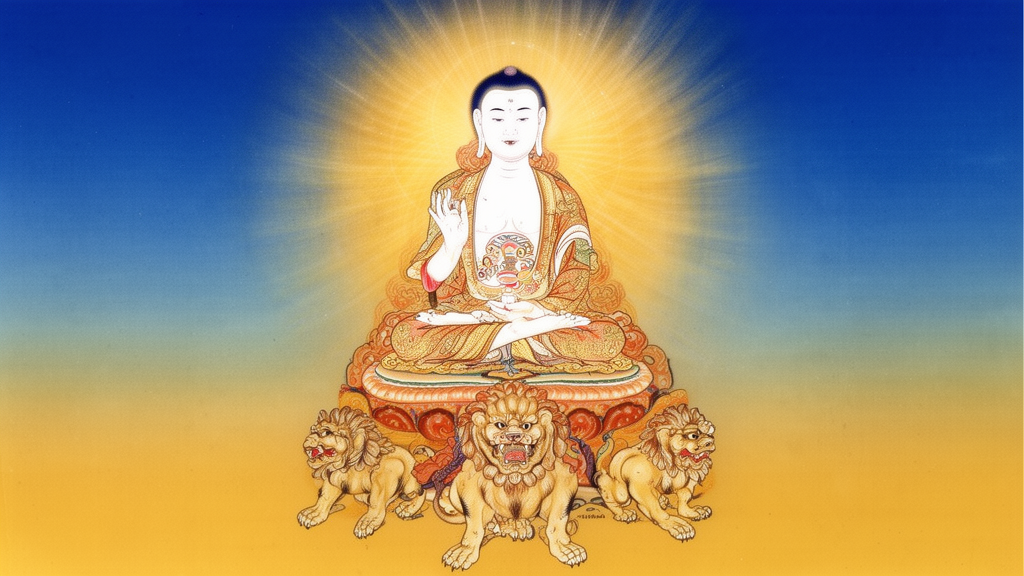
Artistic depictions help readers recognise the figure, but they vary by region and period. The Wikipedia article on the sutra describes a Tibetan representation of Vairocana with his white colour, the teaching gesture (dharmacakra mudrā), and seating on an elaborate lion throne. A medieval Japanese painting of Vairocana from the Vajradhātu Maṇḍala is described as showing the wisdom-fist mudrā.
These two images show a useful point: the same Buddha can be depicted with different gestures and in different maṇḍala contexts. Iconography is best understood as tradition-specific, and devotional images should be read in the context of the community that uses them.
The maṇḍala and the Garbhadhātu
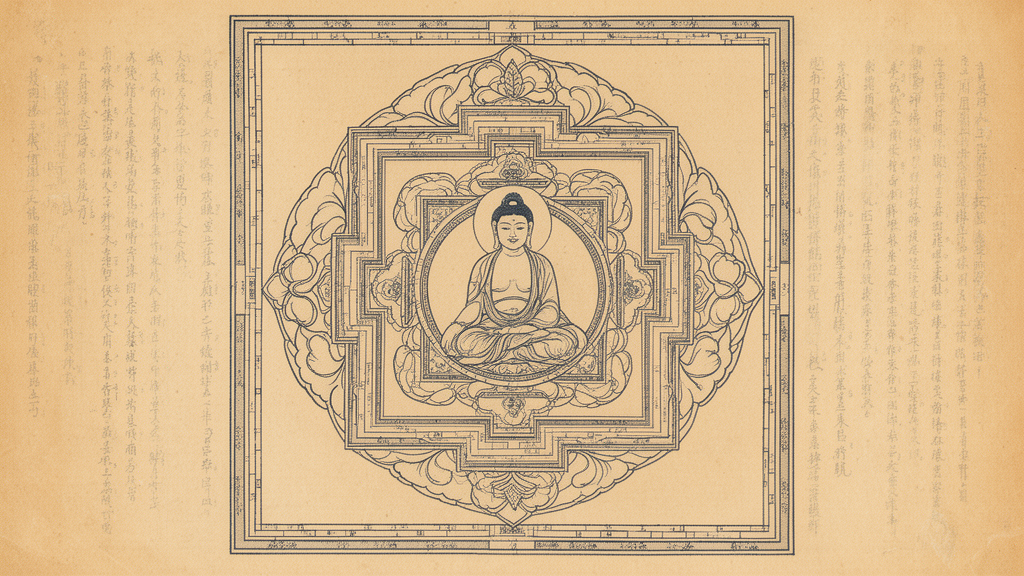
The maṇḍala is one of the most visible features of the Vairocana tradition. The Wikipedia article on the sutra includes a diagram of the Garbhadhātu maṇḍala as used in the teachings of Śubhakarasiṃha drawn from the Mahāvairocana Tantra, with Vairocana at the centre. The BDK introduction also lists maṇḍala construction as one of the main practical subjects of the sutra.
In practical terms, a maṇḍala is a structured symbolic diagram. Its layout expresses a view of the Buddhist cosmos, the Buddhas and bodhisattvas gathered within it, and the path of practice. For students of the sutra, the maṇḍala is a way to see how doctrine is turned into ritual space. Traditional maṇḍala construction and initiation are usually taught by qualified teachers within lineages, and this article does not provide instructions for constructing one.
Distinguishing belief, text, tradition, and scholarship
Readers searching for the Vairocana Sutra often want to understand what the text says, what Buddhists believe about it, and what historians have concluded. These are different questions.
- What the text says: The sutra presents Vairocana as the central Buddha and describes maṇḍala, initiation, mantra, mudrā, and visualisation. Specific verses and chapter-level claims should be checked against a scholarly translation before being quoted.
- Traditional belief: Buddhist communities regard Vairocana as a source of light and wisdom, and they perform practices according to their lineages. Beliefs about the results of practice are religious claims and are not verified facts.
- Historical scholarship: Scholars discuss the date, place of composition, and transmission history. Their conclusions are often qualified, and readers should follow the cited studies.
- Modern interpretation: Modern writers may explain the text in philosophical, psychological, or cultural terms. These are interpretations, not the sutra’s own claims.
When these categories are kept separate, the text is easier to understand, and readers can avoid mistaking a devotional explanation for a historical finding.
Regional and school differences
The Vairocana Sutra is not a single, uniform practice. The text is studied and practised in different ways across regions and schools:
- India and Tibet: The text is classified within tantric categories, and Tibetan Buddhism retains the carya classification.
- Japan: Shingon treats the text as a central scripture alongside the Vajrasekhara Sutra, and Tendai also includes it.
- China and Korea: Chinese and Korean forms of Vairocana and the text’s Chinese title reflect a separate East Asian reception.
These differences are not contradictions. They reflect the way Buddhist communities adopted the text in different languages, institutions, and ritual systems. Anyone studying or practising the sutra should identify which lineage, translation, and commentary they are using.
Examples of how readers can study the text
A practical way to approach the sutra is to combine three kinds of source:
- A scholarly translation: Use an academic or scripture-edition translation, such as the BDK edition, to read the text itself.
- A reference article: Use a general encyclopedia entry to check dates, names, and the text’s place in Buddhist history.
- A teacher or lineage source: For ritual practices, rely on qualified teachers within an established tradition, because the sutra’s practices are tradition-specific.
For example, a reader who wants to understand why Vairocana is called the “Great Sun” can read the Wikipedia overview of the figure, then compare it with the sutra’s own presentation in a translation. A reader who wants to understand maṇḍala practice should study the sutra’s structure and then consult a school-specific source before attempting any practice.
Related HindusGod.com reading
Readers who want to compare the Vairocana Sutra with other scriptures can explore these related articles. Each link points to a WordPress draft on HindusGod.com that may not yet be public; the owner should confirm publication status before relying on these links for readers.
- For a broader Mahayana scripture, see the Avatamsaka Sutra article, which also belongs to the East Asian Buddhist literature in which Vairocana is prominent.
- For another devotional Buddhist text that focuses on a single Buddha or bodhisattva, see the Amida Sutra article.
- For a text on the bodhisattva of compassion, see the Avalokiteshvara Sutra article.
- For a text connected with dhāraṇī practice, see the Dharani Sutra article.
- For meditation-centred scriptures, see the Dhyana Sutra article.
- For ethical and monastic texts, see the Brahmajala Sutra article.
- For another scripture with a cosmic or bodhisattva focus, see the Akasagarbha Sutra article.
- For a text discussing the stages of the bodhisattva path, see the Dasabhumika Sutra article.
- For a general discussion of sutra meaning in Buddhist contexts, see the Diamond Sutra Meaning article.
Frequently asked questions
Is the Vairocana Sutra a Hindu text?
No. It is a Buddhist text, and it is central to Vajrayana and East Asian esoteric Buddhism, especially Shingon. Readers exploring Indian religious history may encounter it because it was composed in an Indian Buddhist setting, but its authority and practice belong to Buddhist communities.
Why is the text called both a sutra and a tantra?
The Wikipedia article explains that the scripture does not call itself a tantra, although later figures often used that term. Japanese tradition receives it as a sūtra, while Indian and Tibetan classifications place it within tantric categories. Both names are in use, and each reflects a different classification.
Can I practise the Vairocana Sutra’s rituals from the text alone?
The sutra describes maṇḍala construction, initiation, mantra, mudrā, and visualisation, but these practices are traditionally taught within lineages under qualified teachers. Reading about them is not a substitute for instruction, and this article does not provide ritual steps.
Summary and next steps
The Vairocana Sutra, or Vairocanābhisaṃbodhi Sūtra, is a central text of esoteric Buddhism. It is also called the Mahāvairocana Tantra and, in Japan, the Mahāvairocana Sūtra. It presents the Buddha Vairocana as a luminous, cosmic source of awakening and combines doctrine with ritual practices such as maṇḍala construction, initiation, mantra, mudrā, and visualisation.
For further study, begin with a scholarly translation, such as the BDK edition, and then consult academic sources for historical questions about date and transmission. When you move from reading to practice, follow a qualified teacher within a recognised lineage. Keep the difference between the text, the tradition, and modern interpretation in view as you read.
Sources and further reading
- Vairocanābhisaṃbodhi Sūtra: Wikipedia overview of the text’s names, composition, classifications, Shingon and Tendai use, and the maṇḍala illustration. Used for the text’s names, date limit, Nālandā proposal, carya classification, and Shingon status.
- Vairocana: Wikipedia overview of the Buddha Vairocana, including the meaning of his name, his “Great Sun” imagery, East Asian names, and listed attributes. Used for the name meaning, sun metaphor, East Asian titles, and listed attributes.
- The Vairocanabhisambodhi Sutra (BDK PDF): Berkeley Buddhist Research Institute edition introduction. Used for the description of the sutra’s practical chapters: maṇḍala construction, initiation rites, mantra recitation, mudrās, and visualisation. Verify against the full PDF before quoting.
- The Vairocanābhisaṃbodhi Sutra (BDK America): Publisher description. Used for the note that the sutra covers doctrinal and ritual aspects and is studied alongside the Adamantine Pinnacle Sutra.