The Nirvana Sutra, known in Sanskrit as the Mahāyāna Mahāparinirvāṇa Sūtra, is a major Mahayana Buddhist scripture. It presents itself as the Buddha’s final teaching, delivered on the last day before his physical death. Its most distinctive ideas are the presence of a Buddha-nature (buddhadhātu, also called tathāgatagarbha) in all beings and a teaching on an eternal, blissful, and pure “True Self.” This is a Buddhist text, not a Hindu scripture, and it should not be confused with the early Pali Mahāparinibbāna Sutta, which belongs to a different tradition of texts.
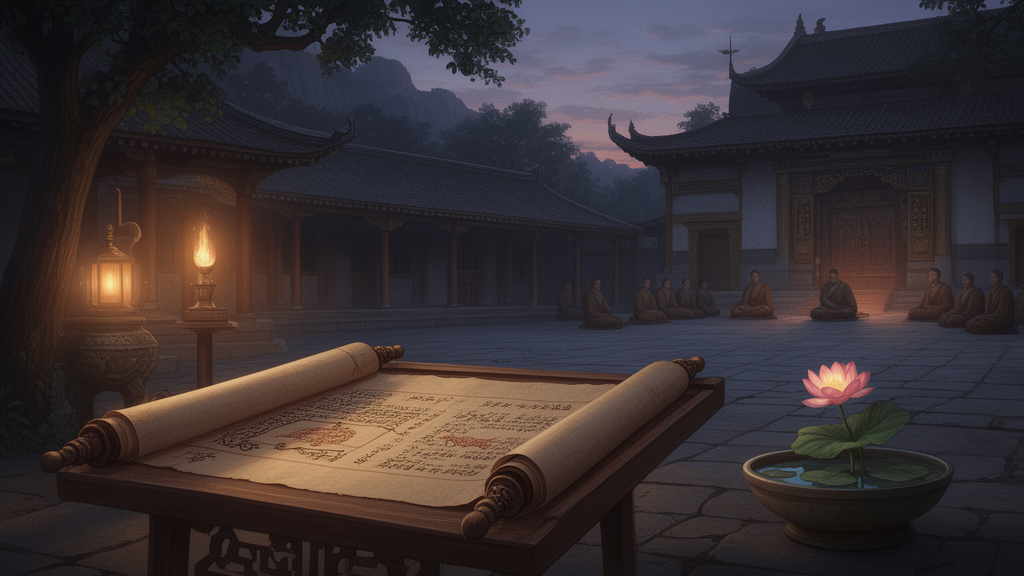
This guide explains what the sutra says, how it developed through Chinese translations, why its teaching on the self is debated, and how readers can approach it with care.
The short answer: what the Nirvana Sutra teaches

The sutra claims to set out the Buddha’s “final explanation” of the Dharma. According to a summary of the text on Buddhism Guide, the sutra calls itself the “all-fulfilling conclusion” of authentic Dharma and says it will reveal the “intended gist” of the Buddha’s teachings (Buddhism Guide, Nirvana Sutra overview).
Its central doctrinal claims are:
- Buddha-nature: Every sentient being contains a salvific Buddha-nature, also described as tathāgatagarbha, the “Buddha-matrix” or “Buddha embryo.”
- True Self: The Buddha’s nirvana is described as having eternal, blissful, pure, and unchanging qualities, including a supramundane Self (ātman).
- Reinterpreted non-Self: The sutra reads the familiar Buddhist teaching of non-Self as a rejection of the impermanent, conditioned ego, not as a denial of every kind of Self.
These claims are presented as the sutra’s own teaching. Many Buddhist readers and scholars treat them as a distinct Mahayana emphasis, and they remain a subject of interpretation.
Two texts with similar titles
Readers searching for “nirvana sutra” may encounter two different Buddhist texts. The Mahāyāna Mahāparinirvāṇa Sūtra is the Mahayana text discussed here. The Pali Mahāparinibbāna Sutta, from the Pali Canon, describes the Buddha’s final days and passing. Buddhism Guide notes that the Mahayana sutra is generally called by its Sanskrit title, while the Pali text is called by its Pali title, for historical reasons and for clarity (Buddhism Guide).
A Wikipedia article on the Mahāyāna text makes the same distinction, stating that the Mahayana sutra should not be confused with the early Buddhist Mahāparinibbāna Sutta, which is not a Mahayana sutra (Wikipedia: Mahāyāna Mahāparinirvāṇa Sūtra). When you read a source, check which text it discusses.
Chinese translations and the question of origins
The sutra survives in Chinese translations, and those translations are central to how it is studied. According to Wikipedia, the text was translated into Chinese several times. The two most important editions are a 416 CE “six fascicle” text and a 421 CE translation by Dharmakṣema, which is about four times longer than the earlier version (Wikipedia).
The difference in length matters for interpretation. Readers who compare editions should be aware that they may be reading different stages of the text rather than one fixed Indian original. Buddhism Guide also refers to a Fa-xian version, and to a Dharmakṣema version in which the Buddha declares that “in truth there is Self (Atman) in all dharmas” (Buddhism Guide).
Scholarly views on the sutra’s origins vary. A teaching resource from the Minnesota Zen Meditation Center describes the long form of the sutra as, in its words, “a probable Chinese fabrication,” while still calling it influential in the formative years of Chan (Zen) and Tiantai Buddhism (Minnesota Zen Meditation Center, Nirvana Sutra PDF). This is an academic judgment, not a settled consensus, and it should be presented as one view among several.
What this means for readers
- Treat the sutra as a text with a complex transmission history.
- Note which translation or edition a commentary or translation uses.
- Distinguish the text’s own claims from later commentary and modern scholarship.
The frame story: the Buddha’s final teaching
The sutra is set at the time of the Buddha’s parinirvana, his final passing. A PDF translation of the Mahayana text, prepared from a version by Kosho Yamamoto, includes a passage describing devas, asuras, and others witnessing the Tathāgata’s entry into nirvana and being “sunk in sorrow” (Mahāyāna Mahāparinirvāṇa Sūtra PDF, Shabkar.org). This dramatic setting frames the sutra as a last, comprehensive teaching rather than an ordinary discourse.
The sutra also makes claims about its own value. Buddhism Guide reports that the text says hearing its name brings happiness and that merely listening to it will lay foundations for later awakening (bodhi). These are the sutra’s own assertions, and they are part of devotional and textual claims within Mahayana tradition. Readers should describe them as the text’s claims, not as verified outcomes.
The core teaching: Buddha-nature and tathāgatagarbha
Much of the sutra’s focus is on Buddha-nature, the idea that the capacity for awakening is present in every sentient being. Buddhism Guide describes the sutra’s emphasis on the salvific Buddha-dhātu, also called tathāgatagarbha, in all living beings (Buddhism Guide).
Tathāgatagarbha is a term that can be translated in more than one way, including “Buddha-matrix” and “Buddha embryo.” The term is used in several Mahayana texts, so the Nirvana Sutra is one important example rather than the only source for the idea. For a broader introduction, see the internal guide on the Diamond Sutra Meaning for comparison of how different Mahayana texts treat key concepts, and the overview of the Avatamsaka Sutra for another major Mahayana vision of Buddhahood.
The jewel parable
The sutra uses parables to explain why beings do not always recognize their own potential. A translation by Dr Tony Page, published on his Nirvana Sutra site, quotes the Buddha on people who search a pool for a radiant gem and grab useless pebbles instead. The Buddha tells monks not to cultivate the perception of impermanence, suffering, and non-Self as the true meaning of the Dharma, and instead to meditate on the perceptions of Self, the Eternal, Bliss, and the Pure (The Nirvana Sutra site, Dr Tony Page).
This passage is useful for understanding the sutra’s method. It is written as an instruction for practice, and it uses vivid contrast between a true treasure and a mistaken one. It is also a translation by one scholar and should be compared with other English renderings before being quoted at length.
The True Self and the debate over non-Self
The most debated part of the sutra is its teaching on the Self. The familiar Buddhist principle of anatman, or non-Self, holds that all phenomena lack a permanent, independent self. Buddhism Guide notes that the Nirvana Sutra controverts the common dictum that “all dharmas are non-Self,” and reports that the Dharmakṣema version has the Buddha declare that “in truth there is Self (Atman) in all dharmas” (Buddhism Guide).
The sutra explains its position by distinguishing two kinds of “non-Self.” According to Buddhism Guide, the sutra’s “non-Self” refers to the impermanent, conditioned ego built from the skandhas, while the Buddha’s True Self is supramundane. The sutra also reinterprets emptiness (śūnyatā) as emptiness of what is compounded, painful, and impermanent (Buddhism Guide).
A separate translated passage from the Perfection of Wisdom literature, quoted on the Nirvana Sutra site, says the Buddha teaches that one who knows the self as nondual knows the Buddha and Dharma. The site uses this to show that Mahayana texts across genres discuss the self in related ways. Because this is a quotation from another text, it should be read as a comparison, not as a summary of the Nirvana Sutra itself.
Why scholars and traditions disagree
- Textual interpretation: Some readers accept the sutra’s True Self language as a precise doctrine. Others read it as a provisional or skillful teaching.
- Traditional emphasis: Different Buddhist schools have placed different weight on non-Self, Buddha-nature, and emptiness.
- Translation choices: Terms such as ātman, self, and Self carry different connotations, and translators handle them differently.
Accurate reporting means stating the sutra’s claim, identifying the tradition or translation, and noting that interpretation varies.
Connections with Hindu thought
The sutra uses the Sanskrit word ātman, which is also central to Hindu philosophy, especially in the Upanishads. However, the Nirvana Sutra is a Buddhist text, and its concept of the True Self is shaped by Buddhist doctrines about nirvana, Buddha-nature, and the Buddha’s final teaching. Comparing it directly with Hindu notions of ātman or Brahman can be useful for study, but the comparison should not be treated as proof that the two traditions teach the same thing.
Readers from Hindu backgrounds may also be interested in how Buddhist and Hindu texts use devotional language. For example, the Bhakti Sutra belongs to a different Indian devotional tradition, and comparing it with Mahayana sutras requires attention to each text’s own context.
Influence on Zen and Tiantai Buddhism
The sutra is widely described as influential in East Asian Buddhism. The Minnesota Zen Meditation Center material states that the Nirvana Sutra was influential in the formative years of Chan (Zen) and Tiantai schools in China (Minnesota Zen Meditation Center). Buddhism Guide also describes its influence on Zen Buddhism and its status as the Buddha’s final Mahayana pronouncement (Buddhism Guide).
These sources describe influence in general terms. They do not establish exactly how each Zen or Tiantai teacher used the sutra, so readers who want detailed history should consult specialist academic studies on Chinese Buddhism.
How to approach reading the Nirvana Sutra
The sutra is long, technical, and written across several layers of tradition. The following steps can help new readers.
- Choose a translation and note its origin. Identify whether it follows a Chinese edition, a Tibetan source, or a modern scholarly reconstruction. The Page edition, for example, is a translation by one scholar.
- Read the frame first. Notice how the text presents itself as the Buddha’s final teaching before reading the doctrinal sections.
- Track key terms. Keep notes on how the translation renders ātman, tathāgatagarbha, nirvana, and non-Self.
- Compare with other Mahayana texts. For broader context, compare the Diamond Sutra and the Amida Sutra, which address different themes such as emptiness, devotion, and the Pure Land.
- Consult commentary and scholarship. Separate the sutra’s claims from later commentary and modern interpretation.
Common misunderstandings
- “It is the same as the Pali Mahāparinibbāna Sutta.” The two texts have related subjects and similar titles, but they belong to different traditions and collections.
- “It says every person is already fully awakened.” The sutra teaches that Buddha-nature is present in beings, but how this relates to practice and realization is discussed differently across traditions.
- “It is a Hindu scripture.” It is a Mahayana Buddhist scripture. Its use of Sanskrit terms does not make it part of Hindu scripture.
For related devotional and sutra-based topics that readers may also explore, see the Avalokiteshvara Sutra and the Brahmajala Sutra, which are also Buddhist texts and should be read in their own contexts.
Frequently asked questions
Is the Nirvana Sutra a Hindu text?
No. The Mahāyāna Mahāparinirvāṇa Sūtra is a Mahayana Buddhist scripture. Hindu and Buddhist traditions share some Sanskrit vocabulary, but the texts belong to different religious traditions, and comparisons should be made carefully.
What is the difference between the Nirvana Sutra and the Pali Mahaparinibbana Sutta?
The Mahayana sutra and the Pali text are different works with similar titles. The Pali Mahāparinibbāna Sutta is part of the Pali Canon and describes the Buddha’s final days. The Mahayana sutra presents a later, expanded teaching centered on Buddha-nature and the True Self.
Why do the Chinese translations matter?
The 416 CE six fascicle text and the 421 CE translation by Dharmakṣema differ substantially in length. Readers should check which version a translation or commentary uses, because the text’s content and emphasis can vary across editions.
Summary
The Nirvana Sutra is a major Mahayana Buddhist scripture that presents itself as the Buddha’s final explanation of the Dharma. Its distinctive teachings include Buddha-nature (tathāgatagarbha), a reinterpreted non-Self, and a True Self characterized as eternal, blissful, and pure. Its Chinese transmission, influence on Zen and Tiantai, and reinterpretation of familiar Buddhist doctrines make it an important text for understanding Mahayana thought. Readers should compare translations, separate the sutra’s claims from scholarly and modern interpretation, and keep Buddhist texts distinct from Hindu scriptures.
Sources and further reading
- Wikipedia: Mahāyāna Mahāparinirvāṇa Sūtra: used for the distinction from the Pali Mahāparinibbāna Sutta and the 416 CE and 421 CE Chinese translations.
- Buddhism Guide: Nirvana Sutra Overview: used for the sutra’s self-description, Buddha-nature emphasis, and the Dharmakṣema statement on Self.
- The Nirvana Sutra: Appreciation of the Mahayana Mahaparinirvana Sutra: used for the translated jewel parable and the sutra’s Self-related passages, as presented by Dr Tony Page.
- Minnesota Zen Meditation Center: Nirvana Sutra PDF: used for the note on scholarly views of the long form and its influence on Chan and Tiantai.
- Mahāyāna Mahāparinirvāṇa Sūtra PDF, translated by Kosho Yamamoto: used for the frame-story detail about devas and others witnessing the Tathāgata’s entry into nirvana.