The terms Veda, Vedanta and Upanishad are closely linked, and readers often meet them together. In short, the Vedas are the oldest body of sacred literature in the Hindu tradition. The Upanishads are the philosophical portions that appear at the end of the Vedas. Vedanta, which literally means the end of the Veda, is the name used both for those final teachings and for later systems of philosophy built on them. This guide explains how these three words fit together, which texts are usually meant, and how traditions and scholars approach them differently.
Short answer: how Veda, Vedanta and Upanishad relate

The Vedas are a collection of texts. The Upanishads are one part of each Veda. Vedanta is the name for the Upanishadic teaching and, in later usage, for a family of philosophical schools that interpret it. A reader who sees the phrase “Veda Vedanta Upanishad” is therefore looking at one connected subject: the wisdom portion of the Vedic literature.
According to the Vedanta Society of Providence, the Vedas are classified into two sections: a hymnal, ceremonial and sacrificial portion called Karma-kanda, and a wisdom portion called Jnana-kanda. The Upanishads belong to the second section. The same source explains that the Upanishads are called Vedanta because they present the “end” or final goal of wisdom. Vedanta USA describes a similar structure, in which each Veda has four parts, and the last of these is called the Upanishad.
What each term means
Veda
Veda means knowledge or wisdom, from a root associated with knowing. In this context it refers to the four Vedic collections: the Rig, Sama, Yajur and Atharva Vedas. The Vedanta Society of Providence notes that the Vedas consist of hymns addressed to gods who personify natural and cosmic phenomena, along with sacrificial and ceremonial rules. The Vedanta Society also states that, in the tradition, the Vedas are regarded as revelations of seers called rishis rather than the work of named authors.
Academic dating differs. The same Vedanta Society page reports that Indologist scholars place the Vedic literature roughly between 1500 and 1000 BCE, while the traditional Indian calendar tradition (Yugabda) gives a much earlier date, about 4000 BCE. These are different frameworks: one is a historical estimate, the other a traditional reckoning. Readers should treat both as positions rather than settled facts.
Upanishad
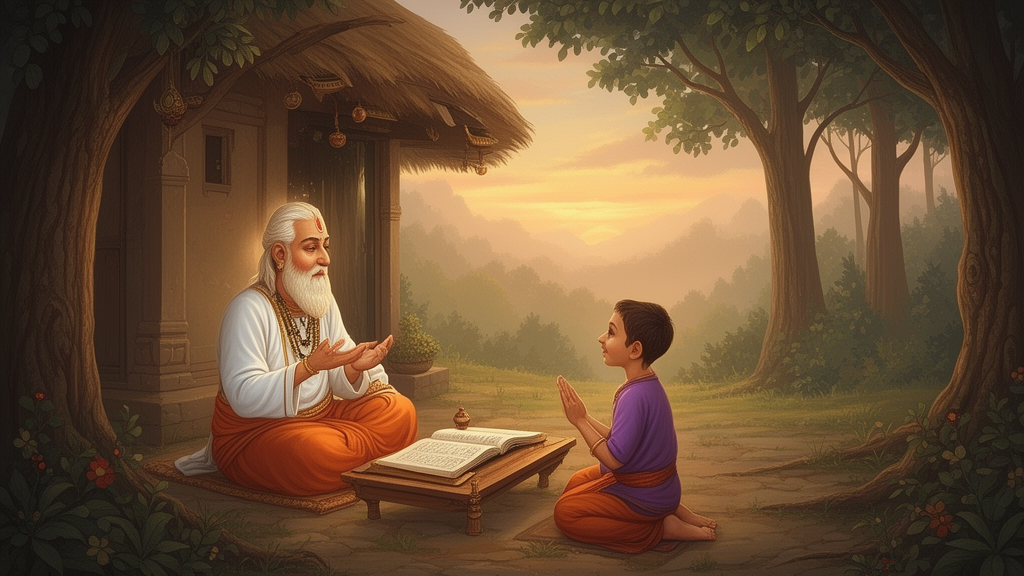
Upanishad is commonly explained as “sitting close to” a teacher, which suggests a student receiving teaching in close proximity to a guru. The Vedanta Society of Providence gives this etymology and also quotes the commentary of Adi Shankaracharya on the Katha Upanishad, in which he interprets the term as knowledge that removes ignorance (avidya). The reader should note that this etymology is a traditional explanation offered by a commentator; modern dictionaries and scholars discuss the word in their own ways.
The Wikipedia article on the Upanishads describes them as ancient Sanskrit religious and philosophical texts of Hinduism. The Advaita Vedanta Home Page explains that the Upanishads are typically found in the concluding portions of the Brahmanas and Aranyakas of the four Vedas. This placement explains why the texts are often described as the “end” portion of the Veda.
Vedanta
Vedanta has two common senses. In the first, it means the end or final part of the Veda, which is the Upanishadic teaching. In the second, it names a philosophical tradition. The Wikipedia article on Vedanta describes it as one of the six orthodox traditions of Hindu philosophy. It also explains that Vedanta includes several classical schools, which are discussed below.
This double meaning is a frequent source of confusion. A reader searching for “Vedanta” may want the Upanishads, the Brahma Sutras, a later school such as Advaita Vedanta, or a modern movement. Each usage requires its own context.
Where the Upanishads sit within each Veda
The Upanishads are not a single book. Each Upanishad is linked to a particular Veda and often to a particular Brahmana or Aranyaka. The Advaita Vedanta Home Page states that “each text is connected to the veda in which it occurs,” and that the teaching is often presented in the context of a specific Vedic hymn or ritual. This is an important point for readers: an Upanishad is best understood in relation to the Vedic branch that preserves it.
The Advaita Vedanta Home Page also notes that in Vedanta traditions the Upanishads are called the Sruti prasthana, meaning revealed scripture from which knowledge of Brahman is obtained. The same page explains that the Indian traditions regard Upanishads as Sruti, which it describes as timeless and unauthored (apaurusheya). The Vedanta Society of Providence similarly says the Upanishads are called Shrutis (“that which is heard”), while other scriptures are called Smritis (“that which is remembered”).
To see how the Upanishads are distributed across the Vedas, the Advaita Vedanta Home Page gives a list of 108 Upanishads found in the Muktikopanishad, arranged by Veda: ten in the Rig Veda, fifty-one in the Yajur Veda, sixteen in the Sama Veda and thirty-one in the Atharva Veda. Its table separates Krishna Yajurveda and Shukla Yajurveda texts. Readers should note that this is one traditional enumeration. Other lists, editions and online libraries may count differently.
For readers who want to explore a specific Veda’s Upanishads, related HindusGod.com topics include Atharva Veda Upanishad, Sama Veda Upanishad, Yajur Veda Upanishad, and Veda Brahmana Aranyaka Upanishad. Each page focuses on a different angle, so it is worth reading them alongside this overview.
The principal Upanishads
Within the larger group, a smaller set is usually called the principal or Mukhya Upanishads. The Advaita Vedanta Home Page explains that these are the texts commented upon by Shankara and other teachers, which gave them special authority as canonical texts. It lists ten:
- Rig Veda: Aitareya
- Shukla Yajur Veda: Brihadaranyaka and Isha (Isavasya)
- Krishna Yajur Veda: Taittiriya and Katha
- Sama Veda: Chandogya and Kena
- Atharva Veda: Mundaka, Mandukya and Prashna
The same source says that modern scholars consider these ten to represent some of the oldest Upanishadic texts. It also notes that some add the Kaushitaki and Shvetashvatara Upanishads, and some add the Maitrayani. The Vedapath website, which offers an online library of 60 Upanishads, sorts texts into categories such as Mukhya, Yoga, Shaiva, Sannyasa and Shakta and Vaishnava. This categorization is useful for study, but it is a modern library scheme rather than an ancient canon.
Readers who want to look at the principal texts individually can start with the HindusGod.com pages on the Aitareya Upanishad and the 10 Upanishad overview. For the broader enumeration of 108 texts, see 108 Upanishad.
Examples from different categories
The Upanishads cover different themes, and the categories help readers choose a starting point. The Advaita Vedanta Home Page observes that the texts are often classified by subject: some teach general Vedanta, some teach yoga, some detail renunciation (samnyasa), and others concentrate on Shaiva, Vaishnava or Shakta deities.
- Katha Upanishad: Wikipedia’s Upanishads article uses an image caption noting that Yama teaches Nachiketa in the Katha Upanishad. This dialogue between a teacher and a student is one of the best-known Upanishadic narratives.
- Adhyatma Upanishad: The Vedapath page describes it as a concise Vedantic treatise, traditionally linked with the Yajur Veda, that directs the seeker from external ritual toward inward self-knowledge. It describes methods such as neti neti (“not this, not this”) negation and the discussion of the five sheaths and three states of consciousness. You can read more on HindusGod.com at Adhyatma Upanishad.
- Adhwayataraka Upanishad: The Vedapath page describes this Atharva Veda text, counted among the Yoga Upanishads, as presenting yoga as a path to liberation through knowledge, with breath regulation, sense restraint and meditation as supports rather than ends in themselves.
These summaries come from a website’s descriptions. For direct study, readers should consult a full translation of the text itself.
Core ideas: Atman and Brahman
The Upanishads deal with the nature of ultimate reality, the self and liberation. Vedapath describes them as exploring the nature of the self (Atman), ultimate reality (Brahman), the relation between the individual and the cosmos, and the path to liberation (moksha). The Vedanta USA website explains that the Reality underlying the universe is called Brahman, and that the same Reality functioning within an individual is called Atman. Uncovering the Self is presented in that tradition as self-realization.
It is important to separate these statements from interpretation. The claim that Atman and Brahman are identical is a central teaching of Advaita Vedanta. The Advaita Vedanta Home Page states that the Upanishads are read in several ways by different Vedanta schools, and the Vedapath summary of the Adhyatma Upanishad states that its central claim is non-difference between Atman and Brahman. Other schools read the same texts differently, as discussed below.
Many Upanishads also reinterpret ritual. The Vedapath summary of the Adhyatma Upanishad describes the idea of an “inner sacrifice,” in which ego, desire and doership are offered into the fire of knowledge. This is a reinterpretation of Vedic sacrifice, not a rejection of ritual in every tradition. Vedic ritual continues in many communities, and scholars discuss how the Upanishads relate to it.
For a broader overview of these concepts, see Meaning of Upanishad.
Vedanta as a family of schools
Once Vedanta became a philosophical label, several schools emerged, each reading the Upanishads, the Bhagavad Gita and the Brahma Sutras in its own way. The Wikipedia article on Vedanta identifies several classical schools, including Bhedabheda (difference and non-difference), Advaita Vedanta, Vishishtadvaita, Dvaita and Shuddhadvaita.
- Advaita Vedanta: Associated with Gaudapada and Adi Shankara. It teaches non-dualism between Atman and Brahman.
- Vishishtadvaita: Associated with Ramanuja. It teaches qualified non-dualism.
- Dvaita: Associated with Madhva. It teaches a fundamental difference between the individual self and the Supreme.
- Bhedabheda and related schools: These include Dvaitadvaita, associated with Nimbarka, and Achintya-Bheda-Abheda, associated with Chaitanya Mahaprabhu, according to the Wikipedia article.
These schools are not interchangeable. The Wikipedia article on Vedanta lists historical periods and teachers for each, and notes that the Upanishads are one shared reference point rather than the sole basis of each system. A reader studying a school should consult a specialist text or introduction for its arguments.
The Wikipedia article also notes that the term “Neo-Vedanta” from the nineteenth century is criticized by some scholars. Because the label is debated, this guide uses it only in passing.
Belief, text, tradition and scholarship
Discussions of the Upanishads often mix several kinds of statement. It helps to keep them separate:
- Scriptural text: What a particular Upanishad says, as found in its Sanskrit text and in a specific translation.
- Traditional belief: The view, held in many Vedanta communities, that the Upanishads are revealed (Sruti) and unauthored.
- Commentary: Explanations by teachers such as Shankara, Ramanuja, Madhva and others.
- Academic study: Historical dating, textual comparison and analysis by scholars.
The Advaita Vedanta Home Page makes this distinction clearly. It explains that Indian traditions regard the Upanishads as timeless, so the dating of composition is not a concern for them, while modern scholars attempt to fix periods of composition. The same page also notes that some texts called Upanishads are not accepted by all traditions, and that acceptance is a question of Sruti status rather than of dates.
The Vedanta Society of Providence gives a similar contrast when it reports that Indologist estimates for the Vedas differ from the traditional calendar. Readers who see different dates in different books are usually seeing this difference between traditional reckoning and historical scholarship.
For this reason, this article avoids giving a single date for any Upanishad. Where dates matter, readers should consult a reputable academic history of Indian philosophy or an authoritative edition with its introduction.
How to begin reading an Upanishad
Upanishads are dense texts, and beginners often find it useful to follow a simple sequence. The steps below are a general study approach, not a required ritual.
- Identify the Veda and school. Check which Veda the Upanishad belongs to and whether it is usually counted among the principal texts. Sources such as the Advaita Vedanta Home Page list these details.
- Choose a translation with a commentary. Look for a translation that identifies the Sanskrit terms and states whether it follows a particular school. Translations of the same text can differ in important words, such as the rendering of atman, brahman and maya.
- Read the context. Many Upanishads appear within Brahmanas or Aranyakas. Reading the surrounding material, or a summary of it, helps you understand why a teaching appears where it does.
- Read in short sections. Take one dialogue or verse group at a time, and note the questions the teacher answers.
- Compare with commentary. Read a traditional commentary or a modern scholarly introduction, and separate the text’s own words from the commentator’s interpretation.
- Record your sources. Note the edition, translator and page number, so you can return to the passage.
Readers who want a structured route can start with Upanishad Vedanta for a general orientation, and then move to the Veda-specific pages listed above.
Translation and spelling notes
The Upanishads appear in many transliteration systems, and the same word may be spelled several ways. The Advaita Vedanta Home Page uses a diacritical transliteration key, for example writing brahman with a lowercase initial and upanishad in lowercase. Vedapath uses forms such as Ātman, Brahman and Upaniṣad. The Vedanta USA website uses forms such as Upanishad and Vedanta. These are variations in spelling, not differences in meaning.
When you read a translation, check whether the translator has rendered key terms such as Atman, Brahman and moksha consistently. Note also that a summary from a website is not the same as a direct translation. This article uses summaries from the cited sites only to describe content and themes, not as quotations of the Upanishads.
Related terms may also appear in searches. For example, the Advaita Upanishad page discusses non-dual teaching, and the Aranyaka Upanishad page covers texts associated with the forest portions of the Vedas.
Practice and devotion in context
The Upanishads are read in different ways. In some communities they are studied as philosophy, in others they are recited as part of Vedic or Vedantic learning, and in others they inform devotional life through the teachings of a particular school or guru. The Vedanta USA website describes its study of Vedanta as a practical wisdom for daily life, but this is that organization’s teaching, not a universal claim across Hinduism.
Some sources connect Upanishadic teaching with peace, harmony and well-being. The Vedanta USA page makes such a claim, but this article does not treat it as an established outcome. Study of the Upanishads can be meaningful to a reader, but no source reviewed here supports a guarantee of material, health or supernatural results.
FAQs
Are the Upanishads the same as Vedanta?
Not exactly. The Upanishads are the texts, and Vedanta is the name often used for them as the “end” of the Vedas. Vedanta is also used for the later philosophical schools that interpret these texts, so the word can refer to either.
How many Upanishads are there?
There is no single agreed number in every tradition. The Advaita Vedanta Home Page lists 108 Upanishads from the Muktikopanishad, and it also identifies ten as principal Upanishads. Other collections and modern libraries count differently.
Which Upanishad should a beginner read first?
Many introductions begin with the principal Upanishads. The Katha, Isha and Mundaka Upanishads are often studied early because they are widely available in translation. Choose an edition with a clear introduction, and consider a teacher or study group if you are new to Sanskrit terms.
Summary
The Veda is the broader body of sacred literature. The Upanishads form its concluding, philosophical part. Vedanta means the end of the Veda, and it also names the schools that developed from the Upanishads. Traditions regard the Upanishads as revealed Sruti, while scholars study their composition and historical development. Reading them well requires attention to the specific text, translation, commentary and tradition. For further exploration, begin with the principal texts and the HindusGod.com pages listed above.
Sources and Further Reading
- Upanishads – Wikipedia: general overview, classification and the Katha Upanishad image caption.
- Vedanta – Wikipedia: meaning of Vedanta, classical schools and historical outline.
- Upanishads – Vedanta Society of Providence: etymology, Sruti and Smriti distinction, Veda classification and Adi Shankaracharya’s commentary on the term.
- The Advaita Vedanta Home Page – Upanishads: relation to Vedic branches, principal Upanishads, the 108-text list and the approach to dating.
- Upanishads in English – Vedapath: categories and brief summaries of Adhyatma and Adhwayataraka Upanishads.
- Vedas and Upanishads – Vedanta USA: structure of each Veda and the description of Vedanta as the end of the Veda.
Further reading is best sought in full translations of the principal Upanishads with commentary from a reputable publisher, university press or academic library.