The Upanishads are the concluding portions of the Vedas, and they are available in Kannada through printed editions, online reading platforms and devotional sites. This guide explains what the term Veda Upanishad means, how the texts relate to the four Vedas, what Kannada resources exist, and how to read translations responsibly. The short answer is that the Upanishads are philosophical and contemplative texts placed at the end of the Vedic literature, and Kannada readers can study many of them with Sanskrit text, transliteration and translation.

Short answer: what is a Veda Upanishad?
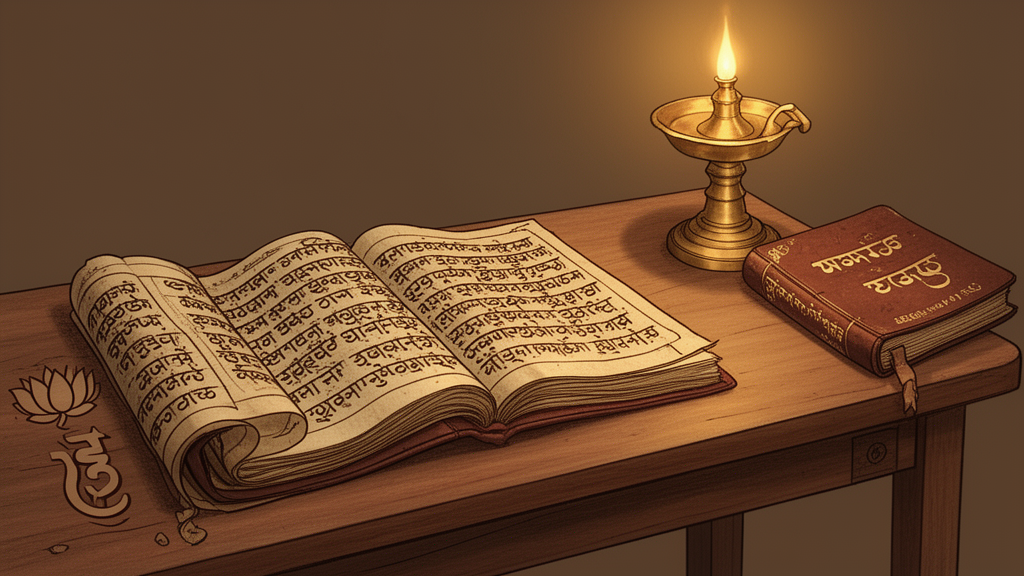
The term usually refers to an Upanishad that belongs to a Veda, or to a Vedic branch (shakha) tradition. A Kannada reader searching this phrase is most often looking for two things: an explanation of how the Upanishads fit within the Vedas, and a way to read these texts in Kannada. The Kannada-language page on Stotra Nidhi presents the Upanishads under the heading ಉಪನಿಷದಃ and lists titles such as Aitareya, Kena, Isha, Katha, Kaivalya and Taittiriya in Kannada script.[1]
Two points matter from the start. First, the Upanishads are not a single book; they are a body of texts with different lengths, styles and emphases. Second, a Kannada edition is a translation or a Kannada presentation of a Sanskrit text, so the reader should always know which Sanskrit recension, transliteration and translator are being used.
What the word Upanishad and the term Vedanta mean
The Kannada Wikipedia article on Upanishads states that the fourth division of the Vedas is called the Upanishads, also written as Upanishad in Devanagari, and that the first three divisions are the Samhitas, Brahmanas and Aranyakas.[2] That article also notes that the Upanishads are commonly called Vedanta, a name that is widely used in tradition and in modern scholarship. This Wikipedia source was not fully inspected for this draft, so the claim is treated as a starting reference rather than a final authority.
The Vedanta platform Vedapath describes the Upanishads as the concluding portions of the Vedas, known as Vedanta, the “end of the Vedas”. It also explains that the word is often understood as “sitting near” a teacher, which points to the traditional setting of teaching by a guru to a student.[3] The meaning “sitting near” is presented here as a traditional explanation of the word, not as a philological proof, and readers who want a scholarly etymology should consult a dictionary or academic commentary.
Why the name Vedanta matters
The name Vedanta means “end of the Vedas” in the sense of being the final part of the Vedic corpus in arrangement. It does not only mean chronological end. Later schools of Vedanta, such as those associated with Advaita, Vishishtadvaita and Dvaita, build philosophical systems on the Upanishads, the Brahma Sutras and the Bhagavad Gita. For a Kannada reader, this distinction helps: the Upanishads are the primary texts, while later Vedanta systems are interpretations of them.
How Upanishads relate to the four Vedas
Traditionally, the four Vedas are the Rig, Yajur, Sama and Atharva. Each Veda has texts for ritual, prayer and commentary, and each has Upanishads attached to its branches. The Vedapath library organises its Kannada-accessible texts under categories such as Atharva Veda, Yajur Veda, Rig Veda and Krishna Yajur Veda, which shows how the texts are commonly grouped in modern presentations.[3]
- Rig Veda: The Aitareya Upanishad is described by the Kannada Wikipedia article as associated with the Rig Veda and as contained within the Aitareya Aranyaka.[2]
- Atharva Veda: The Vedapath listing includes the Adhwayataraka Upanishad under the Atharva Veda and as a Yoga Upanishad.[3]
- Yajur Veda: The Vedapath listing includes the Adhyatma Upanishad as related to the Yajur Veda, with a focus on inner knowledge rather than external ritual.[3]
- Krishna Yajur Veda: The Taittiriya Upanishad is one of the widely read Upanishads in this branch, and Vaidika Vignanam has a Kannada page for its Ananda Valli section.[4]
These groupings are useful, but they should not be read as a simple one-to-one table for every text. Some Upanishads are attached to a Veda by one tradition and classified differently by another. A careful reader checks the edition’s own introduction or the publisher’s notes before accepting a single Veda attribution.
Principal, Yoga and sectarian Upanishads
Vedapath distinguishes between the Mukhya (principal) Upanishads recognised by Adi Shankaracharya and later texts such as Yoga, Shaiva, Vaishnava, Shakta and Sannyasa Upanishads.[3] The Stotra Nidhi Kannada page likewise lists groups of texts without ranking them by age or authority, and includes Ganapati, Shiva-related and Surya-related titles in the same collection.[1] This matters because a reader who expects every Upanishad to teach the same philosophy will be confused. The older principal texts and the later sectarian or yogic texts often address different audiences and concerns.
How many Upanishads are there?
There is no single agreed count that every tradition accepts. The Kannada Wikipedia article states that there are differences of opinion about how many Upanishads exist and when they were composed.[2] Vedapath presents a library of 60 Upanishad texts in Kannada and other languages, and it describes them as available with Sanskrit, transliteration and translations.[3] That number describes one platform’s collection, not a universal canon.
Readers also encounter the number 108 in devotional and publishing contexts. A specific list of 108 texts is a traditional or collection-based grouping, and the list may vary by source. HindusGod.com has a related draft titled 108 Upanishad, which should be checked against its final text before publication. In this guide, the safest approach is to say that counts differ by source and collection.
The Upanishads in Kannada: what is available
Kannada readers have several entry points. Each serves a different need, so it helps to know what each source provides.
Online reading platforms
Vedapath offers Upanishads in Kannada with Sanskrit, transliteration and translation, and says the content includes enrichment in 31 languages.[3] Its pages include categories and short descriptions, such as the Adhwayataraka Upanishad’s summary of yoga as a path of liberating knowledge. The platform also mentions recitation with translation. These features are useful for learners, but users should still compare the Kannada translation with the Sanskrit text and with a trusted printed edition when precision matters.
Devotional text collections
Stotra Nidhi presents Upanishads in Kannada, Telugu, Tamil, Devanagari, English (IAST) and other scripts within a devotional stotra library. Its Upanishad section lists titles from Isha and Aitareya to Kaivalya, Ganapati and Surya, which makes it useful for finding a text by name.[1] Because devotional libraries often focus on recitation, readers should verify whether a page offers a scholarly translation, a devotional rendering or only the Sanskrit text.
Other Kannada texts and files
Vaidika Vignanam has a Kannada page for the Taittiriya Upanishad’s Ananda Valli section, which is part of a larger collection of spiritual and devotional literature in several Indian languages.[4] A Scribd document titled Upanishads in Kannada Language is also listed in the research set, but its content was not inspected for this draft. Readers who use uploaded PDFs should check the publisher, translator, edition date and whether the file has permission to be shared.
For HindusGod.com readers who want a broader overview of Kannada resources, the existing draft Kannada Upanishad is the closest related target page and may be used once it is published. Note that this and the other links in this guide point to WordPress draft destinations, so they may not be public until the owner publishes them.
Core teachings across selected Upanishads
The Upanishads cover many subjects, but several themes recur in the sources reviewed here. The examples below are limited to what the consulted pages describe.
Atman and Brahman
The Vedapath page describes the Upanishads as exploring the nature of the self (Atman), ultimate reality (Brahman), the relationship between the individual and the cosmos, and the path to liberation (moksha).[3] These are central concepts in Upanishadic philosophy, but the way they are explained differs across texts and later schools. A reader should not assume that every Upanishad uses these terms in the same way.
The Aitareya Upanishad and consciousness
The Kannada Wikipedia article summarises the Aitareya Upanishad as a text that presents creation in a philosophical sequence: the self first, then worlds and protective powers, and finally the entry of consciousness into the human body.[2] The same source reports the phrase prajnanam brahma, rendered in the Kannada text as ಪ್ರಜ್ಞಾನಂ ಬ್ರಹ್ಮ, and describes it as a Mahavakya. Because the Wikipedia page was not fully inspected here, readers should confirm the exact phrase and its location in the Sanskrit text in a primary edition before quoting it.
The Adhyatma Upanishad and inner sacrifice
The Vedapath summary of the Adhyatma Upanishad states that it reframes external sacrifice as an inner offering, in which ego, desire and the sense of doership are offered into the fire of knowledge.[3] This is an interpretation given by one platform. It is useful for understanding how some Upanishads move the emphasis from outward ritual to inner discipline, but it should be read alongside the Sanskrit text and a commentary.
The Adhwayataraka Upanishad and yoga
The Vedapath summary describes the Adhwayataraka Upanishad as a concise text in the yoga tradition, where yoga is presented as a path of liberating knowledge rather than only physical or mental technique. The summary says that breath, mind, meditation and absorption are means, while the highest goal is recognition of the self’s self-luminous nature.[3] Readers should note that yoga in Upanishadic texts does not always match modern postural yoga.
Belief, text, tradition and scholarship
When reading an Upanishad in Kannada, it helps to separate four kinds of statement:
- What the text says: the words of the Sanskrit or an identified translation.
- What a tradition teaches: the interpretation of a teacher, lineage or sampradaya.
- What devotees believe: personal faith, practice and experience.
- What scholars argue: historical dating, manuscript evidence, comparative analysis and academic interpretation.
The Kannada Wikipedia article notes disagreement about the number and dating of the Upanishads, which is a good example of a scholarly question that should not be answered with certainty in a popular guide.[2] A precise date for any individual text should be taken from a scholarly edition or academic source, not from a general summary.
Why commentaries matter
Many Upanishads were read through commentaries, especially those of Adi Shankaracharya for the principal texts. Vedapath notes that the principal Upanishads are those recognised by Adi Shankaracharya, which points readers toward his commentary tradition when they want a classical interpretation.[3] A reader does not need to accept any single commentary as the only meaning, but commentaries explain how a tradition has understood difficult passages.
How to read an Upanishad in Kannada: practical steps
The following steps are a reading method, not a ritual requirement. Different communities and teachers have their own practices, and some traditions transmit Upanishads only through a guru or lineage.
- Choose the text by name and Veda. Confirm the Upanishad’s title, Veda association and whether it is a principal, Yoga or sectarian text.
- Check the edition. Look for Sanskrit, transliteration, Kannada translation and the translator’s or publisher’s name.
- Read a short passage first. Many Upanishads are short enough to read in one sitting, but some are longer and need several sessions.
- Compare two translations. If the meaning is unclear, compare a Kannada translation with an English or Sanskrit-based edition.
- Note technical terms. Keep a short list of words such as Atman, Brahman, moksha and sakshi, and read how the translator explains them.
- Use a teacher or community when available. Recitation and interpretation are often taught orally in traditional settings, and a qualified teacher can correct mispronunciations and explain context.
Choosing a reliable Kannada edition
Quality varies widely among online pages, PDFs and printed books. Use the following checks before relying on a Kannada text:
- Does the edition name the Sanskrit source or recension?
- Is the translator identified, and is the translation attributed rather than presented as anonymous?
- Are Sanskrit terms transliterated consistently?
- Does the publisher explain whether the text is a translation, commentary or devotional paraphrase?
- Is the file or page legally shared, and does it have a clear publication date or version?
These checks are important because a popular summary may simplify a passage, and a devotional recitation page may not provide scholarly notes. Neither is wrong by definition, but readers should know which kind of resource they are using.
Related HindusGod.com guides
The following HindusGod.com draft pages are related to this topic. They are listed as target drafts, not confirmed live pages, and should be checked before publication.
- Aitareya Upanishad in Kannada for the Rig Veda-associated text discussed above.
- Atharva Veda Upanishad for the Atharva Veda branch and Yoga-related texts.
- Brihadaranyaka Upanishad in Kannada for a major principal Upanishad.
- Chandogya Upanishad Kannada for another principal Upanishad in Kannada.
- Isha Upanishad in Kannada for a short text often read for its opening verses.
- Katha Upanishad in Kannada for a dialogue-based text.
- Mandukya Upanishad in Kannada for the Mandukya text in Kannada.
- Mundaka Upanishad in Kannada for another principal text.
- Sama Veda Upanishad for the Sama Veda branch.
- Taittiriya Upanishad in Kannada for the Krishna Yajur Veda text discussed above.
- Yajur Veda Upanishad for the Yajur Veda branch.
- Veda Brahmana Aranyaka Upanishad for the layered structure of the Vedic literature.
- Veda Shastra in Kannada for broader Vedic literature in Kannada.
- Meaning of Upanishad for a fuller explanation of the term.
- 10 Upanishad and 108 Upanishad for collection-based lists, which should be read with the note on counts above.
Frequently asked questions
Are the Upanishads available in Kannada?
Yes. Vedapath lists Upanishads in Kannada with Sanskrit, transliteration and translation, and Stotra Nidhi offers Upanishad titles in Kannada script.[3][1] Readers should still check each edition’s translator and source text.
Do all Hindus read the same Upanishads?
No. Different traditions, lineages and communities emphasise different texts and commentaries. Some Upanishads are studied in philosophical schools, some are used in recitation and devotional settings, and some are read mainly by specialists.
Is a Kannada translation enough for serious study?
A Kannada translation can be a useful starting point. For detailed study, compare it with the Sanskrit text, a transliteration and a scholarly or traditional commentary, and note where the translator interprets rather than translates.
Summary
The Upanishads are the concluding portions of the Vedas, traditionally called Vedanta, and they are central to Hindu philosophical thought. Kannada readers can access many texts through online platforms, devotional libraries and individual Kannada pages, but the most reliable reading comes from checking the Sanskrit source, the translator, the Veda or branch attribution and the difference between text, tradition and scholarly interpretation. Begin with one Upanishad, compare editions, and use a teacher or trusted commentary for difficult passages.
Sources and further reading
- Upanishad, Kannada Wikipedia: used for the description of the Vedic divisions, the Aitareya Upanishad summary and the note on disagreement about number and dating. Not fully inspected for this draft.
- Upanishads in Kannada, Vedapath: used for the Kannada library, Vedanta description, Veda groupings, principal Upanishad note and text summaries. Inspected.
- Upanishads, Stotra Nidhi: used for the Kannada-language Upanishad list and script availability. Inspected.
- Taittiriya Upanishad, Ananda Valli, Vaidika Vignanam: used only to show that a Kannada page exists for this section. Not fully inspected for this draft.