The Vedas are commonly described as having four layers: the Samhita, the Brahmana, the Aranyaka, and the Upanishad. Together they move from sacred hymns, to instructions for ritual, to inward interpretation of that ritual, and finally to reflection on ultimate reality. This post explains what each layer contains, how the layers connect, and where the sources agree or differ. The short answer is that the Brahmana explains how to perform rites, the Aranyaka explains what those rites mean, and the Upanishad turns toward knowledge of the self and Brahman.

The Hindumirror overview summarizes the sequence this way: the Samhita contains divine hymns, the Brahmana explains rituals, the Aranyaka interprets them inwardly, and the Upanishad teaches ultimate truth (Hindumirror, Samhita Brahmana Aranyaka Upanishad). That framing comes from a devotional and traditional perspective. Modern academic readers often describe the same texts in more historical terms, which is discussed later in this article.
Quick answer: what each layer does
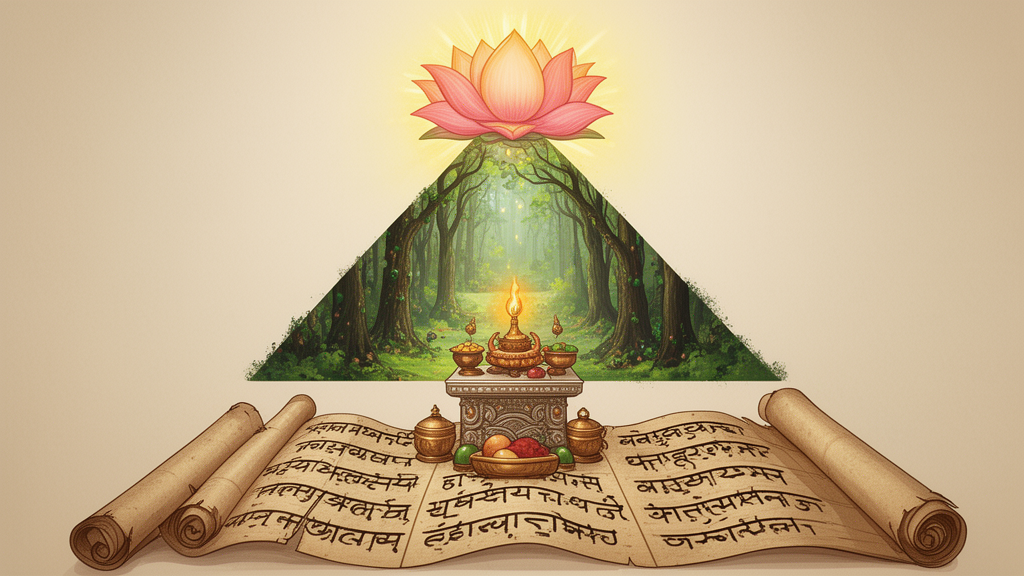
- Samhita: the collected mantras, hymns, and chants used in worship and sacrifice.
- Brahmana: prose texts that lay down rites and explain how sacrifices are performed and how mantras are used in them.
- Aranyaka: texts that explain the inner or symbolic meaning of mantras and rites, traditionally studied by those withdrawing from household life.
- Upanishad: philosophical texts that discuss the self (Atman), ultimate reality (Brahman), and liberation, and that are traditionally placed at the end of each Veda.
These four categories are useful for organizing the literature, but they are not always sharply separated. Many texts contain material that could fit more than one layer. Readers who encounter a particular passage should check which Veda, school (shakha), and text it belongs to before drawing conclusions about its layer.
Why the four-part structure matters
The Vedas are regarded in Sanatana Dharma as apaurusheya, meaning not composed by a human author but revealed to ancient seers and transmitted orally with great care (Hindumirror). That belief is a devotional and traditional claim. It is not a historical claim that scholars can test directly.
Within that tradition, the four-layer structure is often read as a path. A person begins with sacred sound and action, moves to understanding the meaning of action, and ends with knowledge of the self. Hindumirror describes this as a journey from action to realization. Kamakoti.org makes a similar point in a more textual way: the Brahmana is a guide for performing yajnas, and the Aranyaka explains the hidden meaning of the mantras and rites (Kamakoti.org, Brahmana and Aranyaka).
Scholars use the same categories with more caution. They note that these layers were compiled over a long period, and that the boundaries between them reflect later classification as much as original composition. The sections below separate what the texts say, what tradition holds, and what scholarship suggests.
Samhita: the hymns that begin the Veda
The Samhita is the foundation layer. The word means a collection, and in this context it refers to mantras arranged with precise order and phonetic accuracy (Hindumirror). The four Samhitas are the Rig, Sama, Yajur, and Atharva collections.
Nectar Neeti gives concrete examples. The Rigveda Samhita has 1,028 hymns grouped into ten mandalas, addressed to deities such as Agni, Indra, Varuna, and Soma. The Samaveda Samhita rearranges verses from the Rigveda as melodies for chanting. The Yajurveda Samhita contains the formulas, called yajus, spoken during sacrifice. The Atharvaveda Samhita includes charms and songs used in daily life, including for health and protection (NectarNeeti, Exploring Samhitas, Brahmanas, Aranyakas, and Upanishads).
Readers should treat the statement that the Atharvaveda offers charms for health as a description of what the text contains, not as a promise that reciting it produces any particular result. Tradition values these hymns for their power and purpose, but the claims of ritual efficacy belong to devotional belief, not to measurable outcomes.
Brahmana: rites, rules, and their explanation
As ritual practice grew more elaborate, prose texts called Brahmanas were composed to explain the purpose and procedure of ceremonies. The Kamakoti.org summary states that the Brahmana lays down the rites to be performed and explains the procedure for them. It also interprets the words of the mantras in the Samhita and how they are to be understood in the conduct of sacrifice (Kamakoti.org).
This makes the Brahmana the most practical layer. It answers questions such as which offering is made, when it is made, and which words belong to which act. Nectar Neeti notes that each Brahmana is linked to a specific Veda. The Aitareya Brahmana belongs to the Rigveda, the Shatapatha Brahmana to the Yajurveda, the Tandya Brahmana to the Samaveda, and the Gopatha Brahmana to the Atharvaveda (NectarNeeti).
Why the Brahmana matters for later readers
For a reader today, the Brahmana shows how the Vedic sacrifice was understood as an ordered system. Each action had a place, each mantra had a function, and the priest’s knowledge of procedure was essential. This is a textual account of Vedic ritual. It does not tell us how every community practiced these rites in later centuries, and modern Hindu worship draws on many traditions beyond the Brahmanas.
Brahmana and Aranyaka are often confused
Some readers mix the two layers because both discuss ritual. The simplest distinction is this: the Brahmana tells the practitioner what to do and how to do it, while the Aranyaka asks what the action signifies. The Brahmana is more concerned with procedure, and the Aranyaka with interpretation. Readers who want a focused comparison can start with the related HindusGod.com draft on Brahmana Aranyaka Upanishad, which is currently a WordPress draft and may not yet be public.
Aranyaka: from village ritual to forest contemplation
What the name means
The word Aranyaka is derived from aranya, meaning forest. Kamakoti.org points out that neither the Samhita nor the Brahmana urges anyone to live in a forest. Vedic rites were to be performed by the householder (grihastha) in a village. After purification through those rites, a person could go to the forest as a recluse for meditation. The Aranyakas were studied in that later stage of life, traditionally associated with vanaprastha, the forest-dwelling stage (Kamakoti.org).
This explanation is a traditional reading of the name. It is widely repeated, but the exact social practices of the early period are less certain. Scholars should be careful not to treat a later explanation of the name as a precise historical account of how texts were used.
What Aranyakas explain
According to Kamakoti.org, the Aranyakas expound the concepts inherent in the mantras of the Samhitas and the rites detailed in the Brahmanas. They reveal the hidden or metaphorical meaning of the Vedic passages. For the Aranyakas, awareness of the inner meaning of a rite can be more important than the outward performance of sacrifice (Kamakoti.org).
A concrete example helps. Suppose a ritual uses a sacred fire as an offering point. A Brahmana would describe how the fire is tended and where offerings are placed. An Aranyaka would ask what the fire represents within the sacrifice and how the act relates to the inner life of the practitioner. Interpretation of this kind is a feature of the Aranyaka tradition, and different commentators have read such symbolism in different ways.
Named Aranyakas
Wikipedia’s Aranyaka article lists several named texts, including the Aitareya Aranyaka, Taittiriya Aranyaka, Katha Aranyaka, and Kaushitaki Aranyaka. It also notes the Brihad-Aranyaka, which is closely connected with the Brihadaranyaka Upanishad discussed below (Wikipedia, Aranyaka). The same article includes a photograph caption of a page from the Jaiminiya Aranyaka Gana found embedded in a Samaveda palm-leaf manuscript, which shows that Aranyaka material survives within manuscript traditions (Wikipedia, Aranyaka).
Readers exploring these texts should check specific editions and translations, since the names, divisions, and contents can vary between recensions. For a related HindusGod.com draft, see Aranyaka Upanishad (WordPress draft, may not yet be public) and Aitareya Aranyaka (WordPress draft, may not yet be public).
Upanishad: the concluding layer
The Upanishads come at the end of each Veda, which is why they are sometimes called Vedanta, meaning the end or culmination of the Veda. Wikipedia’s series box classifies the Upanishads as one of the four divisions of the Vedic corpus, alongside the Samhitas, Brahmanas, and Aranyakas (Wikipedia, Brihadaranyaka Upanishad). Hindumirror describes the Upanishad as the layer that teaches ultimate truth (Hindumirror).
Upanishad discussions usually focus on Atman (the self) and Brahman (ultimate reality), and on how knowledge of their relation bears on liberation. These are philosophical themes, and they are debated within Vedanta. Adi Shankara, Madhvacharya, and Ramanujacharya each commented on the principal Upanishads, and they did not read them in the same way. Presenting one reading as the only meaning would misrepresent that tradition.
The Brihadaranyaka Upanishad as an example
The Brihadaranyaka Upanishad is a useful case study because it connects the Upanishadic layer with the Yajurveda and with Brahmana and Aranyaka material. Wikipedia lists it as one of the Mukhya, or principal, Upanishads. It is part of the Shukla Yajurveda, and it is linked to the Shatapatha Brahmana and to the Aranyaka tradition. The article attributes the text’s teaching to Yajnavalkya and gives it six chapters (Wikipedia, Brihadaranyaka Upanishad).
The article gives a date of 7th to 6th century BCE, with references. That date should be treated as an approximate scholarly estimate, not a settled fact, because dating Vedic texts is difficult and scholars disagree on the details. Wikipedia also lists the phrase Aham Brahmasmi as a popular verse associated with the text. Readers should check the original passage in a reliable edition rather than relying on a short phrase taken out of context.
The Brihadaranyaka is also a reminder that the layers overlap. It is an Upanishad in the sense of its philosophical content, but it sits inside a Yajurveda tradition connected to ritual and Brahmana literature. Treating it as either purely ritual or purely philosophical would lose part of its context.
Upanishads grouped by Veda
Wikipedia’s list of Upanishads groups them by the Veda to which each is traditionally attached. The Rig-vedic group includes the Aitareya and Kaushitaki Upanishads. The Sama-vedic group includes the Chandogya and Kena. The Yajur-vedic group includes the Brihadaranyaka, Isha, Taittiriya, Katha, Shvetashvatara, and Maitri. The Atharva-vedic group includes the Mundaka, Mandukya, and Prashna (Wikipedia, Brihadaranyaka Upanishad).
This grouping helps readers find a text’s Veda and school, which matters for understanding its ritual background. It is still a classificatory system. Scholars and practitioners may place some texts differently, so readers should confirm the attribution in the edition they are using. Related HindusGod.com drafts that address specific Upanishads include Sama Veda Upanishad, Yajur Veda Upanishad, Atharva Veda Upanishad, and Aitareya Upanishad. All of these are WordPress drafts and may not yet be public.
How the four layers connect
Read in order, the layers show a progression that many traditions describe. The Samhita supplies the mantras. The Brahmana instructs the priest in ritual use. The Aranyaka interprets the inner meaning of those rites. The Upanishad turns toward the self and ultimate reality. Each layer depends on the one before it, at least in the traditional account.
Here is a practical way to read the layers in a single Veda:
- Find the Samhita, which gives the mantras.
- Find the Brahmana for the same Veda, which shows how those mantras are used in ritual.
- Find the Aranyaka, which explains the symbolic or inner meaning of the rites.
- Find the Upanishad, which addresses the self, Brahman, and liberation.
This method works best when you use a specific Veda’s sequence. Because different Vedas have different sets of texts, the exact titles will vary. A reader who studies the Yajurveda, for example, will encounter the Shatapatha Brahmana and the Brihadaranyaka Upanishad, while a reader of the Samaveda will look at other texts within that recension.
Example: a ritual passage read through the layers
Consider a general example rather than a specific verse. A sacrifice involves offerings, recited formulas, and the actions of priests. The Samhita provides the formula. The Brahmana explains when to recite it and which action it accompanies. The Aranyaka asks what the offering symbolizes and how the act trains the mind. The Upanishad may then speak about the self that is beyond the sacrifice. This example illustrates the traditional progression, but actual texts do not always follow such a neat line, so readers should verify each passage in the source.
Tradition, history, and scholarship: where readers should be careful
Discussions of the Vedas involve several kinds of claims, and it helps to keep them apart.
- Scriptural claims: what a named text says, such as the Brihadaranyaka’s teaching attributed to Yajnavalkya.
- Traditional belief: that the Vedas are apaurusheya, revealed and not human-authored, and that the layers lead toward realization.
- Regional and school practice: how a shakha or community preserves, recites, and interprets its texts.
- Historical evidence: manuscript survival, linguistic analysis, and dating based on internal and external evidence.
- Modern interpretation: how contemporary teachers and scholars explain the layers for today’s readers.
Dating is the area where precision is most often overstated. Wikipedia’s dating of the Brihadaranyaka to the 7th to 6th century BCE is one scholarly estimate, and other proposals exist. For that reason, this article avoids claiming a precise date for any layer. Readers who need a firm chronology should consult academic sources and specialist histories of Vedic literature.
The Kamakoti.org text is a devotional and tradition-based commentary, written from within a Hindu religious framework. The Hindumirror and NectarNeeti pieces are popular explanations. Each is useful for understanding how these layers are taught, but none should be treated as a neutral historical study on its own.
Frequently asked questions
Are the four layers the same as the four Vedas?
No. The Rig, Sama, Yajur, and Atharva are the four Vedas. Each Veda has its own Samhita and may also have a Brahmana, Aranyaka, and Upanishad. The four layers describe the internal structure of the Vedic corpus, not four separate books.
Is the Brahmana only about sacrifice?
The Brahmana is centrally concerned with the procedure and purpose of Vedic rites, as Kamakoti.org describes. It also includes interpretation of mantras as used in sacrifice. Readers should not assume that every passage is only about ritual, since commentary and explanation often extend into wider questions.
Does reading the Upanishads replace ritual practice?
Traditions differ. Some teachers present the Upanishads as the culmination of the Vedic path, while others emphasize continued practice alongside study. Ritual obligations also vary by community, lineage, and personal circumstance. Readers who have questions about their own practice should seek guidance from a qualified teacher within their tradition.
Where should I start reading?
Start with a good translation of a single Upanishad and a basic introduction to Vedic structure. Then look at the Brahmana and Aranyaka of the same Veda to see how ritual and interpretation connect with it. Using one Veda at a time avoids confusion between texts that belong to different shakhas.
Summary
The Samhita, Brahmana, Aranyaka, and Upanishad form a traditional four-layer account of the Vedas. The Samhita gives the hymns and mantras. The Brahmana explains how rites are performed and what the mantras mean in that setting. The Aranyaka interprets the inner or symbolic meaning of the rites. The Upanishad turns toward the self and ultimate reality.
The structure is helpful for study, but it should be used carefully. Keep scripture, tradition, scholarship, and modern explanation distinct. Check the Veda, school, edition, and translation before quoting any passage. A useful next step is to read one Upanishad alongside the Brahmana and Aranyaka of the same Veda, using an edition you can verify.
Sources and further reading
- Brihadaranyaka Upanishad, Wikipedia: used for the text’s Yajurveda attribution, its links to the Shatapatha Brahmana and Aranyaka tradition, its six chapters, the attribution to Yajnavalkya, the commentators named, the Upanishad grouping by Veda, and the scholarly dating estimate.
- Aranyaka, Wikipedia: used for the Aranyaka’s place among the Vedic divisions, the list of named Aranyakas, and the manuscript image of the Jaiminiya Aranyaka Gana.
- Brahmana and Aranyaka, Hindu Dharma, Kamakoti.org: used for the description of the Brahmana’s ritual role, the etymology of Aranyaka, and the traditional account of the Aranyaka’s interpretive function.
- Exploring Samhitas, Brahmanas, Aranyakas, and Upanishads, NectarNeeti: used for the Rigveda hymn count and deity examples, the Samaveda and Yajurveda descriptions, the Atharvaveda content, and the Brahmana-to-Veda links. This is a popular explanatory source, not a critical edition.
- Samhita Brahmana Aranyaka Upanishad: The Four Layers of the Vedas, Hindumirror: used for the four-layer summary, the apaurusheya belief as traditionally stated, and the Samhita definition. This is a devotional explainer.
Related HindusGod.com drafts: Brahmana Aranyaka Upanishad, Veda Vedanta Upanishad, Meaning of Upanishad, Jaiminiya Upanishad Brahmana, and Trishikhi Brahmana Upanishad. All are WordPress drafts and may not yet be public.