Veda verses are the mantras and hymns of the four Vedas, the oldest scriptural collections in Hinduism. The word Veda is usually translated as “knowledge” or “sacred knowledge.” Most Veda verses are poetic, sung or recited in archaic Sanskrit, and were traditionally used in sacrifice and ritual. This guide explains what these verses are, how they are arranged, how they are used in different traditions, and how a general reader can study them with care.
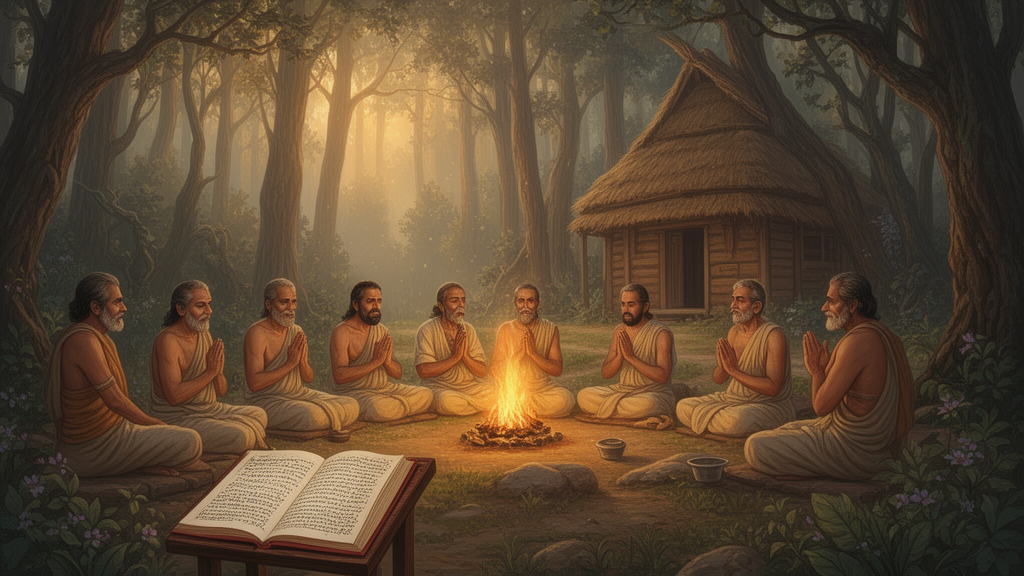
Direct answer: Veda verses are the metrical hymns, prayers, and ritual formulas found in the Rigveda, Yajurveda, Samaveda, and Atharvaveda. Hindus regard the Vedas as shruti, “that which has been heard,” and they have been preserved mainly through memorized oral recitation for a very long time. Scholars date the texts to roughly the second millennium BCE, but the dates vary by source, and the traditional belief about their divine origin is a matter of faith rather than historical evidence.
What Veda verses are
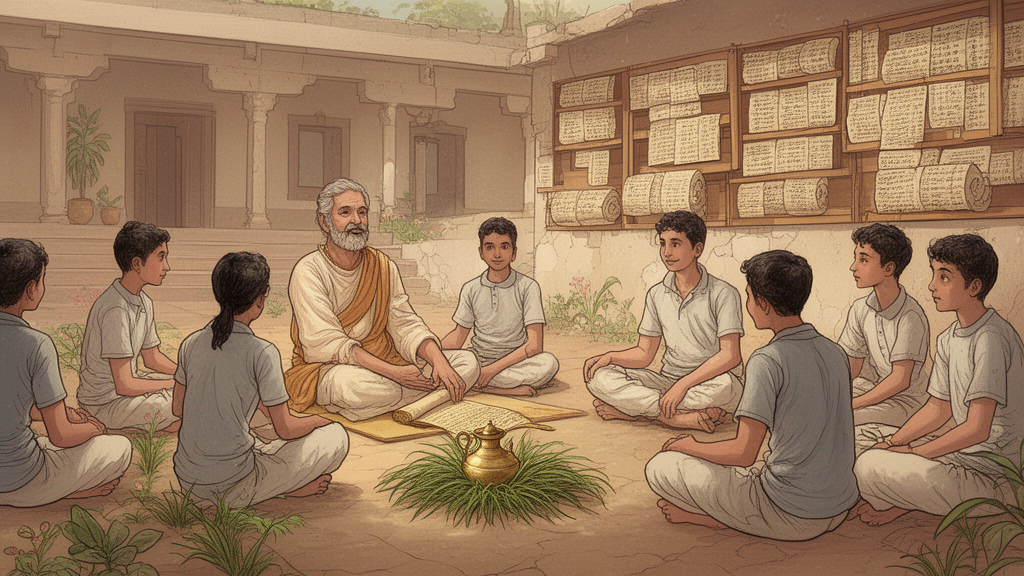
A “verse” in this context is a unit of the Vedic text, commonly called a mantra or rik in the Rigveda. Verses are grouped into hymns (sukta), and hymns are grouped into larger books. The Vedas are therefore not a single continuous book in the modern sense. They are a body of collections, each with its own internal structure.
Wikipedia’s article on the Vedas describes them as the oldest scriptures of Hinduism and gives a combined total of 20,379 mantras across the Vedic corpus. The article on the Rigveda gives about 10,552 mantras for that collection alone. Counts like these depend on how a text is divided, which edition is used, and whether prose passages are counted, so readers should treat any single number as an editorial convention rather than an absolute fact.
Veda verses also differ from later devotional literature. The Puranas, epics such as the Ramayana and Mahabharata, and the Bhagavad Gita are distinct text families with their own authors, dates, and traditions. Many Hindus read those later works more often than the Vedas, and the Vedic collections are typically studied within specialized recitation and ritual traditions.
Shruti, smriti, and the status of the Vedas
Hindu tradition places the Vedas in the category of shruti, “that which has been heard,” in contrast to smriti, “that which is remembered.” Smriti includes texts of human composition that are traditionally treated as authoritative but not revealed in the same sense. The Wikipedia article on the Vedas discusses this classification as part of the Vedic texts’ authority, and a Facts and Details summary of Hindu belief states that many Hindus hold the Vedas to have been received by sages directly from God and then passed on by word of mouth.
This is a traditional belief, not a claim that can be tested by historical method. Academic accounts describe the Vedas as composed by many people over centuries. The Vedic corpus as we have it was shaped by memorization, ritual use, and later editing. A reader can respect the shruti status of the Vedas in Hindu practice while keeping devotional belief and historical scholarship separate in their own study.
The four Vedas at a glance
Traditionally, the Vedic corpus is presented as four collections. Each has a different ritual role, though these roles were developed within specific priestly schools.
- Rigveda: The oldest and largest collection, made up mainly of hymns praising deities such as Agni, Indra, and Soma. Its verses are the most widely studied in academic work on early Vedic language.
- Yajurveda: Contains verses and prose formulas used in sacrificial performance, with the priest directing the ritual action.
- Samaveda: Organizes many Rigvedic verses for melodic chanting in ritual contexts.
- Atharvaveda: Includes spells, charms, and ritual formulas alongside hymns, and it is often described as having a different character from the other three.
Wikipedia’s Vedas article gives approximate composition dates of c. 1500–1200 BCE for the Rigveda and c. 1200–900 BCE for the Yajurveda, Samaveda, and Atharvaveda. The Rigveda article gives a broader range of c. 1500–1000 BCE. Because the sources disagree, this guide uses approximate ranges and does not present any one date as settled. Academic dating remains debated, and the dates describe when the texts were composed or fixed in some form, not when the traditions associated with them began.
How Veda verses are organized
Mandalas and hymns
The Rigveda is divided into ten mandalas, or books. Each mandala contains hymns, and each hymn contains verses. Wikipedia’s Rigveda article describes the collection in these terms and notes that the hymns are a central part of its organization. A reference such as “RV 1.1.1” identifies the Rigveda, Mandala 1, Hymn 1, Verse 1. Scholarly editions often add a letter for a particular pada or line, so a reference like “1.1.1a” points to the first pada of that verse.
Reading a reference: a worked example
The Rigveda article shows its opening line with the reference RV 1.1.1a. The transliteration given there is agniṃ iḷe puraḥ-hitaṃ yajñasya devaṃ ṛtvijaṃ, and the article’s rendering is “I praise Agni, the chosen Priest, God, minister of sacrifice.” This example is useful for seeing how a reference works: the numbers locate the verse, and the transliteration and translation show the text. Note that this is a translation given in one encyclopedia article, not a verbatim quotation from a named scholarly edition. For study, a reader should compare it with a translation attributed to a specific translator.
Pada, transliteration, and pitch accent
Vedic texts were memorized in several forms. The article’s manuscript caption notes a padapāṭha, a word-by-word recension, and mentions that pitch-accent is marked in some manuscripts. Readers who meet these terms should know that they refer to memorization and recitation techniques, not separate texts. A single hymn may survive in several recensions, and differences among them matter to specialists.
Verses in recitation and ritual
Veda verses were, and in many communities still are, recited as part of ritual. Facts and Details, citing a Library of Congress country study from 1988, notes that Brahman priests sang the Vedas during sacrifices for ancient gods and that families passed down oral recitation for thousands of years. The same summary notes that even in the late twentieth century, Brahmans frequently officiated at important ceremonies such as weddings, reciting hymns and making offerings into sacred flames.
These statements describe historical and contemporary practice in certain communities. They do not mean that every Hindu recites Veda verses or knows Sanskrit. Practice varies by region, family, caste history, sampradaya, and access to training. Many Hindus approach the Vedas through summaries, temple recitation, philosophy classes, or devotional songs that draw on Vedic themes. A reader who wants to know how a verse is used should ask a teacher or community tradition about its context rather than assume a single practice.
Ritual use is tradition-specific
The exact ritual use of a verse depends on the Veda, the priestly school (shakha), the occasion, and the performing family. A hymn chanted at one sacrifice may appear in a different role in another tradition. Because these details are specialized, a general article can explain the categories but cannot give a complete ritual manual. Anyone wishing to learn a specific recitation should work with a qualified teacher from the relevant tradition.
Oral transmission and memory
Veda verses were transmitted orally for a very long time. The Facts and Details summary, citing BBC and Library of Congress material, says that Hindus believe the Vedic texts were received by scholars directly from God and then passed on by word of mouth. It also notes that Brahmin priests methodically memorized the Vedas to ensure consistent transmission. Wikipedia’s Vedas article likewise discusses transmission and Vedic learning as distinct topics.
This history explains why sound, rhythm, and exact phrasing matter. The verses were learned by listening, reciting, and correcting. Writing came later in the story of the Vedic corpus, and the existing manuscripts include multiple versions and scripts. Study of these manuscripts is a specialized field, and academic readers should consult editions prepared by scholars rather than relying on popular summaries.
Dating and scholarly interpretation
Historical study of the Vedas asks when the verses were composed, how they were transmitted, what language they reflect, and how they relate to other early Indian and Indo-European material. These questions produce scholarly interpretations that differ from devotional belief. For example, a devotional tradition may hold that the Vedas are eternal revelation, while a historian may describe the textual record as the product of many composers over centuries.
Both viewpoints can be discussed respectfully. The key is to label the claim. “Hindus believe” or “the tradition holds” signals devotional or traditional belief. “Scholars date” or “the manuscript evidence suggests” signals historical interpretation. A careful reader does not need to choose one framework to learn from the other, but should avoid mixing them.
Reading Veda verses in translation
Most readers encounter Veda verses in translation. A translation is an interpretation, and Vedic Sanskrit is difficult even for specialists. Words may have several meanings, grammar may be compressed, and ritual references may be unclear. Good translations usually include notes, explain technical terms, and identify the text edition used.
Choose sources with clear attribution
- Prefer editions and translations that name the translator, publisher, and edition.
- Check whether the translation includes the Sanskrit or transliteration, so you can compare key terms.
- Look for notes that distinguish the verse from later commentary.
- Be cautious with quotation collections that do not identify the Veda, the mandala, or the hymn.
Why quote collections need caution
A popular quotation page can be useful for inspiration, but it is not a reliable scriptural source unless each line is traced to a specific text and translation. For example, one popular page on Vedic quotes, reviewed for this guide, attributes several lines to a Veda but gives no mandala, hymn, or verse number, and some attributions point to Upanishads or other works. Quotations in such collections may be paraphrases, freely composed lines, or mislabeled. A HindusGod.com reader who wants to cite a Veda verse should trace it to a named edition.
Veda verses and the Upanishads
The Vedic corpus is often discussed in layers. Each Veda contains samhita (hymn or mantra collections), and some also embed Brahmanas (prose ritual explanations), Aranyakas (forest texts), and Upanishads (philosophical texts). Wikipedia’s Vedas article describes these embedded texts, and its Rigveda article discusses Rigveda Brahmanas and Aranyakas and Upanishads as separate sections.
This layering matters for readers. A verse from the Rigveda hymn collection is not the same kind of text as a later Upanishad discussing ultimate reality, even though both belong to the Vedic tradition in Hindu usage. The Upanishads are often read in Hindu philosophy, and HindusGod.com has related content on specific Upanishads, such as Rig Veda and Upanishads, Sama Veda Upanishad, and Yajur Veda Upanishad. Readers should note that the relationship between a Veda and its Upanishads varies by tradition and by Upanishad.
Regional and community perspectives
Hindu traditions differ in how they relate to the Vedas. Some communities give daily ritual importance to Vedic recitation. Others focus on temple worship, devotional songs, or philosophical study. Language also varies. Many regional Hindu literatures draw on Vedic themes and terms, and regional-language resources sometimes explain them for local readers. For example, HindusGod.com has content such as Veda Shastra in Kannada and Veda Upanishad in Kannada, which address the topic for Kannada-speaking readers. Their accuracy and the exact content of those pages should be checked before any public reference is made.
A respectful account of Veda verses acknowledges these differences. It does not treat one ritual school, one language, or one interpretation as the single Hindu position.
Common misunderstandings
“Every verse is a mantra for a specific result”
Some popular books describe Veda verses as tools for guaranteed outcomes. Hindu scriptural and devotional traditions contain prayers for many purposes, but neither this guide nor the sources cited here support claims that reciting a verse produces a specific material benefit. Devotion, ritual, and study are best understood as practices within a tradition, not as guaranteed results.
“The Vedas are only about rituals”
Ritual is a major part of the Vedic corpus, but the texts also include hymns of praise, cosmological reflection, and later philosophical discussion. The Upanishads are one example of the philosophical strand. A balanced account should describe ritual and philosophy as different parts of the same broad tradition.
“There is one Veda text”
The Vedas are four collections, each with multiple branches and recensions. Even within one Veda, a verse may appear in several forms. Reading one edition does not give the whole picture.
A practical way to start reading
- Pick one Veda and one mandala. The Rigveda is a common starting point because it is well documented and widely studied.
- Choose a translation with notes. Confirm the translator, edition, and publication details.
- Read the verse reference first. Note the mandala, hymn, and verse number so you can find the same passage later.
- Compare two translations. Differences often reveal where the Sanskrit is uncertain or where translators make interpretive choices.
- Separate the layers. Mark what the verse says, what a commentary says, and what a modern interpretation adds.
- Ask a teacher about practice. If you wish to recite or use a verse in worship, learn the tradition-specific pronunciation and context from a qualified source.
Why the Vedic corpus remains important
Veda verses matter for several reasons. For Hindus, they are the foundational scriptures in the category of shruti, central to ritual memory and religious identity across many communities. For historians and linguists, they are among the oldest surviving texts in South Asia. Facts and Details, drawing on Library of Congress material, describes the Vedas as the oldest surviving body of literature in South Asia, composed in an archaic form of Sanskrit.
For general readers, the Vedas offer a window into early Indian religious imagination: hymns addressed to fire, sky, rain, dawn, and other deities, and ritual language that shaped later Hindu life. Studying them does not require accepting every devotional claim, and it does not require rejecting the tradition. The most useful approach is to read carefully, cite precisely, and keep belief, text, practice, and scholarship distinct.
Frequently asked questions
Are Veda verses the same as mantras?
Many Veda verses are used as mantras in ritual and devotional settings, but not every verse is a mantra in the later sense of a short sacred formula. Usage depends on tradition and context. The Rigveda uses the term mantra for its verses in the Wikipedia count, so the terms overlap.
Which Veda should a beginner read first?
The Rigveda is often recommended because its hymns are widely studied and translated. A beginner should still choose a translation with notes and a clear edition.
Do all Hindus recite the Vedas?
No. Vedic recitation is practiced by some communities and in certain ritual settings, but many Hindus do not learn Vedic Sanskrit. Practice varies widely.
When were the Vedas written?
Sources give approximate ranges and disagree in detail. Wikipedia’s Vedas article gives c. 1500–1200 BCE for the Rigveda, while its Rigveda article gives c. 1500–1000 BCE. Scholars also debate what “written” means for a text that was oral for a long time. Treat any single date with caution.
Summary
Veda verses are the hymns, prayers, and ritual formulas of the four Vedas. They are organized into mandalas, hymns, and verses in the Rigveda and into related collections in the other Vedas. They are classed as shruti in Hindu tradition, were transmitted orally for a long period, and are used in specific ritual and devotional contexts. For accurate study, use named editions, check verse references, separate devotional belief from scholarly dating, and treat quotation collections with care.
Sources and further reading
- Vedas, Wikipedia: used for the overview of the four Vedas, the combined mantra count, approximate dating, shruti and smriti classification, and the discussion of transmission and embedded texts. Wikipedia is a secondary reference; check cited sources before relying on specific dates.
- Rigveda, Wikipedia: used for the description of the Rigveda’s ten mandalas, the verse count of about 10,552 mantras, the reference format RV 1.1.1a, and the example translation given in its opening caption.
- Selections, Passages and Quotes From the Vedas, Facts and Details: used for summaries of oral recitation, Brahmin ritual roles, the meaning of Veda, and the shruti and smriti distinction, attributed in that source to Library of Congress, BBC, and PBS material. Verify those original sources before citing them directly.
Readers who want to go further should consult named scripture editions and academic translations of the Rigveda, Yajurveda, Samaveda, and Atharvaveda, and then compare them with the HindusGod.com resources listed above.