Upanishad Vedanta refers to the philosophical teaching drawn from the Upanishads, the concluding portions of the Vedas, and to the later schools of Vedanta that interpret them. The short answer is that the Upanishads are ancient Sanskrit texts about the nature of the self (Atman), ultimate reality (Brahman), and liberation, and Vedanta, meaning “end of the Vedas,” is the name given to them and to the traditions that build on them. This guide explains the terms, the main texts, the major interpretations, and where the evidence is clear or contested.
Because Hindu traditions are diverse, this article separates four kinds of statements: what a named Upanishad teaches, what a tradition or commentator says it means, what modern scholars can and cannot date, and what devotional communities believe. Where sources differ, the differences are described rather than resolved.
Quick answer: what Upanishad Vedanta means

In most usage, Upanishad Vedanta means the teaching found in the Upanishads and the philosophical systems that claim to rest on them. Two points help readers avoid confusion:
- Upanishads are a body of texts. The Advaita Vedanta Home Page describes them as expositions of doctrine usually found at the end of the Brahmanas and Aranyakas of the four Vedas.
- Vedanta is both a term for these texts and the name of later schools. Wikipedia’s entry on Vedanta describes it as one of the six orthodox traditions of Hindu philosophy.
Traditions that accept the Upanishads as authoritative generally refer to them as Shruti, meaning revealed scripture. The Advaita Vedanta Home Page notes that Vedanta traditions call the Upanishads the Sruti prasthana, the source from which knowledge of Brahman is obtained.
What the word Upanishad means
Sitting near a teacher
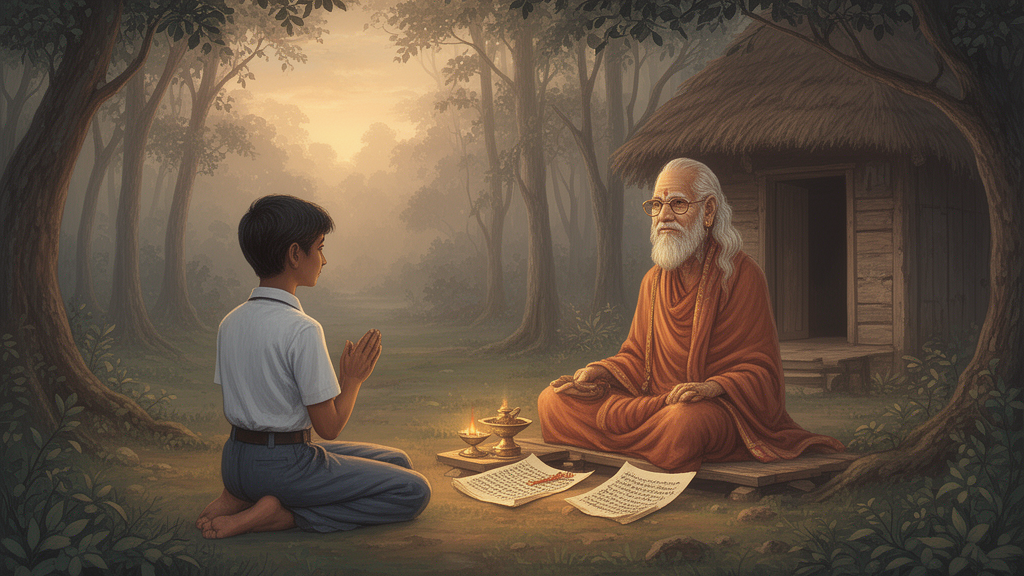
The Vedanta Society of Providence explains that the word Upanishad is etymologically associated with “sitting close to,” a picture of a student seated near a teacher to receive knowledge. Wikipedia’s Upanishads article also treats the etymology as a central topic and uses an image of a teacher and disciple to illustrate it. This is a traditional and widely repeated explanation; readers should treat it as an etymological account rather than a complete history of how the texts were composed.
The same discussion matters for study. Many Upanishadic passages are presented as dialogues or instructions between a teacher and a seeker, and their teaching is often framed around questions that a student brings forward.
Why the name Vedanta
The Vedanta Society of Providence also explains the term Vedanta as “the end of the Vedas,” or the final goal of wisdom, with Veda meaning wisdom and anta meaning end. The Vedapath website makes a similar point, describing the Upanishads as the concluding portions of the Vedas. The idea is that the Upanishads occupy the final, wisdom-centred part of Vedic literature, after the hymns and ritual material.
This name has two uses that are easy to mix up. The texts themselves are the Upanishads. The later philosophical schools, such as Advaita, Vishishtadvaita, and Dvaita, are called Vedanta schools because they present their positions as readings of the Upanishads, the Brahma Sutras, and the Bhagavad Gita, which Wikipedia’s Vedanta article identifies as the three foundational texts of the school tradition.
Where the Upanishads sit within the Vedas
The Vedas are commonly divided into two broad parts. The Providence page describes one part as hymnal, ceremonial, and sacrificial material, often called Karma-kanda, and another part as the wisdom portion, called Jnana-kanda. The Upanishads belong to the wisdom portion.
The Advaita Vedanta Home Page explains that the Upanishads are found in the concluding portions of the Brahmanas and Aranyakas of the four Vedas. Wikipedia’s Upanishads article uses the same structural framework, placing the Upanishads within the division of the Vedas into Samhita, Brahmana, Aranyaka, and Upanishad.
This placement matters because the texts are not uniform books. The Advaita Vedanta Home Page points out that each Upanishad is connected to the Veda in which it occurs, and its teaching is often presented in the context of a particular Vedic hymn or ritual. Reading an Upanishad without noticing its Vedic connection can make its opening sections seem abrupt.
How many Upanishads are there?
The answer depends on the list. Traditions and scholars do not all count the same texts, and the Advaita Vedanta Home Page makes this point directly by noting that some texts called Upanishads may not be accepted by specific traditions.
The principal Upanishads
The Advaita Vedanta Home Page identifies ten principal Upanishads, which it describes as the texts commented upon by Shankara and other teachers, and therefore given special significance as canonical texts. They are listed by Veda as follows:
- Rig Veda: Aitareya
- Shukla Yajur Veda: Brihadaranyaka and Isha
- Krishna Yajur Veda: Taittiriya and Katha
- Sama Veda: Chandogya and Kena
- Atharva Veda: Mundaka, Mandukya, and Prashna
The same page notes that some scholars add the Kaushitaki and Svetasvatara Upanishads to this list, and some add the Maitrayani. Modern scholars, according to the same source, regard the ten principal texts as among the oldest. That claim is a scholarly view, not a traditional one, and it should be read as such.
The 108 Upanishads of the Muktika canon
The Advaita Vedanta Home Page also presents a list of 108 Upanishads as found in the Muktikopanishad. Its breakdown by Veda is Rig Veda (10), Yajur Veda (51), Sama Veda (16), and Atharva Veda (31). The same page groups the wider list into categories, including general Vedanta texts, texts on yoga, texts on sannyasa, and texts centred on the great deities, usually classified as Saiva, Vaishnava, and Shakta.
The Vedapath website, which offers a reading library of Upanishads, organises its collection in similar categories, including Yoga, Vedic (General), Mukhya (Principal), Shaiva, Sannyasa, and Shakta and Vaishnava texts. The website’s own listing describes 60 texts, which shows that a catalogue’s count depends on what it includes. A useful rule is to check which list a source is using before comparing numbers.
A practical note on the category labels
Labels such as “Yoga Upanishad” or “Vaishnava Upanishad” describe a dominant theme or association. They do not mean that the text belongs exclusively to one school or that other traditions reject its teaching. Many readers first encounter the principal Upanishads and only later explore the wider catalogue.

Shruti, authority, and the question of dates
Why traditions call them Shruti
The Providence page explains that the Upanishads are called Shrutis, meaning “that which is heard,” while other scriptures are called Smritis, meaning “that which is remembered.” The Advaita Vedanta Home Page adds that Indian traditions regard the Upanishads as Shruti, which it describes as timeless, eternal, and apaurusheya, meaning unauthored. These are doctrinal claims made by the traditions. They are not statements about historical authorship that modern historians can confirm.
What scholars say about dating
The Advaita Vedanta Home Page observes that, from the standpoint of Vedanta traditions, the date of composition is of no real concern, because the teaching is revealed rather than dated. It also notes that modern scholars try to fix periods of composition for these texts. Readers should keep both perspectives in view.
Providence describes the Vedas as originating in the Indian subcontinent around 1500–1000 BCE “as estimated by Indologist scholars,” while the traditional Indian calendar, Yugabda, places them much earlier. This shows that dating is a matter of method and tradition. Any single date for the Upanishads should be treated as a scholarly range, not as a settled fact, and this article avoids giving one.
Core teachings: Brahman and Atman
Across many Upanishads, two concepts recur. Wikipedia’s Upanishads article includes a section on Atman and Brahman, and the Vedapath summaries describe the relationship between the individual self and ultimate reality as a central theme. The exact wording and emphasis differ from text to text.
Atman and Brahman
Atman is commonly translated as “self,” and Brahman as ultimate reality. The Vedapath summary of the Adhwayataraka Upanishad describes the highest attainment as the recognition of the self-luminous Atman and the non-dual realization that Atman is not other than Brahman. That is a summary of one text’s teaching, and it reflects the non-dual reading associated with Advaita.
The Vedapath summary of the Adhyatma Upanishad states the central claim of that text as non-difference: Atman is Brahman. Other Upanishads and commentators present the relationship differently. Some later Vedanta schools argue for difference-in-non-difference, or for a qualified non-duality, or for a fundamental difference between the individual and the Supreme. Those interpretations are discussed below.
Superimposition and ignorance
The Vedapath summary of the Adhyatma Upanishad says that bondage arises from superimposition, adhyasa, in which the mistaken “I” is placed upon body, senses, and mind. Liberation, in that summary, is the knowledge that removes ignorance, avidya. This is a useful example of how Vedanta texts describe the human problem: not a lack of ritual, but a misidentification of the self.
The same summary notes that the Adhyatma Upanishad reinterprets yajna, or sacrifice, as an inner offering of ego, desire, and doership into the fire of knowledge. This is a teaching about the text’s meaning, and readers who want to check the wording should consult the Upanishad itself in an edition they trust.
Negation and the witness
The Vedapath summary of the Adhyatma Upanishad also describes the use of neti neti, meaning “not this, not this,” as a method of negation, along with a discrimination of the five sheaths and a reflection on waking, dream, and deep sleep states. The witness, or sakshin, is presented as the standpoint from which these states are observed. These are teaching methods described in a secondary summary, and they are a good place to start when reading primary texts with a teacher or commentary.
What “Upanishad Vedanta” means in later schools
Once the Upanishads became the basis of formal philosophical systems, different schools developed different readings. Wikipedia’s Vedanta article lists the classical schools as Bhedabheda, Advaita, Vishishtadvaita, Dvaita, and Shuddhadvaita, with Bhedabheda further divided into Dvaitadvaita and Achintya-Bheda-Abheda.
Advaita Vedanta
Advaita Vedanta is the best-known Upanishad-based school in popular discussion. Wikipedia’s Vedanta article places Gaudapada and Adi Shankara within the sixth to ninth centuries in its historical outline. Shankara’s commentaries on the principal Upanishads are a central reason these texts are studied in the Advaita tradition. The Advaita Vedanta Home Page is a resource maintained within that tradition and presents Upanishadic teaching through that lens.
Vishishtadvaita and Dvaita
Vishishtadvaita, associated with Ramanuja in Wikipedia’s historical outline, is often described as qualified non-duality. Dvaita, associated with Madhva, emphasises a fundamental difference between the individual self and the Supreme. Both schools read the Upanishads alongside other authorities and reach conclusions different from Advaita. For a reader, the key point is that the same Upanishadic passage can support different philosophical readings depending on the commentary used.
Bhakti-oriented readings
Wikipedia’s Vedanta article also places Chaitanya Mahaprabhu’s Achintya Bheda Abheda within the Vaishnava Bhakti Vedanta stream, and its later sections describe modern movements such as Neo-Vedanta. Readers should note that the label “Neo-Vedanta” is itself debated, as the article’s section on criticism of the term shows. Modern presentations of Upanishadic teaching often mix philosophical, devotional, and reformist emphases, and it helps to identify which one a given book or website is using.
Traditions, commentaries, and regional differences
It is a mistake to imagine a single Upanishad Vedanta that every Hindu accepts in the same way. The Advaita Vedanta Home Page describes commentaries on the Upanishads by representatives of various schools of Vedanta. The Vedanta Students website, for example, offers study notes including a number of Shankara Bashyam volumes on the Taittiriya, Kena, and Mandukya Upanishads, reflecting the Advaita commentarial tradition.
The Upanishads also function differently in different communities. For some readers they are primarily philosophical texts for study. For others they are sources for devotional reflection, or they are read in the context of a particular sampradaya, or lineage, with its own commentaries and teachers. The Providence page describes its Upanishad teaching in the context of the Ramakrishna Order, and that context shapes how the texts are presented. Readers should identify the tradition behind any guide they use.
Regional and family practices also vary. Recitation, memorisation, and study methods differ between communities, and this article does not describe any one of them as the standard way to engage the Upanishads. Where a practice is specific to a school, lineage, or region, that should be stated clearly in any guide.
Worked example: the Katha Upanishad
The Katha Upanishad is a useful example of how Upanishadic teaching is often framed as a dialogue. Wikipedia’s Upanishads article uses an image captioned “Yama teaches Nachiketa in the Katha Upanishad,” which reflects the text’s central narrative: a young seeker, Nachiketa, receives instruction from Yama, the deity associated with death. The question of what happens after death, and the nature of the self, form the thread of the teaching.
The Katha is also part of the Krishna Yajur Veda in the Advaita list, and the Vedanta Students site offers two volumes of notes on it, which suggests how much commentary and study material exists. A reader approaching the Katha can start with the narrative, then move to the philosophical sections with a commentary, which makes the dialogue structure easier to follow.
Worked example: the Mandukya Upanishad
The Mandukya Upanishad is among the shortest of the principal texts, yet the Vedanta Students site offers a multi-volume set of notes on it with Shankara’s commentary, arranged in three chapters. That difference in length between the text and its commentary tradition is itself instructive. Short Upanishads often carry dense teachings that commentators spend many pages unfolding.
The Vedapath listing places the Mandukya among the Atharva Veda texts in the principal category. It is also connected in the Advaita list to the Atharva Veda. A reader who studies it should look for both the text and a commentary, because its brevity makes it easy to misread without guidance.
Common misunderstandings
- “The Upanishads are one book.” They are a collection of texts from different Vedic branches, with different styles, subjects, and lengths. The Advaita Vedanta Home Page stresses that they are not uniform.
- “All Upanishads teach the same thing.” Themes recur, but texts differ in emphasis, and commentators read them differently.
- “Upanishad Vedanta is the same as Advaita.” Advaita is one school. Vedanta includes several schools that interpret the Upanishads in different ways.
- “Every Hindu follows the Upanishads in the same way.” Hindu practice and belief vary by community, lineage, region, and personal devotion. The Upanishads are authoritative in some traditions and studied in others with different emphasis.
- “Studying Upanishads produces a guaranteed spiritual or material result.” The sources describe the teaching of liberation and knowledge. They do not support any promise of worldly results, and this article does not make such claims.
Where to begin reading
There is no single required order, but the following is a suggestion based on the lists and summaries above rather than a tradition-wide rule. A reader might begin with one of the principal Upanishads that has a clear narrative or structure, such as the Katha, then read a short text like the Mandukya with commentary. The Isha Upanishad is a common starting point in many study guides because of its brevity, though this claim is not drawn from the sources cited here, and readers should check a trusted edition or teacher.
For readers who want to explore beyond the principal texts, the Vedapath and Advaita Vedanta Home Page lists give an overview of the wider corpus, including yoga, sannyasa, and devotional categories. Readers can then move to the individual pages on this site listed below, each of which covers a specific Upanishad or related topic.
Related HindusGod.com guides
The following HindusGod.com pages are currently WordPress drafts. Their links may not be public until the owner publishes them, so readers should treat them as planned destinations rather than confirmed live pages. They are included where they match a specific point discussed above.
- For the link between Vedas and Vedanta, see Veda Vedanta Upanishad.
- For the meaning of the term, see Meaning of Upanishad.
- For the principal set and the Muktika canon, see 10 Upanishad and 108 Upanishad.
- For the Aitareya text in the Rig Veda, see Aitareya Upanishad.
- For the Atharva Veda texts, see Atharva Upanishad and Atharvashikha Upanishad.
- For the Advaita discussion of Atman and Brahman, see Advaita Upanishad.
- For the Adhyatma text discussed above, see Adhyatma Upanishad.
- For the Atmabodha text, see Atmabodha Upanishad.
- For the Ashtavakra text, see Ashtavakra Upanishad.
- For the Aranyaka context of the Upanishads, see Aranyaka Upanishad.
- For a text in the wider catalogue, see Avadhuta Upanishad.
Frequently asked questions
Is Upanishad Vedanta a religion?
It is better described as a body of scripture and a family of philosophical schools within Hinduism. Practice and belief connected with the Upanishads vary, and not every Hindu community engages them in the same way.
Do I need Sanskrit to study the Upanishads?
Sanskrit helps with close reading, but many readers use translations with commentary. The Vedapath listing, for example, offers Sanskrit, transliteration, and translation together. Readers should choose editions that identify the translator and the commentary tradition.
Are the Upanishads the same as the Bhagavad Gita?
No. The Bhagavad Gita is a separate text, though Wikipedia’s Vedanta article notes that it is one of the three foundational texts used by Vedanta schools, alongside the Upanishads and the Brahma Sutras.
Summary
Upanishad Vedanta refers to the teaching of the Upanishads and to the Vedanta schools that interpret them. The Upanishads are the concluding, wisdom-centred portions of the Vedas, traditionally regarded as Shruti. They present Atman, Brahman, ignorance, and liberation as central themes, though different commentaries read these concepts differently. The best way to study them is to note which text, translation, and tradition a source is using, and to separate scripture, commentary, scholarly dating, and devotional belief.
Sources and further reading
- Upanishads – Wikipedia: overview of the texts, their place in Hindu scripture, the principal list, and the Atman and Brahman section.
- Vedanta – Wikipedia: overview of the term Vedanta, the classical schools, and the historical outline of Vedanta traditions.
- The Advaita Vedanta Home Page – Upanishads: the Sruti status of the Upanishads, the ten principal texts, and the 108-text Muktika list.
- Upanishads – Vedanta Society of Providence: the etymology of Upanishad, the meaning of Vedanta, and the Shruti and Smriti distinction.
- Upanishads in English – Vedapath: a reading library with category labels, summaries of selected texts, and Sanskrit with translation.
- Upanishad – Vedanta Students: study notes and commentary volumes, including Shankara Bashyam editions of selected Upanishads.