The Upanishads are ancient Sanskrit texts that form the concluding portion of the Vedas and are the foundation of Vedanta, the philosophical tradition that treats the Upanishads as the culmination of Vedic thought. They explore the nature of the self (Atman), ultimate reality (Brahman), the relationship between the individual and the cosmos, and the path to liberation (moksha). If you are searching for a reliable way to read them, this guide explains what the texts are, how they are organized, which ideas recur across them, and how to choose translations and commentaries that match your purpose.
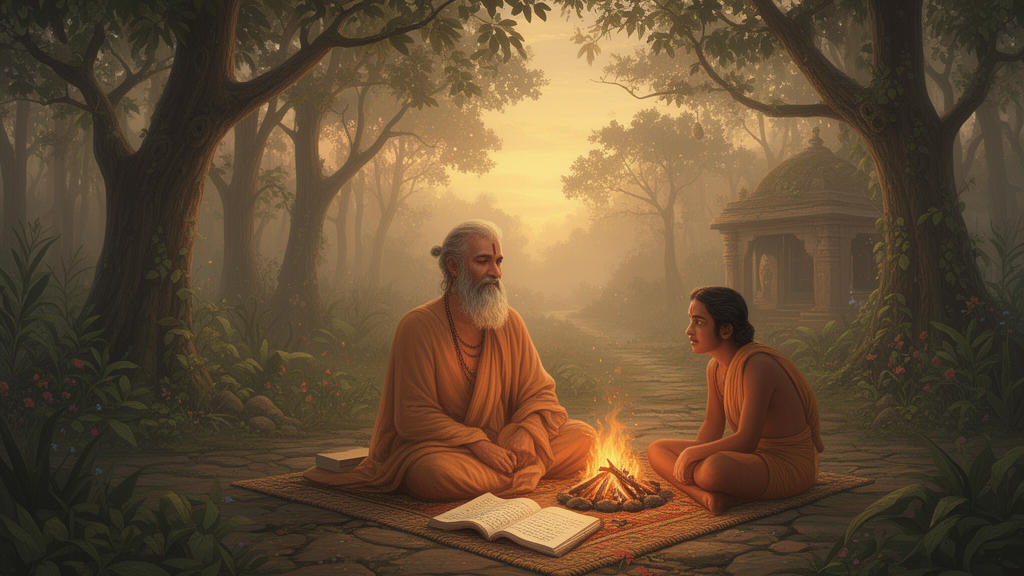
The Upanishads are not one book. They are a collection of many texts, composed and transmitted over a long period, and they belong to different Vedic branches. Devotional belief, oral tradition, historical scholarship and philosophical commentary all approach them differently, so this article keeps those approaches distinct.
What the word Upanishad means
The word is usually explained as relating to sitting near a teacher. One reading-oriented introduction describes the Upanishads as literally meaning “sitting near” a teacher, reflecting the form of many texts as dialogues between teachers and students. Vedapath’s Upanishads overview makes this point and also calls them the concluding portions of the Vedas, known as Vedanta, the “end of the Vedas.”
That explanation is useful, but it is a traditional and introductory gloss rather than a full philological account. Readers who want a detailed discussion of the etymology should consult the Wikipedia article on the Upanishads, which has a dedicated etymology section, and then check the academic sources listed at the end of this post.
Where the Upanishads sit within the Vedas
Traditional Vedic literature is often described in layers. The Samhitas are collections of hymns, the Brahmanas explain ritual, and the Aranyakas and Upanishads move toward meditation and philosophical reflection. The Wikipedia article lists the Upanishads as one division within this larger structure and groups them by their association with the Rig, Sama, Yajur and Atharva Vedas. Its classification lists include Aitareya and Kaushitaki among Rig-Vedic texts, Chandogya and Kena among Sama-Vedic texts, and Brihadaranyaka, Isha, Taittiriya, Katha, Shvetashvatara and Maitri among Yajur-Vedic texts.
This association matters because a single Upanishad is usually read as part of a particular Veda and school. The same word can refer to very different texts, from long prose dialogues to short verse treatises. When you read one, it helps to ask which Veda it is connected with and whether it is counted among the principal texts.
Why the Vedic connection matters for readers
- Ritual background: Earlier Vedic texts focus heavily on sacrifice. Many Upanishads reinterpret ritual in inward terms rather than discarding it entirely.
- Teacher and student setting: Many passages are framed as instruction, so context often comes from who is speaking and to whom.
- Different textual lineages: Manuscript traditions and school affiliations shape how a text is recited, memorized and interpreted.
How many Upanishads are there?
There is no single agreed number that applies in every tradition. The Wikipedia article distinguishes between the Muktika canon, a list of 108 Upanishads, and smaller groupings such as the principal Upanishads. VedaSeek’s Upanishad index presents a Muktika-style list of 108 texts with associated Vedas and classifications, while its own library displays a numbered list that counts 54 chapters, and Vedapath presents 60 texts in its library.
These differences are not contradictions. They reflect what each website chose to include. A number on a website, including a library count, is a publishing decision. It is not a scriptural count that every Hindu community accepts. For that reason, this site will avoid stating one total as if it were universal, and will use numbers only when attributing them to a specific list.
Readers who search for numbered titles such as 112 Upanishads, 12 Upanishads or 18 Upanishads are often comparing lists. The more useful question is which texts a given list includes, which Veda each belongs to, and whether the list is a traditional grouping or a modern compilation.
Principal and minor texts
The Wikipedia article has separate sections on principal Upanishads and on the Muktika canon with major and minor texts. The distinction is commonly used in introductions, but the exact membership of each group depends on the source. Vedapath describes the Mukhya, or principal, Upanishads as those recognized by Adi Shankaracharya, and it separately lists Yoga, Shaiva, Sannyasa, Shakta and Vaishnava texts. The category labels on that site show that many later or sectarian texts are read alongside the principal ones.
For a practical first step, start with a short list of principal texts from a source that states its criteria. Then move to minor or sectarian texts once you understand the core vocabulary.
Core ideas: Brahman and Atman
Most introductions to the Upanishads return to two terms. Brahman usually refers to ultimate reality, the ground of all existence. Atman refers to the self, the innermost principle of an individual being. Several sources reviewed for this post describe the Upanishads as exploring the relationship between these two ideas. Hinduwebsite’s Upanishad introduction calls them revelatory dialogues on Brahman, Atman, Maya and the nature of ultimate reality. Wikipedia has a section titled “Atman and Brahman” that treats the relationship as a central philosophical topic.
The Adhyatma Upanishad, as described by Vedapath, states its central claim as the non-difference of Atman and Brahman. The same summary explains that bondage arises from superimposition (adhyasa), the mistaken sense of “I” placed upon body, senses and mind, and that liberation comes through knowledge that removes ignorance (avidya). This is a description of one text’s teaching as presented by that summary, not a universal statement of all Upanishads.
A worked example: the teaching of self-knowledge
Imagine a student who believes that the self is the body and its moods. An Upanishadic teacher would not simply reject that belief. The teacher would ask the student to examine which part of experience stays constant through waking, dreaming and deep sleep. The Adhyatma summary cited above describes this kind of reflection on the three states and on the five sheaths (pancha-kosha), and it describes the witness-consciousness (saksin) as a standpoint for discernment.
This example shows the method rather than a fixed doctrine. Many Upanishadic passages use questions, negations and comparisons. The method is one reason they remain difficult to translate and easy to misunderstand without context.
The phrase Tat tvam asi
Among the best-known Upanishadic phrases is Tat tvam asi, often rendered as “That you are.” The Wikipedia article includes an image caption noting this phrase at the Sabarimala temple in Kerala, which shows how widely it circulates beyond scholarly study. Readers should note that the phrase’s source text, its context within a larger passage, and its interpretation within different Vedanta schools are separate questions. This post does not provide a verse-level citation for the phrase because the sources reviewed here did not supply one, so readers should consult a full translation of the relevant passage before quoting it.
Maya, reality and the schools of Vedanta
The Upanishads contain passages that are later read through different philosophical lenses. The Wikipedia article has sections on Reality and Maya and on the Schools of Vedanta. Those sections describe differing interpretations, including Advaita Vedanta, Bhedabheda, Vishishtadvaita and Dvaita. These schools agree that the Upanishads are central authorities, but they disagree about how Brahman, the world and the individual soul are related.
Advaita Vedanta is often introduced as a non-dual reading, while Dvaita is often introduced as a dualist reading. Vishishtadvaita and Bhedabheda occupy intermediate positions in common introductions. Those summaries are useful, but they simplify long philosophical debates. If you are studying one school, read its own primary commentaries and the scholarly introductions listed below.
- Advaita Vedanta: emphasizes the non-duality of Atman and Brahman.
- Vishishtadvaita: describes a qualified non-duality in which the individual soul and the world are related to Brahman.
- Dvaita: emphasizes a real distinction between the individual soul and God.
- Bhedabheda: describes a relation of both difference and non-difference.
These labels are scholarly and traditional categories. Many devotees and practitioners do not identify with a single school, and many Upanishads are read devotionally without a formal philosophical framework.
Yoga, devotion and sectarian Upanishads
Not every Upanishad is primarily metaphysical. Vedapath’s category labels include Yoga, Shaiva, Shakta and Vaishnava texts, and its summary of the Adhwayataraka Upanishad describes it as a yoga-oriented text that treats yoga as a path (adhva) leading to saving knowledge (taraka-jnana). According to that summary, prana regulation, sense restraint, meditation and samadhi are practical supports, but discernment that removes ignorance is treated as decisive.
The Devi Upanishad, as presented in VedaSeek’s chapter listing, opens with the gods approaching the Goddess and asking who she is. Her reply, in that translation excerpt, identifies her as the form of Brahman and as the source of both Prakriti and Purusha. This is a devotional and theological text within the Upanishadic corpus, and readers in Shakta traditions may approach it as a central scripture. Readers from other traditions may approach it as a witness to how Goddess-centered theology developed within Upanishadic literature.
This variety shows why a single definition of the Upanishads is difficult. Some texts are philosophical dialogues, some are concise treatises, and some are sectarian works that express the worship of particular deities.
Practical reading notes for devotional readers
- Read a passage slowly and identify whether it describes a teaching, a story, or a meditation method.
- Compare two translations when a line is important to your practice.
- Note whether a passage belongs to a sectarian text such as a Shakta or Vaishnava Upanishad.
- Do not treat a short summary as a substitute for the full text.
Reading the Upanishads: translations and commentaries
Translations shape how readers understand the Upanishads. Hinduwebsite lists English translations by Swami Nikhilananda, Max Muller, Jayaram V and other scholars. Those names show that the texts have been rendered by translators with different aims, periods and approaches, so readers should not assume that one translation is definitive.
Commentaries add another layer. Upanishads.org.in, an initiative linked to Vande Mataram Library Trust and AuroBharati, presents a commentary section that includes Sri Aurobindo’s commentary on the Isha Upanishad and a collection of his writings. The site also presents a passage from Sri Aurobindo’s The Foundations of Indian Culture describing the Upanishads as the supreme work of the Indian mind. That passage expresses Aurobindo’s view and should be read as his interpretation, not as a neutral description of the texts.
How to tell translation from interpretation
- Identify the translator or commentator and the edition you are reading.
- Look for notes that separate the Sanskrit text from interpretation.
- Compare a traditional commentary with a modern academic translation.
- When a term such as Atman or Maya is important, check how the translator defines it.
Historical and scholarly questions
The Upanishads raise historical questions that devotional reading does not always address. The Wikipedia article has separate sections on authorship, chronology and geography, which signals that these questions remain open and are discussed in scholarship. The Vedic Heritage Portal’s Upanishads page offers a qualified view: in the text excerpt reviewed for this post, it describes the Upanishads as containing an intelligible body of verified and verifiable spiritual insights mixed with myths, legends and cosmological speculation about the origin of the universe. That is a useful reminder that a single text can contain several kinds of material.
Historical dates should be treated carefully. Many introductions give broad periods for the Upanishads, but precise dates for individual texts are uncertain and vary among scholars. This post does not provide specific dates because the sources reviewed here did not establish a firm chronology for each text. Readers who need dates for research should consult the scholarly introductions listed in the references.
Belief, text, tradition and scholarship
- Belief: many Hindus regard the Upanishads as part of revealed or sacred knowledge.
- Text: the surviving manuscripts and printed editions are the basis for study.
- Tradition: recitation, teacher lineages and commentary traditions shape how passages are used.
- Scholarship: historians and philologists study dating, manuscript transmission and linguistic change.
These categories overlap, but they should not be merged. A statement that a text is sacred is a devotional or traditional claim. A statement that a text was composed in a particular period is a historical claim that requires evidence.
Western reception and comparisons
The Upanishads have been read widely outside India. The Wikipedia article includes sections on Reception in the West and on similarities with Platonic thought. Those sections show that comparative reading has a long history, but comparisons should be made carefully. A resemblance in theme does not establish historical influence, and philosophical comparison does not replace reading the texts in their own context.
Sri Aurobindo’s remarks, as quoted on Upanishads.org.in, also reflect a modern Indian reading of the texts as a source of direct spiritual experience. Readers can compare such interpretations with academic and traditional readings to see where they agree and where they differ.
A practical path for first-time readers
- Start with an introduction. Read the Wikipedia overview and one short introduction to Brahman and Atman.
- Choose a short principal Upanishad. Use a translation that identifies its translator and notes its sources.
- Read with a glossary. Keep notes on terms such as Brahman, Atman, Maya, moksha and vidya.
- Compare two translations. Look for differences in key sentences and note the translators’ choices.
- Add a commentary. Use a commentary from your own tradition or from a scholarly source, and mark where it departs from the translation.
- Keep a source record. Note the edition, page, chapter and verse so you can return to the passage.
This path is not the only way to read the texts. Many readers begin with a teacher, a community study group, or a devotional practice. The aim here is accuracy and clarity, not a single prescribed method.
Frequently asked questions
Are the Upanishads the same as the Vedas?
No. The Upanishads are generally described as the concluding portions of the Vedas, and they are associated with particular Vedic branches. The Samhitas, Brahmanas and Aranyakas are other major divisions. Tradition often treats the Upanishads as the Vedanta, or the end of the Vedas, but readers should distinguish the Vedic text corpus from later philosophical schools that interpret it.
Do all Upanishads teach the same philosophy?
No. Many share themes such as Brahman and Atman, but the texts differ in style, subject and aim. Some are philosophical dialogues, some are yoga or meditation texts, and some are devotional or sectarian works. Later Vedanta schools also read them in different ways.
Which translation should I read first?
Choose a translation that identifies its translator and explains its approach. Compare at least one academic translation and one translation from a commentary tradition, if possible. The best choice depends on whether you want a literal reading, a devotional reading or a philosophical reading.
Summary and next step
The Upanishads are ancient Sanskrit texts at the end of the Vedic corpus, central to Vedanta and to many later Hindu philosophical and devotional traditions. They explore Brahman, Atman, liberation and the nature of reality, often through dialogue and reflection. Their number, classification and interpretation vary by list, school and tradition, so the most useful next step is to read one short principal text with a clear translation and a source note.
Sources and further reading
- Upanishads, Wikipedia: used for the overview of classification, the Vedic association, the Atman and Brahman and Vedanta school headings, and the sections on authorship, chronology, Western reception and Platonic comparison.
- Upanishads, Upanishads.org.in: used for the site’s description of its Sri Aurobindo commentaries and the Aurobindo passage on the Upanishads.
- The 108 Upanishads, VedaSeek: used for the 108-text Muktika-style list and the Devi Upanishad opening excerpt.
- Upanishads in English, Vedapath: used for the meaning of the term as sitting near a teacher, the Vedanta description, category labels and summaries of the Adhwayataraka and Adhyatma Upanishads.
- Upanishads, Hinduwebsite: used for the introductory description of the Upanishads and the translator names listed on the site.
- Upanishads, Vedic Heritage Portal: used for the qualified statement on verified insights mixed with myths and cosmological speculation. The full page was not inspected for this draft.