The phrase “three sutras” does not refer to one fixed set of texts. In Buddhist literature, it most often points to one of two groupings: the three Pure Land sutras, chosen by the Japanese monk Hōnen, or the three Zen sutras, the Heart Sutra, Diamond Sutra, and Platform Sutra, which a modern publisher has presented together. This article explains both groupings, shows what each source supports, and notes where the labels are traditional, editorial, or scholarly.
Because the HindusGod.com readership often arrives at Buddhist and Hindu texts from different starting points, this guide keeps its focus on Buddhism and then explains how the word “sutra” is used more broadly in Indian religious literature.
What “three sutras” usually means
When readers search for “three sutras,” they may mean one of three things:
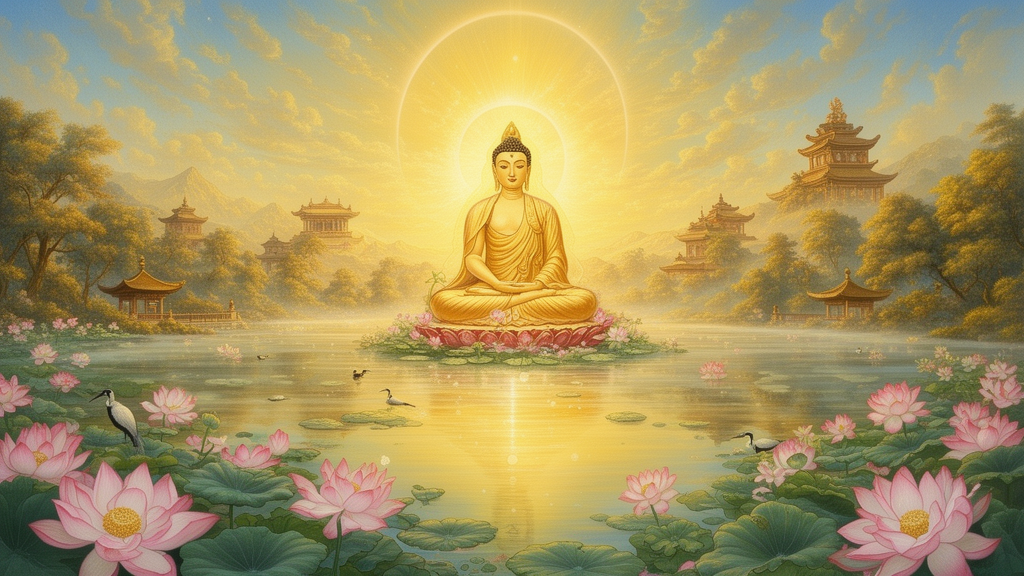
- The three Pure Land sutras, a devotional group associated with the Amitābha Buddha and the Pure Land (Sukhāvatī) tradition.
- The three Zen sutras, a grouping of three well-known Mahāyāna texts that are widely read in Zen contexts.
- A general or editorial trio, such as a book title, study course, or personal reading list, that is not a formal canonical category.
The first two are the most documented. The third should always be checked against the exact source the reader has in mind.
Sutra as a category in Mahāyāna Buddhism
A sutra is a Buddhist scripture presented as the teaching of the Buddha. Mahāyāna Buddhism developed a large body of such texts. The Wikipedia article on Mahāyāna sūtras notes that these texts are accepted as canonical and authentic buddhavacana, or “word of the Buddha,” in Mahāyāna sanghas, and that several hundred Mahāyāna sūtras survive in Sanskrit, Tibetan, and Chinese translations.[1]
The same article explains that Mahāyāna sūtras are traditionally grouped into three types: those spoken by the Buddha, those spoken through the Buddha’s blessings, and those spoken through mandate.[1] This is a classification within the tradition and should not be confused with the “three sutras” groupings discussed below. It also shows why any list of “important” sutras depends on the tradition, era, and canon being discussed.
The Mahāyāna scholar Asaṅga is also cited in the same source as classifying Mahāyāna sūtras as part of the Bodhisattva Tripiṭaka, a collection meant for bodhisattvas.[1]
The three Pure Land sutras

Where the grouping comes from
The best-documented “three sutras” in Japanese Pure Land Buddhism are the three Pure Land sutras. According to the introduction to The Three Pure Land Sutras, published by Bukkyo Dendo Kyokai (BDK), these texts were chosen by Hōnen of Japan (1133–1212) and called the three Pure Land sutras.[4] The same source states that many other sutras and discourses also mention Amitābha and his Land of Bliss, and cites Prof. Kōtatsu Fujita’s estimate that the Chinese Buddhist canon contains two hundred and ninety such scriptures.[4]
This matters for accuracy. The three texts are a selection made within a much larger literature. They are not the only Pure Land scriptures, and a reader should not assume that a “three sutras” label means no other Pure Land teaching is authoritative.
Why the Pure Land tradition values them
The Wikipedia overview of Pure Land Buddhism describes the tradition as a school of Mahāyāna Buddhism that centers on Buddhas and Pure Lands, with Amitābha, also called Amitāyus, prominent among them.[2] The article also lists core concepts such as the Mind of Faith, other power, the Primal Vow, and the Pure Land of Sukhāvatī, and it describes practices such as nianfo, or Buddha recollection, and sutra chanting.[2]
These are doctrinal and devotional categories within Pure Land Buddhism. They describe what practitioners emphasize in the tradition. They do not prove the historical claims a devotee might make about rebirth, liberation, or the reality of a Pure Land as a place, which belong to belief rather than historical evidence.
Points to check before reading
- Confirm the exact three texts named in the edition you are reading. The BDK source identifies the group through Hōnen’s selection, but the full table of contents should be checked in the edition itself.
- Read translations in context. Pure Land texts have been translated into English, Chinese, Japanese, and other languages, and terms such as Sukhāvatī, Amitābha, and Amitāyus are rendered in different ways.
- Distinguish the scripture from commentary. Much of Pure Land practice is shaped by later commentaries and sectarian teachings.
The three Zen sutras: Heart, Diamond, and Platform
A different “three sutras” grouping is common in English-language Zen reading. The Counterpoint Press book Three Zen Sutras presents the Heart Sutra, the Diamond Sutra, and the Platform Sutra together in one volume. The publisher describes them as “often linked to form a trio of texts that have been revered and studied for centuries.”[5]
The Counterpoint description identifies the translator as Red Pine, Bill Porter, whose translations are presented as the basis for the volume.[5] Readers should note that this is a publishing selection. It reflects how these three texts are often read together in English and in Zen study, not a single decision by a formal council.
The Heart Sutra
According to the Counterpoint description, the Heart Sutra offers the Prajñāpāramitā teaching of emptiness.[5] Within Mahāyāna, Prajñāpāramitā literature is a major body of texts on transcendent wisdom. Many readers encounter the Heart Sutra as a short summary of that teaching.
The Diamond Sutra
The same description states that the Diamond Sutra outlines the bodhisattva path followed by the Buddha.[5] It is often read as a text on wisdom, non-attachment, and the bodhisattva ideal. Interpretations vary between schools, so readers should treat any single summary as one reading rather than the only meaning.
The Platform Sutra
The Platform Sutra is described by Counterpoint as an autobiography of Hui-neng, the sixth patriarch of Zen, and as a text whose teachings have served as an introduction to Zen for about 1,300 years.[5] Historians often discuss the text’s composition, editions, and attribution with more caution than a devotional or publishing summary does. The safest approach is to describe it as a traditional Zen text with a long reception history, while noting that questions about its authorship and development are part of scholarly discussion.
Comparing the two groupings
The table below compares the two most common meanings of “three sutras.” It is a reading aid. It does not rank one group above the other.
| Feature | Three Pure Land Sutras | Three Zen Sutras |
|---|---|---|
| Main tradition | Pure Land Buddhism, centered on Amitābha | Zen-related reading traditions, especially in English-language study |
| Who grouped them | Hōnen of Japan, according to the BDK introduction[4] | Counterpoint Press presents them as a trio in one volume[5] |
| Central emphasis | Devotion, the Pure Land, and Buddha recollection[2][4] | Emptiness, the bodhisattva path, and the Zen lineage story[5] |
| Status of the grouping | Historically documented selection within a larger literature[4] | Editorial and reading grouping, not a formal canon division[5] |
Readers who want the devotional and liturgical side of Buddhism may find the Pure Land material more relevant. Readers interested in meditation and philosophical teachings may start with the Zen trio. Many people read both, but they should recognize that these traditions use the texts in different ways.
Where the broader sutra list fits
If you are looking for an overview rather than one trio, begin with a wider guide. HindusGod.com has related pages on Sutras, List of Sutras, and Buddhist Sutras List. These can help you see how the three-text groupings fit into the larger collection of Buddhist scriptures.
For Mahāyāna texts specifically, the Mahayana Sutras guide and the Mahayana Sutras in English page may be useful, especially if you want to see the wider range beyond these three texts. Readers new to the subject may also consult Buddhist Sutras for Beginners. The overall Buddhist sutra literature also includes Theravāda texts, which are discussed on the Theravada Sutras page, and Tibetan collections, covered on the Tibetan Sutras page.
These internal pages are target drafts in the site’s current WordPress workflow. Their public links should be treated as provisional until the owner confirms that each page is published.
Hindu sutra literature and possible confusion
Readers searching for “three sutras” may also be looking for Hindu texts. The word sutra appears in many Indian traditions, but Hindu sutra literature has its own history and categories. HindusGod.com has a separate reference on the Brahma Sutras, which are a major philosophical text in the Vedānta tradition and are distinct from the Buddhist groupings above.
Other Hindu-related pages on the site include Dharma Sutras and Dharma Shastras and the Shiva Sutras of Vasugupta. These are useful for comparing Indian sutra forms, but they should not be merged with Buddhist “three sutras” groupings. This draft did not verify a standard Hindu “three sutras” set, so no such list is presented here as fact.
How to read these texts respectfully
Buddhist sutras are read in many ways: as scripture for worship, as teaching for study, as literature for personal reflection, and as historical documents. A reader’s approach should be clear about which purpose applies.
- For study: Compare two or three translations and read a short introduction from a university press, a scholarly edition, or a recognized Buddhist institution.
- For devotion: Follow the guidance of your own teacher, temple, or lineage. Practices such as chanting, prostration, and recollection vary by school and community.
- For comparison: Note the difference between what a text says, how a tradition interprets it, and what modern scholars conclude about its origins.
No reading or recitation of any sutra is guaranteed to produce a particular material, emotional, or spiritual result. Traditions describe benefits in different ways, and those descriptions are best treated as teachings within a faith context rather than as promises.
Frequently asked questions
Are the three Pure Land sutras the same as the three Zen sutras?
No. The three Pure Land sutras are associated with Pure Land Buddhism and Hōnen’s selection. The three Zen sutras, as presented by Counterpoint Press, are the Heart, Diamond, and Platform Sutras.[4][5] The two groups have different traditions, emphases, and origins.
Is there an official list of “three sutras”?
Not in the sense of a single canonical list across Buddhism. A “three sutras” grouping is a tradition-specific or editorial selection. Check the source before citing it as a canonical division.
Which set should a beginner read first?
It depends on your interest. Readers drawn to devotion and the Buddha’s Pure Land may begin with the Pure Land material. Readers drawn to meditation and the Prajñāpāramitā teaching may begin with the Zen trio. A short introduction to Mahāyāna sutras can help place either group in context.
Summary
“Three sutras” most often refers to either the three Pure Land sutras selected by Hōnen or the Heart, Diamond, and Platform Sutras presented as a Zen trio. Both groupings are useful, but neither is a universal canon. The Pure Land set belongs to a devotional tradition centered on Amitābha. The Zen trio reflects a long reading tradition and a modern publishing presentation. Reading them well means noticing the tradition, the translation, and the difference between scripture, commentary, and scholarly interpretation.
Sources and Further Reading
- Wikipedia, “Mahayana sutras”: overview of Mahāyāna sūtra categories and collections. https://en.wikipedia.org/wiki/Mahayana_sutras
- Wikipedia, “Pure Land Buddhism”: overview of Pure Land terms, practices, and sources. https://en.wikipedia.org/wiki/Pure_Land_Buddhism
- Bukkyo Dendo Kyokai (BDK), The Three Pure Land Sutras (2003 PDF introduction): source for the Hōnen grouping and the note on related scriptures. https://www.bdk.or.jp/document/dgtl-dl/dBET_ThreePureLandSutras_2003.pdf
- Counterpoint Press, Three Zen Sutras by Red Pine: description of the Heart, Diamond, and Platform Sutras. https://www.counterpointpress.com/books/zen-sutras/