The Upanishads are ancient Sanskrit texts of Hinduism that explore the nature of reality, the self, and the ultimate ground of existence. Wikipedia identifies the language of the Upanishads as Sanskrit and places them within the Hindu scriptural category of Shruti, which is connected to the Vedas. Readers who want the original wording usually need to know three things: which texts are included, which script editions are available, and how translations and commentaries shape the meaning. This guide explains each of these points and separates what the texts say from what later traditions and scholars have made of them.
Short answer: the Upanishads are composed in Sanskrit
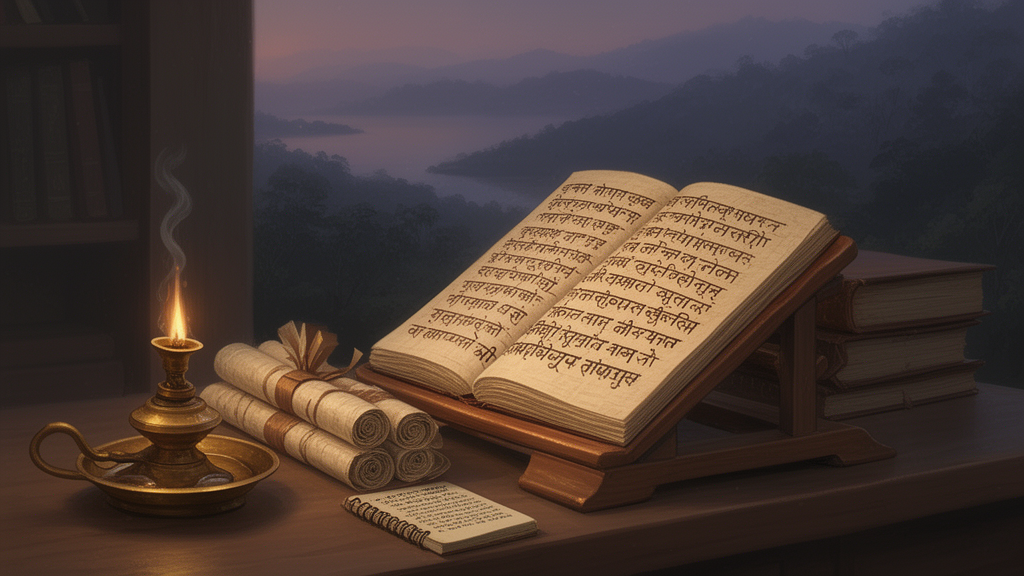
The Upanishads are written in Sanskrit. Wikipedia’s article on the Upanishads lists Sanskrit as the language of the texts and notes that its Indic script may need proper font support to display correctly in some browsers. Sanskrit Documents, a long-running digital library of Sanskrit texts, presents its Upanishad collection in Devanagari, in ITRANS (a transliteration scheme that writes Sanskrit in Roman letters), and in HTML versions prepared for different scripts. For a reader who wants the Sanskrit itself, the most practical starting point is a Devanagari edition, paired with a transliteration or a trusted translation for comparison.
The Sanskrit text is only one layer of the tradition. A verse may have several acceptable English renderings, and each rendering reflects choices about vocabulary and grammar. Commentaries from different Vedanta schools can read the same passage in different ways. This article distinguishes the scriptural wording, the translations, the commentarial traditions, and the modern scholarly discussion throughout.
What the word “Upanishad” refers to
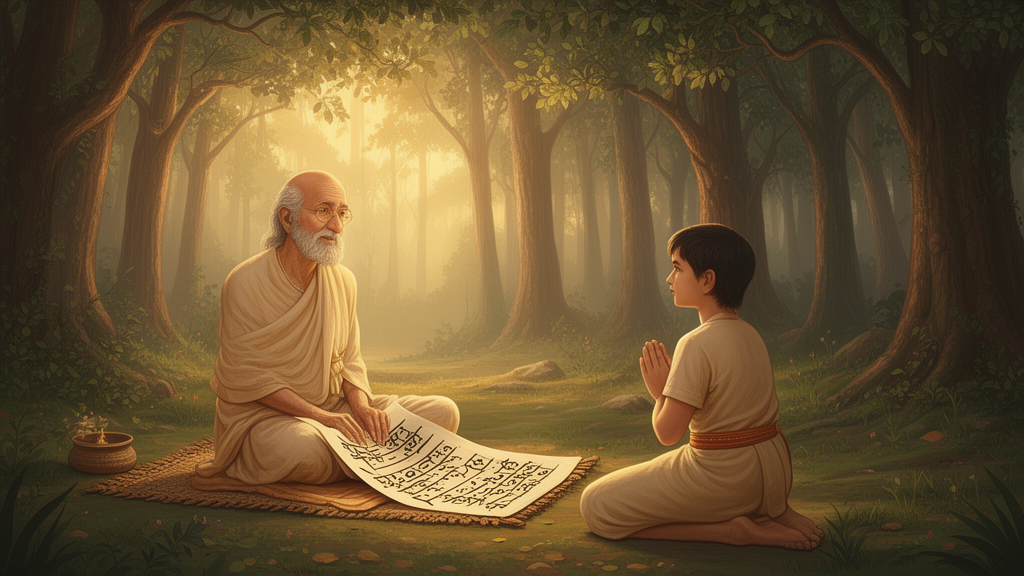
Wikipedia’s article on the Upanishads uses an image caption to connect the word to a scene of a teacher and a disciple, described as giving rise to the etymology of the term. The article’s etymology section is the place to read the full discussion, and readers who want the word’s linguistic history should consult that section and the sources it cites, since the detail is not reproduced here.
In practical terms, the term is widely understood in Hindu learning as a teaching given in close, personal instruction. This is the reason many Upanishads are presented as dialogues: a teacher answers a student’s question, a sage explains a meditation, or a deity responds to a direct request. Several examples below show this pattern.
Which texts are called Upanishads?
The answer depends on which list is used. VedaSeek, which hosts Sanskrit and English versions of the texts, describes a canonical Muktika list of 108 Upanishads and presents its directory as a set of texts with associated Vedas and classifications. Its listing begins with the Isha Upanishad, followed by the Mandukya Upanishad and the Taittiriya Upanishads, and notes alternate names such as Ishavasya for the Isha text.
Other sources count differently. The Internet Archive holds a two-volume set titled 112 Upanishads, described in its catalogue title as containing Sanskrit text, an English translation, and an index of verses. Sanskrit Documents maintains a consolidated list of Upanishad titles in Devanagari that marks many entries as duplicates or uncertain, which shows how titles overlap across collections. A community-uploaded Scribd compilation describes itself as “120 Upanishads,” but this is a user-uploaded document rather than an authoritative edition, so it is not relied on here.
The practical lesson is that a number such as 108, 112, or 120 describes a particular list or edition, not a single universal canon. A reader should always check which edition is meant before comparing counts.
Major and minor Upanishads
Wikipedia’s classification section discusses a Muktika canon and divides the texts into major and minor groups, followed by a list of principal Upanishads and a section on newer texts. The principal Upanishads are the older and most widely studied prose and verse texts. The later and minor texts often deal with specialized topics, including yoga, sectarian devotion, and ritual symbolism. Because classifications differ, it is safer to name the individual text and its Veda than to rely on a vague label such as “major.”
Association with the four Vedas
Wikipedia groups the principal Upanishads under the Vedic branches to which they are traditionally attached. Its outline includes Rig vedic texts such as the Aitareya and Kaushitaki, Sama vedic texts such as the Chandogya and Kena, and Yajur vedic texts such as the Brihadaranyaka, Isha, Taittiriya, Katha, Shvetashvatara, and Maitri. The Atharva Veda is also associated with Upanishadic texts; the Atharvashikha and Atharvashira listings on Sanskrit Documents show this connection in their titles.
This association matters for a reader. The Vedic branch helps place a text within a community of recitation and ritual, but it does not by itself settle every question of date, authorship, or meaning. The Wikipedia article discusses authorship, chronology, and geography in separate sections, and those debates are scholarly rather than settled.
Reading the Sanskrit: script, transliteration, and variant names
Sanskrit can be written in several scripts. Devanagari is the script most commonly used for Sanskrit editions in India. Transliteration uses Roman letters, often with diacritical marks, to represent sounds. Sanskrit Documents offers the upanishhat collection in Devanagari and in ITRANS, while VedaSeek presents Sanskrit alongside English translation. Readers should expect differences in spelling, sandhi (the joining of sounds at word boundaries), and the presence or absence of accents across editions.
Names also vary. VedaSeek notes that the Isha Upanishad is also known as the Ishavasya Upanishad. Taittiriya Upanishad entries may be split into sections such as the Shiksha Valli, the Ananda Valli, and the Bhrigu Valli. When comparing editions, a reader should look for the Sanskrit title in Devanagari first, then check the transliteration and the section headings.
A note on rendering
Wikipedia warns that Indic text may appear as question marks, boxes, or misplaced vowels if a browser lacks suitable font support. If Sanskrit characters do not display correctly, install a Devanagari-capable font or use an ITRANS or transliterated version while you check the original edition. Do not copy text from an unverified source into a study note without comparing it to a reliable edition.
Where to find Sanskrit editions
Several online resources offer Upanishad texts. The following list describes what each source provides, based on the pages consulted for this article. The sources are useful starting points; they are not a substitute for critical editions or academic study.
- Sanskrit Documents: Offers the upanishhat collection in Devanagari and ITRANS, along with HTML formats for different scripts and a list of related information and links. The site also hosts a consolidated Upanishad title list that marks duplicates and uncertain entries.
- VedaSeek: Presents the 108 Upanishads with Sanskrit text and English translation, arranged as chapters with short summaries and alternate names for each text.
- Internet Archive: Holds a digitized two-volume set titled 112 Upanishads, described as containing Sanskrit text, English translation, and an index of verses. Check the item’s licensing and the edition’s details before reusing any part of it.
When using any online edition, note the publisher, the edition, the date if given, and the translator. Keep a record of the URL and the date you consulted it, since websites change over time.
Translations and interpretation
A translation is an interpretation. Sanskrit words such as atman (self) and brahman (ultimate reality) carry layered meanings that translators render differently. A translation that appears in one edition may not match another. For this reason, serious readers compare at least two translations and check unfamiliar terms against a Sanskrit dictionary or a scholarly glossary.
Interpretation also depends on the school that reads the text. Wikipedia’s Vedanta section describes several schools, including Advaita Vedanta, Bhedabheda, Vishishtadvaita, and Dvaita. These schools use the Upanishads together with other texts and commentaries, and they reach different conclusions about the relationship between the individual self and ultimate reality. A reader who studies only one school’s commentary should recognize that it represents one reading among several.
Example: the same teaching, several readings
Consider the phrase Tat Tvam Asi, which Wikipedia illustrates with a photograph of its display at the Sabarimala temple in Kerala. The phrase is often translated as “That thou art.” Its meaning is discussed within several Vedanta traditions, and different schools understand the identity it expresses in different ways. A balanced presentation names the text where the phrase occurs, identifies the commentary used, and explains that the reading is tradition-specific.
The philosophy in brief
Wikipedia’s outline covers development of thought, Atman and Brahman, and the concept of reality and Maya. These are useful entry points, but they are summaries of a large and varied body of literature. The Upanishads do not present one doctrinal system in a single voice. Some passages focus on meditation, some on ethics, some on cosmology, and some on the nature of the knower. A reader should therefore approach each text in its own context.
- Atman is commonly discussed as the self or inner principle. Many Upanishadic passages connect it with consciousness.
- Brahman is commonly discussed as the ultimate reality underlying the world. Several texts describe it through negation, symbol, or analogy.
- Maya is a term used in later Vedanta discussions of appearance and reality, and its meaning varies across schools.
Stories and dialogues in the Upanishads
Many Upanishads are structured as conversations, and their stories provide concrete examples of how the Sanskrit texts present teaching. The following examples come from the sources consulted here.
Yama and Nachiketa in the Katha Upanishad
Wikipedia uses an illustration of Yama teaching Nachiketa in the Katha Upanishad to introduce the texts visually. In this tradition, a young seeker asks a difficult question about what happens after death, and Yama, the lord of death, answers through instruction. The episode is widely retold in Hindu teaching, and readers should note that the dialogue itself belongs to the Katha Upanishad, while later retellings may add or simplify details.
The goddess in the Devi Upanishad
VedaSeek’s summary of the Devi Upanishad says that the gods approach the Goddess and ask who she is. She replies that she is the form of Brahman, the source of the world composed of Prakriti and Purusha, and that she is both knowledge and ignorance. This is a teaching about the Goddess presented in an Upanishadic dialogue. It is an important example of how the Upanishadic corpus includes texts devoted to deities and not only to abstract philosophy. Readers should read the full Sanskrit and a translation rather than relying on a summary.
The meditation dialogue in the Atharvashikha Upanishad
VedaSeek’s summary of the Atharvashikha Upanishad describes Pippalada, Angiras, and Sanatkumara asking Atharvan about the meditation that was used in the beginning, what is to be meditated upon, and who the meditator is. The question structure is typical of Upanishadic instruction: the student asks about method, object, and subject before receiving a teaching.
Belief, tradition, text, and scholarship
Discussion of the Upanishads often mixes several categories. Keeping them separate improves accuracy and respect for the tradition.
- The text is the Sanskrit wording in a specific edition. Its content should be quoted from that edition and cited with the edition details.
- Tradition describes how communities recite, learn, and revere a text. Practices of recitation and memorization vary by region and lineage.
- Belief describes what devotees hold about the texts, the deities they mention, and their spiritual authority. These beliefs are important to followers but are not historical findings.
- Scholarship examines dating, authorship, manuscript transmission, and the relationship of the texts to other works. Scholars disagree on many of these points, and Wikipedia’s chronology and authorship sections make that clear.
A post or study note should say which category a claim belongs to. For example, “The Katha Upanishad presents a dialogue between Yama and Nachiketa” is a textual description. “Reciting this Upanishad brings a particular result” would be a devotional claim, and no source consulted here supports such a promise.
How to study the Sanskrit texts step by step
Readers who want to work with the Sanskrit can follow an ordered approach. This method is one practical option and is not the only tradition of study.
- Choose one text. Begin with a short Upanishad such as the Isha, which VedaSeek lists first in its directory, or with a text you already know by name.
- Confirm the title and Veda. Check the Vedic association and alternate names, since sources differ.
- Read a Devanagari edition. Use Sanskrit Documents or another reliable digital library, and note the edition details.
- Compare with a transliteration. ITRANS or Roman transliteration can help you check pronunciation and word breaks.
- Read two translations. Compare translations from different sources, and note where they differ.
- Consult a commentary or teacher. A commentary from a named school or a qualified teacher can explain context, but record which tradition it represents.
- Keep a source log. Record the URL, edition, translator, and date consulted for each passage you use.
Readers who want a broader overview can begin with the HindusGod.com hub on the Upanishads and then move to more specific guides. The following internal pages are WordPress drafts, and their public availability should be confirmed before publication: Upanishads serves as the general hub; About Upanishads in English covers English-language access; Upanishads Language covers language questions in more detail; and Upanishads Original Language addresses the original wording.
Common questions about Upanishads in Sanskrit
For readers who want a quick orientation, the topic often raises a small set of practical questions. The answers below are kept brief and point back to the evidence discussed above.
Are all Upanishads written in Sanskrit?
The Upanishads that appear in the sources consulted here are presented as Sanskrit texts, and Wikipedia lists Sanskrit as the language of the Upanishads. Translations into other languages, including English and Hindi, also exist. A reader should check the edition to confirm the language of the specific text.
Why do different websites list different numbers of Upanishads?
Different lists count different texts, and some entries are duplicates or variant titles. VedaSeek describes a canonical Muktika list of 108, while the Internet Archive item titled 112 Upanishads reflects another collection. Sanskrit Documents marks duplicates in its consolidated list. Use the number only with the name of the list or edition.
Which translation should I read first?
There is no single answer. Choose a translation that identifies its translator, its edition, and any commentary it follows. Comparing two translations is usually more informative than relying on one.
Why the language question matters for devotion and study
For devotees, the Sanskrit wording can carry a sense of sacred sound and recitation. For students, it provides access to terms, grammar, and structure that translations can flatten. For scholars, the textual history of each Upanishad, including its manuscripts and editions, is a separate field of study. These approaches can overlap, but they should not be treated as interchangeable. A devotional recitation does not establish a historical date, and a historical date does not define what a text means to a community.
Respect for regional and community differences is also important. Some communities recite certain Upanishads as part of daily or ritual life, while others study them mainly as philosophy. Regional customs, teachers, and lineages can shape these practices. This article does not describe any single ritual as universal, and readers should consult a teacher or community source for practice-specific guidance.
Practical takeaway
The Upanishads in Sanskrit are a large family of texts, not a single book with one fixed count or one settled meaning. Begin with the Sanskrit edition you can read, record the source details, compare translations, and identify which tradition or scholarly argument a commentary represents. When sources disagree on counts, dates, or interpretations, state the disagreement rather than choosing the most convenient answer.
Sources and Further Reading
- Upanishads – Wikipedia: General overview of the texts, their Sanskrit language, Shruti classification, Vedic groupings, etymology caption, philosophical topics, and Vedanta schools. Use as an overview; check the cited sources in its reference list for detailed claims.
- upanishhat – Sanskrit Documents: Devanagari, ITRANS, and HTML editions of Upanishad texts, with a list of related information and links.
- A Consolidated List of Upanishads – Sanskrit Documents: Devanagari list of Upanishad titles with duplicate and uncertain markers, useful for seeing how title lists vary.
- The 108 Upanishads – VedaSeek: Sanskrit and English text listings, the Muktika-based directory, alternate names, and chapter summaries such as the Devi and Atharvashikha Upanishads.
- 112 Upanishads (Sanskrit Text, English Translation, An Exhaustive Introduction, Index of Verses), 2 Volume Set – Internet Archive: Digitized two-volume set described as containing Sanskrit text and English translation. Confirm license and edition details before reuse.
Internal WordPress drafts referenced above, pending owner review: 10 Upanishads in Sanskrit and 112 Upanishads may be useful for readers comparing counts; Essence of the Upanishads may be useful for a summary of core themes.