The Upanishads (उपनिषद्) are the concluding portions of the Vedic literature, known as Vedanta, or ‘the end of the Vedas.’ In Hindi, उपनिषद् is usually understood as the teaching that a student receives while sitting close to a teacher, and in philosophical terms it refers to brahmavidya, the knowledge of Brahman. This post explains the word, the main ideas of these texts, how the number of Upanishads is counted, and where scholars disagree about dating.
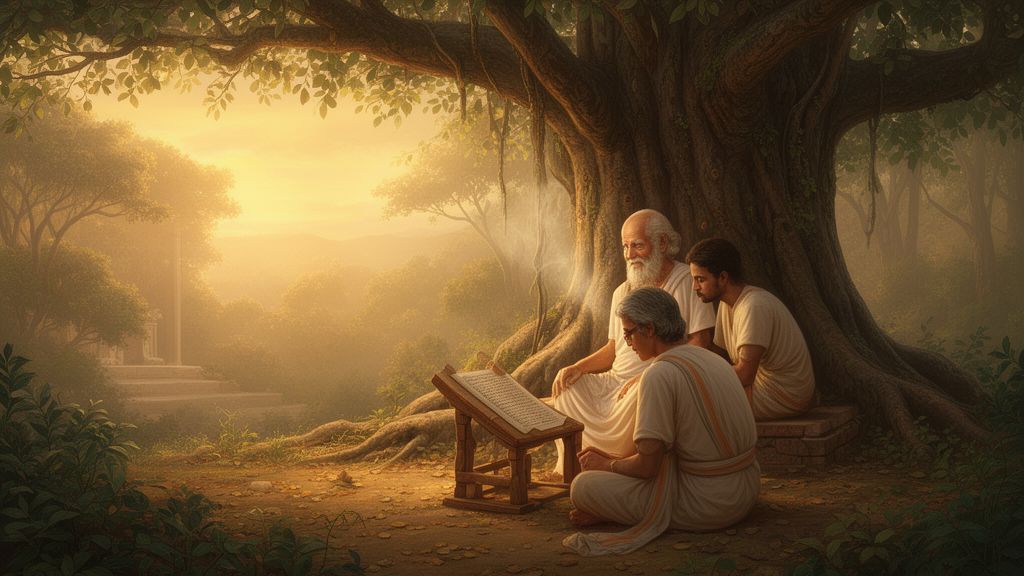
Quick answer: उपनिषद् means a sacred teaching received in close, attentive sitting before a guru, and in the philosophical tradition it points to the knowledge of ultimate reality (Brahman) and the self (Atman). The texts are part of the Hindu scriptural tradition, but they are also philosophical dialogues and commentaries, so they are read in several ways.
What उपनिषद् means in Hindi

In everyday Hindi, readers often search for the phrase ‘upanishads meaning in hindi’ to find a short, clear definition. The most common explanation is that उपनिषद् is connected with the idea of sitting near a teacher. The Vedapath site describes the Upanishads as literally ‘sitting near’ a teacher, and presents them as dialogues between teachers and seekers about Brahman, Atman, consciousness, and liberation.
Some Hindi sources give a grammatical breakdown. KahaniPlace, for example, explains the word as upa (near), ni (down), and shad (to sit), and then connects this with sitting close to a guru. Mahakavya and Vedic Sanatana take a different route, explaining that the word is formed from the root sad with the prefixes upa and ni. They note that the root sad has three meanings in grammar: destruction or loosening (vishaarana), attainment (gati), and sinking or weakening (avasadana).
These explanations do not contradict each other in meaning. The phrase ‘sitting near’ is the easiest reading for a general reader, and the root-based explanation adds a philosophical layer: the teaching is meant to loosen ignorance and lead the seeker toward the highest knowledge. Readers should treat the grammar as a traditional explanation rather than a single modern linguistic verdict.
Two layers of meaning: text and knowledge
Mahakavya reports that Adi Shankaracharya explained the primary meaning of ‘Upanishad’ as brahmavidya, the knowledge of Brahman, and a secondary meaning as the scriptures that teach this knowledge. This distinction is useful. When people say ‘the Upanishads,’ they may mean the body of texts, or they may mean the wisdom contained in them.
Mahakavya also describes the Upanishads as a knowledge that frees a seeker from attachment to visible and heard objects and from the root ignorance (avidya) that sustains saṃsāra. This is a traditional doctrinal statement, so it should be read as the text’s teaching and as the tradition’s interpretation, not as a claim that can be tested in a laboratory.
The Upanishads as Vedanta
The Upanishads are called Vedanta because they are placed at the end of the Vedas, both in the sense of their position in the corpus and their role as the final stage of Vedic teaching. Vedapath says the Upanishads form the culmination of Vedic thought. KahaniPlace also describes them as the final part of the Vedas and calls them Vedanta.
The Hindi Wikipedia article on उपनिषद् notes that the Upanishads placed knowledge above ritual action (karmakanda), which they describe as lower (avara). The reason given is that knowledge moves a seeker from the gross (the world and matter) toward the subtle (mind and self). The same article says that the core teaching of the Upanishads is to understand Brahman, Jiva (the individual self), and the world (jagat). Note that the Wikipedia page was captured as a search snippet in this research set, and its page was not fully inspected, so readers should check the live article before relying on exact wording.
This is an important point for readers. Much of Vedic ritual, including sacrifice and prescribed actions, is discussed in the earlier layers of the Vedas. The Upanishads do not reject ritual in every context, but they frame it as a preliminary discipline and place inquiry into the self at the center. Different communities still practise ritual, worship, and devotion in different ways, and the Upanishads are one part of that wider life.
Core ideas: Brahman, Atman, and Moksha
Most Hindi introductions to the Upanishads return to three terms. Each is central, but each carries layers of meaning that depend on the text and the commentary.
Brahman (ब्रह्म)
Brahman is the ultimate reality. Vedapath describes the Upanishads as exploring the nature of Brahman and the self. In the Taittiriya Upanishad (Ananda-Valli and Bhrgu-Valli section), as presented on the VedaSeek English-Hindi page, the knower of Brahman is said to attain the Supreme, and Brahman is described as truth, knowledge, and infinity. That is a useful example of how the texts speak about the ultimate in abstract, descriptive terms rather than as a single image or form.
Atman (आत्मा)
Atman is the self. Vedapath describes the Upanishads as exploring ‘the nature of the self (Atman).’ The Adhyatma Upanishad, which the Vedapath page associates with the Yajurveda tradition, states in its summary that the self and Brahman are one, and that the ‘I’ identification with body and mind is the source of bondage. That is a summary by the website, not a verse-by-verse translation, so it should be treated as a secondary account of the text.
Moksha (मोक्ष)
Moksha is liberation. Vedapath lists liberation as one of the central subjects of the Upanishads. Vedapath’s summary of the Adhyatma Upanishad says that knowledge that removes ignorance is liberation. Across the tradition, moksha is often discussed as release from repeated birth and death, but the exact meaning varies among schools. Some stress knowledge, some stress devotion, and some stress disciplined practice. Readers should note that these are interpretive frames attached to the texts, not a single shared doctrine.
Famous statements and where they appear
KahaniPlace lists several well-known sayings in Hindi, including aham brahmasmi (“I am Brahman”), tat tvam asi (“That you are”), sarvam khalvidam brahma (“All this is indeed Brahman”), and neti neti (“not this, not this”). These phrases are widely quoted, but the source page does not give a precise verse reference for each one. For a published article, each phrase should be checked against a critical edition or a reliable translation before it is attributed to a particular Upanishad. This post does not give verse numbers for these phrases because the research set did not verify them.
The Mandukya Upanishad, according to KahaniPlace, explains the syllable Om and describes four states of consciousness: waking, dream, deep sleep, and the fourth state (turiya). The Brihadaranyaka Upanishad, according to the same page, teaches the unity of Atman and Brahman. These summaries are useful as an overview, but detailed study should go to the Sanskrit text and a translation with clear attribution.
How many Upanishads are there?
There is no single number that every source accepts, and this is one of the most common points of confusion. The reason is that different lists exist for different purposes.
- 108 Upanishads (Muktika canon): Mahakavya, Vedic Sanatana, and VedaSeek each refer to a traditional total of 108. VedaSeek also presents a directory of the canonical Muktika list, though the number of chapters it displays in its listing differs from 108.
- 13 principal Upanishads (Mukhya): Mahakavya and Vedic Sanatana state that most scholars regard thirteen as principal texts. KahaniPlace also highlights thirteen as the most important. The thirteen named in these sources include Isha, Kena, Katha, Prashna, Mundaka, Mandukya, Taittiriya, Aitareya, Chandogya, Brihadaranyaka, Shvetashvatara, Kaushitaki, and Maitrayani.
- Commentary base: Vedic Sanatana notes that Shankaracharya wrote commentaries (bhashya) on ten Upanishads, and that some of these are considered especially ancient. Vedapath similarly connects the Mukhya group with the list recognized by Adi Shankaracharya.
- A 60-text reading edition: Vedapath’s website presents 60 texts in its reading collection, grouped under categories such as Vedic, Mukhya, Yoga, Shaiva, Sannyasa, and Shakta and Vaishnava.
A practical reading is this: 108 is the traditional total often cited; 13 is the common shortlist of principal texts; and any edition or website may present a smaller or differently grouped collection. When you buy or read a book, check which list it follows.
Dating the Upanishads: where scholars disagree
Dating is one of the areas where the sources differ. Mahakavya reports that Western scholars, in the source’s account, place the Upanishads between about 700 and 600 BCE. It also reports that Lokmanya Bal Gangadhar Tilak argued on astronomical grounds for a date around 1900 BCE. KahaniPlace gives a broader range of 800 BCE to 200 BCE for composition.
These are not the same kind of claim. The earlier date is a scholarly estimate that depends on linguistic, textual, and comparative evidence. Tilak’s date is a specific argument based on his astronomical reading. The range from 800 to 200 BCE reflects the fact that the texts were composed over a long period, and different works may belong to different stages. For this reason, a responsible article should say that the dating of the Upanishads remains debated and should not present one date as settled. This is an area where historical scholarship, traditional belief, and modern interpretation can be easily confused.
Principal Upanishads: short orientation
Reading all the Upanishads at once can be overwhelming. Beginners often start with the principal texts. The summaries below are short and drawn from the research sources. Each should be read with a translation and commentary for a fuller understanding.
Mandukya Upanishad
According to KahaniPlace, the Mandukya Upanishad explains the meaning of Om and the four states of consciousness. Because it is short, it is often recommended as an entry point. Readers who want the Sanskrit text should look for a critical edition or a reliable translation with the Gaudapada karika or other commentary identified, if they wish to study the tradition of commentary.
Katha Upanishad
KahaniPlace describes the Katha Upanishad as a dialogue between Nachiketa and Yama, the lord of death, about death and the immortality of the self. This is one of the best-known stories among the Upanishads. The text belongs to the Katha school associated with the Krishna Yajurveda, as listed in the Vedapath page’s Yajur Veda category.
Mundaka Upanishad
KahaniPlace says the Mundaka Upanishad discusses Brahman and the self. The same page links the phrase ‘Satyameva Jayate’ with this Upanishad. That claim is widely repeated, but the research set did not verify it against the Sanskrit text, so this article does not repeat it as a verified fact.
Brihadaranyaka Upanishad
The Brihadaranyaka is one of the longest and most discussed Upanishads, and is included among the thirteen principal texts in the Mahakavya and Vedic Sanatana lists. KahaniPlace summarises its teaching as the unity of self and Brahman, and links it with the phrase aham brahmasmi.
Aitareya Upanishad
The Hindi Wikipedia page and the Vedapath page both describe the Aitareya Upanishad as linked to the Rigveda and the Aitareya Aranyaka. Vedapath describes it as using an account of creation as a path of philosophical teaching, rather than as a myth told for its own sake. The text distinguishes senses, life-breath, mind, and intellect, and it holds that the self is the witness that illumines all of them. Vedapath’s summary should be checked against a translation before quoting specific passages.
Yoga and Sannyasa Upanishads
Vedapath groups many shorter texts under Yoga, Sannyasa, Shaiva, Vaishnava, and Shakta headings. The Adhvayatāraka Upanishad, which Vedapath places in the Atharva Veda and in the Yoga group, treats yoga as a path to liberation, and says that the final goal is self-realization. It also warns that yogic powers and perceptions are signs along the path, not the decisive outcome. This is a useful example of how texts frame practice: they value disciplined meditation but place the aim in knowledge of the self.
Upanishads beyond Advaita: devotional and sectarian texts
Many readers imagine the Upanishads only as abstract philosophy. The wider collection includes devotional and sectarian texts. Vedapath explicitly lists Shaiva, Vaishnava, and Shakta Upanishads. Its website describes these as ‘sectarian’ texts, and the word should be read in its historical sense: they belong to particular traditions of worship and interpretation.
A clear example from the research set is the Devi Upanishad. In VedaSeek’s English rendering, the gods approach the Goddess and ask who she is. She replies that she is the form of Brahman, and that the world of prakriti and purusha arises from her. This text presents the Goddess as the ground of reality, a viewpoint that is important in Shakta devotion. The text is a Shakta Upanishad and is not necessarily read in the same way by all Hindu communities. Readers should understand it as one voice within the larger corpus.
Similarly, the Amritabindu Upanishad, according to VedaSeek, describes a pure mind and an impure mind, with the impure mind filled with desire and thought, and the pure mind free from desire. This is an example of the psychological vocabulary that appears across the corpus.
Upanishads, the Gita, and the Brahma Sutra
The Hindi Wikipedia article states that the Bhagavad Gita and the Brahma Sutra, together with the Upanishads, are called the prasthanatraya, the three foundational texts of Vedanta. The Wikipedia summary says that the Brahma Sutra and the Gita, to some extent, depend on the Upanishads. This relationship is useful for readers who move from Upanishads to the Gita, because the Gita is often read as a teaching that draws on Upanishadic ideas.
KahaniPlace makes a similar point in a more popular tone, describing the Gita as a kind of summary of the Upanishads, and noting that the Gita discusses Brahman and Atman using concepts from the Upanishads. The phrase ‘essence of the Upanishads’ is a traditional description and not a literal claim about the text’s composition. A careful reader will compare the Gita’s verses with the Upanishadic passages they echo rather than relying on a slogan.
For readers who want a related post, see the HindusGod draft on About Mahabharat in Hindi, which is useful for placing the Gita in the wider epic context. The link is to a target draft and may not be public until the owner publishes it.
Common misunderstandings
The Upanishads are not one book with one doctrine
The collection spans many centuries, schools, and literary forms, from short poems to long prose dialogues. Some texts are narrative, some are meditative, and some are devotional. Presenting them as one unified doctrine is a simplification. Even the teachings that appear most often, such as the unity of Atman and Brahman, are interpreted differently by different commentators.
Knowledge is not the same as ritual rejection
The Hindi Wikipedia summary says the Upanishads place knowledge above ritual, but this does not mean ritual has no place in Hindu life. Vedic rites, temple worship, festivals, and family customs remain part of many traditions. The Upanishads speak about a ranking of practices within their philosophical framework. They should not be read as a call to abandon every form of worship.
Mahavakya phrases are not a substitute for study
Short sayings such as aham brahmasmi are often used in motivational contexts. Their meaning in the texts is connected to the surrounding argument, to the teacher-student setting, and to the commentarial tradition. Taking a phrase out of context can change its meaning. For that reason, a reader should look at the full passage, not only the slogan.
How to start reading the Upanishads in Hindi
A reader who wants to understand the Upanishads in Hindi can follow a simple path. The steps below are a practical reading plan, not a fixed tradition, because many communities have their own guru-shishya methods.
- Read a short introduction. Start with the basic meaning of the term, the idea of Vedanta, and the difference between the Mukhya and wider collections.
- Choose one principal Upanishad. The Mandukya Upanishad is short; the Katha Upanishad is narrative and easy to follow; the Brihadaranyaka is long and better for later study.
- Use a reliable edition with Sanskrit and Hindi translation. Check whether the translator names the commentary they follow. Be cautious with websites that do not name sources.
- Read the passage in context. Do not treat a single line as a complete teaching. Note who speaks and to whom.
- Compare with commentary. Look at a commentary tradition, such as Shankaracharya’s bhashya on selected texts, and see how it explains difficult terms.
- Keep a notebook. Write down terms like Brahman, Atman, moksha, and avidya, and revisit them as you read more.
This approach gives the reader a steady path from simple definitions to primary texts. It also protects against the common habit of collecting slogans without understanding their source.
FAQs
Is उपनिषद् the same as वेदांत?
In many sources, Upanishads and Vedanta are closely connected. The Upanishads are called Vedanta because they come at the end of the Vedas. Vedanta can also refer to later philosophical traditions built on the Upanishads, the Brahma Sutra, and the Gita. The term therefore has both a textual and a philosophical sense.
Which Upanishad should a beginner read first?
There is no single required order. A common starting point is a short text such as the Mandukya Upanishad, or a narrative text such as the Katha Upanishad, read with a translation and introduction. The best first text depends on the reader’s interest and access to a reliable edition.
Are all Upanishads part of the same tradition?
No. The Mukhya texts are most often studied as the principal philosophical Upanishads, but the wider collection includes Shaiva, Vaishnava, Shakta, Yoga, and Sannyasa texts. The tradition is diverse, and different communities may give different weight to different texts.
Summary
The phrase upanishads meaning in hindi usually leads to the idea of ‘sitting near a teacher’ to receive knowledge. In a deeper sense, the Upanishads are the final portion of the Vedas, called Vedanta, and their central subjects are Brahman, Atman, the world, and moksha. The number of Upanishads depends on the list: 108 is the traditional total, 13 are often treated as principal, and some editions present a smaller selection. Dating remains debated, and readers should distinguish between textual teaching, commentary, devotional belief, and historical scholarship.
A useful next step is to read one principal text in a reliable translation, compare it with a commentary, and then explore the wider collection, including devotional Upanishads, with the same care.
Related HindusGod posts
The following HindusGod articles may be useful for related searches. These links point to WordPress target drafts and may not be publicly visible until the owner publishes them.
- Upanishads for a general overview of the topic on the site.
- 10 Upanishads in Hindi for a shorter list of major texts.
- 108 Upanishads in Hindi for the traditional total and its canon.
- 13 Upanishads for the principal group often studied first.
- About Upanishads in English for an English-language orientation.
- Aurobindo Upanishads for a modern interpretive perspective on the texts.
- Ashtavakra in Hindi for a related teacher-student dialogue in the Advaita discourse tradition.
Sources and further reading
- Upanishad, Hindi Wikipedia (https://hi.wikipedia.org/wiki/उपनिषद्): used for the statement that the Upanishads place knowledge above ritual, the aim of understanding Brahman, Jiva, and jagat, and the grouping of Upanishads, Gita, and Brahma Sutra as Prasthanatraya. Note: the page was captured as a search snippet and its HTTP content was not inspected in this research set.
- Upanishads in Hindi, Vedapath (https://vedapath.app/hi/upanishads): used for the description of the Upanishads as the culmination of Vedic thought, the meaning ‘sitting near,’ the category structure, and summaries of the Adhyatma, Adhvayataraka texts.
- 108-Upanishad in Hindi, Mahakavya (https://www.mahakavya.com/108-upanishad-hindi/): used for the etymology via the root sad, Shankaracharya’s distinction between primary and secondary meanings, the list of 13 principal texts, and the differing dating views.
- Upanishad in Hindi, KahaniPlace (https://kahaniplace.in/upanishad-in-hindi/): used for the popular breakdown of the word, the summary of Katha, Mandukya, and Brihadaranyaka, and the list of common mahavakya phrases. Its specific verse references were not verified and are not repeated here.
- 108 Upanishad in Hindi, Vedic Sanatana (https://vedicsanatana.com/108-upanishad-in-hindi/): used for the traditional total of 108, the list of 13 principal Upanishads, the note on Shankaracharya’s ten commentaries, and the dating discussion.
- Upanishads, VedaSeek (https://www.vedaseek.com/books/hi/upanishads): used for the English-rendered passages from the Taittiriya, Devi, and Amritabindu Upanishads and the Muktika directory. The directory’s chapter count differs from the 108 figure; readers should check the edition they use.
For a deeper study, consult a critical edition of the Sanskrit text and a translation that names its commentary tradition, and check a university or academic resource for the dating debate before relying on a single date.