A sutra Zen reference points to the scriptures and scripture-like texts that Zen Buddhism uses, reads, and chants. The word sutra comes from the Sanskrit sūtra, which usually refers to a teaching attributed to the Buddha. In the Pali tradition the equivalent is sutta. Zen, which developed as Chan in China and later spread to Japan, Korea, and Vietnam, has a complicated relationship with scripture. It is often described as a “special transmission outside scriptures,” yet the tradition has a large written textual base. This article explains which sutras matter to Zen, how they are used in practice, and where the evidence is clear, disputed, or devotional.

The short answer: Zen treats a small group of Mahayana sutras as basic reference points, adds a set of Chinese texts that developed inside the Chan tradition, and uses short sutras in daily Soto and other liturgies. The most widely known are the Heart Sutra, the Diamond Sutra, the Lankavatara Sutra, the Vimalakirti Sutra, the Avatamsaka Sutra, and the Lotus Sutra, along with the Platform Sutra of Huineng. Their status is shaped by tradition, lineage, and modern scholarship, and these layers should be kept separate.
This is a Buddhist topic. HindusGod.com covers Indian religious background, and some of these texts developed in the same Indian and Central Asian world that shaped Indian religion. However, the sutras discussed here are Buddhist scriptures, not Hindu scriptures. Where a Hindu reader wants to compare them with Hindu texts, the comparison should be made carefully and labelled as comparison, not as shared scripture.
What a sutra is in Zen
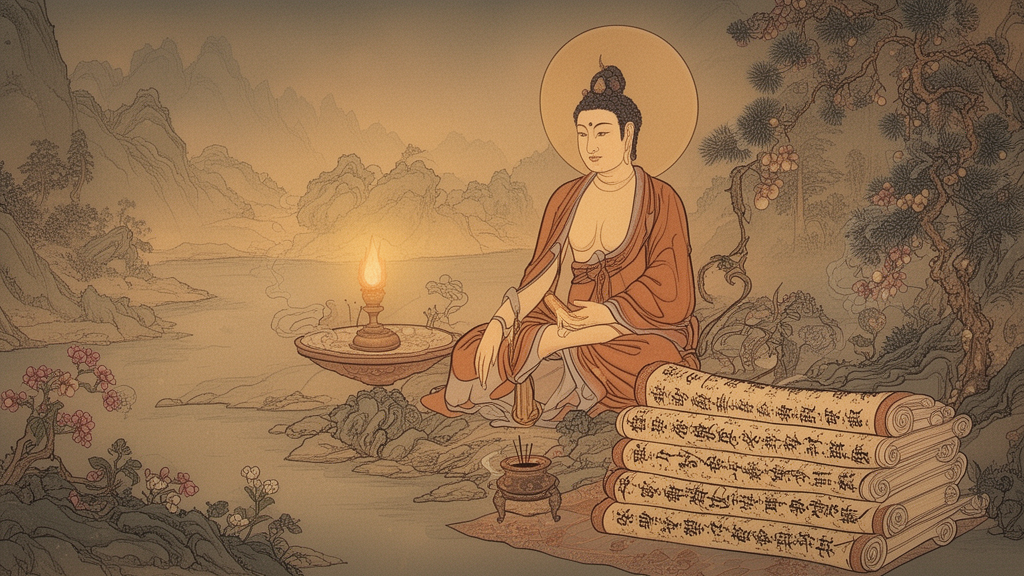
In its broadest sense, a sutra is a discourse presented as the words of the Buddha or of a figure with Buddha-like authority. The Kwan Um School of Zen describes sutras as the source of basic Buddhist teachings. It explains that the Pali Canon holds the Theravada suttas, while the Mahayana Canon, now mostly preserved in Chinese, contains versions of many Pali suttas (called agamas) and thousands of additional sutras. Kwan Um School of Zen: Sutras is a useful practitioner source for this basic framing.
Zen is mainly a Mahayana tradition, so its core sutras come from the Mahayana Canon. Other Buddhist schools, such as Theravada, use different canons and place different weight on texts. The Dhammapada, which is short and in plain verse, is important in Theravada but is not technically a sutra according to the Kwan Um overview. This distinction matters for readers who first meet Zen through general Buddhist books.
In Zen, a sutra is valued in two different ways. It can be studied as doctrine and history, which asks what the text says, when it was composed, and how it was read in different periods. It can also be used as a living liturgical text, recited as an act of respect, gratitude, or dedication. These two uses overlap but are not identical. A scholar may date a text to a particular century, while a temple may chant it every morning for reasons that come from its own tradition.
Why Zen relies on sutras while speaking of “outside scriptures”
The phrase most often attached to Zen is that it is a “special transmission outside scriptures” that “did not stand upon words.” This phrase is part of Zen’s self-description. The Wikipedia-derived overview of Zen scriptures and the meditation-zen.org page both note the phrase, but both also explain that the tradition has a rich doctrinal and textual background. The apparent tension is one of the most useful points for a reader to understand.
Early Chan writers often presented the core of practice as direct awakening rather than dependence on words. At the same time, they quoted sutras, debated their meaning, and used them to justify their teachings. Scripture was not discarded. It was read against the experience of practice, and the practice was read against scripture. For this reason, sutra Zen is best understood as a relationship: scripture is respected as a guide while Zen teachers insist that a text is not the same as awakening.
This also explains why Zen temples often have a wide range of sutras in their liturgy. Some are central doctrinal texts. Others are short devotional or ceremonial chants. The following sections separate these groups so that readers can see what each text does in the tradition.
The Mahayana sutras that shaped Zen
Several Mahayana sutras are repeatedly named as influences on Zen. The meditation-zen.org overview says Zen has been influenced by the Lankavatara Sutra, the Vimalakirti Sutra, the Avatamsaka Sutra, and the Lotus Sutra. The Kwan Um School lists the Prajnaparamita sutras, including the Heart Sutra and the Diamond Sutra, along with the Avatamsaka, Vimalakirti, Lotus, and Lankavatara sutras as basic reference points for the Zen tradition. The Wikipedia overview of Zen scriptures lists a similar set under its “Influential sutras” heading. These are the sutras most readers will meet first.
Heart Sutra
The Heart Sutra, known in Japanese as Hannya Shingyo and in Chinese as a Prajnaparamita text, is the most widely recognized sutra in Zen liturgy. The Zen Deshimaru page describes it as representing “the heart of great wisdom,” and says it was written between the 1st and 6th centuries of the Common Era. That dating is the source’s own statement. Academic dating of Prajnaparamita texts is more cautious, so readers who need a precise date should consult a scholarly edition or introduction rather than treating any single range as settled. For a broader guide to the text and its study, see Heart Sutra Zen (URL to confirm; currently a WordPress draft and may not be public).
The Zen Deshimaru summary explains the central narrative. The bodhisattva Avalokitesvara teaches Sariputra about the emptiness of all beings and all things, because none of them has a fixed or substantial nature. The text presents phenomena as impermanent and dependent on interdependence rather than existing entirely by themselves. In Zen liturgy, the Heart Sutra is among the most frequently chanted texts. The meditation-zen.org page notes that a Heart Sutra chant, the Maka Hannya Haramita Shingyo, is among the most commonly sung texts at Ryumonji and in dojos, according to that site.
Diamond Sutra
The Diamond Sutra is one of the Prajnaparamita texts named by the Kwan Um School as a basic Zen reference point. In the Platform Sutra narrative, as summarized on Grokipedia, the illiterate woodcutter Huineng awakens upon hearing the Diamond Sutra. That story is a traditional account from the Chan lineage narrative. It should be read as tradition, not as a documented biography. The Diamond Sutra’s influence on Zen is well attested in the texts that Zen traditions preserve, but the details of Huineng’s awakening belong to the story told within that tradition.
Lankavatara Sutra
The Lankavatara Sutra (Laṅkāvatāra Sūtra) is listed among the Mahayana texts that influenced Zen. According to the Wikipedia article on the Lankavatara Sutra, the text draws on and explains several Mahayana concepts, including the philosophy of the Yogacara school, the doctrine of emptiness (sunyata), the doctrine of buddha-nature (tathagatagarbha), and the luminous mind (prabhasvaracitta). The Zen scriptures overview lists it among the influential sutras. Readers who want the source should consult the Wikipedia article on the Lankavatara Sutra and then a scholarly translation, since encyclopedia summaries do not replace the text.
Vimalakirti Sutra
The Vimalakirti Sutra is widely cited in Zen as an influence, and the meditation-zen.org overview lists it among the sutras that shaped the tradition. The Wikipedia Zen scriptures article gives it a separate heading among influential sutras. Vimalakirti is a lay figure in the story, which gives the text a particular importance for practitioners who live outside monasteries. Readers should be aware that the sutra’s narrative and its doctrinal ideas are distinct, and that a sutra’s influence on Zen is not the same as proof that a specific Zen teaching came directly from it.
Avatamsaka Sutra
The Avatamsaka Sutra, also known as the Flower Garland Sutra, is named in each of the major Zen reference lists. The Kwan Um School places it among the Mahayana texts that are basic reference points for Zen, and the meditation-zen.org overview includes it among influences. The Wikipedia Zen scriptures article lists it as an influential sutra. Because the Avatamsaka is large and complex, many readers begin with a summary before reading a translation. A related internal guide is available at Avatamsaka Sutra (URL to confirm; currently a WordPress draft and may not be public).
Lotus Sutra
The Lotus Sutra is named among the Mahayana texts that have influenced Zen, according to the Kwan Um School and the meditation-zen.org overview. It is also central to other East Asian Buddhist traditions. For a Zen reader, the important point is that the Lotus Sutra is shared across several schools, so it should not be described as exclusively Zen. Its place in the Zen canon is one of influence and reference rather than of a single Zen-specific authorship.
Chinese texts that became central to Chan and Zen
Zen developed largely in China as Chan, and several Chinese texts became especially important. The Wikipedia Zen scriptures overview lists a set of Chinese texts that includes the Two Entrances and Four Practices, the Surangama Sutra, the Awakening of Faith, the Sutra of Perfect Enlightenment, the Platform Sutra, the Anthology of the Patriarchal Hall, and the Transmission of the Lamp. Some of these are called sutras in their titles even though they were composed in China rather than translated from Indian originals. Readers should keep the category clear: a text can be called a sutra by tradition without being a direct record of the historical Buddha’s words.
The Platform Sutra
The Platform Sutra, formally The Platform Sutra of the Sixth Patriarch, is the best-known Chinese text in this group. According to the Grokipedia summary of the Red Pine edition, the text is traditionally presented as the autobiography, sermons, and dialogues of Huineng (638–713 CE), the Sixth Patriarch of the Chan lineage, recorded by his disciple Fahai after a sermon at Dafan Temple. The same summary says the text is unique among Chinese Buddhist works in being given the status of a sutra. Grokipedia is a secondary, AI-generated and community-edited source, so these details should be checked against a scholarly edition before publication. The traditional account and the historical account should be presented separately.
The Platform Sutra is valued in Zen for its teachings on sudden awakening, buddha-nature in all beings, no-thought, and the non-duality of meditation and wisdom. These are the teachings most often associated with the text in Zen training. The Grokipedia summary also says that modern scholarship dates the earliest extant versions to around the late eighth century and sees much of the attribution and narrative as later construction. That scholarly view should be verified against an academic source, because it changes how the text is read. It does not reduce the text’s devotional and practical importance for many Zen communities.
Transmission of the Lamp and related lineage texts
The Transmission of the Lamp belongs to a different genre. It records lineage and encounter stories rather than presenting a single teacher’s sermons. The Wikipedia Zen scriptures overview lists it among Chinese texts alongside recorded sayings and encounter dialogue, including the Linji yulu, and koan collections. These texts are often grouped as Zen literature rather than sutras in the strict sense. For a reader, the practical difference is that lineage texts describe how Zen teachers were remembered, while sutras claim the authority of Buddhist teaching.
Japanese and Soto texts used in daily practice
In Japan, sutras and Zen literature took many forms. The Wikipedia overview lists Dogen’s Shobogenzo and the Zenshu Shiburoku among Japanese texts. The Zen Deshimaru page, which describes the Soto-influenced liturgy of a Zen association in France, shows how short sutras are used in daily life. The examples below are tradition-specific and should not be taken as the practice of every Zen school.
Short chants in Soto liturgy
The Zen Deshimaru page lists several short texts used in ceremonies. The Takkesa Ge, also called the Kesa Sutra, is chanted as a sign of veneration for the kesa, the robe associated with the Buddha. According to the page, a practitioner may place the robe above the head and chant it silently three times before wearing it. During sesshin, it is chanted by everyone at the end of morning zazen.
The Shigu Seigan Mon presents the bodhisattva ideal through four fundamental vows, the first of which is to save all beings. According to the Zen Deshimaru page, it is chanted every morning and follows the Heart Sutra in ceremonies. The Eko is a dedication to the great masters of the lineage, recited during morning ceremonies. The Fueko is a universal invocation for all beings to awaken to the Way and is recited in the short evening ceremony. The Ji Ho San Shi closes ceremonies as an expression of gratitude to all Buddhas and Patriarchs, often accompanied by three prostrations. The Busho Kapila is chanted during the meal ceremony.
These short texts show a different kind of sutra use. Their meaning is partly in the words and partly in the structure of the day. A reader should not assume that every Zen centre uses the same chants or that the same wording is used everywhere. Lineage, temple, and national practice all shape the liturgy.
Fukanzazengi and the teaching of zazen
The Fukanzazengi is described on the Zen Deshimaru page as a text written by Dogen that presents the essentials of zazen. It is often read as an instruction rather than a sutra in the narrow sense, but it is grouped in Soto collections with sutras. This is a good example of why the category “sutra Zen” is broader than the category “Mahayana sutra.” A reader who wants to study it should look for a standard translation and a commentary from a recognized Soto source.
Hokyo Zanmai
The meditation-zen.org overview lists the Hokyo Zanmai, which it describes as written in the ninth century by the master Tozan Ryokai (807–869), discussing the pure consciousness of zazen. The title is given there as “the precious mirror samadhi.” This is a source-specific statement, and readers who need the historical detail should verify it against an academic study of Tozan and the Caodong lineage before relying on the date.
Scripture, tradition, belief, and scholarship
Sutra Zen is easiest to understand when four layers are separated. The first is the text itself: its words, structure, and translation. The second is tradition: how Zen communities have read, chanted, and transmitted the text. The third is belief: what practitioners hold about the text’s authority, the Buddha’s presence in it, or its power in practice. The fourth is scholarship: what historians and philologists say about authorship, dating, and textual history.
These layers often disagree. A Zen community may describe the Platform Sutra as the record of Huineng’s teaching, while scholars may describe it as a later composition shaped by Southern school debates. Both positions can be stated fairly. A Zen teacher may explain the Heart Sutra’s teaching on emptiness as a guide to practice, while a historian may focus on its role in the development of Prajnaparamita literature. Readers should not treat one layer as proof of another.
Devotional chanting also needs care. Chanting a sutra is a practice of respect, attention, and community for many Zen practitioners. It is not a guarantee of a material result, and no sources here support claims that chanting a particular sutra will produce health, wealth, protection, or any other outcome. The Zen sources describe purpose in terms of awakening, veneration, gratitude, dedication, and ethical vows.
Common misunderstandings about sutra Zen
- “Zen rejects all scripture.” The phrase about a transmission outside scriptures is real, but the tradition preserves and studies a substantial textual base. A better summary is that Zen places direct awakening above textual authority while still using texts as guides.
- “Every sutra is the Buddha’s exact words.” Mahayana sutras were composed and transmitted over centuries, and many Chinese texts carry the title of sutra by tradition or lineage claim. Scholarly editions usually distinguish translation, attribution, and date.
- “All Zen centres chant the same texts.” Liturgy varies by lineage, country, and temple. The Soto chants described above are examples from one tradition and one source, not a universal Zen canon.
- “Sutra Zen is the same as Hindu scripture.” The sutras discussed here are Buddhist. Comparisons with Hindu texts can be useful for historical context or for readers exploring Indian religion, but they should be presented as comparison rather than shared authority.
How to read a Zen sutra with care
A reader who wants to begin should follow a simple sequence. The steps are practical and do not require a specific school of Zen.
- Choose a reliable translation. Check the translator, the edition, and whether the text is attributed to a school. The Kwan Um School notes that translations vary in quality and that commentaries are worth consulting.
- Read a short introduction. Look for the text’s tradition, probable date range, and textual history. Academic introductions are more reliable than general summaries for dates and authorship.
- Read for the main teaching, not one quotation. Many sutras repeat key ideas in different forms. A single line can be misread if taken out of its paragraph and section.
- Compare with a Zen commentary. A commentary from a recognized teacher or lineage shows how the text is understood in practice. Keep commentary separate from the sutra’s own words.
- Test your understanding in practice carefully. If you sit or chant with a community, follow its guidance and ask a teacher about tradition-specific forms. Do not expect a text to produce a guaranteed result.
Readers who want a broader map of Buddhist sutras can also look at the Pali and Mahayana distinction, which affects which texts appear in a given canon. The Agama Sutra page, which is currently a WordPress draft, is one possible starting point for the agama collections discussed in the Kwan Um overview: Agama Sutra (URL to confirm; currently a WordPress draft and may not be public).
Connecting sutra Zen to related HindusGod.com topics
Some Zen sutras connect to themes that appear in Indian religious literature, such as meditation, emptiness, mantra, and the figure of the bodhisattva. The Dhyana Sutra page is a relevant starting point for readers interested in meditation terminology: Dhyana Sutra (URL to confirm; currently a WordPress draft and may not be public). The Dharani Sutra page may help readers understand the role of dharani in Buddhist practice: Dharani Sutra (URL to confirm; currently a WordPress draft and may not be public).
The Avalokiteshvara Sutra page is relevant because Avalokitesvara appears in the Heart Sutra narrative: Avalokiteshvara Sutra (URL to confirm; currently a WordPress draft and may not be public). Readers who want to compare Buddhist devotional figures with Hindu deities should treat each figure within its own tradition. Shared Indian background does not mean shared doctrine.
For a general meaning-focused overview of sutra terminology, the Meaning Sutra page may be useful: Meaning Sutra (URL to confirm; currently a WordPress draft and may not be public). If the owner publishes these target drafts later, the links above will become public; until then, they should be treated as planned internal destinations rather than live pages.
Frequently asked questions
Is the Heart Sutra the most important Zen sutra?
It is among the most widely known and frequently chanted. The Zen Deshimaru page describes it as the most well-known sutra common to all Buddhist lineages in its presentation, and the meditation-zen.org overview says it is among the most commonly sung texts in some Zen temples. “Most important” depends on whether one measures importance by daily use, doctrinal influence, or scholarly attention, so the answer depends on context.
Did Huineng really write the Platform Sutra?
The text presents itself and is traditionally presented as the record of Huineng’s teaching. Modern scholarship, as summarized in a secondary source, dates the earliest extant versions to around the late eighth century and sees much of the narrative as later construction. Readers should consult an academic introduction to the Platform Sutra for the current scholarly position before making claims about authorship.
Do I need to be a Zen practitioner to read these sutras?
No. Many readers approach sutras through translations and commentaries for study. A Zen community may offer guidance on chanting and practice, but reading a text does not require membership. Readers should remember that a sutra’s devotional use is tradition-specific.
Are Zen sutras part of Hindu scripture?
No. They are Buddhist scriptures or Buddhist-related texts. They are relevant to Indian religious history, and some share cultural and linguistic background with Hindu texts, but they belong to the Buddhist canon and should not be presented as Hindu scripture.
Takeaway
Sutra Zen is best understood as the study and use of Buddhist and Zen-related texts within a tradition that values direct awakening while still relying on a rich written heritage. The Heart Sutra, Diamond Sutra, Lankavatara Sutra, Vimalakirti Sutra, Avatamsaka Sutra, and Lotus Sutra shaped Zen’s doctrinal background. The Platform Sutra and other Chinese texts shaped Chan and Zen identity. Short Soto chants show how sutras live in daily ritual. A careful reader will separate what a text says, how a tradition uses it, what believers hold about it, and what scholars have shown about its history.
Sources and further reading
- Zen scriptures, Wikipedia: overview of Zen scripture, influential sutras, Chinese and Japanese Zen literature. Used for the list of influential and Chinese texts. Verify against primary editions for detailed claims.
- Laṅkāvatāra Sūtra, Wikipedia: summary of the Lankavatara Sutra’s Mahayana concepts. Used only for the concepts named in the summary; not inspected in full during this drafting.
- The Platform Sutra: The Zen Teaching of Hui-neng, Grokipedia: secondary summary of the Platform Sutra and Red Pine edition. Flagged as a secondary, unreviewed source; the dates and scholarly claims need verification against an academic introduction before publication.
- Sutras, Kwan Um School of Zen: Americas: practitioner guide to basic Buddhist sutras, Mahayana reference texts, and translation notes.
- Zen Buddhist Texts, Sutras, meditation-zen.org: Soto-oriented list of sutras and translations, including the Maka Hannya Haramita Shingyo and Hokyo Zanmai. Used for the influence statement and the cited descriptions; the page was not fully inspected during this drafting.
- Traditional sutras of Zen Buddhism, Zen Deshimaru: description of Heart Sutra, Takkesa Ge, Shigu Seigan Mon, Eko, Fueko, Ji Ho San Shi, Fukanzazengi, and Busho Kapila in a Soto-influenced liturgy.