Sutras in Mahayana Buddhism are the canonical scriptures that Mahayana communities accept as authentic teaching. Mahayana sutras are a large, varied body of texts, many written in Sanskrit and later preserved in Chinese and Tibetan translations. Mahayana Buddhists regard them as the Buddha’s teaching, while modern scholars generally date them several centuries after the historical Buddha and read them as a development within Buddhist thought. This guide explains what these texts are, how they are classified, which major sutras are most widely known, and why belief and scholarship answer the question of origin differently.
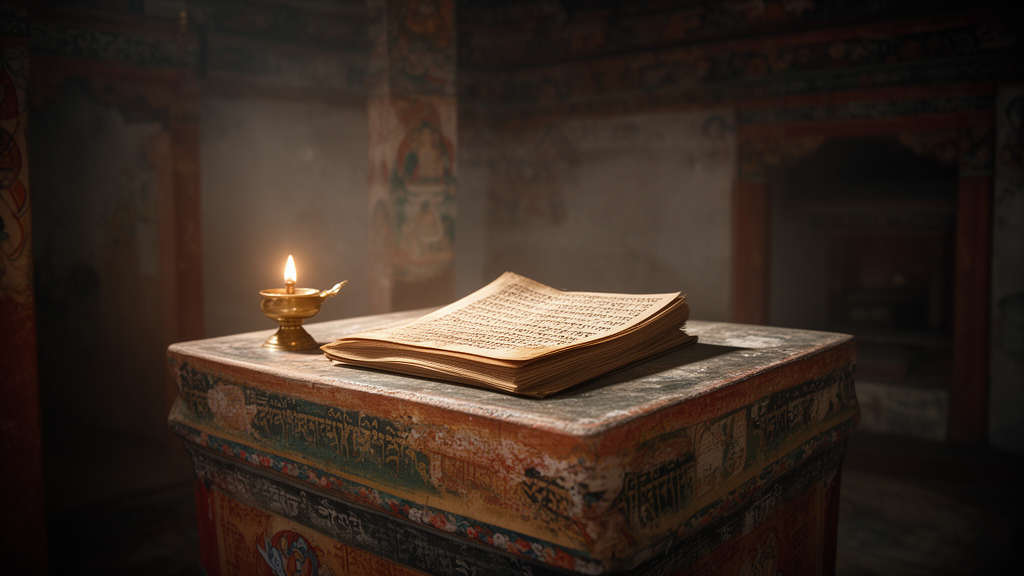
What Mahayana sutras are

The term sutra (Sanskrit sūtra, “thread” or “discourse”) refers to a Buddhist scripture presented as a teaching. In the Mahayana tradition, the sutras are described by the Wikipedia overview of Mahayana sutras as texts accepted as canonical and authentic buddhavacana, meaning the word of the Buddha, in Mahayana sanghas. The same overview notes that several hundred Mahayana sutras survive in Sanskrit, Tibetan, and Chinese translations, and that the texts are largely preserved in Sanskrit manuscripts and in the Tibetan and Chinese Buddhist canons.
Mahayana sutras are not a single book. They are a genre. Readers new to the subject often assume there is one Mahayana scripture, similar to a single holy book in other traditions. In practice, Mahayana scriptures come in many forms: long philosophical treatises, dialogues, narratives about past lives of bodhisattvas, collections of verses, and texts centred on devotional visualization or ritual. The University at Buffalo research guide describes the Mahayana sutras as a broad genre that various Mahayana traditions accept as canonical, and it notes that the teachings contained in them, taken as a whole, form a loose bundle of various and sometimes contradictory ideas.
For a broader orientation to the wider category, the HindusGod.com guide List of Sutras (URL to confirm as live; currently a WordPress draft target) can help readers compare sutra collections across traditions. For a plain-language definition of the word itself, see Sutra Meaning in Buddhism, also a draft target.
How Mahayana sutras are classified
Mahayana tradition does not treat all sutras in the same way. The Wikipedia overview describes three types of sutras that Mahayana texts claim for their authority: those spoken by the Buddha, those spoken through the Buddha’s blessings, and those spoken through mandate. These categories are a traditional way of explaining how a text can be authoritative even when its origin is not tied to a historical teaching session. They should be read as a description of how Mahayana tradition explains authority, not as a historical account of how each text was composed.
A separate classification appears in the Indian scholastic tradition. According to the Wikipedia overview, the Buddhist scholar Asanga classified the Mahayana sutras as part of the Bodhisattva Tripitaka, a collection of texts meant for bodhisattvas. This is useful for readers because it shows that Mahayana texts were often understood as scriptures for a particular spiritual path, the path of the bodhisattva, rather than as a replacement for the older Pali discourses preserved in the Theravada tradition.
The claim of Buddha-speech: belief, oral tradition, and scholarship
Many Mahayana sutras present themselves as the words of the historical Buddha, Shakyamuni, taught to his closest disciples. This presentation is central to how Mahayana communities understand their scriptures. It is important, however, to distinguish three layers of the question.
Devotional belief
For many Mahayana practitioners, the sutras are authentic teaching. Some teachers hold that all teachings that arise from the Buddha’s fundamental insight are his speech, whether or not they are verifiable as the words of the historical figure. The University at Buffalo guide notes that there are scriptural supports for this perspective even within the Pali Canon. This is a belief within the tradition, and it is presented that way here.
Traditional transmission accounts
Mahayana traditions also preserve stories about how the sutras were transmitted. The Buffalo research guide describes an account in which many parts of the texts were written down at the time of the Buddha and stored for five hundred years in the realm of the nagas, serpent-like supernatural beings. According to these accounts, the teachings were revealed later because people at the time of the Buddha were not able to understand them, and suitable recipients had not yet appeared. This is an oral and devotional narrative. It is not historical evidence, and the guide states that the transmission claim rests on oral tradition rather than historical evidence.
Scholarly dating
Modern scholarship approaches the texts through language, manuscripts, translations, and the history of ideas. The Buddhist Resources guide to Mahayana sutras states that modern scholarship generally dates the texts to several centuries after the Buddha’s death and reads them as a new development within Buddhism rather than the Buddha’s own words. The same guide adds that this does not trouble practicing Buddhists, who treat the texts as authentic teachings of the Dharmakaya, the Buddha’s truth-body, rather than as words of the historical figure. Readers can therefore hold both a devotional view and a historical view without treating one as the other’s substitute.
The earliest date usually associated with the emergence of Mahayana sutras is also a matter of interpretation. The Buddhist Resources guide describes the Mahayana sutras as emerging in India from around the 1st century BCE onward. Other scholars and traditions may place their beginnings differently, so the date should be read as a general scholarly estimate rather than a fixed starting point.
Core ideas found in Mahayana sutras
Mahayana sutras share several recurring themes. The Buddhist Resources guide identifies four that are especially characteristic. These themes are useful for interpreting many different texts, though not every sutra emphasizes all of them equally.
The bodhisattva path
Central to the Mahayana sutras is the ideal of the bodhisattva, a being who vows to attain Buddhahood for the benefit of all beings. The University at Buffalo guide describes this ideal as central, though not unique, to the sutras. The Buddhist Resources guide contrasts this with the early Buddhist suttas preserved in the Pali Canon, which emphasize the path of the arhat, or personal liberation. The contrast is a common way scholars describe the change in emphasis, though Theravada and other traditions may describe their own goals differently.
Emptiness
The sutras develop the teaching of sunyata, usually translated as emptiness. The Buddhist Resources guide explains that emptiness means that phenomena lack inherent, fixed, independent existence. The Prajnaparamita literature, a family of texts centred on perfect wisdom, introduced this teaching in a sustained way. The BuddhaNet guide to Mahayana sutras states that the Diamond Sutra, one of the two most famous texts in the Prajnaparamita group, sets forth the doctrines of emptiness and wisdom, or prajna. Readers should note that these terms are doctrinal concepts, and Buddhist schools explain them in different ways.
Skillful means
The Buddhist Resources guide describes upaya, or skillful means, as the idea that the Buddha uses whatever methods are needed to help beings awaken, including teachings that may appear to contradict one another. This theme helps explain why the sutra literature includes so many different styles and levels of teaching. It is a doctrinal interpretation found in these texts and in later commentary, and it should not be treated as a neutral historical description.
Many Buddhas
Many Mahayana sutras describe a universe containing many transcendent Buddhas, of whom the historical Buddha is only one. The Buddhist Resources guide highlights Amitabha, the Buddha of infinite light, as one of the most important. Pure Land traditions build especially on this theme, as discussed below.
Major Mahayana sutras and what they teach
The Wikipedia overview lists many key Mahayana sutras grouped by type, including Prajnaparamita sutras, the White Lotus Sutra, Buddhafield sutras, Samadhi sutras, the Avatamsaka Sutra, the Vimalakirti Nirdesa, Buddha-nature sutras, and many others. The following summaries focus on a small selection. Each description is limited to what the cited sources state. For a more complete overview, readers can consult the Mahayana Sutras guide (URL to confirm as live; currently a WordPress draft target).
The Prajnaparamita sutras and the Heart and Diamond Sutras
The Prajnaparamita group is one of the most influential bodies of Mahayana literature. The Buddhist Resources guide names the Heart Sutra, the Diamond Sutra, and the Lotus Sutra among the most influential Mahayana texts. The BuddhaNet guide describes the Diamond Sutra as one of the two most famous scriptures in the Prajnaparamita group, the other being the Heart Sutra, and it says the Diamond Sutra sets forth the doctrines of emptiness and wisdom. The Heart Sutra is widely recited in East Asian and other communities, but the sources reviewed here do not provide detail on its recitation practices, so those details should be checked against specific tradition sources.
Readers who want a more focused introduction to the Heart Sutra can compare it with the Mahayana Sutras in English page (URL to confirm as live; currently a WordPress draft target), which is intended to help English-speaking readers find accessible editions and background.
The Lotus Sutra
The Lotus Sutra is among the best-known Mahayana texts. The Buddhist Resources guide lists it among the most influential Mahayana sutras, and the Wikipedia overview includes a category of White Lotus Sutra material in its survey of key texts. The Lotus Sutra is also a prominent subject in the HindusGod.com draft Lotus Sutra Mahayana Buddhism (URL to confirm as live; currently a WordPress draft target). Because the sources here do not provide a verified summary of its chapters, this guide does not describe its teachings in detail. Readers should consult a named translation and its introduction.
The Avatamsaka Sutra
The Avatamsaka, or Flower Garland, Sutra is described by the BuddhaNet guide as the second longest sutra in the Mahayana canon, with forty chapters. The same guide states that it records the higher teaching of the Buddha to bodhisattvas and other high spiritual beings, and that it contains large, independent sutras, including the Gandavyuha Sutra, the Dashabhumika Sutra, and the Amitayurdhyana Sutra. The Wikipedia overview also lists the Buddhavatamsaka Sutra among the key texts. Chapter counts can differ among editions and translations, so readers should check the edition they use.
Amitabha and Pure Land sutras
The Shorter Amitabha Sutra, also called the Smaller Sukhavativyuha Sutra, is described by the BuddhaNet guide as one of the three sutras that form the doctrinal basis of the Pure Land school. The guide says the other two are the Meditation Sutra and the Longer Amitabha Sutra. The Shorter Amitabha Sutra describes the blessings and virtues of Amitabha Buddha and his Pure Land, and it discusses rebirth. In Pure Land communities, these texts are central to devotion. The concept of rebirth in a Pure Land is a belief within those traditions, and it is not a claim that scholars can test historically.
The Brahmajala Sutra
The Brahmajala, or Brahma Net, Sutra is described by the BuddhaNet guide as containing the Ten Major Precepts of Mahayana followers and the Bodhisattva Precepts. This is a useful example of a sutra that serves an ethical and monastic function rather than primarily a philosophical one. Readers interested in precepts should compare the text with teachings from their own tradition and with a named academic or monastic translation.
Collections, commentaries, and canons
Many Mahayana sutras survive within larger collections. The Wikipedia overview refers to several collections, including the earliest group of Mahayana sutras translated into Chinese, the translations associated with Kumarajiva, the Sutrasamuccaya, the Madhyamaka school’s use of sutras, and the sutra material found in the Chinese and Tibetan canons. The overview also mentions Newar Buddhism as a context in which Mahayana sutra collections are preserved.
A sutra commentary is a different category from a sutra. Commentaries explain, organize, and argue for interpretations of scripture. The Wikipedia overview includes a separate section on Mahayana sutra commentaries, and readers should keep this distinction clear. When a teaching is attributed to a sutra, it is important to ask whether the statement comes from the scripture itself, from a later commentator, or from a modern author summarizing the tradition.
Translations, versions, and manuscripts
The Wikipedia overview states that Mahayana sutras are largely preserved in Sanskrit manuscripts and in translations such as the Tibetan and Chinese canons. This means that a single sutra may exist in several languages, and the versions may differ in length, organization, and wording. The Wikipedia article on the Mahayana Mahaparinirvana Sutra, which was not inspected for this draft, gives one example: the Nirvana sutra was translated into Chinese several times, with a 416 CE six-fascicle text and a 421 CE translation by Dharmaksema that is about four times longer than the earlier one. Because this detail is from a source that was not inspected, it should be verified before publication.
Translation is not a neutral act. Translators make choices about technical terms such as sunyata, prajna, and bodhisattva, and they may explain those choices in introductions or notes. Readers should look for editions that identify the translator, the source language, and the textual basis. Where a translation is copyrighted, readers should use legally accessible editions and avoid relying on unauthorized copies.
Why counts of Mahayana sutras differ
Sources do not always agree on how many Mahayana sutras survive. The Wikipedia overview states that several hundred Mahayana sutras survive in Sanskrit, Tibetan, and Chinese translations. The University at Buffalo guide states that around one hundred Mahayana sutras survive either in extant Sanskrit manuscripts or in Chinese and Tibetan translations. These figures can both be discussed, but they should not be combined into one claim. The difference may reflect how the texts are counted, which translations are included, and which collections are considered. Readers should treat any specific number as a source-dependent estimate.
Using Mahayana sutras today
Mahayana sutras are studied in universities and monasteries, recited in temples, copied in many languages, and discussed in Buddhist teaching. Their use varies by school, country, language community, and individual practitioner. A Pure Land devotee, a Zen student, a Tibetan monastic, and a university student reading the Diamond Sutra in translation may each approach the text differently. None of these approaches is the only valid one.
Readers from Hindu backgrounds may find it helpful to compare the Mahayana sutra tradition with other scriptural traditions while keeping each tradition on its own terms. For example, comparisons with Hinduism and Buddhism (URL to confirm as live; currently a WordPress draft target) can explain shared historical contexts, but they should avoid implying that the two traditions treat scripture in identical ways. Scholars and practitioners in both traditions have written about relations between them, and that scholarship should be consulted directly.
A practical reading guide for beginners
Readers who want to begin with Mahayana sutras can use the following ordered approach. It does not replace guidance from a teacher or tradition.
-
Choose a named edition. Select a translation that identifies the translator, the source language, and the textual basis, such as a published academic or tradition-based edition.
-
Read the introduction first. Introductions often explain the text’s context, school, and interpretive history. This helps separate what the sutra says from what later commentators say.
-
Note the sutra’s type. Ask whether the text is a philosophical treatise, narrative, ritual text, ethical code, or devotional scripture. Its type shapes how it should be read.
-
Read for the central themes. Look for bodhisattva ideals, emptiness, skillful means, and references to many Buddhas, while accepting that not every text emphasizes them equally.
-
Compare with commentary. Once you have read the sutra, consult a commentary by a named author and mark which ideas belong to the scripture and which belong to the commentary.
-
Record your sources. When you cite a sutra, note the translation, chapter or section as given in that edition, and the page or online source you used.
Frequently asked questions
Are Mahayana sutras the same as the Pali suttas?
No. The Pali suttas are preserved in the Pali Canon of the Theravada tradition. The Buddhist Resources guide contrasts the early suttas, which emphasize the arhat path, with the Mahayana sutras, which emphasize the bodhisattva path. The Buffalo guide also notes that the Mahayana sutras are a separate genre of scripture accepted by Mahayana traditions.
Did the historical Buddha teach the Mahayana sutras?
Mahayana tradition holds that the sutras are authentic teaching of the Buddha, but modern scholarship generally dates the texts several centuries after the Buddha’s death. Both views can be described, but they answer different questions. One is a belief within the tradition, and the other is a historical interpretation.
Which Mahayana sutra should a beginner read first?
There is no single required starting point. Many readers begin with a short text such as the Heart Sutra or the Diamond Sutra because they are widely cited and are described by the sources reviewed here as influential Prajnaparamita texts. Choose a reliable translation with an introduction.
Summary
Sutras in Mahayana Buddhism are a broad genre of scripture accepted by Mahayana communities as authentic teaching. They include well-known texts such as the Diamond Sutra, the Lotus Sutra, the Avatamsaka Sutra, and Pure Land sutras, and they are preserved in Sanskrit, Tibetan, and Chinese sources. Mahayana traditions present the sutras as the Buddha’s speech, while modern scholarship generally dates them to several centuries after the historical Buddha and reads them as a development within Buddhist thought. Readers gain the most by distinguishing devotional belief, traditional transmission, textual evidence, and academic interpretation, and by consulting named editions and reliable commentary.
Sources and further reading
- Mahayana sutras, Wikipedia: overview of classification, key sutras, canons, and commentaries. Used for the three types of sutra, Asanga’s classification, manuscript and translation survival, and the list of key sutra groups.
- Buddhist Scriptures: Guide to Mahayana Sutras, BuddhaNet: summaries of the Amitabha, Avatamsaka, Brahmajala, and Diamond Sutras.
- Mahayana Sutras, Buddhist Resources: introduction to the bodhisattva path, emptiness, skillful means, many Buddhas, and dating.
- Mahayana: Primary Texts, University at Buffalo Research Guides: academic guide covering the Mahayana sutra genre, oral-tradition claims, the naga transmission account, and textual diversity.
- Mahayana Mahaparinirvana Sutra, Wikipedia: cited for Chinese translation dates. This page was not inspected for this draft; verify before publication.
- A List of Major Mahayana Sutras, Learn Religions: further reading only. This page was not inspected for this draft, so no claims are drawn from it.