Sarah Macdonald is the Australian journalist, author, and former radio presenter who wrote Holy Cow! An Indian Adventure, a memoir first published in 2002. The book follows her move from Australia to New Delhi, her serious illness there, and her wider search for meaning through encounters with Hinduism, Islam, Jainism, Sikhism, Christianity, and other traditions. This guide explains who Macdonald is, what the book covers, how readers have responded to it, and how it relates to the Hindu topics covered on HindusGod.com.

Direct answer: what is Holy Cow! An Indian Adventure?
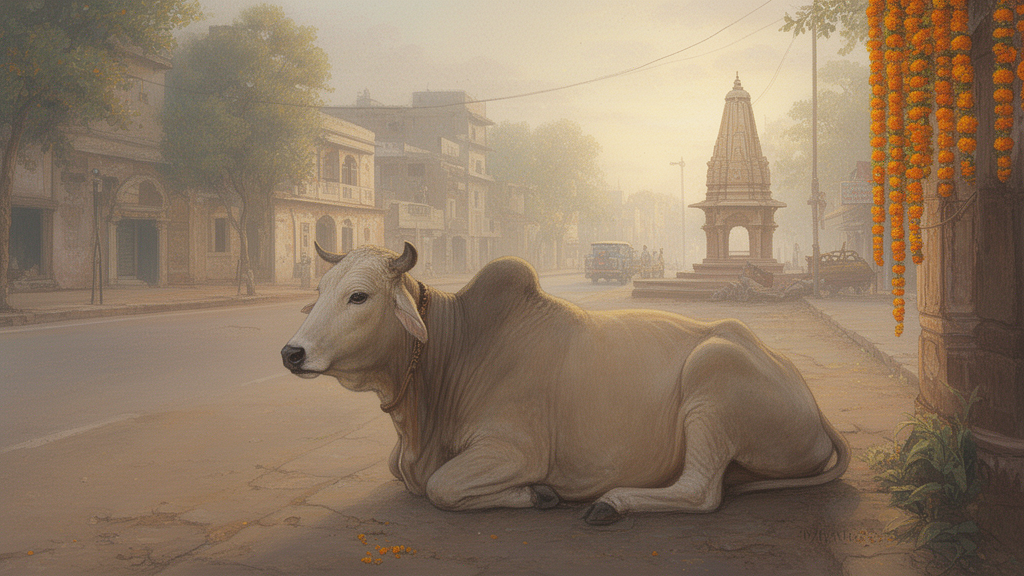
Holy Cow! An Indian Adventure is a travel memoir by Sarah Macdonald. According to Wikipedia, the book was her first, was published in 2002, and became a best-seller, with sales reported at 75,000 copies. Goodreads describes it as a memoir with travel, religion, and biography themes, and Penguin Random House lists it as a nonfiction title. It is a personal account, not a scriptural study or a textbook on Hindu belief. Its value for readers interested in Hinduism lies in its firsthand perspective on one outsider’s encounters with many religious settings in India.
The phrase “holy cow” is also a common English exclamation of surprise. The title uses that idiom, so readers should not treat it as a claim about any single religious teaching. The research gathered for this article did not include a dedicated study of cow veneration in Hindu scripture, so this article does not make claims about that subject.
Who is Sarah Macdonald?
Sarah Macdonald was born in 1966 at Crown Street Women’s Hospital in Sydney, according to Wikipedia. Wikipedia reports that she studied psychology at university and then travelled extensively before starting her media career. Goodreads describes her as an Australian journalist, author, and radio presenter. Readers searching for her name may also encounter a different person with the same name, so it helps to check that the author is the Australian journalist who wrote Holy Cow!.
Early career and radio work
Wikipedia states that Macdonald completed a cadetship at ABC NewsRadio and then worked as Triple J’s political correspondent in Canberra. She later hosted Triple J’s morning show. Her broadcast career also included television programmes such as Recovery, which aired from 1996 to 2000, Race Around the World from 1997 to 1998, and Two Shot, according to the same source.
Before the book, Macdonald left Triple J in 2000 to live in New Delhi with her husband, ABC foreign correspondent Jonathan Harley. Wikipedia reports that she wrote her first book during that period. The article also says she later took over from Julie McCrossin as breakfast presenter on ABC Radio Sydney for a few months in late 2005.
Later work
Wikipedia lists several later projects, including a podcast called The Full Catastrophe, which she co-presented with author Rebecca Huntley from August 2016 to December 2018. The article also reports that, as of May 2022, she was presenting Evenings on ABC Radio Sydney. Because Wikipedia notes that its page needs updating about her later ABC work, readers should check the current ABC schedule before assuming any position is current.
The story of Holy Cow! An Indian Adventure
The memoir’s central frame is a personal reversal. Goodreads summarises the premise: in her twenties, Macdonald backpacked through India and left with a strong impression of heat, pollution, and poverty. An airport beggar read her palm and told her she would return to India, and for love. She rejected the prediction. Eleven years later, the prediction proved accurate when her partner was posted to India and she moved to New Delhi.
The palm reading and the return
The palm reading works as the book’s opening hook. It gives the narrative a clear question: will a place she rejected become part of her life? Goodreads and the Penguin Random House listing both present the book as a story of moving from resistance to a more open relationship with India. The palm reading is a memorable device, but the book presents it as one person’s recollection, not as a verified prophecy or a religious claim.
The move to New Delhi also changes her professional life. Goodreads says she quit her dream job to move to the most polluted city on earth. That phrase reflects the book’s description of the city, and readers should treat it as the author’s framing rather than an environmental measurement.
Illness and inner questions
Shortly after settling in Delhi, Goodreads reports, Macdonald fell seriously ill with double pneumonia. The illness leads her to question her mortality and what she calls her inner spiritual emptiness. The book’s description says she concludes that peace must be found within. This is the emotional turning point. The memoir shifts from a travel account to a search for personal meaning.
For readers, this section shows how memoir differs from religious instruction. It records a person’s fears, questions, and changing views. It does not provide a doctrinal explanation of illness, healing, or karma, and it should not be used as a medical or spiritual guide.
Encounters with many traditions
Goodreads describes the book as covering encounters with Hinduism, Islam, Jainism, Sufis, Sikhs, Parsis, and Christians, as well as yogis, swamis, and Bollywood figures. The Amazon listing and the Penguin Random House page also present the book as a travel and religion memoir. For HindusGod.com readers, the Hindu sections are useful as an outsider’s impressions. They are not a substitute for reading primary texts or community-based sources.
When reading any memoir about a religious setting, separate three things: the author’s experience, the practices she observed, and the traditions those practices belong to. A visit to an ashram, a conversation with a guru, or a retreat may reflect one place or one teacher, not all Hindu practice. Regional, family, and sampradaya differences are substantial, so a single encounter should not be read as a complete account.
Why the title can be read in different ways
The title uses a familiar exclamation. In English, “holy cow” often signals surprise, and the book’s subtitle, An Indian Adventure, places the reader in a travel story. The title may attract readers interested in cows and Hindu tradition, but the book’s structure is mainly autobiographical. Readers looking for a study of cow reverence in scripture, history, or village life will need other sources.
This distinction matters for search and for accuracy. A reader who wants a memoir review should look for the book’s author, publication details, and reception. A reader who wants Hindu teachings about the cow should look for scripture-based and scholarly work, and should expect regional variation in how cows are regarded and treated.
How readers have responded
Goodreads shows a wide range of reader opinions. As captured on the page, the book had an average rating of 3.54 from 18,363 ratings, with about 52 percent of ratings at four or five stars and about 14 percent at one or two stars. These figures reflect Goodreads users at the time the page was inspected, and they will change over time.
One reader review on Goodreads criticised the memoir’s tone and portrayal of India, describing the author’s view as selfish and sceptical of religion. Other reviews on the same page, which are not reproduced here, may praise its humour and honesty. A balanced reading is to see the book as a personal account that some readers find engaging and others find frustrating. Its critics and admirers both respond to the author’s voice, not to a scholarly claim about Hinduism.
How to read Holy Cow! alongside Hindu sources on HindusGod.com
Readers who finish the memoir often want to know more about the traditions the author encountered. HindusGod.com has several related drafts that may be useful once the owner publishes them. Their links are included below, but the URLs are WordPress draft links and may not be public until the owner publishes those posts.
- For a direct page about the book itself, see the Holy Cow Book draft.
- For a page with a closer title match to the memoir, see the Holy Cow an Indian Adventure draft.
- For a separate discussion of cow-related myths, see the Myth of the Holy Cow draft.
- For a Hindi-language treatment of the same theme, see The Myth of Holy Cow in Hindi draft.
- For another collection with a cow-themed Indian title, see the The Holy Cow and Other Indian Stories draft.
- For a different cow-centred memoir title that readers sometimes confuse with this subject, see the Holy Cancer How a Cow Saved My Life draft.
- For a scripture-focused page on a related search term, see the Holy Gita draft and the Holy Geeta draft.
- For general pages on the concept of a holy book, see the Holy Book draft and the Holy Book Meaning draft.
These links are internal drafts, so they should be checked before publication. The titles are paraphrased from the verified target list, and the anchor text describes each destination. Any future page on Hindu cow traditions, verified by scripture and scholarship, should be created as a separate article rather than inferred from this memoir.
A practical reading guide
Readers who want to get the most from the memoir can use a simple method. The steps below separate what the author reports from what she is describing.
- Start with the publication details and author background, using the Wikipedia biography and a publisher listing to confirm the edition you have.
- Read the palm-reading opening and the New Delhi chapters with attention to the author’s personal motives and emotions.
- Note each religious setting the author visits, and ask which tradition, teacher, or place it belongs to.
- When a Hindu practice or term appears, check it against a primary text, a scholarly source, or a community-based explanation before accepting it as general Hindu teaching.
- Compare the book with reader reviews, but treat them as opinions rather than factual verification.
Frequently asked questions
Is Sarah Macdonald the author of Holy Cow!?
Yes. Wikipedia and Goodreads identify the author of Holy Cow! An Indian Adventure as Sarah Macdonald, an Australian journalist, author, and radio presenter born in 1966. Readers searching for other people with the same name should confirm the author details on the book listing.
Is Holy Cow! a religious text?
No. It is a memoir. It describes the author’s experiences and encounters with religious people and places. It is not a scripture, a commentary, or a scholarly account of Hinduism.
What religions does the book discuss?
Goodreads says the memoir describes encounters with Hinduism, Islam, Jainism, Sufis, Sikhs, Parsis, and Christians, along with yogis, swamis, and other figures. The depth and accuracy of each encounter should be judged by the reader, and no single chapter should be treated as representative of an entire tradition.
Is the book about the cow in Hinduism?
The title uses the idiom “holy cow,” and the book includes Indian settings. The research for this article did not verify a specific account of cow veneration in scripture or practice, so readers should look for separate sources on that topic.
Final thoughts
Sarah Macdonald’s Holy Cow! An Indian Adventure is a memoir of an Australian writer’s return to India, her illness in New Delhi, and her search for inner peace. Its strengths are the personal narrative and the view of many religious encounters. Its limits are equally clear: it is one author’s account, not a complete guide to Hinduism or to the cow in Indian life. Read it as a personal story, check its religious observations against reliable sources, and use HindusGod.com’s related pages once they are published for further study.
Sources and further reading
- Sarah Macdonald (journalist), Wikipedia — used for her birth year, early career, ABC and Triple J work, move to New Delhi, and the book’s publication year and sales figure.
- Holy Cow: An Indian Adventure, Goodreads — used for the book’s premise, page count, first publication date, genre labels, and reader rating distribution at the time of inspection.
- Holy Cow by Sarah Macdonald, Penguin Random House — used for the publisher listing and nonfiction categorisation of the book.
- Holy Cow: An Indian Adventure, Amazon — used only to confirm the ISBN and listing for the paperback edition.