Palm Sunday is a Christian observance, and “Desiring God” is the name of a Christian ministry founded by John Piper. Searches for palm sunday desiring god usually lead to Desiring God’s Palm Sunday articles and sermons, which reflect on the Gospel of Luke’s account of Jesus entering Jerusalem. This post explains what those resources say, what the Gospel account reports, and how the observance fits within Christianity. It also offers context for Hindu readers who encounter the topic, without presenting Christian belief as Hindu teaching.
Direct answer: what Palm Sunday commemorates
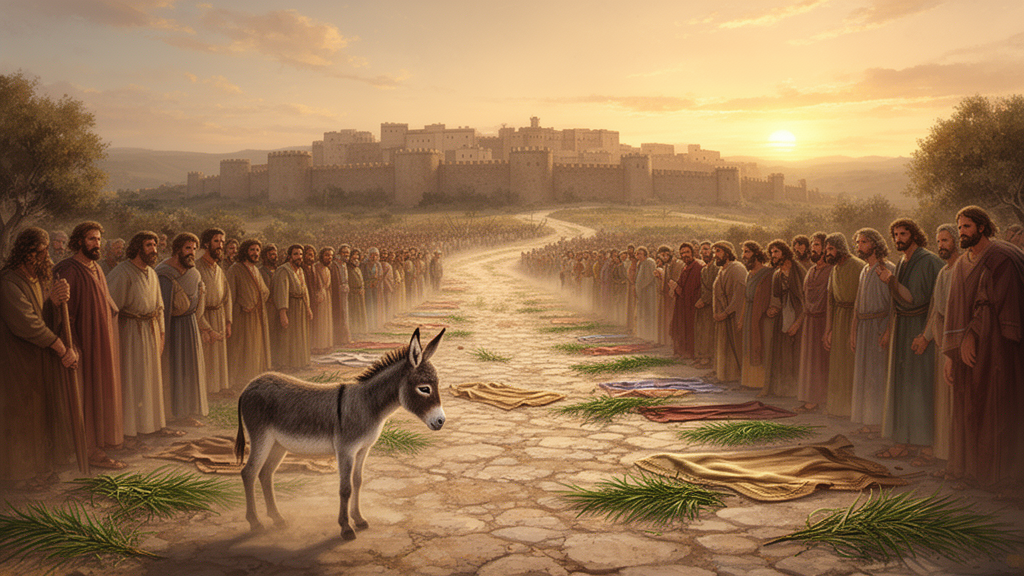
Palm Sunday marks the day Jesus entered Jerusalem, as described in the Gospels, and is observed by many Christian churches as the first day of Holy Week. In Luke 19:28–44, the crowd rejoices, lays cloaks on the road, and shouts a blessing on the king who comes in the name of the Lord. Desiring God’s treatments of this passage focus on what the crowd was saying and expecting, not only on the palm branches. This is a Christian reading of a Christian text. Other traditions, including Hinduism, do not share its scriptures, feasts, or theology.
The Gospel passage behind the observance
Jesus sends for a colt
Desiring God’s sermon page for Luke 19:28–44 reproduces the passage. Jesus sends two disciples to a village ahead of them, where they will find a colt that no one has ridden. If anyone asks why they are untying it, they are to say, “The Lord has need of it.” The colt is brought to Jesus, the disciples throw their cloaks on it, and he rides on it. Some readers see here a deliberate fulfillment of prophecy, a point that commentators discuss, but the Luke text itself does not name a specific prophecy in these verses.
Cloaks and palm branches on the road
As Jesus rides along, people spread their cloaks on the road. The palm branches are mentioned in the Gospel traditions and are central to the name of the day. Jonathan Parnell, writing for Desiring God in 2014, describes how fresh green palm branches and worn clothing formed a path of welcome for Jesus as he moved toward the city.
The branches were not the central problem in that account. Parnell argues that the crowd’s words mattered more than the gesture itself. Readers who want the object-level details should compare Luke’s wording directly in a Bible translation, since summaries vary in emphasis.
What the crowd said and why it mattered
Luke reports that the whole multitude of disciples began to rejoice and praise God with a loud voice for the mighty works they had seen. Their words, as printed on the Desiring God page, were: “Blessed is the King who comes in the name of the Lord! Peace in heaven and glory in the highest!” (Luke 19:38, English text as printed by Desiring God).
Some Pharisees in the crowd asked Jesus to rebuke his disciples. He replied that if they were silent, the stones would cry out (Luke 19:39–40). Desiring God’s article explains the Pharisees’ concern as a worry that Jesus was receiving a welcome reserved for Israel’s Messiah. Parnell and the Christian Post summary of his essay both present Jesus as accepting that welcome rather than stopping it.
The gap between expectation and outcome
Parnell’s article argues that the crowd wanted salvation of a political and military kind: a Messiah who would march into the city and expel Rome. The Christian Post summary of the essay describes that expectation and contrasts it with what followed by Friday, when the same crowd called for crucifixion. Whether readers accept that reading depends on their theology, but the article is a clear example of how Christian preachers use the gap between hope and outcome as a teaching point.
Jesus weeps over Jerusalem
Luke places a second scene inside the same passage. As Jesus draws near and sees the city, he weeps over it, saying that the city would have known “on this day” the things that make for peace, but that those things are now hidden from its eyes (Luke 19:41–42). The Desiring God page reproduces this text. The passage continues with a warning about coming days, which Christian commentators typically connect with the later destruction of Jerusalem. That connection is an interpretation shared widely among Christian scholars, not a fact that every reader must accept.
For many Christians, this moment balances the joy of the procession with grief. Preachers use it to show that the same event contains both celebration and sorrow.
What Desiring God publishes on Palm Sunday
The ministry behind the resources
Desiring God describes itself through its author profile as a ministry founded and taught by John Piper, who also served as pastor of Bethlehem Baptist Church in Minneapolis, Minnesota, for 33 years. The organization publishes articles, messages, books, podcasts, and devotionals, and its resources are oriented toward what it calls everlasting joy in Jesus Christ. Those are its own statements of purpose; readers should judge its theology by reading its materials directly.
The Palm Sunday materials
- Palm Sunday: Tears of Sovereign Mercy, a Palm Sunday message by John Piper dated April 13, 2003, based on Luke 19:28–44. The page offers an audio download.
- The Problem of Palm Sunday, an article by Jonathan Parnell dated April 13, 2014. It is the first piece in a Holy Week series on the final days of Jesus, inspired by a book by Justin Taylor and Andreas Köstenberger.
These two items are the Desiring God resources verified for this post. Other Palm Sunday commentaries exist from different Christian traditions, and readers comparing views should consult several.
How Christians observe Palm Sunday
Practices vary widely among churches. Some traditions hold processions with palm or other branches, read the Luke or Matthew passage aloud, or begin Holy Week services. Others observe the day with a sermon and a shorter liturgy. Because Christian denominations differ in liturgy, calendar, and language, a church’s own practice is the best guide for a particular congregation. This post does not describe a single official rite.
Dates change each year
Palm Sunday falls on the Sunday before Easter, so its date changes from year to year and depends on the calendar used by each church. Readers should check a current church calendar for the year in question rather than relying on an older date.
Context for Hindu readers
HindusGod.com focuses on Hinduism: its deities, scriptures, festivals, and devotional practices. Palm Sunday belongs to Christianity. It does not appear in the Vedas, the Bhagavad Gita, or the Puranas, and it is not a Hindu festival. Readers who encounter Palm Sunday in a Hindu context may be exploring interfaith questions, comparative religion, or a relative’s tradition.
Abrahamic faiths and shared vocabulary
Christianity is one of the Abrahamic religions, together with Judaism and Islam. Those traditions share some vocabulary and some historical roots but differ in scripture, theology, and practice. Hindu traditions are not Abrahamic and have their own sacred literature and understanding of the divine. For a general comparison of the idea of God across these traditions, see Abrahamic God (WordPress target draft; public status unconfirmed).
Terms such as “God,” “Lord,” and “savior” can carry different meanings across traditions. In Christian usage, “Messiah” and “Savior” refer to Jesus in specific theological ways. Hindu usage of similar words refers to different deities and concepts. Readers should not assume that a shared English word has the same content in both traditions.
Where a general belief overview fits
For a broader introduction to how belief in God is understood in different settings, see Belief in God (WordPress target draft; public status unconfirmed). Readers who want a deeper treatment of Christian doctrines connected with the Holy Spirit can consult Holy Spirit Desiring God (WordPress target draft; public status unconfirmed), which discusses a related Desiring God topic.
Distinguishing scripture, tradition, and interpretation
Understanding this topic requires separating four kinds of statements:
- Scripture: what the Gospel of Luke records, such as the crowd’s words in Luke 19:38 and Jesus’ weeping over Jerusalem in Luke 19:41–42.
- Tradition: the Christian practice of observing Palm Sunday as the first day of Holy Week, which many churches follow in different ways.
- Interpretation: Desiring God’s reading that the crowd’s expectations explain the problem Parnell identifies, and Piper’s reading of the Luke passage as a message on mercy.
- Scholarship: historical and literary discussion of Jerusalem in the first century and of how Luke frames the event. This post has not verified specific academic sources on those questions, so it makes no claims about them.
Desiring God resources are devotional and pastoral. They are useful for understanding one Christian reading of the text, but they are not neutral historical reports and should not be treated as the only Christian view.
Practical examples of how the text is read
Example one: the crowd’s praise
A reader can compare the Luke 19:38 wording in several translations. The phrase “the King who comes in the name of the Lord” echoes earlier language in the Psalms, which Christian readers often connect with the event. Checking the Psalm reference directly in a Bible edition is a good way to verify that link before using it.
Example two: the stones that would cry out
Jesus’ reply in Luke 19:40 is often read as an assertion that the coming of the king will be proclaimed even if people are silent. Parnell’s article and the Christian Post summary both emphasize this point. A devotional reading can focus on the value of praise; a historical reading can ask how Luke’s first readers understood the image. Both approaches are legitimate, but they answer different questions.
Example three: from procession to Friday
Parnell’s article uses the Palm Sunday crowd to ask whether readers would have stayed faithful once the expectations failed. The Christian Post summary quotes his description of how the crowd’s shouts later turned to a call for crucifixion. This is presented as a pastoral warning, and readers can weigh it as a Christian application rather than an historical claim about every person in the crowd.
Frequently asked questions
Is Palm Sunday a Hindu festival?
No. Palm Sunday is a Christian observance connected with the Gospel accounts of Jesus entering Jerusalem. It is not part of Hindu scripture or festival calendars. Hindu festivals are discussed separately on HindusGod.com, and readers should consult festival guides for those dates and traditions.
What is Desiring God?
Desiring God is a Christian ministry founded by John Piper. Its website publishes articles, sermons, books, podcasts, and devotionals. Its materials reflect a specific Christian theological perspective, and readers may wish to compare them with other traditions.
Where should I start reading about Palm Sunday?
Start with Luke 19:28–44 in a Bible translation of your choice. Then read the two Desiring God pieces cited in this post, and compare them with a commentary or sermon from a tradition you want to understand more fully.
Summary
Palm Sunday commemorates Jesus’ entry into Jerusalem as recorded in Luke 19:28–44. Desiring God’s resources on the passage emphasize the crowd’s praise, the Pharisees’ objection, Jesus’ reply about the stones, and his grief over the city. Those are Christian readings, and this post has tried to separate scripture from tradition, interpretation, and scholarship. For Hindu readers, Palm Sunday is an example of a different religious tradition, and it is best approached with attention to its own sources and terms.
Sources and further reading
- Desiring God, Palm Sunday Tears of Sovereign Mercy (message by John Piper, April 13, 2003, on Luke 19:28–44): desiringgod.org/messages/palm-sunday-tears-of-sovereign-mercy
- Desiring God, The Problem of Palm Sunday (article by Jonathan Parnell, April 13, 2014): desiringgod.org/articles/the-problem-of-palm-sunday
- Anugrah Kumar, “What’s The Problem of Palm Sunday? DesiringGod Writer Explains,” The Christian Post, April 13, 2014: christianpost.com