This article explains the “myth of holy cow” debate in plain language. The question usually asked is whether the cow was always sacred in India, and whether ancient Indian texts describe cow-eating. The short answer is that the phrase comes mainly from historian D. N. Jha’s book The Myth of the Holy Cow (2001), which argues that cattle, including cows, were not treated as inviolable in ancient India as they later came to be, and that some Vedic and post-Vedic texts describe the eating of beef. Many Hindus today regard the cow as sacred, and that devotional view is a religious and cultural reality. The historical question of when and how that sanctity developed is a separate matter, and scholars continue to debate it.
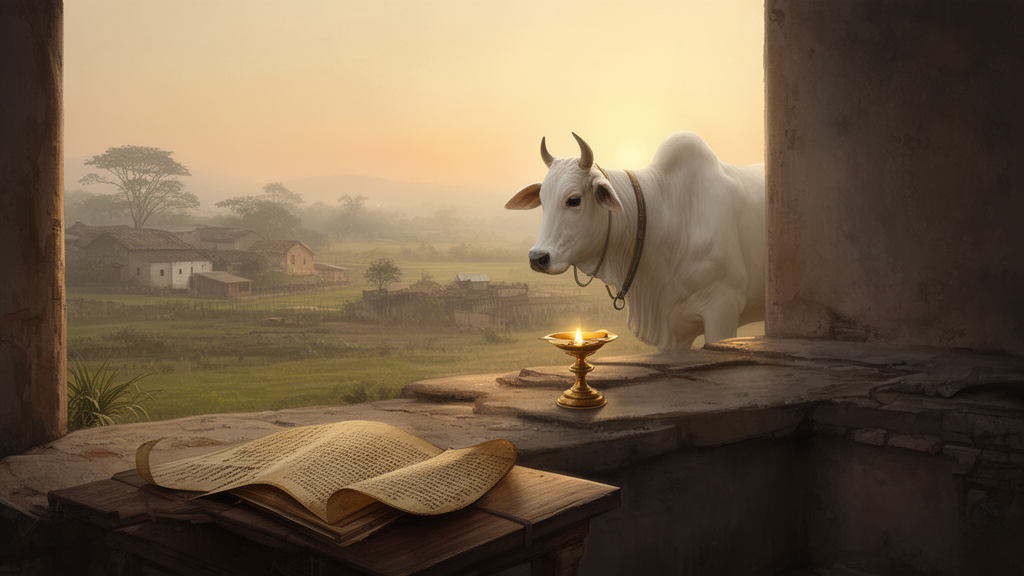
This guide separates four things that are often mixed together: what the book argues, what the cited texts say, what later traditions believe, and what academic reviewers have made of the argument. Where sources disagree, the disagreement is described rather than resolved by assumption. For Hindi readers, transliterated terms such as gau (cow), yajna (sacrifice), and dharmashastra (legal and ethical treatises) are explained where they first appear.
What Is the “Myth of the Holy Cow” Argument?

The phrase refers to the title of a 2001 book by D. N. Jha, published first by Matrix Books and later republished by Verso in 2002, according to the Wikipedia entry on the book. Wikipedia describes the book as aiming to dispel the idea that cows were holy in ancient India. The same entry summarises the core claim: the book stated that cows were eaten in ancient India, and that cattle were neither inviolable nor as revered in ancient times as they were later.
The argument is historical. It concerns evidence in texts and what that evidence suggests about diet, ritual, and social practice in particular periods. It does not claim that Hindu devotion to the cow is false, and it does not make a theological judgement about whether the cow should be honoured today. Readers who approach the book as a statement about present-day belief often misread its scope.
Who was D. N. Jha?
Dwijendra Narayan Jha (1940–2021) was an Indian historian who taught at the University of Delhi and studied ancient and medieval India. His Wikipedia biography describes him as a Marxist historian and notes that he trained under R. S. Sharma at Patna University. Wikipedia also says his work examined socio-economic structures in early India and challenged popular beliefs about the sanctity of the cow and the tradition of eating beef. The Navayana edition of the book, whose text is available in an online PDF copy on Scribd, includes an “About the Author” note describing him as a former Professor of History at the University of Delhi.
The book’s main line of reasoning
Based on the book’s table of contents, which appears in the Navayana edition, Jha organises his enquiry around texts and periods rather than around a single claim. Chapter titles include “‘Animals are verily food’ but Yajnavalkya Favours Beef,” “The Rejection of Animal Sacrifice: An Assertion of the Sacredness of the Cow?”, “The Later Dharmasastric Tradition and Beyond,” and “The Cow in the Kali Age and Memories of Beef Consumption.” The final chapter is titled “Resume: The Elusive ‘Holy Cow’.” The structure shows that Jha treats the sacredness of the cow as something to be traced across centuries of texts, not as a fixed feature of the earliest period.
A publisher’s description on the Amazon.in listing calls the book an argument against the historical sanctity of the cow, written as a response to prevailing attitudes about beef. That is a marketing description rather than scholarly evidence, so it is useful for understanding how the book was presented, not for establishing its findings.
What the Ancient Texts Say, as Quoted by Jha
The central dispute is about what early texts actually say. Jha’s book quotes or discusses passages from the Vedic and post-Vedic corpus. Readers who want to check the passages should consult the original editions and translations, because a secondary summary, including this one, can simplify the grammar and context of a passage.
The Taittiriya Brahmana and the horse-sacrifice
The Navayana edition quotes a passage from the Taittiriya Brahmana in its front matter, cited there as Taittiriya Brahmana III.9.8.2–3 in an edition published in Poona in 1979. The passage concerns the horse-sacrifice, in which the Adhvaryu priest is described as seizing or binding cows. The text states that the cow is the sacrifice and that the cow is food, and the sacrificer thereby obtains sacrifice and food. The English rendering printed in the book is credited to Paul-Emile Dumont, published in the Proceedings of the American Philosophical Society in December 1948.
This passage is significant to the debate because it links cows with sacrificial and food-related language. Supporters of Jha’s reading treat it as evidence that cattle held a ritual and nutritional role in some Vedic settings. Those who object to his reading may argue that the passage is metaphorical, that “food” and “sacrifice” are used in a symbolic register, or that a single brahmana passage cannot stand for the whole period. The text itself does not settle this dispute, which is why the interpretation matters as much as the quotation.
Animal sacrifice and the question of sacredness
Jha’s second major chapter examines the rejection of animal sacrifice and asks whether this rejection reflects an “assertion of the sacredness of the cow.” The chapter title itself frames the question as open. In the historical record, the move away from animal sacrifice in some traditions is often linked with the rise of ahimsa (non-violence), but the relationship between that development and the specific reverence for cows is a question of interpretation. Jha’s book, based on the chapter title, asks whether later reverence for the cow can be read back into the earlier rejection of animal sacrifice, and it suggests caution about making that connection automatically.
Yajnavalkya and the question of beef
The first chapter’s title refers to a line about animals being food and to the view that the sage Yajnavalkya favoured beef. Readers should treat this claim carefully. It is a claim about how Jha reads particular texts, and it is discussed by Jha in the context of Vedic ritual and dietary rules. Other scholars and traditions may read the same passages differently, and the ritual context of a sacrifice is not the same as everyday diet.
Later dharmashastra and the Kali Age
Dharmashastra is a body of texts on dharma, or social and ritual duty. Jha’s chapters on the later dharmashastra tradition and on “the Cow in the Kali Age” examine how later authors treated cattle and whether they describe beef-eating as a memory of earlier practice. This is an area where the historical evidence is layered: texts were composed, revised, and commented on over long periods and in different regions. A claim about “the” dharmashastra position is therefore only a simplification, and readers should check which text and commentary is being discussed.
Why the Cow Is Sacred in Many Hindu Traditions
The debate can be confusing because many Hindus today regard the cow as sacred, and this belief is widely expressed in devotion, family life, and some legal and social contexts. It is important to describe that belief accurately and without treating it as a historical claim that Jha’s book can disprove or confirm.
Devotional belief is not the same as historical evidence
When a devotee says that the cow is holy, they are usually describing a present religious relationship: the cow is honoured as a living being associated with nourishment, auspiciousness, and the family’s well-being. That statement is a devotional belief. It is not a claim that every ancient text described the cow as sacred in the same way, or that every community has always held that view. Jha’s historical argument addresses the earlier period. A devotee’s statement addresses present practice. The two can coexist, but they answer different questions.
Academic histories of religion typically make this distinction explicitly. Scripture, commentary, tradition, and modern interpretation are different categories, and a responsible discussion keeps them apart. A later commentary that praises the cow may tell us how a tradition developed, but it does not prove what an earlier Vedic ritual meant.
Regional, community, and family differences
Hindu practice is not uniform. Attitudes towards cattle vary by region, caste and community, occupation, diet, and family custom. Some Hindu families avoid beef as a matter of devotion; others have different dietary practices. Some communities have long-established cattle-related customs, and there are also Hindus who do not regard the cow as sacred in the same sense. The book’s debate does not tell readers what any particular family should do, and this article does not make such a prescription.
Laws in India have also changed over time and differ among states. Because legal rules on cattle slaughter are a matter of current law rather than scripture, this guide does not summarise them. Readers who need legal information should consult current state regulations or qualified legal sources.
Why the Debate Became So Heated
The argument in The Myth of the Holy Cow has been discussed in academic reviews and in public controversy. These two spheres should be kept separate. A scholarly review evaluates arguments and evidence. A public reaction may respond to the book’s perceived meaning for religious identity.
Scholarly reception
Wikipedia’s entry on the book cites reviews by historians of religion. It names David M. Knipe of the University of Wisconsin, Madison, whose review appeared in the Journal of the American Academy of Religion in 2004, and Matthew Sayers, whose review appeared in The Journal of Asian Studies in 2003. Wikipedia quotes Sayers as describing the book as a “well-organized, well-focused, and concerted effort to demonstrate that the modern understanding that the cow has been sacred since Vedic times is a mistake.” That quoted phrase is cited to a review, but the full review text was not inspected for this article, so readers should check the original review before relying on the exact wording.
Threats and legal action, as reported
Wikipedia reports that Jha received death threats after publication, that Hindu activist groups created controversy over the book, and that the book was banned by the Hyderabad civil court. The Wikipedia article cites news coverage for these points. This article reports them as claims made in that source. A reader who needs legal details should check the court record or a reliable news report about the ruling, because this article did not verify the court order directly.
The controversy is also relevant for tone. Writing about the cow in Hindu contexts requires care. Describing devotion as foolish or describing the historical argument as an attack on Hindus both distort the subject. Neutral language helps readers see that the disagreement concerns evidence, interpretation, and identity, not simply whether people are good or bad.
Myth, Misunderstanding, or Complex History?
The title of Jha’s book uses the word “myth” in the sense of a widely held belief that he challenges. Readers should understand that usage. In this context, “myth” does not mean a falsehood told deliberately. It refers to the modern assumption that the cow was sacred in the same way throughout Vedic times, which Jha argues is not what the early evidence shows.
A more balanced description might say that the historical record is complicated. Some texts discuss cattle as food and as sacrificial material. Other texts and later traditions emphasise protection, non-violence, and the cow’s role in agriculture and family life. Devotion to the cow often draws on several strands at once. The result is not a single story, and the “myth” framing can be useful only if it is applied carefully.
Three questions to ask when reading claims about the holy cow
- Which text is being quoted? Check the title, period, and edition. A Vedic passage, a dharmashastra text, and a modern devotional book are different sources.
- Is the statement a text, a commentary, or a modern interpretation? A claim about what a text says is not the same as what a later commentator or modern author says it means.
- Does the claim describe past scholarship, present devotion, or legal reality? These are separate levels and should not be merged.
Examples of How the Debate Appears in Practice
The debate is easy to misread in everyday conversation. Consider three examples.
- A question about ancient diet. If someone asks whether early Indians ate beef, the historically serious answer is that some texts and scholars discuss beef consumption in particular Vedic and post-Vedic contexts, and that this is contested. A flat yes or no misses the textual and interpretive complexity.
- A question about present devotion. If someone asks why many Hindus revere the cow, the answer should explain devotional meanings, family customs, and regional practices. It should not claim that all Hindus share a single theology or that devotion rests on one ancient verse.
- A question about the book. If someone asks whether Jha’s book is accurate, the answer depends on which claim is tested. Reviews by historians of religion are one source of evaluation, but they should be read directly rather than summarised from memory.
For readers interested in related Hindu texts and themes, the following HindusGod.com drafts may be useful once the owner decides to publish them. Their live URLs are not yet confirmed as public:
- For an overview of the book itself, see the draft Myth of the Holy Cow (target draft; may not be public yet).
- For a general introduction to Hindi-language holy texts, see Hindi Holy Book (target draft; may not be public yet).
- For the Bhagavad Gita in Hindi, see Geeta in Hindi (target draft; may not be public yet).
- For the Mahabharata, which contains many of the dharma and ritual discussions that readers may encounter, see About Mahabharat in Hindi (target draft; may not be public yet).
- For Bhagavata literature, see Bhagwat Hindi (target draft; may not be public yet).
These links are internal recommendations only. They have been checked against the owner’s verified draft list, but they are not confirmed as live public pages.
Frequently Asked Questions
Did Jha say that Hindus should eat beef?
No. The book is a historical argument about ancient texts and practices. It does not make a recommendation about diet for modern Hindus. Readers should not read the book as a statement about present-day religious obligations.
Is the cow sacred in the Vedas?
This is the central question in the debate, and sources differ in how they answer it. Jha argues that the modern understanding of the cow as sacred since Vedic times is a mistake, according to Wikipedia’s summary of the book and the review quoted there. Other scholars and traditions may read the same evidence differently. A careful answer should name the specific text and explain the interpretation.
Why do many Hindus consider the cow holy today?
Many Hindus honour the cow through devotional belief, family custom, and community practice. The reasons can include the cow’s association with nourishment and the household, and the reverence attached to it in later texts and traditions. These are religious and cultural explanations. They are not the same as a historical claim about the earliest Vedic period.
Was the book really banned?
Wikipedia reports that the book was banned by the Hyderabad civil court. This article cites that report but has not verified the court order. Readers who need a legal conclusion should consult the court record or reliable news coverage.
Summary and Takeaway
The myth of the holy cow in Hindi and English discussions usually refers to D. N. Jha’s argument that the cow was not as inviolable in ancient India as it later became. The argument rests on readings of Vedic, post-Vedic, and dharmashastra texts, and it has been reviewed by scholars of religion. The argument is historical, not a judgement on present devotion.
The most useful approach is to keep three layers apart: what a text says, how later traditions understood it, and how people practise devotion today. When these layers are distinguished, the debate becomes clearer. Readers can respect Hindu devotion to the cow while also examining the historical evidence that Jha and other scholars discuss.
Sources and Further Reading
- The Myth of the Holy Cow, Wikipedia: used for the book’s publication details, its summary, the reviews by Knipe and Sayers as cited there, and the reported death threats and court ban.
- D. N. Jha, Wikipedia: used for biographical details, his academic training and positions, and the summary of his arguments about the cow and beef.
- D. N. Jha, The Myth of the Holy Cow, Navayana edition (2009), PDF on Scribd: used for the table of contents, the Taittiriya Brahmana passage as quoted in the book, and the author note. The Scribd copy is a third-party upload; readers should prefer a licensed edition.
- Full text of “The Myth of the Holy Cow,” Internet Archive: consulted as an online text of the book. The page was inspected, but the full text was not used for detailed quotations in this article.
- The Myth of the Holy Cow, Amazon.in listing: used only to describe how the book was presented commercially. This is not evidence for the book’s findings.
Further reading to check before publication: the original reviews by Knipe and Sayers, and a licensed edition of the Taittiriya Brahmana with a translation and commentary, should be consulted directly by the editor.