The mystery of the Grail refers to the unanswered questions that surround the Grail in medieval Arthurian romances: what the Grail is, why it matters, and what a seeker is meant to find. The short answer is that the Grail is not a figure from Hindu scripture or the Hindu deities. It is a central motif in European Arthurian literature, and its meanings have been debated by scholars, writers, and esoteric interpreters for centuries. This article explains where the legend comes from, what the main modern interpretations say, and how readers can compare it with Hindu epic and devotional traditions without mixing them together.
What the Grail mystery is
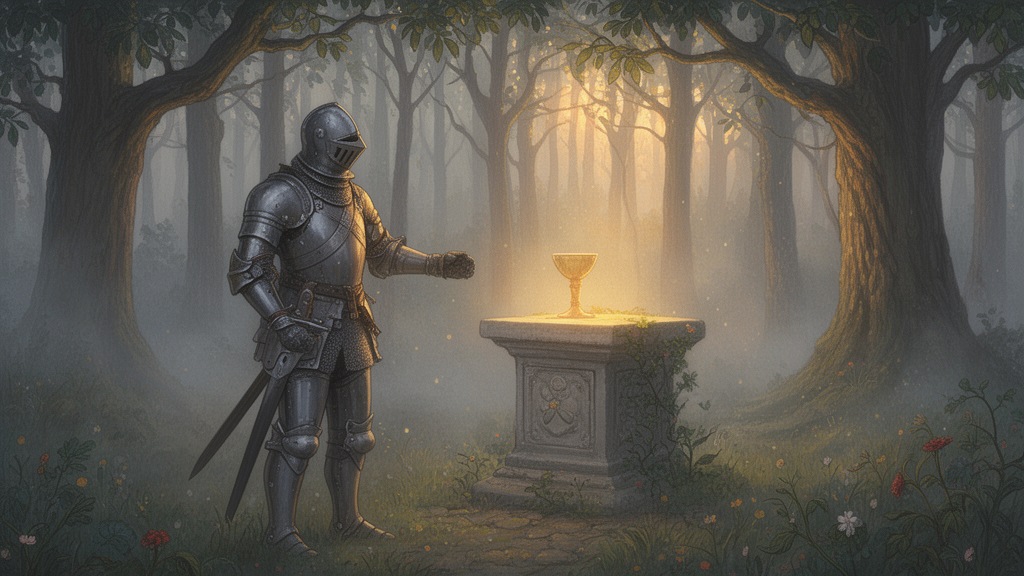
In the Arthurian romances, the Grail is a sacred object or vessel sought by knights, most famously in quest narratives. Joseph Campbell’s writings on this material, collected in Romance of the Grail, describe the Grail quests as part of the Matter of Britain, the body of legends about King Arthur, Merlin, Gawain, Guinevere, the Lady of the Lake, and the Fisher King. Grokipedia’s summary of the book reports this content, but it is an AI-generated wiki and should be checked against the publisher’s edition before it is relied on for detail.
The mystery is therefore literary and interpretive first. The stories leave important questions open. The Grail is described, sought, and sometimes glimpsed, but its exact nature shifts from one telling to another. That openness is one reason the legend has attracted so many readings.
Why the question matters to Hindu readers
HindusGod.com readers often come to comparative mythology through the Mahabharata, the Ramayana, the Puranas, and devotional literature. Those traditions have their own sacred objects, quests, and symbols, but none of them is the Grail. A responsible comparison begins by recognizing the difference between a religious text, a medieval romance, a modern scholarly reading, and a symbolic interpretation. For a related epic-focused discussion, see Mahabharat Mystery (URL to confirm as live; currently a WordPress draft).
The Arthurian background
The Grail belongs to the Arthurian cycle, a group of medieval romances in which knights test courage, loyalty, and faith. Campbell’s account, as summarized in the collection, traces the Arthurian material to Celtic origins and also argues that influences from Greek, Islamic, and Indian myths reached the cycle through trade and cultural networks, including the Silk Road. Grokipedia reports this claim as Campbell’s position. It should be read as one interpreter’s view of cultural transmission, not as settled historical proof that any specific Indian myth shaped a specific Grail episode. Scholars of medieval literature debate how such connections can be shown.
Among the motifs Campbell emphasizes is the Dolorous Stroke, a wound to the king that turns the land into a wasteland, and the quest for restoration by a true knight. These motifs explain why the Grail mystery is tied to healing, failure, and renewal. They also explain why readers often treat the legend as a story about inner transformation rather than only a story about objects.
Romance, scripture, and devotion are different categories
The Grail romances are not scriptures in the sense used in Hindu traditions, where texts such as the Bhagavad Gita or the Vedas are received as authoritative within a living religious community. The Grail romances are narrative literature, written for courtly audiences. Their authority comes from their literary tradition and influence, not from a sacred community that treats them as revealed truth. Keeping that distinction clear helps prevent confusion when comparing them with Hindu texts.
Modern readings of the Grail
Modern readers have offered several kinds of interpretation. The most useful way to read them is to separate what the medieval texts say from what the interpreter adds. The following sections describe two prominent examples.
Joseph Campbell: the Grail as psychological and mythic pattern
Campbell’s reading, as summarized in the collected volume, treats the Arthurian romances as a kind of secular mythology that offers symbolic patterns for psychological growth, personal authenticity, and the process of love understood as a transforming force. This is an interpretation. It draws meaning from the stories and from comparative mythology rather than reporting a doctrine held by a religious community.
Campbell’s approach is useful for comparison because it looks for recurring patterns: wounded kings, quests, trials, and restoration. Hindu readers may recognize similar structures in stories about tests of dharma, exile and return, or a hero’s search for a lost ideal. Recognizing a shared pattern is not the same as claiming a shared origin. A pattern can arise in different cultures for different reasons, and a careful reader keeps those questions open.
Julius Evola: the Grail as initiatory symbol
The Italian esoteric writer Julius Evola wrote a separate study, The Mystery of the Grail. Its full text is available in the Internet Archive’s full-text copy, and the opening of the text, as shown in a PDF copy hosted at Tradition.st, begins by asking readers to overcome what Evola calls a “literary prejudice” before approaching the romances as more than entertainment. This is Evola’s own framing and is a claim about how to read the texts.
A search excerpt from another PDF copy, hosted on the Internet Archive, states that Evola reads the Grail legend as dealing with an initiatory mystery and as a symbolic expression of the hopes of certain medieval ruling groups for a spiritually grounded Holy Empire. That is Evola’s interpretation, not a historical finding confirmed by independent evidence in this packet. The full text should be read directly before quoting it.
Evola’s reading differs sharply from Campbell’s. Campbell emphasizes psychological and comparative meaning; Evola emphasizes esoteric initiation and political-spiritual symbolism. Readers should note that these are two modern interpretations among many, and that historians and literary scholars assess them with different criteria.
Historical evidence and interpretation
A common source of confusion is the difference between what the medieval romances narrate, what historians can document about their composition and circulation, and what later writers have claimed the Grail “really” meant. The romances are literary artifacts. Their meanings can be studied through manuscripts, language, genre, and reception. Esoteric or symbolic readings are valuable as interpretations, but they should not be presented as historical proof.
This distinction is especially important for popular claims about hidden histories or secret lineages. Several of the related articles on HindusGod.com draft list deal with such claims. Readers should treat those topics as separate questions and check each claim against primary texts and academic sources. For example, see Holy Blood Holy Grail and Bloodline of the Holy Grail (URLs to confirm as live; currently drafts).
What scholars can and cannot say
- Scholars can study the surviving Arthurian texts, their languages, and their literary relationships.
- Scholars can compare themes such as quests, wounded kings, and wasteland imagery across narratives.
- Scholars generally cannot confirm that a single hidden Grail object existed in history or that the romances encode a secret teaching, unless a source independently supports that claim.
- Esoteric and comparative readings can illuminate symbols, but they remain interpretations.
Comparing the Grail with Hindu traditions
Hindu traditions have their own rich symbolism of sacred vessels, quests, and transformation. Examples include the churning of the ocean in the Puranic narratives, in which the pot of amrita appears, and the many stories of tests faced by heroes and devotees. Such comparisons can be enlightening, but they should be made carefully and with the source identified.
A useful approach is to compare structures rather than claim equivalence. Ask what each story is for, who tells it, and what it asks of the listener. In a Hindu devotional setting, a story may be part of worship, moral teaching, or narrative theology. In a medieval romance, it may serve courtly values and literary ambition. In an esoteric study, it may point toward inner initiation. These are different functions.
Avoid unsupported equivalences
It is tempting to say that the Grail is “the same as” an Indian sacred object or that Arthurian legend came directly from Indian myth. The sources in this packet do not establish either claim. Campbell’s suggestion of Indian influence on the Arthurian cycle is a proposal that would need detailed evidence to be assessed. Until such evidence is examined, the responsible position is to present the idea as a claim, attribute it, and note that it is debated.
For readers interested in Hindu epic mysteries, a more reliable path is to study the texts directly. Start with a respected translation of the epic in question, then consult scholarly introductions. HindusGod.com readers can also explore related reading such as Books About the Holy Grail for further study of Grail literature (URL to confirm as live; currently a draft).
The main Grail romances and characters
The Grail mystery is often approached through its characters. Each one carries a different emphasis.
- King Arthur represents the court and its ideals. In the sources summarized here, the Arthurian world is where the quests begin and where the cost of failure is felt.
- Merlin appears in the Arthurian material as a figure of prophecy and magic, and Campbell’s collection discusses him among the central figures.
- Gawain, Lancelot, and Perceval represent different models of knighthood, from courtesy and loyalty to purity and spiritual testing. For Perceval, see Perceval and the Holy Grail (URL to confirm as live; currently a draft).
- The Fisher King is linked to the wounded king motif and the restoration of the land.
Readers who want a character-focused study can also read Parsifal and the Holy Grail and Lancelot Holy Grail (URLs to confirm as live; currently drafts), which address other strands of the legend.
Religious care and Christian context
The Grail romances are shaped by medieval Christian culture. Many Grail stories involve Christian symbols, sacraments, and saints, and later interpreters have read the Grail in Christian devotional terms. Readers should not treat the Grail as a Hindu or pan-religious object. Each tradition deserves its own account.
The Grail also appears in historical discussions connected with Christian groups and movements. For example, one related draft explores the Cathars, a medieval movement that is discussed in historical scholarship, and another addresses Mary Magdalene. See Cathars and the Holy Grail and Mary Magdalene and the Holy Grail (URLs to confirm as live; currently drafts). These topics involve disputed interpretations, and each should be read with its evidence in view.
Reading the Grail mystery well
A balanced reader can follow a simple method. First, read a primary text in translation. Second, read a scholarly introduction or historical study. Third, read interpretive works such as those by Campbell or Evola, and identify whether the claim is textual, historical, traditional, or interpretive. Fourth, compare with other traditions only when the comparison is specific and supported.
A practical reading path
- Read a summary of the Arthurian cycle and its major quest stories.
- Read Campbell’s comparative account, checking his claims against the primary texts.
- Read Evola’s introduction and note where he moves from literary analysis to esoteric interpretation.
- Compare one motif, such as the wounded king or the quest, with a specific Hindu narrative, and state the basis for the comparison.
Frequently asked questions
Is the Grail mentioned in Hindu scripture?
No. The Grail is a motif in European Arthurian romance. Hindu scriptures and epics have their own sacred symbols and stories, and they should be studied on their own terms.
Did Arthurian legend come from Indian myth?
The sources here report Campbell’s view that influences from several cultures, including Indian myth, may have reached the Arthurian cycle through trade networks. That is a debated claim. It has not been established by the sources reviewed for this article.
Are Evola’s readings of the Grail accepted by historians?
Evola’s study is an esoteric interpretation. Readers should weigh it as one interpretation, and should check it against historical and literary scholarship before treating its claims as established.
Summary
The mystery of the Grail is best understood as a literary and interpretive question. The Grail belongs to medieval Arthurian romance, where it drives quests, tests knights, and symbolizes restoration. Campbell reads it as a pattern of psychological and mythic meaning, while Evola reads it as an initiatory and esoteric symbol. Neither reading is a Hindu teaching, and neither should be presented as historical proof without evidence.
For readers of Hindu traditions, the most useful lesson is method. Separate scripture from romance, belief from history, and tradition from interpretation. Then compare stories carefully, naming the sources behind each claim. For further reading on comparative epic themes, consult the related drafts linked above once they are confirmed live.
Sources and further reading
- Romance of the Grail: The Magic and Mystery of Arthurian Myth (book) summary, Grokipedia. Supports the description of Campbell’s collection and his reading of the romances. This is an AI-generated wiki; verify against the publisher’s edition.
- The Mystery of the Grail, full text, Internet Archive. Primary text of Evola’s study for direct checking of his claims.
- The Mystery of the Grail, PDF, Tradition.st. Supports Evola’s opening argument about a literary prejudice.
- The Mystery of the Grail, PDF copy, Internet Archive. Supports the description of Evola’s initiatory and Holy Empire reading, as shown in a search excerpt.
Further reading should include a published translation of the Arthurian romances and an academic introduction to the Grail literature, selected by the editor after verification.