“Ramayan Shastra” is a phrase people use when they want to understand the Ramayana as a sacred text. The Ramayana (also spelled Ramayan or Rāmāyaṇa) is traditionally attributed to the sage Valmiki and is one of the two great epics of Hinduism. The word shastra generally means a treatise, teaching or authoritative text, but the Ramayana is usually classed as an epic poem rather than a technical manual. This article explains what the phrase can mean, how the text is organized, what its main story says, and how different traditions read it.
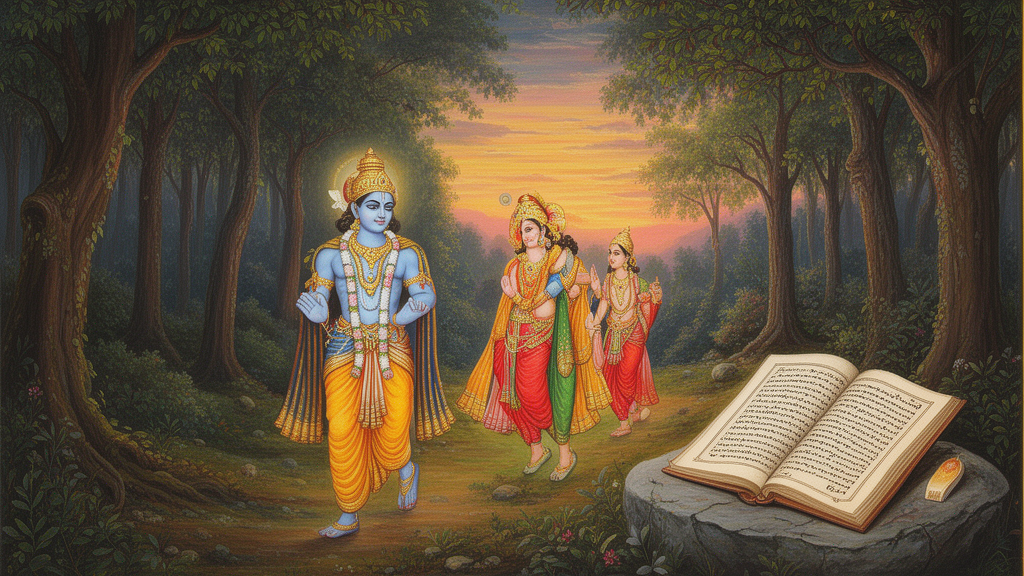
Short answer: what is the Ramayan Shastra?
In most usage, “Ramayan Shastra” refers to the Ramayana itself, the Sanskrit epic that tells the story of Rama, prince of Ayodhya. It is not usually a separate scripture with its own title. The Ramayana is widely treated in Hindu devotional and educational settings as a text that teaches dharma (righteous conduct) through narrative. Scholars, by contrast, treat it as a literary work composed and transmitted over a long period. Both views can be held at once, but they answer different questions: one concerns devotion and moral teaching, the other concerns texts, manuscripts and history.
If you searched for this phrase while looking for a specific book, edition or commentary, check the title, language and publisher carefully. Different editions are organized differently and may use different verse numbers and translations.
What “shastra” means and why the phrase is ambiguous
Shastra as treatise or authoritative teaching
The term shastra means scripture or treatise. A widely used Indian study module on the Sastras describes them as collections of treatises covering philosophy, law, ethics, medicine, arts and spirituality, and says the term itself means scripture or treatise (Scribd course module, Madhav Kandali’s Assamese Ramayana file). That usage is broad. Dharmashastras deal with conduct and social duty, Arthashastra with statecraft, and Nyaya Shastra with logic. In that wider sense, a text can be called a shastra because it offers authoritative teaching in a field.
Why the Ramayana is usually called an epic
The Ramayana is commonly described as an ancient Sanskrit epic poem attributed to Valmiki (Wikipedia, “Ramayana”). It is a narrative work, organized into books and told through characters, dialogue and episodes. A reader who expects a list of rules or philosophical argument may be surprised. The moral and philosophical content is present, but it is carried through story, example and speech rather than through systematic treatise.
Why the phrase can cause confusion
Some websites and study materials use Shastra as a label for many Indian subjects, including Rasayan Shastra, which means chemistry in the older sense of the word. Those pages are about a different subject. In this article, “Ramayan Shastra” is used only in the sense of the Ramayana as a sacred and literary text.
Traditional authorship and structure
Valmiki and the traditional account
The traditional attribution to Valmiki is part of the text’s devotional and cultural identity. Wikipedia describes the Ramayana as attributed to Valmiki and notes that it is an ancient Sanskrit epic. In Hindu tradition, Valmiki is also remembered as the poet who composed the Ramayana after receiving its story. This is a traditional account, not a fact that can be confirmed from independent historical records. Treat attribution as belief and tradition, and treat dating and composition as separate questions discussed later.
The six major books, or kandas
The Ramayana is divided into major books called kandas. The Wikipedia article lists the synopsis under Bala, Ayodhya, Aranya, Kishkindha, Sundara and Yuddha Kandas, followed by Uttara Kanda. Many readers encounter the first six as the core narrative, but editions and recensions differ on how the final book is treated, as discussed below.
- Bala Kanda: the childhood of Rama and the background of the story.
- Ayodhya Kanda: Rama’s exile and the crisis in Ayodhya.
- Aranya Kanda: the forest years, including Sita’s abduction.
- Kishkindha Kanda: the alliance with the vanara kingdom and the search for Sita.
- Sundara Kanda: Hanuman’s journey to Lanka and his meeting with Sita.
- Yuddha Kanda: the war with Ravana.
- Uttara Kanda: the later events after the war, including Rama’s rule and the story’s conclusion in many versions.
Sargas and verse counts
The Vedanta Shastras Library, an online devotional library, describes the Ramayanam as having six major kandas and about 24,000 verses, with each kanda divided into sargas (chapters). It gives sarga counts of 77 for Bala Kanda, 119 for Ayodhya Kanda, 75 for Aranya Kanda, 67 for Kishkindha Kanda, 68 for Sundara Kanda and 128 for Yuddha Kanda (Vedanta Shastras Library, “Ramayanam”). These figures are useful as a reference for that edition, but they should not be treated as universal. Printed editions, critical editions and regional recensions can differ in the number of verses and chapters they include.
The core story in brief
Rama’s exile from Ayodhya
The story begins in Ayodhya, where Rama, the eldest son of King Dasharatha, is prepared to become king. A political crisis forces him into exile for fourteen years. Rama accepts the decision and goes into the forest with Sita and his brother Lakshmana. The exile is a central example in the text of keeping one’s word and accepting a painful duty. Many devotional readers read this section as a lesson in loyalty, patience and family obligation.
Sita’s abduction and the search
In the forest, Sita is abducted by Ravana, the demon king of Lanka. Rama and Lakshmana search for her and form alliances with the vanara (monkey-like) people of Kishkindha. The search is one of the text’s most detailed movements, and it shows the Ramayana’s structure: each stage introduces new characters and tests Rama’s resolve.
Hanuman and Sundara Kanda
Hanuman is one of the most beloved figures in Ramayana devotion. Sundara Kanda, which Vedanta Shastras Library describes as the Beauty or Hanuman section, follows his journey to Lanka and his meeting with Sita (Vedanta Shastras Library, “Ramayanam”). Devotional communities often read this book on its own, but its place within the larger story matters, since it prepares the war that follows.
The war and the return
Yuddha Kanda covers the war between Rama’s allies and Ravana’s forces. The conflict ends with Ravana’s defeat, and Sita is reunited with Rama. The Uttara Kanda then covers the aftermath, including questions about Sita’s reputation and Rama’s rule. The treatment of these later events varies across traditions and editions, so readers should check which version they are following.
Dharma as the central theme
Dharma is the main ethical idea in the Ramayana. It includes duty to family, to a king, to a spouse and to one’s word. Characters are often praised or criticized according to how well they fulfill these duties. Rama is the central example, but the text also shows Sita, Lakshmana, Bharata and Hanuman acting from their own understanding of duty.
Dharma is not presented as a simple list of rules. The epic places characters in conflicting obligations, and readers are asked to think about what is right in a specific situation. For this reason, many commentators treat the Ramayana as a teaching text, while also acknowledging that the story raises difficult questions about justice, gender and kingship.
Examples of dharma in the narrative
- Rama accepts exile to honor his father’s word, a decision that shapes the entire plot.
- Bharata, who might have inherited the throne, refuses to rule in Rama’s place during the exile.
- Hanuman serves Rama with loyalty and humility, which many devotees see as a model of devotion.
- Sita’s conduct during captivity is read by devotional communities as steadfastness, but interpretations of her later trials vary.
These examples come from the narrative itself. Their meaning is still interpreted differently by commentators, teachers and communities.
Versions, recensions and regional retellings
Wikipedia’s article on the Ramayana shows that it has many versions, including Indian, Southeast Asian and European retellings, as well as Buddhist and Jain versions within India (Wikipedia, “Ramayana”). It also has sections on recensions and a critical edition, which shows that scholars distinguish between textual traditions. This matters because a story found in one regional retelling may not appear in the Sanskrit critical edition, and a popular local version may omit parts that appear elsewhere.
Regional Indian versions
Many Indian languages have their own Ramayana texts. HindusGod.com has draft articles on several of them, including Assamese, Bengali, Bangla, Adbhut, Adhyatma, Anand, Arjun and Aalha Ramayan. Each one reflects a regional literary tradition. Their stories, emphasis and style differ, so they should be read as different retellings rather than as one fixed text.
- Assamese Ramayan (URL to confirm as live; currently a WordPress draft)
- Bengali Ramayan (URL to confirm as live; currently a WordPress draft)
- Bangla Ramayan (URL to confirm as live; currently a WordPress draft)
- Adhyatma Ramayan (URL to confirm as live; currently a WordPress draft)
Southeast Asian and other traditions
The Ramayana has also been adapted across Southeast Asia. The Wikipedia article lists versions associated with Cambodia, Indonesia, Malaysia, Myanmar, the Philippines and Thailand, among others. These adaptations often reflect local languages, art forms and religious settings. A reader should not assume that a Thai, Javanese or Cambodian retelling follows the same sequence or characterization as a North Indian version.
Ramayana in festivals and devotion
The Ramayana is closely linked to Hindu festival life. Wikipedia includes a section on its influence on holidays, with separate subsections on Vijayadashami and Diwali. In many communities, Ramlila performances, readings and recitations are part of these observances. The exact practices vary by region, family and community, and the dates of festivals should be checked against the local calendar each year.
Devotional readers often approach the Ramayana through regular reading, recitation or listening. Some follow a book-by-book schedule, while others read selected passages. These are tradition-specific practices. The Ramayana does not require one single method of worship, and no reading practice should be presented as guaranteed to produce a particular material result.
Devotional and scholarly approaches
A devotional reader may approach the text as sacred revelation, as a guide to conduct, or as a source of comfort. A scholar may study its manuscripts, language, editorial history and social context. Both approaches are valid. The mistake is to treat them as the same thing. A devotional belief about authorship, for example, is not the same as a historical finding about when the text took its present form.
Scholarly questions: dating and composition
The Ramayana’s dating is an open scholarly question. The Wikipedia article includes a dedicated dating section, and readers who want the current range of views should consult it and the sources it cites. In this article, no single precise date is presented as settled. The text’s present form is generally understood to have developed over time, through oral and written transmission, and through the work of editors and reciters.
Critical editions were prepared to compare manuscripts and identify shared passages. Their work helps explain why different editions can differ in verse count, chapter structure or the inclusion of certain episodes. Readers who want a critical text should look for an edition that explains its editorial method and manuscript base.
How to read the Ramayana respectfully and accurately
The Ramayana is widely read in many languages, and readers meet it through translations, retellings, television serials, plays and devotional commentaries. A careful reader can use the following approach.
- Choose a clear edition or translation. Check whether it is a critical edition, a translation, a retelling or a devotional abridgement.
- Note the translator or commentator. Interpretations of dharma, Sita, Rama and Ravana can differ widely between commentaries.
- Separate scripture from commentary. When a claim is based on a particular commentary, say so rather than attributing it directly to the epic.
- Compare versions where possible. If a story is important to your reading, check whether it appears in several retellings.
- Respect community practice. Festival customs and recitation traditions often differ between regions and families.
Frequently asked questions
Is the Ramayan Shastra a separate book?
Usually, no. The phrase is most often used to refer to the Ramayana. Check the exact title of any book or edition you find, because some titles combine the word shastra with other subjects.
Who wrote the Ramayana?
The Ramayana is traditionally attributed to the sage Valmiki. This attribution is part of Hindu tradition. Scholars study the text’s composition and transmission separately from that traditional account.
Which kanda should a beginner read first?
Many beginners start with the Bala Kanda for background, then read the Ayodhya Kanda for the exile story. Others begin with Sundara Kanda because of its devotional focus. There is no single required order, and the best choice depends on your purpose and the edition you use.
Summary
“Ramayan Shastra” most commonly refers to the Ramayana, the ancient Sanskrit epic attributed to Valmiki. The word shastra in this context points to an authoritative text, and the Ramayana is studied as both a devotional and literary work. Its six major kandas, plus the Uttara Kanda in many traditions, tell a story of duty, exile, devotion and war. Its meaning is shaped by regional retellings, festivals and commentaries. A careful reader keeps the text, the tradition and modern scholarship distinct.
Sources and further reading
- Ramayana, Wikipedia: used for the attribution to Valmiki, the kanda structure, the list of versions and recensions, the critical edition and the sections on influence and festivals. Treat as a general reference that points to further scholarly sources.
- Ramayanam, Vedanta Shastras Library: used for the traditional description of the Ramayanam, its approximate verse count and sarga counts for each kanda in that library’s edition, and its description of Sundara Kanda.
- Shastra, Ramayan and Mahabharat module, Scribd: used for a general definition of the term Sastra. This is a student course module uploaded to a document-sharing site, so it is treated as a secondary educational source.
Readers who want to go further should compare a critical edition, a translation with an identified translator, and one or more commentaries from recognized traditions.