Prashna Shastra (Kannada: ಪ್ರಶ್ನಶಾಸ್ತ್ರ) is a branch of Jyotisha, the Indian astrological tradition, that answers a specific question asked at a specific moment. Instead of reading a full birth chart, the astrologer casts a chart for the time the question is put and uses it to address that one matter, such as a marriage, a job, or a business decision. In Kannada-language sources, the subject is usually described as a practical tool for cases where birth details are unknown or incomplete. This guide explains the term, the methods named in Kannada sources, and the limits of what those sources can verify.

Direct answer: what Prashna Shastra in Kannada refers to
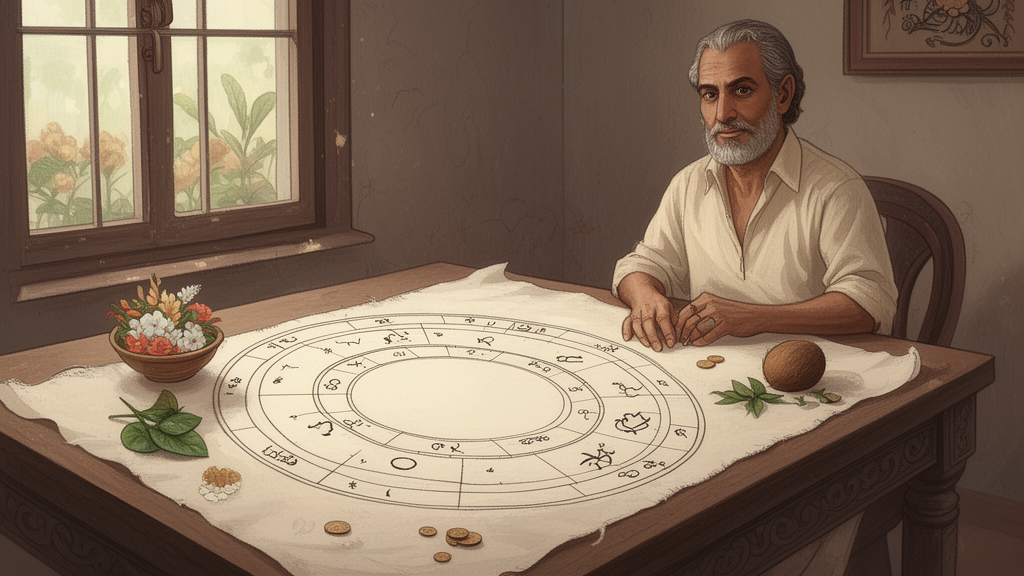
In Kannada, the phrase normally means the Prashna Shastra of horary astrology. A Kannada astrology column published by Vijay Karnataka describes it as useful when a person’s janma details, meaning date, time and place of birth, are not known precisely. It also states that Prashna Shastra does not give the general life-long results that a birth chart is used for. Instead, a chart is drawn for the moment the question arises, and the question is answered within that chart. [1]
Two points matter for readers searching this term. First, the word prashna appears in more than one tradition. Second, the astrological method is practised by individual astrologers and is not a single, standardised system. The sections below separate these points so readers can see what each source supports.
Two different meanings of “Prashna”
Prashna Shastra as horary astrology
The astrological sense is the one most Kannada readers encounter. Here the word prashna means a question, and shastra means a body of knowledge or a discipline. A Kannada astrology article written by a practitioner describes the approach as one in which a chart is prepared for the time of the query, and the querent’s question is then read through that chart. [1]
Prashna Upanishad: a different text
The Prashna Upanishad is a separate work. A Kannada-language text page on Stotrams describes it as embedded in the Atharva Veda, classed as a Mukhya Upanishad, and listed as number five in the Muktika canon of 108 Upanishads. The same page summarises it as having three prashnams, or parts, each with two sections, and as dealing with higher and lower knowledge, the nature of Brahman, and the path to knowing Brahman. [5]
The Upanishad is a philosophical scripture. It does not describe horary charts or astrological methods. Readers who search for the term should therefore check whether they want astrology or Upanishadic philosophy. This article covers the astrological meaning, and the Upanishad is discussed only to avoid confusion.
How a prashna chart is prepared
The main principle described in English-language practitioner material is to fix the rising sign, or lagna, and the positions of the planets for the moment the question is asked. A practitioner’s account of the Prashna Marga tradition states that the time at which the question is put is the most important fact in this branch. [6]
Kannada sources describe the same basic steps. The article in Vijay Karnataka explains that a “tatkala” (instant) prashna kundali is prepared for the time of asking, and that the astrologer then reads planetary results and prays before giving an answer. [1] The chart is treated as if it belonged to the querent, but it is limited to the question being asked. [1]
When the querent is not present, the same practitioner account says the time of a phone call or the time of an email should be recorded, and that the chart is erected for the place where the astrologer is located. [6] This detail shows that the method depends heavily on the recorded time and location of the question, not only on the querent’s birth data.
Step-by-step overview
- The querent states a single, clear question.
- The astrologer records the exact time the question is asked. If the question arrives by phone or email, the time of receipt is recorded instead. [6]
- A chart is erected for that moment and place, following the method the astrologer uses. [1][6]
- The astrologer reads the chart in relation to the question, and in many traditions also considers the querent’s gestures and omens before answering. [1]
- The astrologer gives an interpretation. Practitioner sources describe this as a judgement, not a guaranteed outcome.
The number of steps and their order differ between astrologers and regional schools, so this list is an overview of what the Kannada and English sources describe, not a universal procedure.
Qualities expected of the astrologer and the querent
What the astrologer is expected to have
The Vijay Karnataka article lists qualities that a Prashna astrologer should cultivate. These include a pure mind, freedom from arrogance, devotion to the divine, respect for teachers and elders, sound practice of astrology, and skill in clear speech and in reasoning from indications. [1] The article also says the astrologer should observe the querent’s bodily movements and omens before answering. [1]
The English practitioner account of Prashna Marga adds that an astrologer should be an expert in Jyotisha, proficient in mathematics, lead a religious life, speak the truth, and have some knowledge of philosophy and mythology. [6] Those are traditional expectations stated by practitioners. They are not independent evidence that any particular astrologer is skilled or accurate.
What the querent is expected to bring
The same English practitioner account says that a querent approaches the astrologer with fruits, flowers, tamboola and dakshina, and with sincere intent rather than a wish to test the astrologer. [6] Kannada sources also state that the querent should be physically and mentally clean, should not be unsettled while asking, and should ask only one question at a time. [1]
These are customs and recommendations within the practitioner tradition. They are better described as tradition-specific etiquette than as requirements that every astrology school follows.
Methods named in Kannada sources
The Vijay Karnataka article lists several methods used in Prashna Shastra. The list begins with Ashtamangala Prashna, followed by Tajaka method, Swara Nadi, Udaya Lagna, Arudha Lagna, Ishta Sankhya Lagna and other approaches. [1] The article’s text is cut off in the copy inspected, so this list should not be treated as complete. A reader who wants the full list should consult the original article or a fuller Kannada text.
- Ashtamangala Prashna: named in the Kannada article as the first of the listed methods. [1] Its procedure is not described in the inspected text.
- Tajaka method: named in the same list. [1] The sources inspected do not explain its rules.
- Swara Nadi: named as a method, with no procedure given in the inspected text. [1]
- Udaya Lagna and Arudha Lagna: named as methods in the same list, which refer to the rising sign and a related chart point. [1]
- Ishta Sankhya Lagna: named as a further method. [1]
Because the inspected sources name these methods without describing their steps, this article does not explain how any method is calculated. Anyone who plans to study one should use a dedicated textbook or teacher and treat that instruction as tradition-specific.
When Prashna Shastra is used
Questions the chart is meant to address
The Kannada column gives examples of questions a querent might ask: when a daughter’s marriage will take place, when a son will find employment, and whether a business will be profitable. [1] The article says Prashna Shastra is suited to direct questions of this kind, and that it is not meant to describe a person’s whole life.
Nasta Jataka: when no horoscope is available
The English practitioner account describes the Nasta Jataka situation, where a person has no horoscope. In that case, the astrologer can attempt to construct a chart from information about the person’s life events. [6] The same source notes that a skilled astrologer may sometimes identify the purpose of a visit before the question is asked, by considering the surroundings and circumstances connected to the question, described in the text as kala, desha and vartamana, meaning time, place and present situation. [6]
This is a claim made by the practitioner tradition. It is not an empirical test, and the sources do not show how often such identification is accurate.
Belief, tradition and scholarship: how to read the claims
Prashna Shastra mixes three kinds of material, and readers should keep them apart.
Devotional and traditional belief
Many practitioners describe prashna charts as answers that can be trusted when the astrologer is pure in character and the question is sincere. The English practitioner account states that predictions made by an astrologer who has mastered the principles will never be false. [6] This is a belief held within the tradition. Readers should not treat it as a proven fact, and they should be cautious of any promise that a reading guarantees a particular result.
Text and textual references
The inspected Kannada and English sources are practitioner articles and book listings, not critical editions or academic studies. The Kerala Prasna Shastra item on the Internet Archive is a catalogue entry for a text by Maharishi Keral. The captured page inspected showed site navigation and did not display the text’s contents, so this article does not claim to know what that work says. [4] The Exotic India listing for a Kannada book titled Prashna Shastra Balabodh shows that Kannada-language introductory material exists, but the listing does not describe the book’s contents beyond its title and format. [3]
Scholarly and historical questions
The inspected sources do not provide historical dates, manuscript evidence or academic analysis of Prashna Shastra’s origin or spread in Karnataka. Statements about when the method developed, how it moved between regions, or how Kannada practice differs from Telugu, Malayalam or Tamil practice would need academic sources that were not verified for this article. Readers who need that history should look for work by historians of science and of Indian astronomy and astrology in university libraries.
Regional and linguistic variation
The term appears in several languages. A HindusGod.com draft on Prashna Shastra in Telugu exists in the site’s draft list, and it may cover related material in another language. [Internal link, see below]. Readers may also encounter the spellings Prasna, Prashnashastra, and Prashna Shashtra. These variants refer to the same subject in most sources, but a single search term does not guarantee that every source uses the same method names or rules.
Kannada practitioners and Malayalam texts such as the Kerala Prasna Shastra catalogue entry may follow different terminology. The Kerala title is one example that shows the existence of regional works on the subject, but this article does not compare their methods.
Related HindusGod.com guides
Readers exploring Indian knowledge systems often read about other shastras. The following HindusGod.com pages are draft targets and may not be public yet. Their links are included for planning and will become public only if the owner publishes those posts.
- For a Telugu-language treatment of the same term, see Prashna Shastra in Telugu.
- For a related divinatory discipline that reads the hand, see Hasta Shastra in Kannada.
- For the hand-line tradition specifically, see Hast Rekha Shastra in Kannada.
- For the samudrika tradition of body reading, see Hasta Samudrika Shastra Kannada.
- For the broader Vedic background on sacred knowledge, see Veda Shastra in Kannada.
- For the concept of duty and social order that shapes many traditional shastras, see Dharma Shastra in Kannada.
- For ritual and temple manuals, which are a separate category from horary astrology, see Agama Shastra in Kannada.
- For a related topic on esoteric practice that readers may confuse with Prashna, see Tantra Shastra Kannada.
Each of these pages covers a different discipline. A reader who wants the astrological background should read the Telugu Prashna guide and the sections above, while the palmistry and body-reading guides cover separate methods that should not be treated as part of Prashna Shastra.
Frequently asked questions
Is Prashna Shastra the same as the Prashna Upanishad?
No. Prashna Shastra, in the sense covered here, is a horary astrology method. The Prashna Upanishad is a philosophical text in the Atharva Veda tradition, and its content concerns knowledge of Brahman. [5] Both share the word prashna, which means question.
Can Prashna Shastra be used without a birth chart?
The Kannada column says it is useful when birth details are unknown or incomplete, because the chart is drawn for the time the question is asked. [1] The English practitioner account describes a Nasta Jataka approach in which a chart may be constructed from life events. [6] Both are claims made within the practitioner tradition.
Does Prashna Shastra guarantee an outcome?
The sources do not show that any prashna reading guarantees a result. Practitioners present readings as judgements based on the chart and the astrologer’s skill. Readers facing health, legal, financial or safety decisions should consult qualified professionals in those fields.
Where can I read more in Kannada?
The Vijay Karnataka article is a practical starting point, though its text was cut off in the copy inspected. [1] The Exotic India listing points to a Kannada book titled Prashna Shastra Balabodh. [3] Readers should check publisher details and the actual contents before relying on any book.
Summary and next steps
Prashna Shastra in Kannada refers, in most sources, to horary astrology. A chart is prepared for the time a single question is asked, and the astrologer answers that question using the chart, the astrologer’s training, and the procedures of the particular school. Kannada and English practitioner sources name several methods and describe etiquette for querents and astrologers, but they do not provide historical evidence or independent verification of accuracy.
Readers who want to study the subject should begin with a clear view of the term’s two meanings, check the source of any method they encounter, and look for scholarly works on Indian astrology before accepting historical claims. Anyone making a major life decision should seek qualified advice in the relevant field.
Sources and Further Reading
- Prashna Shastra column, Vijay Karnataka: used for the description of the method, the listed methods, the querent and astrologer qualities, and the examples of questions. The text inspected was incomplete.
- Complete Prashna Upanishad in Kannada, Stotrams: used for the description of the Upanishad’s place in the Atharva Veda and its structure. Translations on the page are attributed by the site and are not independently verified.
- Prashna Shastra Balabodh (Kannada), Exotic India: used only to show that a Kannada book with this title is listed for sale. The contents were not verified.
- Kerala Prasna Shastra, Internet Archive: used only to show that a catalogue entry with this title exists. The captured page did not show the text.
- Prashna Shastra, Jyothishi: used for the English account of Prashna Marga qualifications, querent practices, the time of the question, and the Nasta Jataka approach. This is a practitioner website and is not an academic source.