The phrase “Ramana Upanishad” is not a single, standard text that scholars or major Upanishad lists identify by that name. Most readers who search for it are looking for one of three things: the Sri Ramana Para-Vidya Upanishad, the teachings of Sri Ramana Maharshi (1879–1950) that are often described in Upanishadic terms, or a Rama-centred Upanishad, which has a similar spelling but a different focus. The sources checked for this article confirm the existence of the first and the context of the second and third, but they do not establish the full verse-level content of a text called “Ramana Upanishad.” This post explains those distinctions so you can read sources accurately.

The short answer
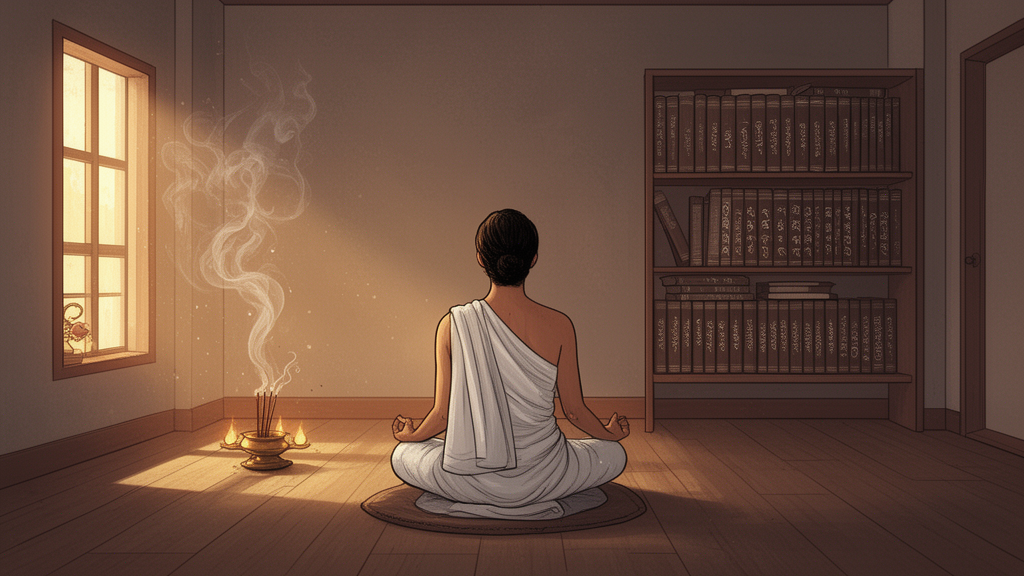
If you mean a text connected with the name of Sri Ramana Maharshi, the best-documented starting point is the Sri Ramana Para-Vidya Upanishad, which is listed in an Internet Archive record. If you mean Ramana Maharshi’s own spiritual teaching, the central practice is self-enquiry (asking “Who am I?”), which is widely described as rooted in Advaita Vedanta. If you mean Rama, the avatar of Vishnu, you are probably looking at a Rama-centred Upanishad such as the Rama Rahasya Upanishad. The spelling “Ramana” with the letter n refers to the sage; “Rama” refers to the deity.
Two spellings, two traditions
Readers often confuse these names because they look alike, but they belong to different religious contexts.
- Rama is a deity and avatar of Vishnu. Texts in his name, including several Rama-centred Upanishads, focus on his worship, mantras, and divine identity.
- Ramana is the name of the sage Ramana Maharshi, born Venkataraman Iyer in Tiruchuzhi, Madras Presidency, in 1879, who lived most of his adult life near Arunachala in Tiruvannamalai and died there in 1950, according to the Wikipedia article on Ramana Maharshi.
A search for “Ramana Upanishad” may therefore return material about the sage, about Rama, or about a text whose title combines both names. Checking which one a page describes is the first step in using it responsibly.
What the term “Upanishad” means
The Upanishads are generally treated as part of the Vedic literature and as a foundation of later Vedanta thought. The Sri Ramana Maharshi glossary entry on the Upanishad describes them as texts containing utterances (sruti) about the nature of Ultimate Reality (Brahman) and the path to liberation (moksha or mukti). It notes that the concepts of Brahman and the Self (Atman) are central, and that more than 200 Upanishads are known, of which the first dozen or so are usually regarded as the oldest and most important, the principal or mukhya Upanishads.
This description comes from a devotional-educational site, so it reflects one traditional framing. Academic histories of the Upanishads place them within a long and varied textual tradition, and scholars date and classify them in different ways. Readers who want a full scholarly account should consult a university or reference-level source alongside devotional material.
The Sri Ramana Para-Vidya Upanishad
The most direct match for the phrase is the Sri Ramana Para-Vidya Upanishad record on the Internet Archive, which lists a digital copy available for download and streaming. The record title indicates that the text is connected with Sri Ramana, but the page content retrieved for this article showed only the Archive’s navigation and did not display the text, its translator, its edition, or its Sanskrit or Telugu source.
That gap matters. Without the text itself, this article cannot state:
- how many verses or chapters it contains;
- whether it is counted among the traditional lists of Upanishads;
- who prepared the edition or translation, beyond the uploader listing;
- what specific doctrines it teaches in its own words.
Before quoting this text, readers should open the edition directly, check the translator’s introduction, and compare it with a second edition if possible. Upanishads often circulate in multiple recensions, and devotional editions may add commentary that is not part of the original text.
How to cite a text like this responsibly
When you write about a text whose origin is not fully documented, separate three layers: what the text itself says, what the editor or translator claims about it, and what you infer. For example, “the edition states that the text is associated with Sri Ramana” is a claim about the edition. “The text teaches X” requires a verse-level reference from the edition you are reading.
Ramana Maharshi and the Upanishadic teaching
Ramana Maharshi did not, according to the sources reviewed here, present his teaching as a commentary on one specific Upanishad. The best-known formulation of his method is self-enquiry. The Wikipedia article describes his teaching as self-enquiry, a form of jnana yoga, and notes that he is associated with Advaita-oriented thought. It also mentions his well-known remark that, among all the thoughts that arise in the mind, the thought “I” is the first. The article lists his notable works as Nān Yār? (“Who am I?”) and Five Hymns to Arunachala.
The Sri Ramana Maharshi website links the Upanishadic vocabulary of Brahman and Atman to his teaching in its glossary, describing the Upanishads’ thematic focus as “know your Ātman.” This is a devotional interpretation. It is useful for understanding how followers read the sage through Upanishadic terms, but it is not a neutral academic statement that every scholar would accept.
Where Upanishadic language appears in his teaching
- Self as the starting point. Self-enquiry directs attention to the sense of “I” rather than to external objects or ritual procedures.
- Non-dual vocabulary. Advaita Vedanta, which the Wikipedia article places in his background, uses Brahman and Atman language that echoes Upanishadic statements.
- Grace and surrender. His devotees, as described in the same overview, often emphasised surrender and grace alongside inquiry. Different followers give these elements different weight.
Students should treat these links as interpretive. A teaching can be described in Upanishadic terms without being a verse-by-verse continuation of a particular Upanishad.
Rama-centred Upanishads: a useful comparison
Because Rama is a major deity in Vaishnava devotion, several Upanishads are associated with his worship. The VivekaVani page on the Rama Rahasya Upanishad introduces it as a text that, in its own framing, belongs to the Atharva Veda and is described as an authoritative source for methods of worshipping Lord Rama. This is a traditional claim reported by the publisher and should be read as such.
The text’s opening dialogue shows the kind of material these Upanishads contain. In the translation shown on the page, sages ask the devotee Hanuman which principle is greatest among the Vedas, Puranas, and other knowledge. He answers that the greatest principle is the sacred syllable Om, identified with the Brahma Taraka, and presents Rama as supreme Brahman. The page also describes the six-syllable mantra Rāṁ Rāmāya Namaḥ and states that chanting it is said to produce the same effect as meditating on Om, a claim that belongs to the text’s devotional teaching rather than to modern historical evidence.
This example illustrates a general point. Upanishadic texts can be devotional, philosophical, ritual, or practical at the same time. A reader who searches for a “Rama Upanishad” may find material that is very different in purpose from Ramana Maharshi’s self-enquiry.
Why the distinction matters for devotees
A devotee of Rama may read the Rama Rahasya as a guide to worship. A student of Ramana Maharshi may read self-enquiry as a path of contemplation. Neither reading cancels the other, but they should not be merged into a single claim that “the Ramana Upanishad teaches X” unless a specific text supports it.
How to study these texts carefully
For readers who want to go beyond summaries, the following steps reduce confusion:
- Identify the exact title and edition. Note the publisher, translator, year, and whether the text is in Sanskrit, a regional language, or English.
- Read the translator’s introduction. It usually explains the text’s manuscript history, sectarian orientation, and translation choices.
- Separate verse from commentary. Footnotes and devotional explanations are not the same as the root text.
- Compare with a second source. A comparison with a different edition or with a reference-level overview helps identify disputed readings.
- Ask what kind of claim is being made. Scriptural statement, tradition, scholarship, and personal experience require different kinds of support.
If you are a practising devotee, your own lineage or teacher may provide guidance that is not described in these public sources. This article does not prescribe a practice for every reader.
What the evidence does not show
Several questions cannot be answered from the sources checked for this post:
- the exact date or manuscript history of the Sri Ramana Para-Vidya Upanishad;
- whether it appears in any canonical list of Upanishads;
- the full chapter or verse structure of the text;
- any specific claim about spiritual results from reciting it.
Where these gaps exist, the responsible approach is to say so plainly rather than fill them with assumptions. Readers should be cautious of pages that offer a confident “number of verses” or a specific historical date without citing the edition they used.
Frequently asked questions
Is there an Upanishad written by Ramana Maharshi?
The sources reviewed here do not show that Ramana Maharshi authored a traditional Upanishad. The Archive.org record associates the Sri Ramana Para-Vidya Upanishad with his name, but the text’s origin and authorship should be checked in the edition itself before making a firm claim.
Is “Ramana Upanishad” the same as “Rama Upanishad”?
No. The sage is Ramana Maharshi, and the deity is Rama. Rama-centred Upanishads such as the Rama Rahasya are a different group of texts with different devotional aims.
Where should a beginner start?
Start with a reliable overview of the Upanishads, then read one clearly identified translation of a principal Upanishad. After that, read Ramana Maharshi’s teaching on self-enquiry in a translation with a clear editor’s note. This sequence helps distinguish the tradition from the teacher’s method.
Closing takeaway
“Ramana Upanishad” is best understood as a search phrase that can point to a specific text, to the teaching of Sri Ramana Maharshi, or to a confusion with Rama-centred scriptures. The safest reading path is to name the text or teacher precisely, locate the edition, and separate the root text from commentary and devotional interpretation. Where the sources are thin, saying so is more useful to readers than an invented summary.
Sources and further reading
- Ramana Maharshi, Wikipedia: used for biographical dates, the description of self-enquiry, and the list of notable works.
- Upanishad glossary entry, Sri Ramana Maharshi website: used for the description of Upanishads as sruti texts on Brahman and Atman and the count of more than 200 known Upanishads. This is a devotional-educational source.
- Sri Ramana Para-Vidya Upanishad, Internet Archive: used to confirm that a digital record exists under this title. The text itself was not verified in this review.
- Rama Rahasya Upanishad, VivekaVani: used for the publisher’s description of the text’s Atharva Veda association, its worship focus, and the opening dialogue summarised above.
Related reading on HindusGod.com
For background on the term, see Meaning of Upanishad. For an overview of the numbered collections, see 10 Upanishad and 108 Upanishad. Readers interested in non-dual themes may also consult Advaita Upanishad, Atmabodha Upanishad, and Avadhuta Upanishad. For texts linked to the Atharva Veda, see Atharva Upanishad and Atharvashikha Upanishad. For a related self-referential text, see Adhyatma Upanishad, and for an Upanishad in a different philosophical tradition, see Ashtavakra Upanishad. These are WordPress drafts and may not yet be publicly visible.