The Principal Upanishads is a 1953 English edition and translation of key Upanishadic texts, edited and introduced by the philosopher and statesman Sarvepalli Radhakrishnan. It is one of the most widely read modern introductions to the Upanishads in English. Its value lies in combining a translation with an interpretive introduction written from a modern philosophical perspective. Readers should keep three things separate: what the ancient texts say, how later Hindu traditions have read them, and how Radhakrishnan himself interpreted them.

Short answer: The Principal Upanishads is Radhakrishnan’s selection and translation of the central Upanishads, presented with introductions that explain their philosophical themes, especially the relationship between the individual self (atman) and ultimate reality (Brahman). It is a scholarly and philosophical reading, not a neutral transcript of traditional commentary, and it should be read alongside the original texts and other traditional sources.
What the Upanishads Are
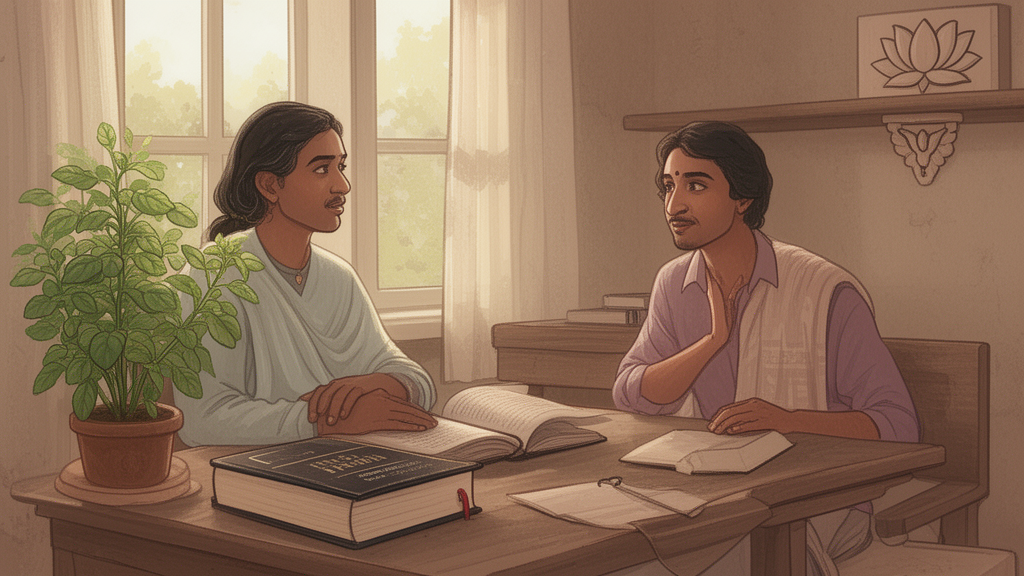
The Upanishads are a body of philosophical texts that form the final layer of the Vedic literature, often called Vedanta, meaning the end or culmination of the Vedas. They are usually discussed in the context of Hindu scripture under the broader category of shruti, the texts considered revealed or heard in traditional Hindu thought. Their content is largely dialogic and speculative. Teachers and students discuss the nature of reality, the self, death, knowledge, and liberation.
The word upanishad is commonly explained as a reference to sitting down near a teacher to receive instruction. That explanation is a traditional and etymological interpretation, and scholars discuss it alongside other possible readings. For a general introduction, the Wikipedia overview of the Upanishads gives a basic summary, but for scholarly detail readers should consult academic reference works and the texts themselves.
Not all Upanishads are considered equally important. Traditional Hindu lists include more than a hundred texts, while a smaller group is often called the principal or major Upanishads. These older prose texts are usually regarded by scholars as among the earliest, though the exact dating of each text remains debated and should not be stated as settled.
Who Was Sarvepalli Radhakrishnan?
Sarvepalli Radhakrishnan (1888–1975) was an Indian philosopher, educator, and public figure. He held academic posts in philosophy and religion, wrote widely on Indian and comparative philosophy, and later served as Vice President and then President of India. His writing on the Upanishads and the Bhagavad Gita brought Indian philosophical texts to many English-speaking readers. For background, see the Wikipedia biography of Sarvepalli Radhakrishnan, and check its references for primary and academic sources.
Radhakrishnan’s approach is important for readers to understand. He interpreted the Upanishads as a philosophical system with a broadly unified vision, emphasizing spiritual experience and the inner identity of the self with the ultimate. Many scholars and traditional teachers see this as one legitimate reading among several. Others, including those working within specific Vedanta schools such as Advaita, Vishishtadvaita, and Dvaita, have offered different interpretations of the same texts.
The Principal Upanishads Book: Scope and Structure
Radhakrishnan’s edition gathers the Upanishads he regarded as principal and presents them in English translation with an introduction and explanatory notes. The book is organized so that a reader can move through the texts in sequence or consult individual sections. Because the original texts are varied in style, some are narrative and dialogic, while others are short aphoristic statements, the translation and introduction help connect them thematically.
Readers should check the specific edition they are using. Publishers, reprints, and page numbering differ, and the book’s contents and introductory material can vary between printings. When citing the book, record the edition, publisher, and year. The original publication was issued in 1953 by George Allen and Unwin in London, with later editions and reprints published in India and elsewhere.
Why the Selection Matters
Choosing which Upanishads count as principal is a scholarly and editorial decision. Radhakrishnan’s selection reflects his judgment of which texts were most influential or philosophically central. Other editors and traditions may choose different sets. Some Hindu communities use the term principal in a looser sense, and some lists include later works. For that reason, a reader who sees a different count, such as ten, twelve, or thirteen, is not necessarily encountering an error. They may be seeing a different canon or convention.
Texts Commonly Associated With the Principal Group
Among the texts most often discussed as principal or major Upanishads are the Isha, Kena, Katha, Prashna, Mundaka, Mandukya, Taittiriya, Aitareya, Chandogya, and Brihadaranyaka. Some lists also include the Shvetashvatara, Kaushitaki, and Maitri Upanishads. The exact grouping depends on the editor or tradition. Readers who want to confirm the contents of a particular edition should compare its table of contents with a reliable scholarly reference.
Major Themes in the Principal Upanishads
Although the texts differ in genre and setting, several themes recur. Understanding these themes helps readers see why Radhakrishnan grouped them together and why they remain important in Hindu philosophical discussion.
Atman and Brahman
The most frequently discussed theme is the relation between atman, usually translated as the self, and Brahman, usually translated as ultimate reality. Several Upanishads explore whether the inner self is identical with, distinct from, or dependent upon the ultimate. Radhakrishnan tends to emphasize their deep unity. Later Vedanta schools disagree about how to understand this relation, so the phrase should be treated as a reading of the texts rather than a single universal doctrine.
Knowledge and Liberation
Many Upanishadic passages present knowledge as the key to liberation from repeated rebirth, called samsara. The texts describe this knowledge as insight into the nature of the self and reality, not merely ritual performance. This shift from ritual to inner understanding is one reason scholars often describe the Upanishads as a turning point in Indian thought. The claim that the texts emphasize knowledge over ritual is widely made in scholarship, but how strongly the texts should be contrasted with the earlier Vedic ritual tradition is debated.
Death, Rebirth, and the Self
Several texts address what happens at death, the cycle of rebirth, and the nature of consciousness in waking, dreaming, and deep sleep. The Mandukya Upanishad, for example, is known for a detailed treatment of the syllable Om and the four states of consciousness. Such discussions are central to later traditions, but the details vary. Readers should read the original text or a reliable translation rather than relying on summaries that attribute exact doctrines without citation.
Ethics and Self-Discipline
Some Upanishads, including the Katha and Taittiriya, contain teachings on restraint, truthfulness, and disciplined living. These passages are not presented as a complete ethical code. They are part of a broader spiritual training that aims at inner clarity. Modern readers sometimes take a single ethical sentence out of context. A careful reading considers the surrounding dialogue and the teacher-student setting.
How to Read Radhakrishnan’s Translation and Introduction
The translation is accessible, but it is an interpretive translation. Translators must choose English words for terms such as atman, Brahman, prana, and maya that carry layered meanings in Sanskrit and in later commentary. Radhakrishnan’s choices reflect his philosophical framework. When a word is translated as self, soul, reality, or spirit, readers may need to check how the same word is used elsewhere in the text.
A useful habit is to compare Radhakrishnan’s rendering with at least one other translation. Public-domain or openly available texts can help. The Sacred Texts Archive index of Upanishads provides access to older English translations, which are useful for comparison, though they are older and should be treated as historical translations. Academic editions with Sanskrit text and notes provide stronger support for detailed study.
Tips for Reading Efficiently
- Read the introduction first to understand Radhakrishnan’s framework, then read the texts with that framework in mind.
- Note when a passage is narrative, such as a dialogue between a teacher and student, and when it is a short doctrinal statement.
- Keep a separate note of what the text says and what the introduction says.
- Compare key terms across translations before drawing conclusions about doctrine.
Scripture, Commentary, and Modern Interpretation
Hindu scripture is understood in more than one way. The Upanishads are shruti, but their interpretation has been shaped by commentaries such as those attributed to Shankara, Ramanuja, and Madhva, among others. Each commentary reflects a theological or philosophical school. Radhakrishnan’s introduction is a modern philosophical interpretation, shaped by his academic background and his engagement with Western philosophy and comparative religion.
This distinction matters because readers may encounter the Upanishads through several lenses at once: scripture read in a temple or home, a historical text studied by scholars, a philosophical system discussed in universities, or a modern spiritual book. None of these lenses is automatically wrong, but they answer different questions. Scripture is often read for devotional and ethical guidance. Scholarship asks about language, date, manuscript history, and context. Modern interpretation may connect the texts to present concerns.
Regional and Tradition-Based Differences
Hindu communities do not all read the Upanishads in the same way. Some traditions give central importance to Vedanta philosophy, while others emphasize devotion to a personal deity, ritual practice, or regional sacred literature. Within Vedanta itself, Advaita, Vishishtadvaita, and Dvaita schools present different accounts of the relation between self and ultimate reality. Readers should therefore avoid assuming that Radhakrishnan’s reading represents all Hindu thought.
Language and region also matter. Many people encounter these texts in English, Hindi, Tamil, Telugu, Kannada, Bengali, or other languages, with local commentary traditions and study practices. Temple teaching, household reading, and academic classes may each use different editions and emphasize different passages.
Practical Examples for Study
A useful way to begin is to choose one short text and read it in two translations. For example, a reader might begin with the Isha Upanishad, which is brief, and compare how different translators render key terms. Another approach is to follow a theme, such as the four states of consciousness discussed in the Mandukya Upanishad, and then compare that discussion with the introduction in Radhakrishnan’s book.
A study notebook can help. For each passage, record the text name, section, translator, edition, the main idea in your own words, and any terms that need further research. This method keeps scripture separate from commentary and makes later citation easier.
- Choose one Upanishad from the principal group.
- Read the translation once for overall meaning without stopping to analyze every term.
- Read the introduction section relevant to that text.
- Reread the passage and note the key terms, such as atman, Brahman, knowledge, or liberation.
- Check one or two additional translations or academic commentaries.
- Write a short summary that separates what the text says from what you think it means.
Common Misunderstandings
One misunderstanding is that the Upanishads present one simple doctrine. In fact, they contain varied dialogues, metaphors, and arguments. A second misunderstanding is that Radhakrishnan’s introduction is identical to traditional Hindu interpretation. It is a modern philosophical reading that many people find helpful, but it should be identified as such. A third is that a single sentence captures the whole text. Upanishadic teaching often unfolds through dialogue, repetition, and gradual clarification.
Related Reading on HindusGod.com
Readers who want broader context may find these related HindusGod.com articles useful. Each link is a verified WordPress draft URL from the site’s current draft inventory, so the link will become public only if the owner publishes that target post.
- Principal Upanishads Radhakrishnan offers a companion discussion of Radhakrishnan’s edition and its place in modern study.
- S Radhakrishnan the Principal Upanishads covers Radhakrishnan’s work on this collection.
- Principal Upanishads provides a general overview of the principal group.
- Radhakrishnan Upanishads looks at Radhakrishnan’s broader engagement with the Upanishads.
- The Principal Upanishads by Dr S Radhakrishnan offers an additional look at this edition.
- 10 Principal Upanishads discusses the ten-text grouping often cited in traditional and modern lists.
- 13 Principal Upanishads explains the thirteen-text grouping used in some editions.
- S Radhakrishnan Upanishads covers Radhakrishnan’s writing on the Upanishads.
- Ten Principal Upanishads explores the ten principal texts in more detail.
- The Thirteen Principal Upanishads examines the expanded principal list.
- The Bhagavad Gita Sarvepalli Radhakrishnan discusses Radhakrishnan’s commentary on another major scripture.
- Upanishads gives a broad introduction to the Upanishadic literature.
- 112 Upanishads addresses the larger traditional collection.
- 12 Upanishads covers a twelve-text grouping.
- 13 Upanishads explains a thirteen-text listing.
- 14 Upanishads covers a fourteen-text grouping.
- 18 Upanishads covers an eighteen-text grouping.
- 3 Upanishads covers the smaller sets of major texts.
- 4 Upanishads discusses a four-text listing.
- 5 Upanishads covers a five-text grouping.
Frequently Asked Questions
Is The Principal Upanishads a translation of all the Upanishads?
No. It is a selection of principal texts, not the full traditional collection, which includes many more works. Readers should check the edition’s contents to see which texts are included.
Is Radhakrishnan’s interpretation the only correct reading?
No. It is an influential modern philosophical reading. Other scholars and Vedanta schools interpret the same texts differently, and readers should compare sources where the wording or doctrine matters.
Should beginners start with the Brihadaranyaka or a shorter text?
Many readers begin with a shorter text such as the Isha Upanishad because it is brief and easier to study in one sitting. The Brihadaranyaka is longer and more complex. Choose according to your time and background.
Sources and Further Reading
- Radhakrishnan, Sarvepalli. The Principal Upanishads. George Allen and Unwin, 1953. Check the specific reprint and edition details before citing.
- Wikipedia: Upanishads provides a general overview with references for further checking.
- Wikipedia: Sarvepalli Radhakrishnan provides biographical background for the author.
- Sacred Texts Archive: Upanishads offers older English translations useful for comparison.
Closing Takeaway
The Principal Upanishads is a useful entry point to central Upanishadic ideas, especially the relation between self and ultimate reality. Its strength is clarity and philosophical framing. Its limitation is that the framing is Radhakrishnan’s own. A thoughtful reader will read the translation, check the introduction, compare other translations and commentaries, and keep scripture, tradition, and modern interpretation distinct.