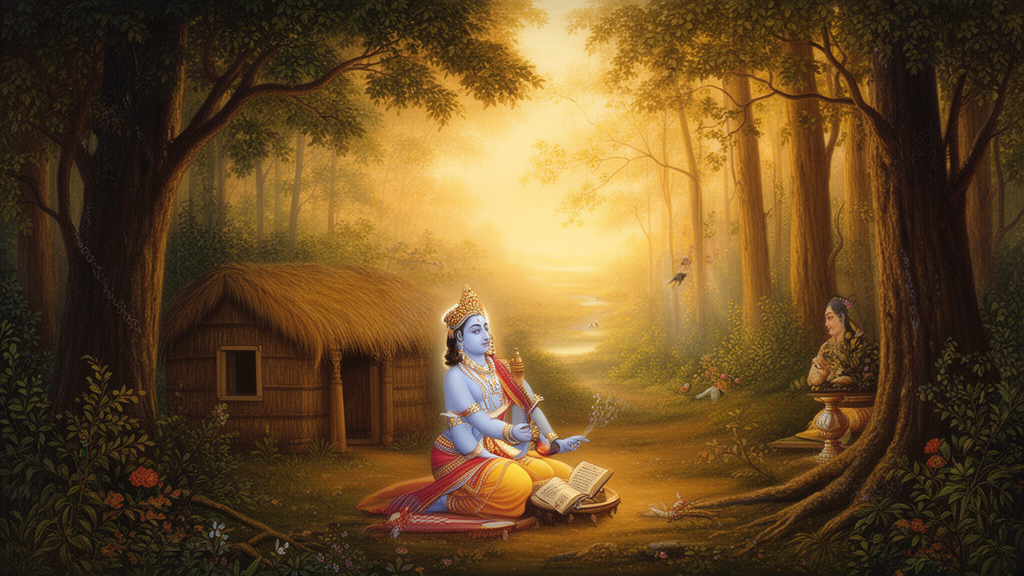
The Rama Upanishad is usually understood as a Sanskrit text that presents Lord Rama as the supreme reality, and it is closely associated with Rama mantra practice, yantra worship, and devotional meditation. Its best-known form in modern discussion is the Rama Rahasya Upanishad, a text that secondary summaries describe as a dialogue delivered by Hanuman. This guide explains what the text is, how its teachings are presented, and where careful readers should separate scripture, tradition, and modern interpretation.
One important caution applies from the start. The sources available for this article were mainly encyclopedic summaries, not a critical Sanskrit edition or a full translation of the text. The details below are therefore presented as claims reported by those summaries, and readers who want to study the Upanishad in depth should compare it with a scholarly edition and a translation that names its translator.
What the Rama Upanishad Is
The phrase “Rama Upanishad” is used in more than one way. In everyday discussion it most often refers to the Rama Rahasya Upanishad. Grokipedia, a web encyclopedia whose content should be checked against primary sources, describes it as a minor Sanskrit Upanishad attached to the Atharva Veda and listed among the 108 principal Upanishads in the Muktikopanishad. The same summary places it as the 54th text in that list. That listing should be confirmed against a published edition of the Muktika list before it is repeated in scholarly work.
The Upanishads are a body of texts usually treated as the concluding portions of the Vedas and as foundations of Vedanta philosophy. Many readers know the word from the phrase Upanishad, often glossed as “sitting near” a teacher, which points to the teacher-student setting of these texts. For background on the broader category, see our guide to the meaning of Upanishad, which is currently a WordPress draft and may not yet be publicly visible.
Within this category, the Rama Upanishad stands out because it is devotional as well as philosophical. Its teachings combine Vedantic ideas about ultimate reality with the worship of Rama, the central figure of the Ramayana and, in Hindu traditions, an avatar of Vishnu. Wikipedia’s article on Rama notes that the Upanishad tradition is one of the literary sources in which Rama is discussed, alongside the Ramayana, the Adhyatma Ramayana, and other texts. The article on the Ramayana also places Rama within a wider epic tradition with many versions.
Where the Text Sits in the Upanishad Tradition
Readers often ask whether the Rama Upanishad is “a real Upanishad” in the same sense as the older prose Upanishads such as the Brihadaranyaka or Chandogya. The answer depends on what is meant by “real.” Traditional lists, especially the Muktika list, count a set of 108 Upanishads, and many of those texts are later than the early Vedic-period Upanishads. Modern scholars commonly distinguish the older, widely studied Upanishads from later texts that were composed or compiled across centuries and often reflect sectarian interests.
The Rama Upanishad belongs to the second group in most accounts. Its devotional focus on Rama, its mantra material, and its ritual instructions give it a different character from many classical Upanishads that focus primarily on Brahman, atman, and self-knowledge. This does not make it less meaningful for devotees, but it does mean that scholars and practitioners often read it in a different framework.
Tradition, belief, and scholarship
It helps to separate four kinds of statement when reading about this text:
- Textual claims describe what the Upanishad itself says, such as its dialogue form or its discussion of Rama as Brahman.
- Traditional belief describes what devotees hold, such as the view that Rama is the highest reality or that japa of the mantra brings spiritual benefit.
- Regional or community practice describes how particular groups use the text, including whether they treat it as a scripture for daily worship.
- Scholarly interpretation describes how historians and philologists date, compare, and classify the text.
Keeping these separate avoids a common mistake: assuming that a devotional belief is a historical fact, or that a scholarly date is a religious judgment.
Structure of the Rama Rahasya Upanishad
The most detailed structural summary available for this article comes from Grokipedia, which describes five cantos, often called kandas or sections in English summaries. The summary also states that the text opens with traditional Shanti Patha invocations for peace and auspiciousness. Because the source is a secondary summary, the following outline should be read as a guide to the text’s general organization rather than as a verified chapter-by-chapter table.
- Opening inquiry. According to the summary, sages ask which truth is highest among the Vedas, Puranas, Smritis, and cosmic powers.
- Identity of Rama. In the summary’s account, Hanuman answers by presenting Rama as the embodiment of Brahma Taraka, a liberating principle the summary compares to Om.
- Mantras and their parts. The second canto is described as detailing many Rama mantras, beginning with a single-syllable seed and moving to longer forms.
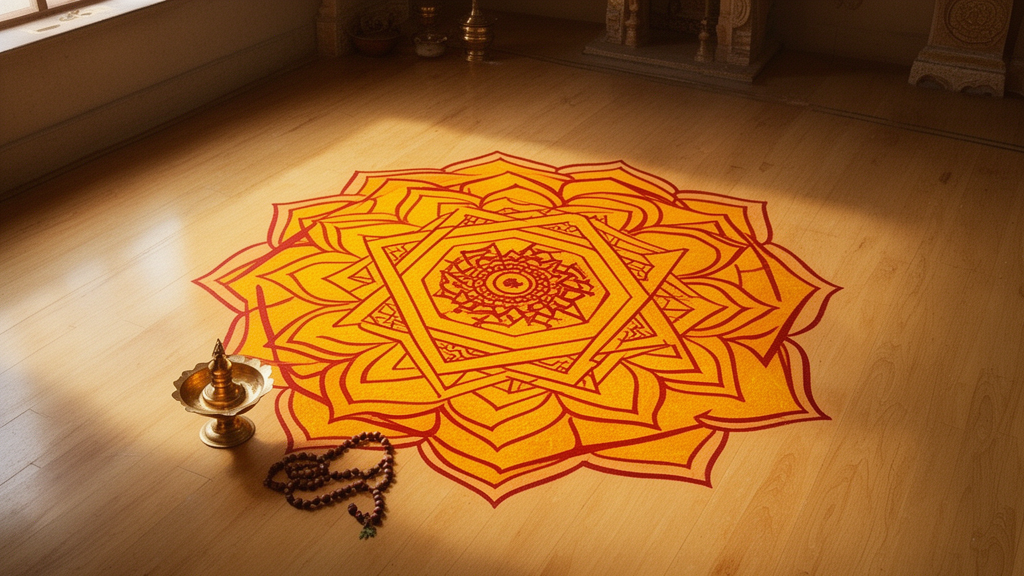
- Yantra. The third canto is described as explaining the construction of a Rama yantra, a geometric diagram with a central form and surrounding protective deities.
- Worship and japa. The fourth canto is described as prescribing ritual worship, including layered invocations and intensive repetition practices.
- Metaphysical conclusion. The fifth canto is described as affirming the mantras’ divinity and linking Ramayana episodes with philosophical meanings.
These descriptions give readers a useful map, but they should be checked against a critical edition. Manuscript traditions of Upanishads often differ in verse numbering, section titles, and the length of passages, and a summary may compress or regroup material.
Core Teaching: Rama as Supreme Brahman
The central claim of the Rama Upanishad, as summarized in secondary sources, is that Rama is not merely a heroic king or an avatar of Vishnu, but the ultimate reality known in Vedanta as Brahman. Grokipedia describes this as the revelation of Rama’s “esoteric identity” as Para Brahman. The same summary says the text places Rama’s companions and family members, including Lakshmana, Bharata, and Sugriva, as aspects or limbs of Rama within a larger theological system.
This teaching shows how the Upanishad blends two strands of Hindu thought. From the Vedanta side, it uses the language of ultimate reality, liberation, and the inner self. From the bhakti side, it places personal devotion to Rama at the center of spiritual life. Many devotees read these strands together: the Ramayana supplies the story and emotional relationship, while the Upanishad supplies a metaphysical account of who Rama is.
How a reader can approach this claim
When reading this teaching, it helps to ask three questions:
- What does the text itself say about Rama’s identity, and in which section?
- How does a tradition such as a Vaishnava or Vedantic community interpret that identity?
- What do historians say about the date and composition of the text?
A devotee may say that Rama is Brahman and find that statement meaningful in prayer. A scholar may study the same statement as a theological development within a particular period of Hindu literature. Both approaches can be respectful when they are kept distinct.
Mantras and Japa in the Rama Upanishad
The mantra material is one of the most practical parts of the Rama Upanishad. Grokipedia states that the second canto describes many Rama mantras, starting with the one-syllable seed Rāṃ, which the summary associates with fire, Vishnu, and Shiva, and moving to longer forms such as the six-syllable Om Rāṃ Rāmāya Namaḥ. The same summary says each mantra is given with its traditional seer, meter, deity, and body placement instructions, called nyasa.
Japa means repeated recitation of a mantra. In many traditions, japa is practiced with a rosary, with silent repetition, or with aloud recitation depending on the lineage and the teacher’s instruction. The Upanishad’s own presentation of these practices, as summarized, treats repetition as a way to focus the mind and to honor Rama’s name and nature.
Tradition-specific instruction
Mantra instructions are not identical across communities. Some practitioners receive a mantra through initiation from a guru. Others learn it from family or temple practice. Several details in the Upanishad, such as the number of repetitions or the exact placement of mantra syllables on the body, are tradition-specific and should not be presented as universal rules for all Hindus. Anyone who wishes to practice a mantra is best served by a qualified teacher within their own lineage.
The Upanishad, as summarized, also links mantra practice with the goal of liberation and with the traditional four aims of human life, often called purusharthas: dharma, artha, kama, and moksha. A responsible reading notes that this is a claim within the text’s devotional framework. It is not a guarantee of any material result. Readers should avoid assuming that mantra repetition produces predictable worldly outcomes.
Yantra and Worship Procedures
The Rama Upanishad, according to the summary, describes a Rama yantra, a geometric diagram used in worship. The third canto is said to describe a hexagonal core, concentric petals, and guardian deities of the directions, such as Indra and Agni, arranged around Rama at the center. The fourth canto is described as prescribing a layered worship sequence, sometimes called avarana puja, which moves from the center outward through successive circles of invocation.
Yantra worship is found in many Hindu traditions, but its details vary widely. Some temples and families use diagrams as meditative supports. Others use them within formal initiation systems. A reader who wants to draw or use a yantra should understand that the design and ritual use are tradition-specific, and that a printed diagram is not automatically an authorized instrument of worship.
Practical examples of respectful study
- Read the Upanishad’s description of the yantra alongside a scholarly diagram or a temple tradition’s explanation, noting where the sources differ.
- Use a published translation to check the names of guardians and their order in the diagram before drawing one.
- Ask a teacher whether a particular yantra or puja sequence belongs to your family or lineage.
The Rama Upanishad and the Ramayana
The Ramayana is the foundation for much of Rama devotion. Wikipedia’s article on the Ramayana describes it as an ancient Sanskrit epic attributed to Valmiki, and it notes that the epic has many versions and regional adaptations. The Rama Upanishad does not replace the epic. Instead, the Upanishad reads the epic’s characters and episodes through a theological lens.
Grokipedia’s summary says the fifth canto integrates Ramayana allegories, including the reading of Ravana as maya or illusion. This kind of allegorical interpretation is important in Hindu theology, but it is an interpretation. The Ramayana as a narrative also has its own devotional and literary meaning. Readers who enjoy the epic may find that the Upanishad adds a philosophical layer rather than a replacement story.
Retellings and versions
Rama’s story varies across regions and languages. Wikipedia’s Rama article lists several literary sources, including Tamil literature, the Adhyatma Ramayana, the Ramacharitmanas, and the Yoga Vasistha, alongside Upanishadic material. Mythopedia’s entry on Rama also presents Rama as an avatar of Vishnu and central figure of the Ramayana, while noting that the epic is traditionally attributed to Valmiki. Because these retellings differ in emphasis and detail, it is best not to treat one version as the only authentic account.
Textual Variants and Research Cautions
Readers should expect differences among editions, translations, and online texts. Upanishads survive in manuscript traditions and printed editions, and the same text may appear with different titles, verse divisions, or mantra lists. Online summaries may also contain errors, especially when they are generated quickly or copied from one another.
For that reason, the claims in this article are limited to what the reviewed sources support. Where a source is an encyclopedia summary, it is treated as a lead for further checking. Where a source is a general reference article, it is used for context rather than for detailed claims about the Upanishad’s content. Readers should also note that Wikipedia and similar sites may change over time.
Questions to ask about any edition
- Does it identify the source text, edition, or manuscript tradition?
- Does it name the translator or editor?
- Does it distinguish the Upanishad’s own words from commentary?
- Does it explain the mantra and yantra instructions, or does it simply reproduce them?
Scholarly and Devotional Perspectives
Scholars approach the Rama Upanishad with questions about date, authorship, sectarian context, and relationship to other texts. Such questions are often difficult to answer precisely because many Upanishads were transmitted orally, copied in manuscripts, and revised over long periods. Claims that give an exact date or author should be checked carefully, and unqualified statements about dating should be treated with caution.
Devotional perspectives are equally important. For many Rama devotees, the Upanishad is not only a text to analyze but a source of prayer, meditation, and identity. A respectful article should not dismiss that experience as mere belief, nor should it present devotional claims as proven historical facts. The reader benefits most when both perspectives are described clearly.
How to Begin Studying the Text Responsibly
Readers who want to explore the Rama Upanishad can follow a careful sequence:
- Learn the basic category. Read a general introduction to the Upanishads, such as the meaning of Upanishad draft, once it is publicly available.
- Compare related Rama texts. Look at the Rama Tapaniya Upanishad and the Rama Rahasya Upanishad Telugu draft to see how Rama-centered Upanishads are presented in different languages and editions.
- Check the canon list. Confirm the Muktika listing and the Upanishad’s Vedic attachment in a reliable scholarly or traditional source.
- Use a translation. Choose a translation that names its translator and explains its source text.
- Seek a teacher for practice. If you plan to chant mantras or perform yantra worship, ask a qualified teacher from your tradition.
Related Upanishads on HindusGod.com
Readers who want to compare the Rama Upanishad with other texts may find the following pages useful. Each link below points to a WordPress draft from the HindusGod.com content plan. These drafts may not yet be public, so readers should treat them as planned destinations until they are published.
- 108 Upanishad, for the traditional list that places the Rama Upanishad within a larger canon.
- 10 Upanishad, for a broader introduction to the principal Upanishads.
- Atharva Upanishad, for the Vedic association that the Rama Upanishad is said to share with the Atharva Veda.
- Atharvashikha Upanishad, for another Atharva Veda-linked text.
- Adhyatma Upanishad, for a comparison of inner-self teaching in shorter Upanishads.
- Advaita Upanishad, for the non-dual interpretive background that informs Vedantic readings of Brahman.
- Swami Rama Mandukya Upanishad, for a commentary-based study of the Mandukya tradition.
Frequently Asked Questions
Is the Rama Upanishad the same as the Ramayana?
No. The Ramayana is an epic poem attributed to Valmiki, while the Rama Upanishad is a Sanskrit text presented as a philosophical and devotional dialogue about Rama. The Upanishad refers to Ramayana material, but it is a separate work.
Does reciting the Rama mantra guarantee a specific result?
No reliable source supports a guaranteed material result. Devotees may recite the mantra for spiritual purposes, and the Upanishad’s summary presents liberation as its highest aim. Claims about protection, success, or wealth should be treated as traditional beliefs, not verified outcomes.
Which Upanishad should a beginner read first?
Beginners often start with a general introduction to the Upanishads and with a classical text such as those discussed in the 10 Upanishad draft. The Rama Upanishad is more specialized because of its devotional and mantra focus.
Summary
The Rama Upanishad, especially the Rama Rahasya Upanishad, presents Rama as the supreme reality within a framework that combines Vedanta, mantra practice, yantra worship, and devotion. According to secondary summaries, it is attached to the Atharva Veda, listed among the 108 Upanishads, and organized into five cantos. Its mantra and yantra teachings are tradition-specific and should be studied with a qualified teacher. A careful reader distinguishes the Upanishad’s own claims from devotional belief, community practice, and scholarly interpretation, and checks any detailed claim against a critical edition before relying on it.
Sources and Further Reading
- Rama, Wikipedia, for an overview of Rama as an avatar of Vishnu and the literary sources that discuss him, including Upanishadic material.
- Ramayana, Wikipedia, for the epic’s attribution, versions, and influence.
- Rama, Mythopedia, for a general mythological overview of Rama and the Ramayana narrative.
- Rama Rahasya Upanishad, Grokipedia, for a secondary summary of the text’s canto structure, mantra content, and yantra description. Verify these details against a primary edition before relying on them.
- Rama, Britannica, for a general reference entry on Rama as a widely worshipped Hindu deity and central figure of the Ramayana.
Further reading should begin with a critical edition or a translation that names its editor and translator, followed by academic histories of the Upanishads.