The Rama Tapaniya Upanishad is a Sanskrit text that presents Lord Rama as the supreme reality, or Brahman, and links devotion to Rama with Vedantic ideas of self-knowledge and liberation (moksha). It is usually classed among the minor Upanishads associated with the Atharvaveda and is counted among the 108 Upanishads of the Muktika canon. Its central claim is that worship of Rama, especially through the Rama mantra and meditation, is a direct path to moksha.
This guide explains what the text says, how it is organized, which teachings it emphasizes, and where scholarly and devotional views differ. It separates what the scripture states from later commentary, devotional belief and modern interpretation. For the wider story of Rama, see the separate articles on the Ramayana and on Rama’s divine status in Hindu traditions (Rama Upanishad is a related text worth comparing).
Quick answer: what is the Rama Tapaniya Upanishad?
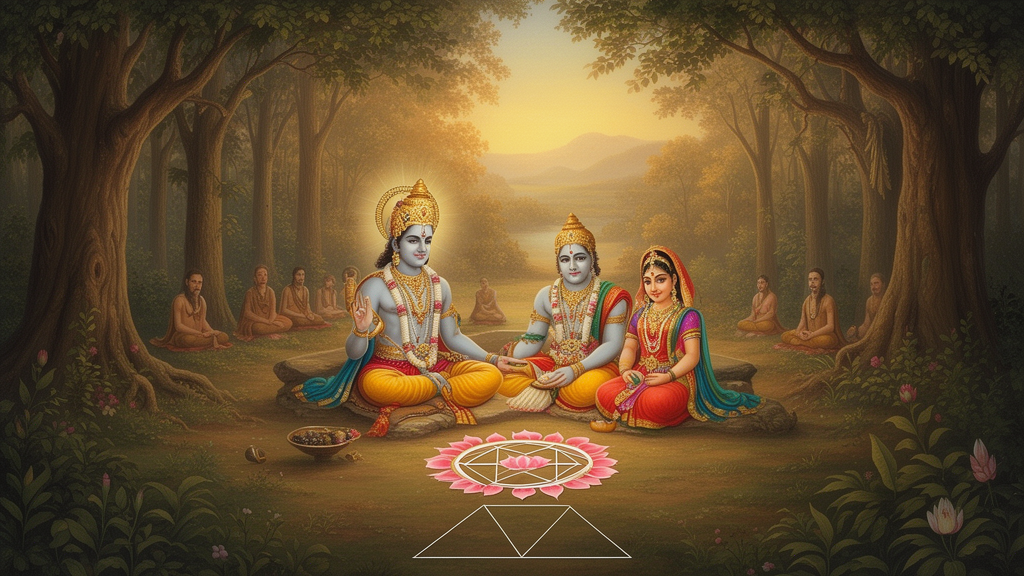
The Rama Tapaniya Upanishad is a short devotional-philosophical text in Sanskrit. It is traditionally read as an Upanishad of the Atharvaveda and is divided into two parts, the Purva (earlier) and Uttara (later) Tapaniya sections. The Purva section describes Rama, Sita and Lakshmana in meditative imagery and presents Rama as the embodiment of dharma and knowledge. The Uttara section presents Shiva teaching the Rama mantra and identifies Rama with the Supreme, the cosmos and the Vedic sounds.
According to the summary in Grokipedia’s entry on the Rama Tapaniya Upanishad, the text contains around 54 mantras in total, and the Uttara section repeats a key invocation 47 times. Because that figure comes from a secondary summary, readers who need exact counts should check a critical edition or a scholarly translation of the Sanskrit text.
Name, classification and the meaning of ‘tapaniya’
Where the text sits in the Upanishadic literature
Upanishads are generally treated as the concluding portions of the Vedas, and the word is often used for the philosophical texts that discuss Brahman, Atman and liberation. The Rama Tapaniya is listed in traditional groupings as an Atharvaveda Upanishad, and the Muktika canon of 108 Upanishads is a later collection that includes it. The Muktika list is itself a traditional grouping, not a single historical edition, so the inclusion of this text should be understood as a matter of the tradition’s classification rather than a standalone historical fact.
The word ‘tapaniya’
The title is commonly explained with reference to tapas, a Sanskrit term that can mean austerity, heat or spiritual discipline. Grokipedia notes that the Upanishad offers folk-etymological explanations of the name. Folk etymologies are traditional word-explanations that do not always match modern linguistic analysis. For this reason, the safest approach is to say that the title is connected with the idea of tapas, while noting that commentators and modern scholars do not present one fixed meaning.
Rama as the central figure
Rama is one of the most widely worshipped Hindu deities. Mythopedia describes him as an avatar of Vishnu and the central figure of the Ramayana, a story traditionally attributed to the sage Valmiki. Wikipedia’s article on Rama also notes that Rama is counted among the avatars of Vishnu in the Dashavatara list. The Rama Tapaniya Upanishad takes this familiar figure and develops him in philosophical terms, rather than retelling the epic narrative.
Structure of the text: Purva and Uttara sections
The Upanishad is divided into two sections. Reading the sections separately helps readers see that the text combines visualization practice with a more explicit teaching about mantra and identity.
The Purva Tapaniya section
According to Grokipedia’s summary, the Purva section describes Rama as the embodiment of ethical living, knowledge, prosperity and renunciation. It presents Rama as Para Brahman, beyond measure and form, who nevertheless takes a worshippable form, with Sita described as Prakriti, or nature. The section also uses meditative images. Grokipedia describes geometric arrangements, including a triangular pattern formed by Rama, Sita and Lakshmana, surrounded by deities, sages such as Vasishta, and directional guardians. These images are presented as aids to contemplation of Rama’s all-pervading nature.
The imagery is best understood as devotional visualization. It is not a historical description of a shrine or a map of worship used in every temple. Readers who wish to imitate such meditation should treat it as a contemplative exercise described in the text, and should follow the guidance of a teacher or lineage where appropriate.
The Uttara Tapaniya section
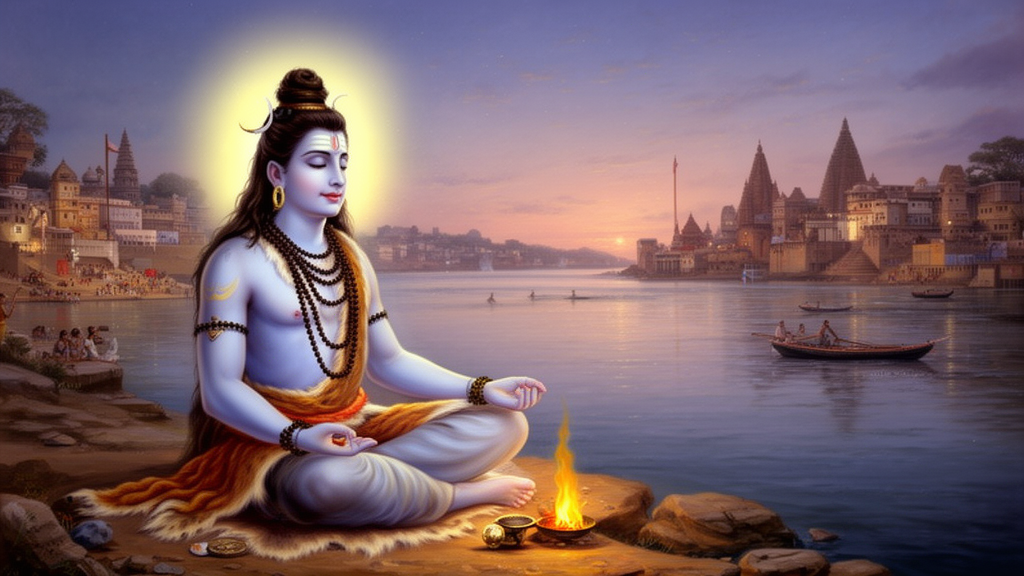
The Uttara section is set in Varanasi, according to Grokipedia, and presents Shiva speaking of the Rama mantra as a means of protection and liberation. Grokipedia describes the six-syllable mantra ‘Ram Ramaya Namah’ as the central practice, said to remove sin and lead to salvation, particularly when recited at the time of death. Because this is a summary of the text’s teaching, the mantra’s exact wording, syllables and recitation details should be checked against the Sanskrit edition or a translation used by a scholar or lineage.
The same section links Rama with multiple cosmic and divine categories. Grokipedia lists the identification of Rama with Vishnu, Shiva and Brahma, the ten avatars, the five elements, the seven Vyahrutis and the syllable Om. It also describes the repetition of a key declaration 47 times. The point of such identification in the Upanishad is theological: Rama is presented as the single reality underlying all names of the divine, not as one deity competing with others.
Key teachings of the Rama Tapaniya Upanishad
Rama as non-dual reality
The most important teaching is that Rama is not merely a historical king or an epic hero but the non-dual reality. Grokipedia describes Rama as the reality that encompasses illusion (maya), all existence and ultimate joy. In Vedanta, non-duality (advaita) usually refers to the view that the individual self (Atman) and ultimate reality (Brahman) are not ultimately different. The Rama Tapaniya uses this vocabulary and applies it to Rama.
This is a devotional form of Vedanta. It should be distinguished from the view that devotion is only a preliminary step to knowledge. The text combines bhakti, loving devotion, with jnana, knowledge of the self. For readers, this means the Upanishad can be read as a bridge between the devotional Rama tradition and the philosophical language of the Upanishads.
Rama, Sita and cosmic order
In the Purva section, Sita is described as Prakriti, a term from Samkhya and later Hindu philosophy that generally denotes nature or primordial matter. Grokipedia presents Sita as the principle of nature in relation to Rama’s transcendent reality. Readers should be careful here: the pairing of Rama and Sita in this text is theological symbolism, not a biography. Many devotional communities also read Rama and Sita as a divine couple whose relationship expresses dharma and love, but that is a tradition-specific reading rather than a universal doctrine.
Liberation and the promise of spiritual outcomes
Grokipedia states that the text promises divine vision, mastery over occult powers and a deathless state through mantra repetition and meditation. Such promises appear in the text as described by that summary, and they should be presented as the scripture’s claims within its own framework. They are not guarantees that a reader will experience a given result. Modern readers should also note that many Upanishads emphasize inner knowledge and detachment, and that occult powers are often treated with caution in the wider tradition.
Mantra practice: what the text teaches and how traditions apply it
Mantra practice is central to the Uttara section, but the details of practice vary. Some communities recite the Rama mantra as a daily japa, a repeated recitation counted on a rosary or simply kept in the mind. Others use it at specific times, such as morning worship, Ekadashi observances or the period around Rama Navami, the festival celebrating Rama’s birth that Wikipedia’s Rama article lists among the major Rama festivals.
A simple way to approach the practice, without making claims about results, is to follow these ordered steps:
- Read a translation or commentary first so that the meaning of the mantra and the context of the Uttara section are understood.
- Choose a consistent time and place for recitation, following the practice of your household, lineage or teacher.
- Recite slowly and with attention, using a rosary if your tradition uses one.
- Keep a record of the practice, if helpful, and review it with a teacher or community member who knows the tradition.
These steps describe general devotional practice and are not a ritual prescription from the Upanishad itself. Where the text describes specific meditative images, such as the mandala-like arrangement in the Purva section, a reader should treat them as traditional contemplation aids and seek guidance on whether and how to use them.
Dating and textual history: what is known and what is uncertain
Grokipedia states that the Rama Tapaniya Upanishad was likely composed between the 8th and 14th centuries CE. This date range is useful as a summary of scholarly uncertainty, but it should not be treated as a confirmed historical date. Many minor Upanishads were composed, revised and transmitted over long periods, and their dates are often debated. A reader who wants a firm date should consult a critical study of the text, which will explain the evidence for dating and any manuscript differences.
The text’s later status also matters. Its emphasis on Rama as supreme Brahman reflects a devotional movement that developed alongside other Rama-centred works. Wikipedia’s Rama article lists several literary sources for Rama devotion, including the Adhyatma Ramayana, the Ramacharitmanas and the Yoga Vasistha, as well as Upanishadic material. Each of these works has its own history and audience. Comparing them can show how Rama’s image changed over time, but the comparison should not assume that all these texts share one author, date or theology.
How the Rama Tapaniya differs from the Ramayana and other Rama texts
The Ramayana, attributed to Valmiki, is an epic poem that narrates Rama’s life, exile, the abduction of Sita by Ravana and the war in Lanka. The Rama Tapaniya is not a narrative epic. It is a short Upanishad that uses the figure of Rama to explain philosophical and devotional themes. A reader who wants the story should begin with the Ramayana or a reliable retelling, while a reader who wants the theology of Rama worship may find the Upanishad more relevant.
The distinction matters because Hindu traditions do not treat all Rama material as one text. Wikipedia’s Ramayana article notes that the epic exists in many versions across India and Southeast Asia, with significant regional differences. The Rama Tapaniya belongs to a different genre. Readers should therefore avoid assuming that a detail from the Ramayana appears in the Upanishad, or that the Upanishad’s theology is the same as that of every Rama devotional community.
Regional and sampradaya perspectives
Rama is worshipped in many regional and devotional settings, and the way his identity is understood varies. Some Vaishnava communities see Rama as an avatar of Vishnu, while others emphasize Rama as the Supreme Being in his own right. Wikipedia’s Rama article describes Ramaism, a tradition that treats Rama as the Supreme Being, though it is a specific devotional stance rather than the view of all Hindus. Shaiva readers may encounter the Uttara section’s teaching that Shiva transmits the Rama mantra, and may read this as a sign of harmony between traditions. Other readers may approach the text primarily as Vedanta. None of these approaches is the single correct reading.
Regional customs also shape how the text is used. Ramayana performances, Ramlila dramas and festival observances differ across North India, South India and Southeast Asia. Simple English Wikipedia’s Rama article notes Rama-related traditions as part of a wide Hindu framework, but readers should check local communities and teachers for specific observance details.
Examples of how the text can be explored
Readers who are new to the Rama Tapaniya Upanishad often find it useful to compare its ideas with other devotional and Upanishadic texts. Consider three examples:
- Devotion and knowledge together: The Upanishad combines the warmth of Rama bhakti with the language of Brahman and Atman, showing how the two are sometimes presented as complementary rather than opposed.
- Symbolic imagery: The triangular arrangement of Rama, Sita and Lakshmana in the Purva section illustrates how the text uses visual symbols to guide contemplation, similar to many meditative images in Hindu worship.
- Mantra as focus: The Uttara section’s emphasis on repeating a short mantra resembles the broader Hindu practice of japa, where a single sacred phrase becomes the focus of attention.
For readers who want to compare the Rama Tapaniya with other minor Upanishads on the site, the related pages Rama Rahasya Upanishad Telugu and Swami Rama Mandukya Upanishad may be useful once they are published, because they connect Rama with other Upanishadic themes. Pages on Atharva Upanishad and 108 Upanishad can help readers place the text within the Atharvaveda and Muktika classifications. Each of these links points to a draft page that may not yet be public, so editors should confirm status before publication.
How to read the Rama Tapaniya Upanishad responsibly
Readers who approach the text for the first time can keep their study clear by separating four kinds of statement. First, what the text itself says, such as its description of Rama as Brahman. Second, traditional belief or devotional interpretation, such as the view that the mantra protects at death. Third, scholarly observations about dating, manuscripts and classification. Fourth, modern commentary and personal practice. Keeping these categories distinct prevents a summary from being read as a verified historical claim or as a guarantee of a spiritual result.
It is also wise to use a translation with a named translator and publication details, and to compare it with a second source where possible. Because the Upanishad is short but dense, a commentary can help readers understand terms such as Brahman, Atman, Prakriti and Vyahruti. Any Sanskrit term that appears in a translation should be read in its context, as meanings can shift across traditions.
Frequently asked questions
Is the Rama Tapaniya Upanishad part of the Ramayana?
No. The Ramayana is an epic poem traditionally attributed to Valmiki, while the Rama Tapaniya is a shorter Upanishad. The Upanishad refers to Rama and draws on his identity, but it does not retell the epic narrative.
Does the text say which mantra to chant?
According to the summary of the Uttara section on Grokipedia, the central mantra is ‘Ram Ramaya Namah’. Readers should confirm the exact wording and recitation instructions in a reliable edition or translation and follow a teacher or tradition for practice.
Is the Rama Tapaniya Upanishad the same as the Rama Upanishad?
They are different texts. The Rama Tapaniya is a Sanskrit Upanishad described as having Purva and Uttara sections. Readers who search for the Rama Upanishad should check the separate page and confirm the text being discussed.
Summary and next steps
The Rama Tapaniya Upanishad is a short but significant text that presents Rama as supreme Brahman and links his worship with the Upanishadic pursuit of liberation. Its Purva section offers meditative imagery centred on Rama, Sita and Lakshmana. Its Uttara section teaches the Rama mantra and identifies Rama with cosmic and divine categories. Its dating, manuscript history and exact details should be checked in scholarly sources, and its practices should be approached according to a reader’s own tradition and teacher.
For readers who want to continue, the next step is to read a reliable translation, compare it with the Ramayana or other Rama texts, and consult a teacher if you plan to undertake mantra practice. Editors should also confirm the status of linked draft pages before publishing this article.
Sources and further reading
- Grokipedia: Rama tapaniya Upanishad. Used for the summary of the Purva and Uttara sections, the mantra, the 47-fold repetition, the proposed date range and the classification within the Atharvaveda and Muktika canon. This is a secondary, AI-assisted summary and should be checked against a primary edition.
- Wikipedia: Rama. Used for Rama’s status as a major deity, his place among the Dashavatara avatars, the listing of Rama-related literary sources, Rama Navami and the note on Ramaism.
- Wikipedia: Ramayana. Used for the attribution of the epic to Valmiki and for the existence of many regional versions.
- Simple English Wikipedia: Rama. Used for a general overview of Rama within Hindu traditions.
- Mythopedia: Rama. Used for Rama as an avatar of Vishnu, the Ramayana’s narrative outline and the bond with Hanuman as bhakti.
Further reading: consult a critical or scholarly edition of the Rama Tapaniya Upanishad and a translation with a named translator. URL to confirm before publication.