The Ram Rahasya Upanishad (Sanskrit: राम रहस्य उपनिषत्, often transliterated as Rama Rahasya Upanishad) is a minor Upanishad that presents Rama as the supreme reality. It is written in Sanskrit, is traditionally linked to the Atharvaveda, and is classified as a Vaishnava Upanishad. Its central claim is that Rama is the ultimate Brahman, and it explains the mantras, diagrams and worship practices through which devotees approach him. This guide explains what the text says, how it is classified, where scholars place it in time, and where the evidence is uncertain.
Direct answer: what is the Ram Rahasya Upanishad?
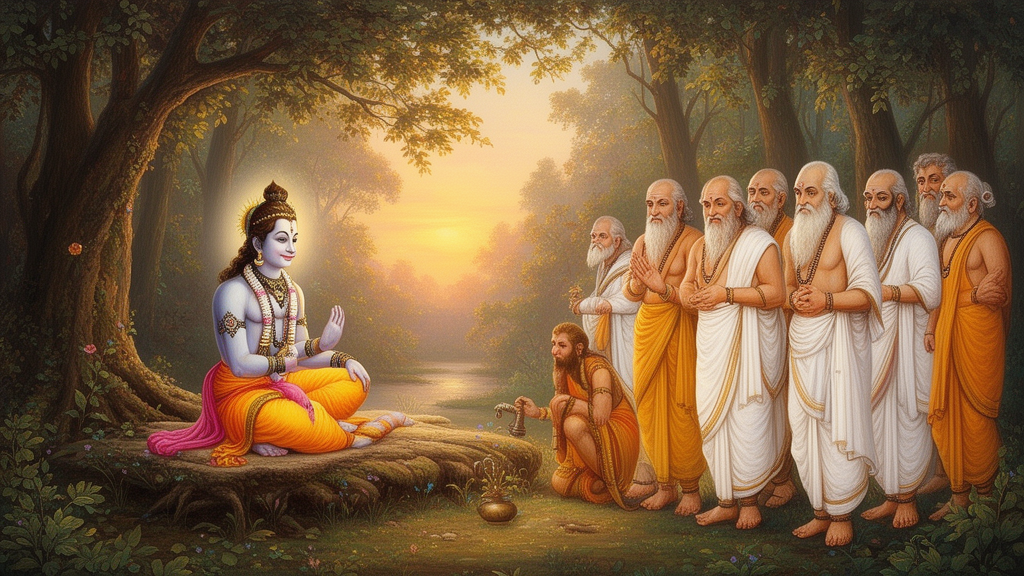
The Ram Rahasya Upanishad is a late Sanskrit text in the Upanishadic style that belongs to the Vaishnava tradition. Wikipedia describes it as one of the 31 Upanishads attached to the Atharvaveda and as one of the 14 Vaishnava Upanishads, with five chapters and a date range given as the 9th to 11th century.Wikipedia: Rama Rahasya Upanishad A secondary summary describes it as a dialogue in which Hanuman explains the esoteric identity of Rama to a group of sages and then teaches the methods of his worship.Grokipedia: Rama Rahasya Upanishad
For most readers, the most useful way to approach the text is as three layers: the teaching about Rama, the mantra and yantra practices described for devotees, and the philosophical explanation of why those practices are considered meaningful within Vaishnava Vedanta. Each layer needs a different kind of source, and this article keeps them separate.
The name and its spelling
You will see the title written in several ways. The Devanagari form is राम रहस्य उपनिषत्, the IAST transliteration is Rāma Rahasya Upaniṣad, and the English forms Ram Rahasya Upanishad and Rama Rahasya Upanishad both appear widely. The word rahasya means secret or mystery, so the title can be read as the Upanishad of Rama’s secret, which is how Wikipedia translates it.Wikipedia: Rama Rahasya Upanishad
The spelling difference between Ram and Rama is common in English. Rama is the usual transliteration in scholarly writing, while Ram is common in popular usage. Neither changes the meaning of the title. The word upanishad is written with different diacritics in different sources, and this article uses the common English form.
Readers may also meet a Telugu-language version of the same title. HindusGod.com has a separate draft on that topic, which may not yet be public: Rama Rahasya Upanishad Telugu. Treat it as a different edition or language study rather than a substitute for the Sanskrit text.
Where the text sits in the Upanishadic tradition
Attachment to the Atharvaveda
The Upanishads are usually associated with particular Vedas. Wikipedia states that the Rama Rahasya is one of 31 Upanishads attached to the Atharvaveda.Wikipedia: Rama Rahasya Upanishad The idea of a text being attached to a Veda is a traditional classification. It tells readers which textual family the Upanishad is linked with, but it does not mean that the content was composed in the same period as the earliest Vedic hymns.
Vaishnava classification
The Upanishad is classified as one of the 14 Vaishnava Upanishads.Wikipedia: Rama Rahasya Upanishad Its main theme is the supremacy of Rama, who is revered in Vaishnavism as an avatar of Vishnu. Wikipedia lists the text under Vaishnavism and Vedanta as its philosophical context.Wikipedia: Rama Rahasya Upanishad This matters because Rama is also worshipped in many traditions outside a strictly Vaishnava frame, and readers should not assume that every Rama devotee reads the text in the same way.
Date and historical uncertainty
Wikipedia gives the date range as the 9th to 11th century.Wikipedia: Rama Rahasya Upanishad This is a scholarly estimate for a text whose composition history is not fixed by a single datable record. Readers should treat the date as a range proposed in reference literature, not as a certainty. Where a source calls the text late, this usually means it is later than the older Vedic and classical Upanishads, not that it is unimportant.
The article also needs to be careful with traditional claims. Some secondary summaries place the Rama Rahasya among a larger canon of 108 Upanishads listed in the Muktikopanishad, where it is described as the 54th text.Grokipedia: Rama Rahasya Upanishad That enumeration is a traditional canon list. It should be checked against a primary edition or a dedicated scholarly study before being repeated as fact. HindusGod.com has a separate overview of the 108 Upanishad list: 108 Upanishad (URL to confirm as public; currently a WordPress draft).
The structure of the text: five cantos
The Rama Rahasya is usually described as having five chapters, often called cantos in secondary summaries.Wikipedia: Rama Rahasya Upanishad The summary below follows the broad outline given in the secondary source. Chapter titles, verse numbers and exact internal divisions should be checked against a specific Sanskrit edition before any citation is made.
Canto one: the sages’ question and Rama’s limbs
The text is framed as a dialogue. Hanuman answers a question posed by sages, who ask which truth is highest among the Vedas, Puranas, Smritis and cosmic powers. The first canto is said to establish Rama’s angas, or aspects, including deities such as Ganesha, Saraswati, Durga and Narayana, and figures from the Ramayana such as Lakshmana, Bharata and Sugriva. In this presentation, these figures are understood as contained within Rama.Grokipedia: Rama Rahasya Upanishad
Canto two: the Rama mantras
The second canto is described as covering many variations of Rama mantras. It begins with the one-syllable seed syllable Rāṃ and moves toward longer forms. The six-syllable form most often cited in secondary summaries is Om Rāṃ Rāmāya Namaḥ. Each mantra is said to have prescribed sages, metres, deities and bodily placement rituals called nyasa. Practitioners are said to repeat the mantra as japa for purification and the traditional goals of life.Grokipedia: Rama Rahasya Upanishad
Canto three: the Rama yantra
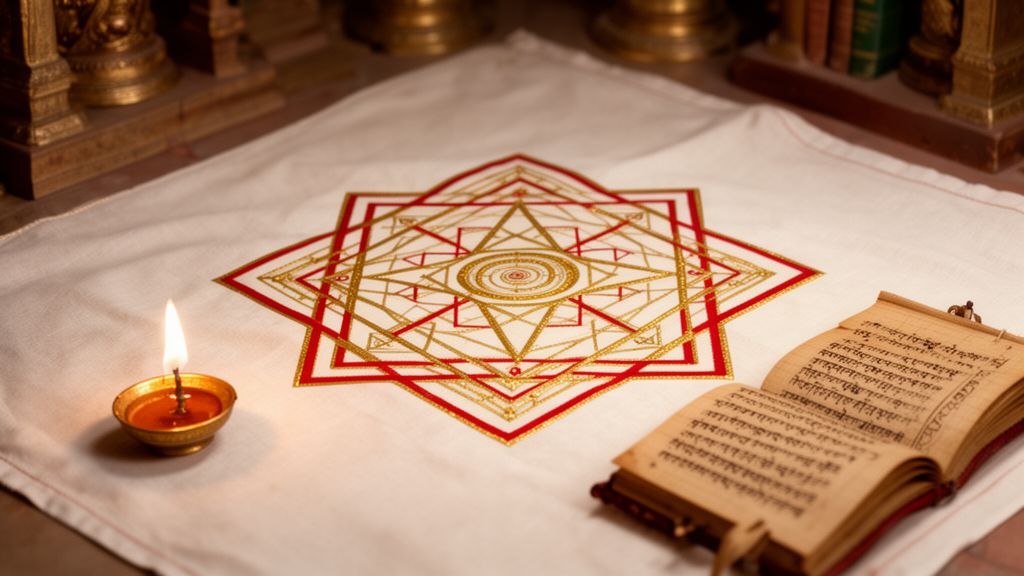
The third canto is said to describe the construction of a Rama yantra, a geometric diagram with a central hexagonal form, concentric petal rings, and guardians of the directions such as Indra and Agni. The yantra is described as a sacred palace with Rama at its centre.Grokipedia: Rama Rahasya Upanishad A diagram of this kind should be described, not drawn freehand from memory. Readers who want to construct one should consult a trained teacher and a reliable published diagram.
Canto four: worship procedure
The fourth canto is summarized as prescribing puja for the yantra. The stages mentioned include layered invocations moving from centre to periphery, intensive repetition called purashcharana, and offerings and homa, or fire ritual, with tarpana, a libation rite. The summary also mentions salutations to Rama in relation to cosmic and ritual categories, including the vyahritis, planets and siddhis.Grokipedia: Rama Rahasya Upanishad These ritual elements are tradition-specific. Many households and temples use simpler forms of worship, and the full procedure is normally taught within a lineage.
Canto five: metaphysical teaching
The fifth canto is described as the philosophical culmination. It affirms the divinity of the mantras, equates the six-syllable Rama mantra with Om in this text’s teaching, and reads Ramayana episodes allegorically. One example given in the secondary summary is the interpretation of Ravana as maya, or illusion.Grokipedia: Rama Rahasya Upanishad
Core teaching: Rama as Para Brahman
The central theme is that Rama is the highest reality. The secondary summary calls Rama Para Brahman, the ultimate reality, and describes the text as integrating Vedantic philosophy with Tantric and devotional elements.Grokipedia: Rama Rahasya Upanishad Wikipedia likewise places the text in Vaishnava and Vedanta contexts.Wikipedia: Rama Rahasya Upanishad
Vedanta is a broad philosophical tradition. Within it, different schools understand Brahman, the self and the world in different ways. The Rama Rahasya’s presentation of Rama as Brahman should therefore be read as the text’s own teaching, not as a universal statement shared by every Vedantic school. Readers who study Advaita, Vishishtadvaita or Dvaita will find that each tradition frames the relationship between a personal deity and ultimate reality differently.
Devotion and knowledge
The text is often discussed as a meeting point of philosophical knowledge and devotional practice. Its stated aim, as summarized in secondary sources, is liberation, or moksha, through understanding Rama and through the mantra and worship practices described in the text.Grokipedia: Rama Rahasya Upanishad A devotee’s experience of such aims is a matter of faith and practice, not something a text can guarantee in measurable terms.
The angas and the sages in the dialogue
The sages named in the secondary summary include Sanaka, Mudgala, Shandilya, Paingala, Yajnavalkya, Bharadwaja, Prahlada and Vibhishana.Grokipedia: Rama Rahasya Upanishad The presence of these names helps place the text within a wider literary world of sages, but the names alone do not establish historical participation. Their role in the dialogue is literary and teaching-based.
The inclusion of deities such as Ganesha, Saraswati and Durga within Rama’s angas shows an inclusive devotional structure. In many Hindu traditions, these deities receive independent worship. The Rama Rahasya presents them as aspects within a larger Rama-centred framework. Readers from other sampradayas may interpret this differently, and it is fair to describe it as the text’s teaching rather than a universal theology.
The Rama mantras and japa
What the bija Rāṃ represents
The seed syllable Rāṃ is central to many Rama mantras. Secondary summaries say the text associates it with fire, Vishnu and Shiva.Grokipedia: Rama Rahasya Upanishad Bija mantras are short, concentrated syllables used in Tantric and devotional practice. Their meanings are often explained by lineage teachers, and the associations listed in one text may not match those given in another.
The six-syllable mantra
The six-syllable mantra Om Rāṃ Rāmāya Namaḥ is widely used in Rama devotion, and secondary summaries identify it as a central form in this Upanishad.Grokipedia: Rama Rahasya Upanishad It is a mantra of worship and remembrance. Its meaning can be translated as an offering of reverence to Rama, with the seed syllable and the invocation of Om placed at the start. Translations should be attributed to the translator or teacher who provides them.
Japa as a practice
Japa means repeated recitation, often with a rosary or by counting. Many traditions advise that the mantra be received from a guru or teacher, and some lineages require initiation. Whether to practise a mantra with a particular count, time, posture or ritual preparation depends on the tradition. This article does not give a prescription for those details.
- Text: The Rama Rahasya describes multiple mantra forms and their prescribed details.
- Tradition: Practice rules vary between Vaishnava lineages and between households.
- Teacher: Many devotees learn mantras from a guru rather than from a book alone.
The Rama yantra and puja
A yantra is a geometric diagram used in worship. The Rama yantra described in the third canto is said to have a hexagonal core, petal rings and guardian deities placed around its outer structure.Grokipedia: Rama Rahasya Upanishad The yantra is used as a focus for meditation and worship, and its symbolism is explained in the Upanishad as a palace-like structure.
The worship sequence in the fourth canto includes layered invocations and ritual offerings. The text’s procedures are detailed and are meant for a qualified practitioner. Readers should not attempt complex purashcharana, homa or tarpana rites based only on a summary. Those practices usually require guidance, correct materials and an understanding of the lineage that governs them.
Household and temple practice
Rama is worshipped in homes and temples in many forms, including images, murtis, readings from the Ramayana and simple daily offerings. The Rama Rahasya’s yantra-based worship is one practice among many. It should not be presented as the only proper way to worship Rama.
Ravana as maya and the Ramayana as allegory
The Ramayana is a major epic in which Rama defeats Ravana. In the Rama Rahasya, as summarized in secondary literature, some episodes are interpreted allegorically. Ravana is described as maya, or illusion, in the fifth canto’s metaphysical teaching.Grokipedia: Rama Rahasya Upanishad
This kind of interpretation is important for readers who know the Ramayana as a narrative epic. The Upanishad reads story elements as spiritual teaching, but the epic also remains an independent literary and devotional tradition. Readers may encounter different versions of the Ramayana, and the Rama Rahasya should not be used to define the only meaning of the epic.
For a broader introduction to the epic, readers can consult HindusGod.com’s Rama-related material: About God Ram (URL to confirm as public; currently a WordPress draft).
How different communities read the text
The Ram Rahasya Upanishad is not read in one uniform way. A few points are useful for readers to keep in mind.
- Vaishnava readers may see the text as part of their canonical or devotional literature, especially where Rama is understood as an avatar of Vishnu.
- Rama devotees from other traditions may use the mantras and devotional songs without adopting every ritual detail described in the Upanishad.
- Scholars may read the text as a late Upanishadic and Tantric-influenced work, with attention to its composition history, manuscript variation and philosophical argument.
- Regional readers may encounter translations or versions in local languages, such as the Telugu edition noted earlier, and these may differ in arrangement or emphasis.
Readers who belong to a specific lineage should follow their own teacher’s guidance on mantra, yantra and puja. The article describes the text, but it does not replace lineage instruction.
Evidence, uncertainty and scholarship
This article distinguishes four kinds of claim. The first is what the text itself says, which should be checked in a Sanskrit edition or a reliable translation. The second is traditional belief, such as the view that Rama is Para Brahman or that mantra practice leads toward liberation. The third is historical and scholarly estimate, such as the 9th to 11th century date range. The fourth is modern interpretation, including allegorical readings of the Ramayana.
Some sources used for this overview are secondary. Wikipedia offers a general reference point with a date range, Vaishnava classification and Atharvaveda attachment.Wikipedia: Rama Rahasya Upanishad The Grokipedia page is useful for summarizing canto content, but it is an AI-generated encyclopedia page with a fact-check label, so its claims about chapter contents and sage names should be confirmed against a primary text before citing them in scholarly work.Grokipedia: Rama Rahasya Upanishad
Where specific verse numbers, Sanskrit wording or exact manuscript dates are needed, readers should consult a critical edition or academic study. This article does not provide verse-level citations, because those were not verified against a primary Sanskrit edition during preparation.
A practical way to read the Ram Rahasya Upanishad
- Start with a translation that names its translator and edition, so the wording can be checked.
- Read the framing dialogue first to understand who speaks and who listens.
- Note the five-canto structure and read each canto as a unit, rather than jumping only to mantras or diagrams.
- Separate the text’s teachings from later commentary, lineage practice and personal devotion.
- If you plan to practise mantra or yantra worship, seek a teacher from a recognized lineage before starting.
This approach helps readers see the Upanishad as both a theological text and a source of devotional practice, without treating every detail as a universal rule.
Frequently asked questions
Is the Ram Rahasya Upanishad part of the 108 Upanishads?
Some traditional lists of 108 Upanishads include the Rama Rahasya, and one secondary summary places it as the 54th text in the Muktikopanishad’s canon.Grokipedia: Rama Rahasya Upanishad Readers should check the list in a specific source, because enumerations vary.
Is the text the same as the Ramayana?
No. The Ramayana is an epic narrative. The Ram Rahasya Upanishad is a Sanskrit Upanishadic text that refers to Ramayana figures and episodes and interprets some of them spiritually.Grokipedia: Rama Rahasya Upanishad
Do I need initiation to chant the Rama mantra?
Practice rules differ by tradition. Some teachers encourage learning a mantra from a guru, while others allow personal recitation of widely used names and mantras. Readers should follow the guidance of their own lineage or teacher.
Closing takeaway
The Ram Rahasya Upanishad is a late Sanskrit Vaishnava text that presents Rama as the highest reality and explains mantras, yantra worship and philosophical readings of the Ramayana. Its value for readers lies in understanding its structure, its devotional aims and its place in Upanishadic and Vaishnava literature. The best next step is to read a reliable translation, compare it with lineage teaching, and keep the text, tradition and scholarly estimate distinct.
For a related reading in the same editorial collection, see Gayatri Rahasya Upanishad and Saraswati Rahasya Upanishad (URLs to confirm as public; currently WordPress drafts). For a general introduction to the term, see Meaning of Upanishad (URL to confirm as public; currently a WordPress draft).
Sources and further reading
- Rama Rahasya Upanishad, Wikipedia: used for the Sanskrit title, Atharvaveda attachment, Vaishnava classification, five-chapter count, and 9th to 11th century date range. Secondary reference; check primary editions before scholarly citation.
- Rama Rahasya Upanishad, Grokipedia: used for the canto-by-canto summary, sage names, mantra forms, yantra description, puja stages and the Ravana-as-maya reading. AI-generated secondary summary; verify against a primary text.
- Rama Rahasya Upanishad Telugu: internal draft on a Telugu-language edition (URL to confirm as public).
- 108 Upanishad: internal draft on traditional Upanishad enumerations (URL to confirm as public).
- Meaning of Upanishad: internal draft on the term Upanishad (URL to confirm as public).