The phrase raksha sutra meaning refers to a simple idea with layered religious and cultural uses. Raksha means protection and sutra means thread, so a raksha sutra is a protective thread. In Hindu practice it is a consecrated thread tied on the wrist or another part of the body during a puja, a homa, a wedding, or a festival. Its significance comes from the ritual in which it is tied, the mantra spoken with it, and the relationship between the people taking part. It is not a single fixed object with one universal ritual, and the name and customs differ across families, regions, and communities.
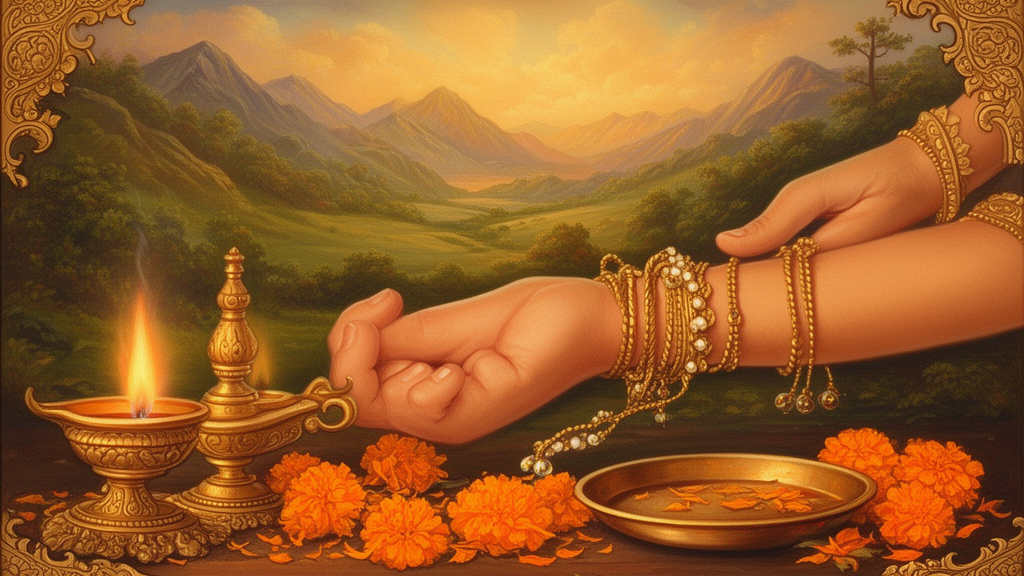
This article explains the word’s meaning, the ritual settings where the thread appears, the mantra and mythic narrative most often connected with it, regional and astrological variations, and how it relates to Raksha Bandhan. It separates what the sources state, what traditions teach, and what scholars and dictionaries say about the terms.
The direct answer: what raksha sutra means
Literally, rakṣā means protection and sūtra means thread or cord. A Sanskrit-English dictionary entry for rakṣāsūtra, reproduced on Wisdom Library from the Monier-Williams dictionary, glosses the compound as “a carrying-girth.” A Nepali-English dictionary entry on the same site gives a more practical meaning: “a ceremonial thread for protection.” Both entries are lexical glosses. They confirm the compound and its basic sense, but they do not describe how the thread is used in ritual.
In devotional and ritual usage, the raksha sutra is understood as a thread that carries a prayer for protection, blessing, and steadiness. The Hinduculture Hub article describes the thread as one that “can carry a prayer for protection, a blessing and the memory of a religious commitment.” The Divine India article describes it as a sacred thread adorned during Hindu rituals that symbolizes protection and auspiciousness. These are descriptions of how the thread is understood in practice. They are not a guarantee of any particular outcome.
Other names for the same thread
Readers will meet several names, and they do not always mean exactly the same thing:
- Raksha sutra is the Sanskrit compound and the term used in mantras and scriptural-style discussion.
- Mauli is a common name in many parts of India for the red or yellow thread tied on the wrist during worship. The Divine India article uses “Mauli” as an alternative name for the Raksha Sutra.
- Kalava is the name used in the Divine India article for the thread tied during rites, particularly in its discussion of which hand to use.
- Rakhi is the word most often used for the thread tied by a sister on her brother’s wrist during Raksha Bandhan. Times of India describes the rakhi as a bright thread tied on the wrists of brothers, and it notes that the chanting of mantras gives the rakhi “an added meaning” as a raksha sutra.
These names overlap in everyday speech, but a rakhi tied at a family festival and a mauli tied by a priest during a puja are not always treated the same way. Naming should follow the context and the family’s own usage.
Where the thread appears in Hindu practice
Raksha Bandhan and the sibling bond
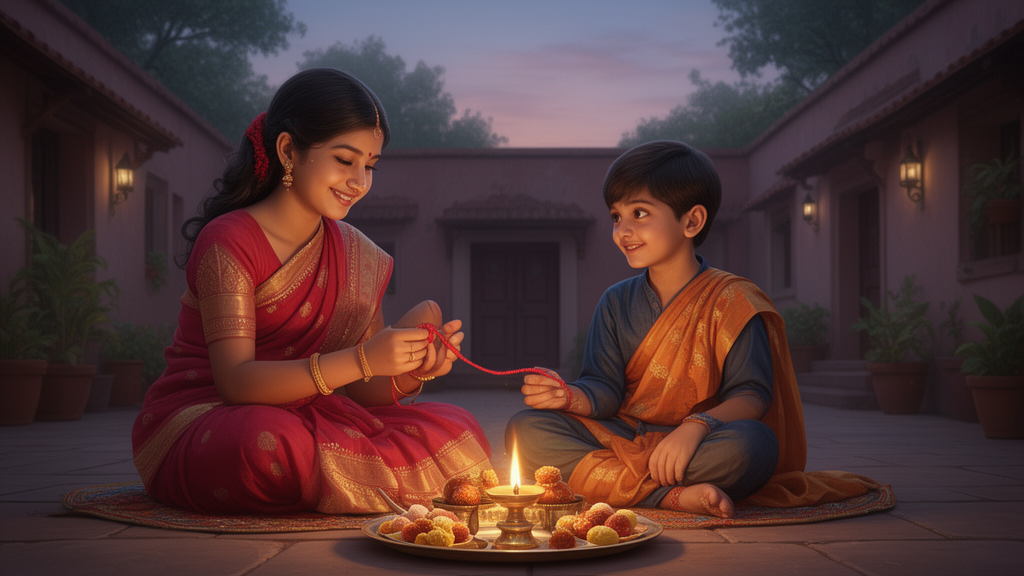
The most familiar setting is Raksha Bandhan, which the Hinduculture Hub article describes as a familiar setting for a protective thread. In this festival, a sister ties a thread on her brother’s wrist and prays for his well-being, and the brother gives a promise of protection in return. The sibling relationship is the social and emotional frame of the rite. It is widely observed in many parts of India, though the specific customs vary by region and family.
The Hinduculture Hub article makes an important point: the sister’s rakhi is one setting, but ritual threads also appear in other ceremonies. Understanding the raksha sutra means looking at the setting as well as the object.
Pujas, yajnas, and other rites
The Divine India article states that during pujas, yajnas, or other religious rituals, the Mauli is tied as a symbol of divine protection. The Hinduculture Hub article notes that in a puja or wedding, the priest may tie a thread as part of the rite. In these settings the thread is often associated with the officiating priest, the mantra, and the sacred purpose of the occasion. The person receiving the thread is usually a participant in the rite rather than a relative bound by family duty.
Weddings and other life-cycle ceremonies
The Hinduculture Hub article cites a documented wedding example, in which a thread is tied during the ceremony. Threads in weddings are commonly understood as marking the couple’s commitment and the blessing of the rite. The exact thread, its color, and the person who ties it vary considerably across communities. Readers planning a wedding should follow the officiant and family tradition rather than a general guide.
The Sanskrit mantra and the Bali story
The mantra as recorded in sources
The best-known mantra associated with the raksha sutra is recorded in several sources, with minor differences in spelling and transliteration. Times of India gives the Sanskrit text as yena baddho bali rajā dānavendro mahābalaḥ, tena tvām prati-badhnāmi rakṣe mā cala mā cala, with a transliteration beginning “Om yena baddho Bali raja danavendro mahabalah.” The Divine India article gives the text as Yen Baddho Bali Raja Danavendro Mahabalah | Ten Twam Abhibadhnami Rakshe Maa Chala Maa Chala. The differences in spelling are typical of transliteration, and readers will find several forms in printed and online material.
The mantra’s meaning is given in the sources as follows. Times of India renders it as: “I tie this sacred thread on you, just as it was tied to the mighty King Bali. May it protect you always and never come undone.” The Divine India article gives a more literal rendering: “I bind you with the same Raksha Sutra with which the great powerful Danavendra King Bali was tied, which will protect you, O Raksha, you remain steadfast, remain steadfast.” Both are translations rather than the original Sanskrit, and they differ in wording. A translation should be attributed to the source that offers it.
The Vamana and Bali narrative
The mantra refers to a story about Bali, a daitya or asura king, and Vishnu in his Vamana form. The Divine India article summarizes the mythic tradition: Lord Vishnu’s Vamana avatar is said to have tied the raksha sutra on King Bali’s wrist, and only after that did he order Bali to go to the netherworld. The India Herald article gives a fuller retelling. It describes Bali’s grand yagna, the warning from Guru Shukracharya, the thread already tied on Bali’s wrist, Bali’s promise to give Vamana what he desired, and the three-step request that led Bali to offer his own head. Vishnu then sent Bali to Patala.
These are popular retellings. Neither source names the Purana, epic, or other text from which the narrative comes, and the details vary between retellings. Readers who want the earliest textual version should consult the relevant Purana or the Vamana narrative in a critical edition or translation, and should note that the story appears in several traditions with differences in emphasis. The mantra’s association with this story is a tradition connected to the rite, not a line from a specific text that the sources identify.
How the mantra is used
The Times of India article states that the Raksha Sutra mantra is usually said by a priest or by the sister when she ties the rakhi. The Divine India article says the priest tells the host that he ties the same thread with which Bali was bound in the bondage of religion, and then speaks to the thread, asking it to remain steady. The article’s wording of the scholars’ interpretation should be read as one traditional interpretation. It is not the only way the mantra is understood.
The mantra’s emphasis on steadfastness, expressed in the repeated words mā cala (“do not move” or “remain steady”), is an interpretive point found in the sources. Whether the repetition is understood as a plea to the thread or as a prayer for the wearer’s steadiness depends on the teacher or community.
Belief, text, tradition, and scholarship
Discussion of the raksha sutra often mixes four kinds of statements. They should be kept separate:
- Textual or lexical statements, such as the meaning of rakṣā and sūtra, which dictionary entries support.
- Mythic narratives, such as the Vamana and Bali story, which appear in several retellings and have variations.
- Ritual practice and tradition, such as who ties the thread, on which hand, and with what words. These differ by family, region, and lineage.
- Devotional belief, such as the conviction that the thread protects the wearer. This is a belief held by many devotees, but it is not something a sources-based article can verify as an outcome.
Scholarly work on Hindu ritual would generally treat such threads as part of a wider practice of consecrated threads, sacred cords, and blessing rites. The sources used here do not provide a historical study of when the practice began, so this article does not offer a historical date or origin.
Regional and astrological variations in tying
Several customs differ in detail. The Divine India article gives one set of rules: “According to astrology, men and unmarried girls should always tie Kalava on their right hand. So married women should tie Kalava on their left hand. Keep in mind that while getting Kalava tied, the fist should be clenched and the other hand should be on the head.” It also notes that some people tie the thread on specific fingers or the upper arm according to personal or regional customs.
These rules should be read as one published tradition. Many families do not follow an astrological hand rule, and the sources do not show that the rule is universal. A family priest, elder, or temple tradition is the best guide to local custom. The same applies to the color of the thread: the Divine India article says it is typically red or yellow, symbolizing strength and purity, but other communities and traditions use different threads and colors.
Who ties it
The Divine India article says the Mauli is tied on the wrist by priests or elders, accompanied by chanting of mantras. In sibling celebrations, the sister ties the thread. Both forms appear in the sources, and the difference reflects the setting rather than a contradiction. In a puja, the priest or elder is the usual officiant. In Raksha Bandhan, the sister is the one tying the thread on her brother’s wrist.
Raksha Bandhan and its lunar date
Raksha Bandhan is a festival whose date depends on the lunar calendar and local calendars. The Divine India article says it is celebrated on the full moon day in August, and it presents the sibling bond as its central meaning. The Times of India article gives the 2025 date as August 9, 2025, which was correct for that year’s calendar as described in that article. Readers planning for a particular year should check a current, authoritative panchang or festival calendar for their region rather than relying on a year-old article. The festival date should not be inferred from a previous year’s calendar.
The festival also has a broader cultural meaning. Hinduculture Hub describes it as a festival that, though popularly associated with sibling love, is connected with the ancient practice of invoking divine guardianship. Other sources, including the India Herald article, describe the festival in similar terms. These descriptions are widely shared, but the sources do not present a single historical account of the festival’s origin.
How the thread is commonly tied
The following steps reflect the general pattern described in the sources. They are not a universal procedure, and families and priests may follow different steps.
- Prepare a clean thread, commonly described as red or yellow in the sources, and a clean space.
- The person tying the thread, such as a priest, elder, or sister, may chant the mantra or a prayer appropriate to the family tradition.
- The thread is tied on the wrist, or on a finger or upper arm if local custom requires it. The Divine India article describes clenching the fist during a tie performed by a priest in one tradition.
- The recipient may offer a prayer, a gift, or a promise of protection, depending on the setting. In Raksha Bandhan, the brother’s promise to protect the sister is traditionally part of the exchange.
Ritual details should be confirmed with a qualified priest or community elder, especially for puja or wedding use.
Practical examples from the sources
The sources offer several concrete settings where the thread is tied. Hinduculture Hub mentions a puja, a wedding, and sibling observance. Divine India lists Raksha Bandhan and religious ceremonies such as pujas and yajnas. The India Herald article describes the thread as tied during religious ceremonies, havans, and major festivals. The Times of India article describes the thread as tied by sisters on brothers’ wrists during Raksha Bandhan.
A reader can understand the meaning in each setting by asking three questions: who ties the thread, what the ritual is for, and what the mantra or prayer says. This approach keeps the discussion grounded in the actual practice rather than a single definition.
Common misunderstandings
The thread is not a guaranteed shield
Several popular sources describe the raksha sutra as a shield against negative energies, and some describe it as protecting the wearer from harm. These are devotional descriptions. They reflect what devotees hope for and believe, but no reliable source here shows that the thread guarantees protection from illness, accident, or misfortune. A responsible reading treats the thread as a sacred prayer and a symbol of commitment, not a material or supernatural guarantee.
There is no single universal ritual
Because customs vary, a single answer to “how should I tie it” can be misleading. Families in different regions may tie the thread on different parts of the body, use different hands, and recite different words. Respect for the family, temple, or priest’s instructions is more useful than a single procedure.
Raksha sutra and rakhi are related but not identical
A rakhi is usually a decorated thread for the sibling festival, while a raksha sutra is a broader term for a protective thread used in many ritual settings. The two overlap in Raksha Bandhan. Their meaning is shared, but the rakhi carries a particular family and social meaning.
How to read the sources on this topic
The sources available for this topic are mostly devotional or popular in tone, and they differ in accuracy and detail. The Wisdom Library entry is a useful lexical reference for the compound. The Divine India and Hinduculture Hub articles describe ritual practice and mythic background. The Times of India article gives a popular account of the mantra and its use during Raksha Bandhan. The India Herald article is a more narrative retelling of the Bali story with interpretive language.
For further study, a reader should look for a critical edition or translation of the relevant Purana, a scholarly study of Hindu ritual threads, or a published treatment of the sibling festival. Those works will provide more reliable historical context than popular articles.
Frequently asked questions
Is raksha sutra the same as mauli?
In many contexts, yes. The Divine India article uses Mauli as a name for the Raksha Sutra. Local usage differs, and the name may depend on the region and ritual setting.
Can anyone tie a raksha sutra?
The sources describe priests, elders, and sisters as the usual tiers of people who tie it, depending on the setting. Whether a particular person may tie it in a particular ritual should be confirmed with the family or officiant.
Does the mantra have to be recited?
The sources describe the mantra as commonly recited during tying, but they do not present it as mandatory in every family or community. Its use is tradition-specific.
Does wearing a raksha sutra protect against harm?
Devotees may believe so, and many sources describe it that way. No source here establishes that it guarantees protection. The thread is best understood as a sacred prayer and a symbol of commitment within a religious tradition.
Closing takeaway
A raksha sutra is a protective thread whose name combines rakṣā, protection, and sūtra, thread. Its meaning in ritual depends on the setting, the person tying it, the mantra, and the family or community tradition. The mantra connected with the Bali and Vamana story is widely cited, but its textual source and interpretations vary. Readers who want to understand the thread should look at the setting, the words used, and the local tradition, and should treat devotional claims about protection as belief rather than guaranteed fact.
Related HindusGod.com reading
For related topics, readers can explore the HindusGod.com draft pages Raksha Sutra and Raksha Sutra in English. These are target drafts and may not be public at the time of publication. The owner should confirm each link before publishing this post. Readers interested in a deity-specific thread may also consult the Hanuman Raksha Sutra draft, the Rama Raksha Sutra Kannada draft, and the Sri Rama Raksha Sutra draft. Each of these pages addresses a distinct devotional text or tradition, and readers should distinguish them from the general ritual thread discussed here.
Sources and further reading
- Raksha Sutra: Protective Threads in Hindu Rituals, Hindu Culture Hub. Supports the general meaning of the term, the wider ritual settings beyond the sibling festival, and the wedding example.
- Raksha Sutra Mauli: Rules, Significance, and Occasions for Tying, The Divine India. Supports the Mauli name, the Sanskrit mantra and translation as presented by the site, the Vamana and Bali account, the hand rules described as astrological, and the occasions for tying. The page is popular and its interpretation should be read as one tradition.
- Rakshasutra, Rakṣāsūtra, Raksha-sutra: 3 definitions, Wisdom Library. Supports the lexical gloss from the Monier-Williams dictionary (“a carrying-girth”) and the Nepali dictionary gloss (“a ceremonial thread for protection”). It is a dictionary aggregator and should be checked against the original dictionaries for scholarly use.
- Raksha Sutra: The Sacred Thread That Guards Destiny, India Herald. Supports the narrative retelling of the Bali and Vamana story and the description of the thread’s use in ceremonies. Its devotional and metaphysical language should be read as interpretation.
- What is the Raksha Sutra mantra? And why it should be recited while tying Rakhi, Times of India. Supports the mantra transliteration, the popular translation, the statement that a priest or sister usually recites it, and the 2025 date for Raksha Bandhan as stated in that article.
- Raksha Sutra Mantra Meaning and Vidhi, AstroVedansh. Listed in the research set, but the page content inspected did not provide text that could be verified for specific claims, so no claim in this article relies on it.