The Prashnopanishad (प्रश्नोपनिषद्) is a short Upanishad that is organized as six questions asked by six students of the sage Pippalada. If you want to read it in Hindi, the text is available in several Hindi editions and online reading formats. This guide gives a direct overview first, then explains the structure, context, main themes, and reliable places to read it. Where sources differ or where this guide cannot verify a detail, it says so.
Quick answer: what is the Prashnopanishad?
The Prashnopanishad is one of the principal Upanishads, traditionally associated with the Atharvaveda. It is written in Sanskrit and presented as a dialogue. Six young seekers approach the teacher Pippalada with questions about the origin of beings, the forces that sustain life, the origin of prana (life-breath), the states of waking and sleep, meditation on Om, and the nature of the person (purusha). Hindi readers usually encounter it in a Hindi translation, sometimes with the Sanskrit verses printed alongside.
Hindi readers searching for the Prashnopanishad usually want one of three things: a clear summary of the six questions, a readable Hindi text, or background on who the characters are. This article covers all three.
What the Prashnopanishad teaches in brief
The Upanishads are commonly read as philosophical texts that explore the nature of Brahman (the ultimate reality), the Atman (the inner self), and the path to knowledge. The Prashnopanishad approaches these themes through questions and answers rather than through a single continuous argument. Each question opens a short teaching, and the teachings connect to one another.
The text is therefore best read slowly, one question at a time. A reader who wants a quick overview can read the summary below, but a fuller understanding comes from reading the Sanskrit verses in a reliable edition, together with a translation and commentary.
Setting: Pippalada, the six students, and the year of discipline
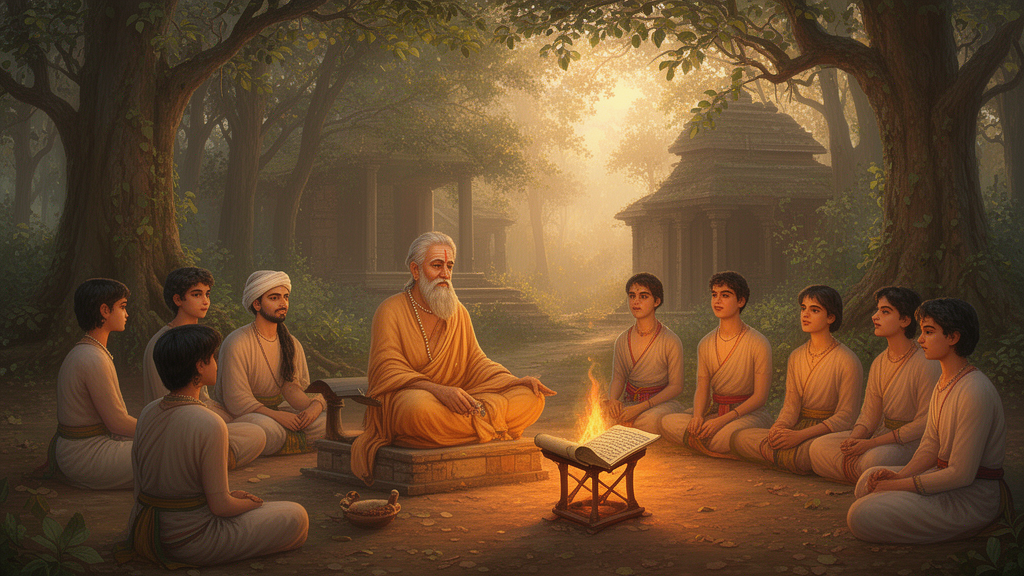
According to the Mahakavya Hindi presentation of the text, the Prashnopanishad has six sections, called six questions, and it opens with six young seekers, including Sukesha, arriving at the ashram of the sage Pippalada. The sage asks them to stay with him in disciplined practice for one year before asking their questions. Only after this period is the question-and-answer teaching given. Mahakavya’s Hindi page on the Prashna Upanishad describes this framing.
This opening is a teaching in itself. The source presents two points: first, that a student becomes ready for knowledge through a period of steady, disciplined service to a teacher, not simply by asking questions; and second, that a teacher should assess a student’s readiness before giving deeper teaching. Hindi commentary traditions often draw these lessons from the frame, but they are interpretations of the text rather than separate statements in it.
The Hindi translation by Rai Bahadur Babu Zalim Singh, listed on ePustakalay, is one Hindi edition that is available for reading online. Its listing describes a Hindi and Sanskrit book of about 100 pages. A second ePustakalay listing, with an unknown translator and about 135 pages, also presents the text in Hindi. Readers should check the edition, translator, and publisher before relying on a specific rendering.
The six questions
The following summary follows the common structure of the six questions. The names and order of the questioners should be checked against the edition you use, because not every Hindi listing names all six students.
- First question: the origin of creation. The first student, identified in the Hindi text as Kabandhi (कबन्धी) in one ePustakalay excerpt, asks from where all beings are born. The question is about the source of the whole prajā, or created world.
- Second question: the supporting powers. The second question asks which powers or deities support beings. The teaching connects the world of living beings with the operation of the senses and cosmic forces.
- Third question: the origin of prana. The third question asks from where prana, the vital breath, arises. A major teaching of the text concerns the relation between prana and the self.
- Fourth question: the states of the person. This question concerns which parts of a person rest or remain awake during sleep, and what the inner self does in dreaming and deep sleep. Readers should note that this is a central teaching in the Upanishad, but its interpretation varies by commentary.
- Fifth question: meditation on Om. The fifth question concerns Om (ॐ). The HinduNidhi description of the book lists Om as a theme of the fifth question, and the text is widely taught as a teaching about meditating on Om as a means to knowledge of the Supreme.
- Sixth question: the person and liberation. The final question concerns the person (purusha) and the knowledge that leads to liberation. The HinduNidhi description lists the teaching of the self and liberation under this theme.
These summaries reflect how Hindi reading guides and publisher descriptions present the six themes. Readers who need line-by-line accuracy should compare the Sanskrit verses with a critical edition and a reliable commentary, because the numbering of verses and the division of sections can vary between editions.
Prana, the senses, and the body
Prana is the central concept in the early questions. In ordinary Hindi usage, prana means breath or life force. In the Upanishad, prana is presented not only as physical breath but as a principle that sustains the body and the senses. The text describes how prana is linked with other powers, and how the senses depend on a common life principle.
The ePustakalay excerpt from the Zalim Singh translation shows a commentary-style Hindi explanation of the sun as a source of light and vision, and of cosmic powers as supports for living beings. This passage illustrates a common method in the commentary tradition: the text speaks of the sun, the fire of the world (Vaishvanara), and the cosmic person, and the commentary interprets them as aspects of one underlying self. Readers should treat these images as part of the text’s teaching method, not as separate natural-science claims.
In practice, a reader can approach the prana section by asking three questions: what is said about the origin of prana, how prana relates to the senses, and how the teaching moves from physical description to inner knowledge. Taking these questions in sequence helps avoid reading the passage as a simple list of cosmic correspondences.
Om and meditation
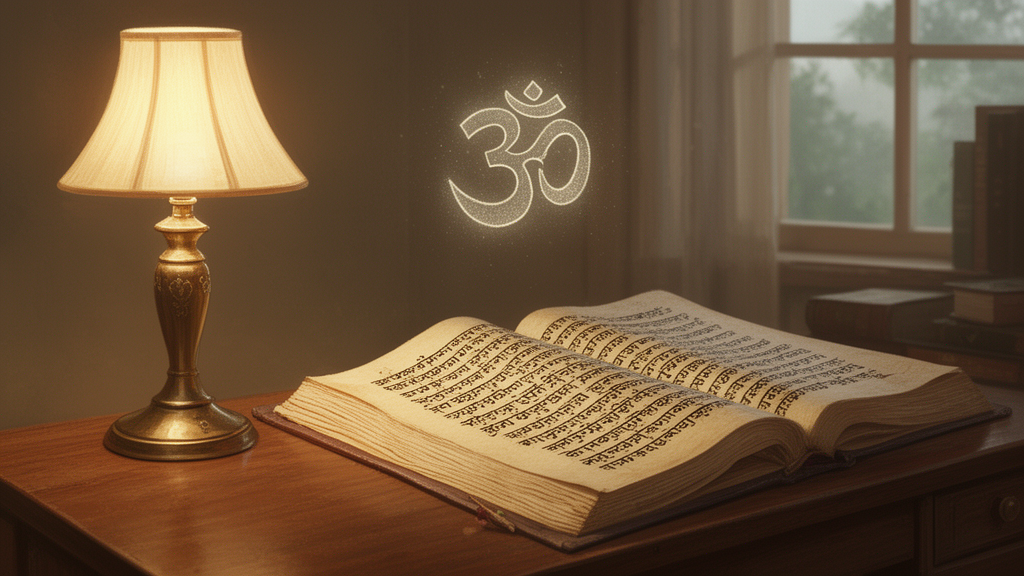
The teaching on Om is one of the best-known parts of the Prashnopanishad. The fifth question leads to a discussion of meditation on Om as a path to the highest reality. Om is usually explained in Hindu tradition as the sacred syllable that represents Brahman, and the Upanishad connects its recitation and contemplation with knowledge of the self.
For devotional practice, this section is often read alongside Mandukya and other Upanishads that treat Om. Hindi readers who want to explore the theme further can consult the Ishopanishad Hindi guide (URL status: target draft, may not be public yet), which covers another Upanishad in the same tradition of contemplative teaching. The Prashnopanishad’s teaching on Om is a philosophical instruction within the text, and any ritual use of Om in daily practice is a later devotional or tradition-specific custom.
Scripture, tradition, and scholarship: keeping them distinct
When reading the Prashnopanishad, it helps to separate four kinds of statement:
- What the text says: the Sanskrit verses and their direct content, such as the six questions and the teacher’s answers.
- Traditional belief and interpretation: the commentary tradition’s reading of the verses, including Advaita and other Vedanta readings, which may differ among schools.
- Historical and academic questions: when the text was composed, and by whom. The Mahakavya page notes that the dating of the Upanishads is not settled, and that a broad range of roughly 3000 BCE to 500 BCE is commonly cited for the Upanishads as a group. It also states that the author is traditionally credited as a sage rather than a known individual.
- Devotional practice: how families and communities use the text in worship or study, which may vary by region and sampradaya.
These categories are not competing claims. A devotee may read the Prashnopanishad as revealed scripture, a historian may place it in a particular period of Vedic literature, and a student may study its philosophy for its argument. Each approach is valid, but the claims differ. A careful Hindi article should not present one reading as the only correct one.
Hindi translations and reading tips
Readers searching for a Hindi Prashnopanishad usually find three kinds of material:
- Full Hindi translations that present the Sanskrit verses with a Hindi rendering.
- Simplified commentary editions that explain the meaning in plain Hindi, sometimes with a summary of each question.
- Digital reading and download pages that host PDFs or online viewers.
HinduNidhi describes its Hindi PDF as a Gita Press edition with Sanskrit verses, a simple Hindi translation, and a detailed explanation. That description comes from the publisher’s page and should be checked against the actual PDF before it is relied upon. Digital copies on third-party sites may vary in quality, may be scanned from older print editions, and sometimes contain machine-translated or OCR-affected text. The ePustakalay pages show machine-translated excerpts, and their OCR output contains visible errors. Readers should therefore compare any digital copy with a printed or reputable edition.
Tips for reading the Hindi text
- Read one question at a time, and note the questioner’s name and the teacher’s answer.
- Keep the Sanskrit verse number and the Hindi translation side by side when studying.
- Use a glossary for terms such as prana, purusha, Brahman, and Atman.
- Check whether the edition includes a commentary by a known author or publisher.
How to study the Prashnopanishad in practice
A useful approach for a Hindi reader is to study the text in four passes:
- Read the summary of the six questions to understand the framework.
- Read the Hindi translation of one question slowly, using a dictionary for unfamiliar words.
- Compare the teaching with a second edition or commentary to see how interpretations differ.
- Reflect on the teaching in your own practice, while keeping the textual meaning separate from personal devotional experience.
Study groups in many communities read the Upanishads in a shared session, with one person reading the Hindi and another explaining the terms. Such practice is a tradition-specific method, and different groups follow different schedules and commentaries.
Related Upanishads and scriptures
The Prashnopanishad belongs to a wider body of Upanishadic literature. Readers interested in related texts may find these HindusGod.com guides useful, though their URL status should be confirmed before publication:
- Kathopanishad in Hindi (URL status: target draft, may not be public yet) for another Upanishad presented as a dialogue between teacher and student.
- Kenopanishad in Hindi (URL status: target draft, may not be public yet) for a shorter Upanishad that also centers on questions about the source of knowledge and power.
- Hindi Shastra (URL status: target draft, may not be public yet) for an overview of Hindi-language scriptures.
- Hindi Scripture (URL status: target draft, may not be public yet) for more on Hindi scripture reading.
- Geeta in Hindi (URL status: target draft, may not be public yet) for the Bhagavad Gita, which is often studied alongside the Upanishads.
Common questions about the Prashnopanishad in Hindi
Is the Prashnopanishad part of the Vedas?
The Prashnopanishad is traditionally associated with the Atharvaveda, and the Mahakavya and HinduNidhi descriptions both place it there. Upanishads are generally treated as the concluding portions of the Vedic corpus, often called Vedanta. Scholars treat the exact relation between Upanishads and Samhitas as a matter of ongoing study.
Who is the teacher in the Prashnopanishad?
The teacher is the sage Pippalada, who is presented as answering six students. The text is traditionally attributed to a sage tradition rather than to one clearly documented author.
Is there one correct Hindi translation?
No single Hindi translation is the only authoritative version. Translators and commentators may render the same Sanskrit term differently. Reading two or three translations helps clarify difficult passages.
Does reading the Prashnopanishad guarantee any spiritual result?
This guide cannot make claims about outcomes. The text is presented in tradition as a teaching for seekers, and its meaning and practice are understood differently by different communities. Reading it is a study and devotional choice, not a guaranteed result.
Takeaway
The Prashnopanishad in Hindi is best approached as a dialogue of six questions from disciplined students to a sage. It explores creation, prana, the states of the person, Om, and the path to self-knowledge. For a reliable reading, choose a complete Hindi edition with the Sanskrit verses, compare the translation with one commentary, and keep the scripture’s teaching separate from later devotional and historical interpretation.
Sources and further reading
- Prashnopanishad, Hindi Wikipedia: general Hindi overview; the page lists the six opening questions in summary. Note: this page was listed but not fetched during preparation, so verify before relying on it.
- Prashna Upanishad in Hindi, Mahakavya: Hindi reading page; describes the Atharvaveda association, the six sections, Pippalada, the six students including Sukesha, and the one-year discipline.
- Prashnopanishad (Prashnopanishad) Hindi PDF, HinduNidhi: publisher description of a Hindi PDF; lists the six themes and says the edition is presented by Gita Press with Sanskrit verses and Hindi explanation. Verify the edition details in the PDF itself.
- Prashnopanishad, Rai Bahadur Babu Zalim Singh, ePustakalay: Hindi book listing with a machine-translated excerpt; excerpt contains OCR-style errors, so use only for orientation.
- Prashnopanishad, unknown translator, ePustakalay: Hindi book listing with an excerpt that refers to Katyayana Kabandhi and the first question on the origin of beings; the excerpt is partly garbled.
- Prashnopanishad Hindi, Internet Archive: digital item page for a Hindi Prashnopanishad; the page content inspected did not include the text, so check the scanned edition directly.