The Prashna Upanishad is a short Upanishad of the Atharvaveda tradition, arranged as six questions that students put to the teacher Pippalada. Readers searching for the Prashna Upanishad in Hindi usually want three things: a clear summary of what the text teaches, a way to follow its six sections in Hindi, and a sense of how it differs from commentary and modern interpretation. In short, the text presents prana, the vital life-principle, as central to life and to self-knowledge, and it moves from questions about creation and the senses to the meditation on Om and the person’s relation to the imperishable (akshara). This guide explains the structure, the main teachings, and how to read a Hindi edition responsibly.
What the Prashna Upanishad Is
The Prashna Upanishad, called Prashnopanishad in Sanskrit, belongs to the Atharvaveda. Hindi-language sites that summarize it describe it as one of the principal (mukhya) Upanishads of that Veda, and they describe its 67 verses as divided into six sections, one for each question.[2] Another Hindi reference also describes the text as having six khandas, which it calls six questions, and as being attributed to the sage Pippalada.[3]
The title means roughly ‘the Upanishad of questions.’ The text is written in Sanskrit. Its form is dialogic: students ask, and the teacher answers in sequence. This format is important for understanding the work. It is not a list of doctrines delivered in one speech. It is a graded teaching in which each question leads to the next.
Dating deserves caution. Hindi reference pages discuss the broad period of the early Upanishads, but they do not agree on exact dates, and Upanishadic chronology is debated among scholars. This guide therefore does not give a specific composition date. Readers who need a historical date should consult a specialist academic source.
The Teacher and the Six Students
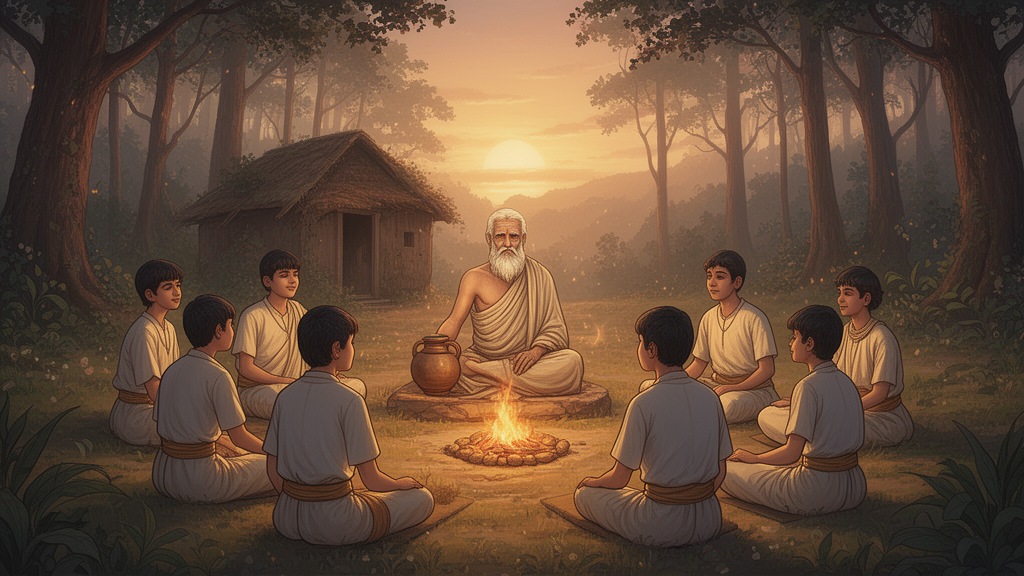
The setting is an ashram of the sage Pippalada. Six young seekers arrive, each with a question about reality. Hindi summaries name the first of them as Kabandhi Katyayana, who asks where all beings come from, and the second as Bhargava Vaidarbhi, who asks which powers sustain the human being and which of them is supreme.[2] The other four students are commonly named Kausalya Ashvalayana, Satyakama Saibya, Sukesha Bharadvaja, and Sauryayani Gargya. A Hindi edition on another site lists Sukesha among the six visitors.[3]
Before answering, Pippalada sets a condition. According to the Hindi commentary summary on Mahakavya, he asks the students to remain with him for one year in restraint, and afterward anyone may ask any question.[3] The Vedapath summary reads the same opening as stressing tapas, brahmacharya, and discipline as the basis for readiness to receive this teaching.[2]
This opening has two lessons that the text itself implies. First, knowledge of the self is not gained by a single question and answer. Second, a teacher should test a student’s readiness, because teaching given without preparation may be of little use. These are readings drawn from the text’s narrative frame. They are not separate ritual rules.
The Six Questions in Brief
The following summaries are general and based on the Hindi reference pages. They do not replace a full translation. Readers should check the Sanskrit and a complete translation when a specific verse matters for study or teaching.
Question 1: The origin of beings
Kabandhi Katyayana asks where creatures come from. Pippalada answers in terms of Prajapati, who performs tapas and produces a pair: prana, often associated with the sun, and rayi, associated with matter, food, or the moon.[2][3] The same section, according to Hindi summaries, also describes the northern (uttarayana) and southern (dakshinayana) paths as connected with the soul’s journey.[3] Commentators have read these passages in different ways, so readers should treat the cosmic imagery as part of the Upanishad’s teaching and not as a settled cosmology.
Question 2: Which power is supreme?
Bhargava Vaidarbhi asks how many powers (devatas) support the body and which of them is highest. Pippalada answers that prana is supreme. According to the Vedapath summary, when prana leaves the body, the senses follow it, as bees follow a queen.[2] The same summary says prana is present as fire, sun, rain, and wind, and it compares prana to the unborn Brahman.[2]
Question 3: Speech, breath, and the senses
The third question, asked by Kausalya Ashvalayana, concerns the relation between prana and the other vital functions. The Hindi summaries available to this draft do not give enough verified detail to reproduce the argument step by step, so this guide does not summarize the section further. Readers should read this section in a full translation with commentary.
Question 4: Dream, sleep, and the inner person
Satyakama Saibya’s question concerns the states of consciousness. The Hindi teaching summary connects this part of the text to waking, dream, and deep sleep as contexts in which the inner person is examined.[2] The later Mandukya Upanishad is more famous for its systematic treatment of these states, so readers who want a focused analysis of waking, dream, and sleep may wish to compare the two texts.
Question 5: Om and the path beyond
Sukesha Bharadvaja asks about Om. The Prashna Upanishad presents the syllable Om, including its parts A, U, and M, as a support for meditation. Hindi summaries describe it as a means for graded realization and for going beyond the sound to what it points toward.[2] Knowledge of Om is presented as a way of approaching the highest reality, not as a magical formula with guaranteed results.
Question 6: The sixteen kalas
Sauryayani Gargya asks about the person (purusha) and the sixteen parts, the kalas. Hindi summaries state that the sixteen kalas arise from the imperishable (akshara Brahman) and dissolve back into it.[2] The teaching makes the person a composite whose parts have a source beyond them. Commentators differ on the exact enumeration of the kalas, so this guide does not list them. Readers should consult a complete edition with commentary.
Key Teachings of the Prashna Upanishad
Several themes recur across the six questions. Each one is supported by the Hindi summaries cited above, and each should be read as the text’s teaching, not as universal Hindu doctrine.
- Prana as the chief life-principle. The text treats prana as more than breath. It is presented as the principle that holds the senses, mind, and life-functions together.[2]
- Rayi and prana as complementary. Matter or food (rayi) and life-energy (prana) form a pair in the text’s account of creation and sustenance.[2]
- Inward reading of Vedic images. Cosmic and ritual images, including the sun, moon, and the paths of the year, are interpreted in terms of inner self-knowledge.[2]
- Om as support for meditation. The syllable is taught as a graded aid to realization.[2]
- Death and the imperishable. The teaching on prana and the sixteen kalas is linked, in Hindi summaries, to freedom from fear of death.[2]
The text’s argument is that knowing the source of life is a form of liberating knowledge (brahmavidya). It is not only information about the cosmos. The Vedapath summary describes this as an integration of ritual and contemplation, in which external Vedic symbols are read at the level of inner experience.[2]
Text, Tradition, and Interpretation
Readers often encounter the Prashna Upanishad through different kinds of material. It helps to keep these separate.
- The Upanishad itself is the Sanskrit scripture. Its verses and their order are the primary text.
- Commentaries, such as the Shankara Bhashya and the Anandagiri Tika, are traditional interpretations written by named authors. A Hindi edition combining these commentaries is catalogued on the Internet Archive.[5]
- Translations are interpretations in another language. A Hindi translation may follow a particular commentary, or it may use modern wording. Readers should check which tradition a translation follows.
- Devotional and popular summaries help readers approach the text, but they may simplify or add material not in the original.[2][3][6]
- Academic and historical work asks questions about authorship, date, and textual history. Those questions remain debated for the Upanishads generally.
Different Vedantic and Hindu traditions read the Upanishads in different ways. A Advaita reader, a Vishishtadvaita reader, and a Dvaita reader may interpret the same passage differently. This guide does not present one reading as the only correct one.
How to Choose a Hindi Edition
Many Hindi editions exist. They vary in completeness, commentary, and transliteration. When choosing one, consider the following:
- Check whether the edition includes the full Sanskrit text, not only a summary.
- Look for a named translator or commentator, and note which tradition they follow.
- Compare how the edition numbers the six sections (khandas or prashnas) with other editions.
- If you want the classical commentary, look for an edition that includes the Shankara Bhashya and Anandagiri Tika.[5]
- Read a second translation for any passage that matters to your study.
Hindi readers may also find the Wikipedia Hindi article on the Prashna Upanishad useful as a starting point, though the content of that page was not inspected for this draft and should be checked directly before relying on its details.[1] A Hindi listing of translations of principal Upanishads on that page points to other editions that readers can compare.[1]
Reading the Prashna Upanishad in Hindi: A Practical Path
The text is short, but its questions are dense. A focused reading plan can help.
- Read the opening frame first. Note the six students and the condition of one year of discipline before the answers begin.
- Read one prashna at a time. Stop after each section and summarize its question in your own words.
- Compare the Sanskrit terms. Keep a short list of prana, rayi, akshara, kala, and Om, and check how your Hindi edition translates each one.
- Use a commentary for difficult passages. Sections about the sun, moon, and the kalas are commonly read with commentary.
- Connect the text to related Upanishads. Readers interested in the states of consciousness may compare this text with the Mandukya Upanishad Hindi draft, and those interested in the Om meditation may find the Mundaka Upanishad Hindi draft a useful companion for the study of Brahman.
- Keep a note of what the text says and what the commentator says. This separation helps you avoid mixing scripture with later interpretation.
For a broader view, the All Upanishad in Hindi draft gives an overview of the wider collection, and the Aitareya Upanishad in Hindi draft introduces another Rigvedic Upanishad. The Prashna Upanishad in English draft is a useful companion for readers who want to compare English wording with the Hindi text.
Connections with Other Upanishads
The Prashna Upanishad shares themes with several other Upanishads. Comparing them can deepen understanding, but the connections should be read carefully, since each text has its own structure and purpose.
- Prana and the senses appear in the Upanishadic literature beyond this text, and readers may explore them in the Kena Upanishad Hindi draft, which deals with the powers behind perception.
- Om and the states of consciousness are developed in depth in the Mandukya Upanishad Hindi draft.
- Death and the self are central themes in the Katha Upanishad Hindi draft, which tells the story of Nachiketa.
- The inner ruler and the unity of all things are discussed in the Isha Upanishad Hindi draft.
- Dialogue and the teacher-student relation are also visible in the Chandogya Upanishad Hindi draft and the Brihadaranyaka Upanishad Hindi draft.
These links are offered for further reading. They do not mean that the texts teach identical doctrines. Each Upanishad should be read in its own context.
Common Misunderstandings
Several misunderstandings appear in popular discussions of the Prashna Upanishad.
- Prana is not only breath. In the text, breath is one expression of a larger principle.
- The text is not a manual for guaranteed results. Its teachings concern knowledge, discipline, and liberation. Claims that a meditation or recitation brings material benefit are not stated in the text and should not be presented as scriptural promises.
- One Hindi edition is not the whole tradition. Commentaries and sub-traditions read the text differently.
- Sanskrit names may vary in spelling. You may see Prashna, Prashn, or Praśna, and the students’ names are transliterated in different ways. Check the spelling in your edition.
Frequently Asked Questions
Is the Prashna Upanishad in Hindi a translation of the original Sanskrit?
Yes, Hindi editions are translations or adaptations of the Sanskrit text. Their quality depends on the translator and on whether the full text is included. Compare two editions when accuracy matters.
How many sections does the Prashna Upanishad have?
The text is commonly described as having six sections, one for each question. Hindi reference pages give the verse count as 67 in one summary and mention six prashnas in another.[2][3] Verse counts can differ between editions, so check the edition you are using.
Which Veda does the Prashna Upanishad belong to?
Hindi reference pages place the text in the Atharvaveda tradition.[2][3][4] Scholars and traditions may describe Upanishadic affiliations with some variation, so readers who need precise school information should consult an academic source.
Closing Summary
The Prashna Upanishad is a short text that teaches through six questions. It begins with discipline and readiness, moves through the origins of beings and the supremacy of prana, considers the states of consciousness, teaches the meditation on Om, and ends with the sixteen kalas and the imperishable. For readers in Hindi, the most useful approach is to read one question at a time, compare two editions, and keep the text separate from later commentary. That practice honors both the scripture and the traditions that have studied it.
Sources and Further Reading
- Prashnopanishad, Hindi Wikipedia. Useful for a list of Upanishad translations; content not fully inspected for this draft.
- Prashna Upanishad in Hindi, Vedapath. Hindi summary of the six questions, prana, Om, and the kalas.
- Prashna Upanishad in Hindi, Mahakavya. Hindi introduction, six khandas, and the one-year condition.
- Prashnopanishad Hindi, The Vyasa. Hindi edition page identifying the text as Atharvaveda and listing the Vigyana Bhashya by Pt. Motilal Shastri.
- Prashna Upanishad with Shankara Bhashya and Anandagiri Tika, Internet Archive. Catalogue entry for a Hindi edition with classical commentaries.
- Prashna Upanishad Hindi Translation, Bhaktilok. Hindi translation page; use with caution and compare against a full edition.