The Prashna Upanishad is a short Upanishad of the Atharva Veda, arranged as a dialogue in which six seekers approach the sage Pippalada with six questions about Brahman. In English, readers usually meet it as a question-and-answer teaching on the origin of creatures, the life-force (prana), the mind and the states of consciousness, the syllable Om, and the ‘sixteen parts’ of the person. This guide explains the text’s setting and main teachings, notes how English translations and commentaries differ, and suggests how to read it with care.
Direct answer: what the Prashna Upanishad teaches
The Prashna Upanishad presents spiritual knowledge as the answer to disciplined questions. According to the English summaries and translations reviewed for this article, its central concerns are prana as the chief life-principle, the paired principles of rayi (matter or food) and prana (life-energy), meditation on Om, and the teaching that the person arises from and returns to the imperishable (akshara). The text is traditionally treated as a principal (mukhya) Upanishad of the Atharva Veda. Readers should keep in mind that its teachings are received through a scripture and interpreted through commentary, so the answers below are presented as what the text says and how traditions have read it.
What the word Prashna means
‘Prashna’ is the Sanskrit word for ‘question’. The Wisdom Library description of Shankara’s commentary calls the Upanishad ‘a series of philosophical poems presented as questions (prashna) inquired by various Hindu sages’ and answered by Pippalada, and it lists the topics as knowledge of Brahman, the relation between the individual (purusha) and the universal (Atman), meditation, and immortality. The title therefore describes the method of the text: teaching proceeds by inquiry rather than by a single doctrinal statement.
Readers who search for this text under other spellings will see variants such as Prasna Upanishad, Praśna Upaniṣad and Prashnopanishad. These refer to the same work. Transliteration choices differ among translators and publishers, so a single English title may appear in several forms across editions.
Place in the Vedic literature
The Prashna Upanishad belongs to the Atharva Veda. The Vedapath description calls it a principal (mukhya) Upanishad of that Veda and notes that it is cast as a disciplined dialogue. The Stotrams page, which reproduces the Sanskrit and English text, states that it is embedded in the Atharva Veda and that it is listed as number 5 in the Muktika canon of 108 Upanishads. The Muktika list is a traditional enumeration, and readers who compare Upanishad lists will find that counts and ordering differ across sources, so it is best treated as one traditional classification rather than a universal ranking.
For a broader orientation to the Upanishads as a group, see the HindusGod guide to Meaning of Upanishad and the overview of About Upanishads in English. Readers interested in how many Upanishads are traditionally counted can compare the articles on 108 Upanishad and 10 Upanishad, which address the numbering question in different ways.
The setting: six seekers and the sage Pippalada
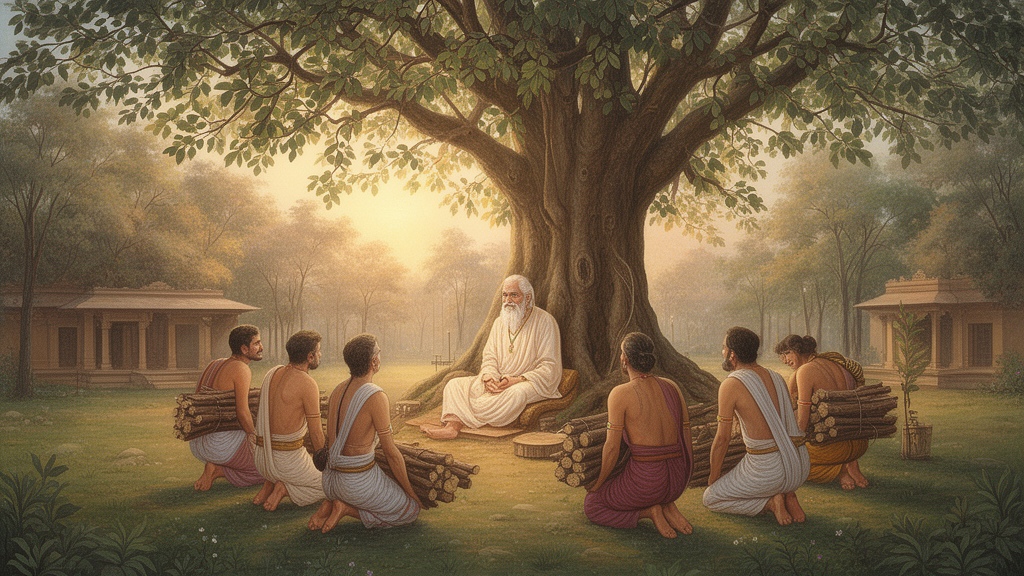
The opening section of the text, as reproduced in the Shankaracharya.org English translation (attributed there to Swami Nikhilananda’s The Upanishads: A New Translation), names six seekers who are ‘devoted to Brahman and firm in Brahman.’ They approach the sage Pippalada carrying fuel in hand, a traditional gesture of respect for a teacher. Pippalada tells them to stay with him for a year, practising austerity, chastity and faith, and then they may ask what they wish. The teacher’s promise is conditional: if the seekers know the answer, he will tell them everything.
This framing matters for reading the whole text. The Upanishad presents knowledge as something received within a disciplined relationship between teacher and student. Tapas (austerity), brahmacarya (chastity or disciplined living) and sraddha (faith) are presented as the preparation for inquiry. Readers should not treat this as a literal set of conditions for any modern study of the text; rather, it reflects the scripture’s own picture of how liberating knowledge is received.
The six questions, with the prashna divisions
The Wisdom Library index of Shankara’s commentary divides the Upanishad into six prashnas (sections). Other English presentations describe the text differently. The Stotrams page says the Upanishad ‘contains three Prashnams (parts), each with two sections,’ and gives a summary of the first part as defining ‘Higher Knowledge’ and ‘Lower Knowledge.’ Because the numbering differs, this article follows the six-section scheme of the commentary index while noting that other editions may divide the text differently.
Question 1: From where do creatures originate?
The first seeker, Kabandhi, asks the first question: from where are living beings born? Pippalada answers in terms of Prajapati, the Creator, who desired progeny. After austerity, Prajapati created a pair, the moon (rayi) and the sun (prana). According to the translation reproduced by Shankaracharya.org, the sun is prana, life, and the moon is rayi, food. The text states that food is all that is, both what has form and what is formless.
The passage then describes the sun’s daily course through the directions and says that the sun is the soul of all creatures and all forms. A verse, introduced as a rik, describes the sun as full of rays, all-knowing, non-dual, and the support of all life. This is scriptural description, not a scientific account of the sun. Readers who want to see how commentators treat these symbols can compare the Shankara commentary at Wisdom Library’s Prashna Upanishad with Shankara’s Commentary.
Question 2: The devas and the faculties
The second section is titled ‘Discussion of Devas’ in the commentary index. The Upanishad’s dialogue in this part concerns the devas, or powers associated with the senses and bodily functions, in relation to prana. Because this article did not retrieve a full, verified English rendering of this section, it does not summarize its detailed arguments. Readers should consult a full translation or the commentary for the specific claims made.
Question 3: The origin and nature of prana
The third section concerns prana in more detail. The Vedapath summary describes prana as ‘not merely breath but the coordinating life-principle upon which the senses and mind depend,’ and mentions a ‘dispute of the senses’ in which the faculties contend about which is most important. The same summary says the text treats prana as the chief life-principle. This is one of the Upanishad’s best-known teachings in popular English discussion, and it should be read in its own terms: prana is presented as the sustaining principle of the body-mind, not only as physical breath.
Question 4: The mind, dream and deep sleep
The fourth section is titled ‘Mental states and Bliss’ in the commentary index. The Vedapath summary says the Upanishad offers ‘a reflective analysis of waking, dream, and deep sleep’ and an analysis of the inner person. The three states of waking, dreaming and deep sleep are a recurring theme across Upanishadic literature, and readers may recognize them from other texts. In this Upanishad, the analysis is directed toward self-knowledge rather than psychology in the modern sense.
Question 5: Meditation on Om
The fifth section teaches meditation on the syllable Om. The Vedapath summary describes ‘graded meditation on Oṃ (A-U-M) and the whole Oṃ as supports for graded realization and transcendence.’ Readers who want a related text on Om can read the HindusGod article on Mandukya Upanishad English, which addresses the same syllable in a different Upanishad. Devotional practice around Om varies widely among traditions, so instructions for chanting or meditation should come from a qualified teacher within a particular lineage rather than from a general article.
Question 6: The Purusha of sixteen parts
The final section concerns the Purusha of sixteen kalas (parts). Vedapath describes the doctrine of the ‘sixteen parts’ (shodasha-kala), which asserts that the person’s constituents arise from and return to the imperishable (akshara). The text presents this knowledge as a means to overcome fear of death and to orient oneself toward liberation. The commentary index gives the same section title. Readers should note that ‘liberation’ (moksha) here is a scriptural and philosophical goal, interpreted differently across Vedanta, yoga and devotional schools.
Key teachings at a glance
- Disciplined inquiry: Knowledge is received through austerity, chastity and faith, as the opening scene shows.
- Prana as life-principle: Prana coordinates the senses and mind, according to the Vedapath summary and the text’s own dialogue.
- Rayi and prana: Matter or food and life-energy are presented as complementary principles of manifestation.
- Om as support for meditation: The syllable is taught as a graded support for realization.
- The person and the imperishable: The sixteen parts arise from and return to akshara, which is the basis for the teaching on mortality.
English translations and commentaries
Several English translations are available, and each reflects choices about wording, transliteration and commentary. The following sources were inspected for this article:
- Swami Nikhilananda’s translation, cited on the Shankaracharya.org page as The Upanishads: A New Translation. The page reproduces an English rendering of the Upanishad with the Sanskrit invocation.
- Max Müller’s translation, as credited on the Stotrams page for the invocation. Stotrams also states that its translations ‘may contain occasional inaccuracies,’ which is a useful reminder for any online text.
- Shankara’s commentary, translated by S. Sitarama Sastri (1928), as presented on Wisdom Library. This pairs the Sanskrit with IAST transliteration and English, and it reflects the Advaita Vedanta reading of the text.
A fourth translation, by V.D.N. Rao, appeared in a search result but was not opened for this article, so it is not summarized here. Readers who need a specific interpretation should compare at least two translations and, where possible, a commentary that identifies its school.
How traditions read this Upanishad
The Upanishad’s teachings are read through several interpretive lenses. Shankara’s commentary, as indexed by Wisdom Library, frames the text within Advaita Vedanta, a non-dualist philosophy. The Vedapath summary emphasizes an ‘interiorized’ reading in which Vedic symbols, including the sun and moon, are read as contemplative and psychological. Other schools, including those in devotional Vaishnava and Shaiva traditions, may approach the same texts with different priorities. This article does not present one of these readings as the only valid one.
Readers should therefore distinguish three things: what the scripture says in translation, what a commentary tradition has taught about it, and what modern scholars or teachers argue. Statements such as ‘the sun is prana’ belong to the text’s symbolic language. Statements about the text’s date, authorship or precise place within the Atharva Veda require historical sources, and this article does not offer them without verification.
A practical way to read the text
- Begin with the invocation, which asks for auspicious hearing, seeing and life, and ends with the words ‘Peace, peace, peace’ in the translation reviewed.
- Read the first question and answer slowly, noting the pair of rayi and prana and how the text relates food and life-energy.
- Compare the Nikhilananda or Max Müller translation with the Shankara commentary for the same section to see how wording changes meaning.
- Read the fifth and sixth sections together to see how Om meditation and the sixteen parts relate to the person and the imperishable.
- Use a teacher, study group or lineage-based guide before adopting any meditation method from the text.
Relation to the Hindi version and other Upanishad guides
Readers who prefer Hindi may find the HindusGod article on Prashna Upanishad in Hindi useful for comparing terminology across languages. Because English translations choose different words for terms such as prana, rayi and akshara, a bilingual comparison can clarify meanings that a single translation may simplify. For readers exploring the wider corpus, the HindusGod articles on Brihadaranyaka Upanishad English, Chandogya Upanishad in English and Kena Upanishad English offer other Upanishadic teachings on the self, knowledge and Brahman. Readers interested in the Upanishad’s view of liberation may also consult Katha Upanishad English and Mundaka Upanishad in English.
Devotional use and recitation
In many communities, Upanishads are recited, studied in schools of Vedanta, or used as part of daily or ritual study. The invocation is widely recited as a peace prayer, and its opening wish for auspicious hearing and seeing is often used in contexts that have nothing to do with the rest of the text. Recitation practices, including accent, sequence and which portions are used, vary by lineage and region. Where a specific recitation or ritual is involved, the practice should be learned from the community or teacher that follows it.
The text itself describes knowledge as liberating, but this article makes no claim that reading, reciting or meditating on the Upanishad will produce any particular material, health or worldly result. The scripture’s promise is spiritual and philosophical, and it is best approached as a teaching rather than a guarantee.
Frequently asked questions
Is the Prashna Upanishad in English a complete translation?
Several English versions exist, including the Shankaracharya.org page reproducing a translation attributed to Swami Nikhilananda, the Stotrams Sanskrit-English page crediting Max Müller for the invocation, and the Wisdom Library’s Shankara commentary. Each should be checked for completeness, because online pages can reproduce only part of a text.
Which Veda is the Prashna Upanishad connected with?
The sources reviewed connect it with the Atharva Veda. Vedapath calls it a principal (mukhya) Upanishad of that Veda, and Stotrams says it is embedded in the Atharva Veda.
Why do sources give different numbers of sections?
The Wisdom Library commentary index lists six prashnas, one for each question and seeker, while the Stotrams page describes three parts with two sections each. Editions and reading schemes may divide the text differently, so readers should note which numbering a source uses before comparing references.
Closing takeaway
The Prashna Upanishad in English is best approached as a dialogue about questions that matter: where life comes from, what sustains the body and mind, how to meditate on Om, and what the person is in relation to the imperishable. Read it with more than one translation, check the commentary that accompanies it, and keep scripture, traditional interpretation and modern scholarship distinct. Its questions are simple to state and demanding to answer, which is part of why the text has remained a subject of study for so long.
Sources and further reading
- Prashna Upanishad English Translation, Shankaracharya.org: English rendering of the Upanishad, with the source note attributing the translation to Swami Nikhilananda’s The Upanishads: A New Translation. Used for the setting, the first question and the invocation.
- Prashna Upanishad in English, Vedapath: Summary of the Upanishad’s structure and key teachings, including prana, Om meditation, the three states and the sixteen parts. Used for the interpretive summary; the Vedapath page is a secondary summary, not the primary text.
- Prashna Upanishad with Shankara’s Commentary, Wisdom Library: Index of the six prashnas and the Advaita framing of Shankara’s commentary, with the 1928 S. Sitarama Sastri English edition noted. Used for section titles and the commentary context.
- Complete Prashna Upanishad in English (IAST), Stotrams: Sanskrit, IAST and English text with translator credit for the invocation; the page also notes possible translation inaccuracies. Used for the Atharva Veda association, the Muktika listing and the three-part description.